To start a vending machine business, identify promising locations, choose a machine format for the people using them, and calculate what a conservative level of sales would leave after expenses.
Then set up the business, check licenses and insurance, negotiate a written placement agreement, inspect suitable equipment, and launch with a small product assortment.
Secure a location worth serving before buying the machine. Permission to install equipment is only the beginning: customers must actually use it.
There is no reliable single startup price for every vending business. Used or new equipment, delivery, payment hardware, opening stock, and site charges all affect the cash required.
The larger financial danger is a machine that earns too little to cover refills, travel, maintenance, and the owner’s time. Vending requires regular work, even when nobody is standing behind the counter.
Last fact-checked: October 12, 2026
This guide is for US beginners considering a first snack, beverage, combo, bulk, specialty, or healthy vending machine, including people who may later build or buy a route.
It covers demand, startup economics, placement terms, compliance, equipment, and daily service.
The numbers in the worked example are illustrative, not market averages.
1. How a vending machine business works
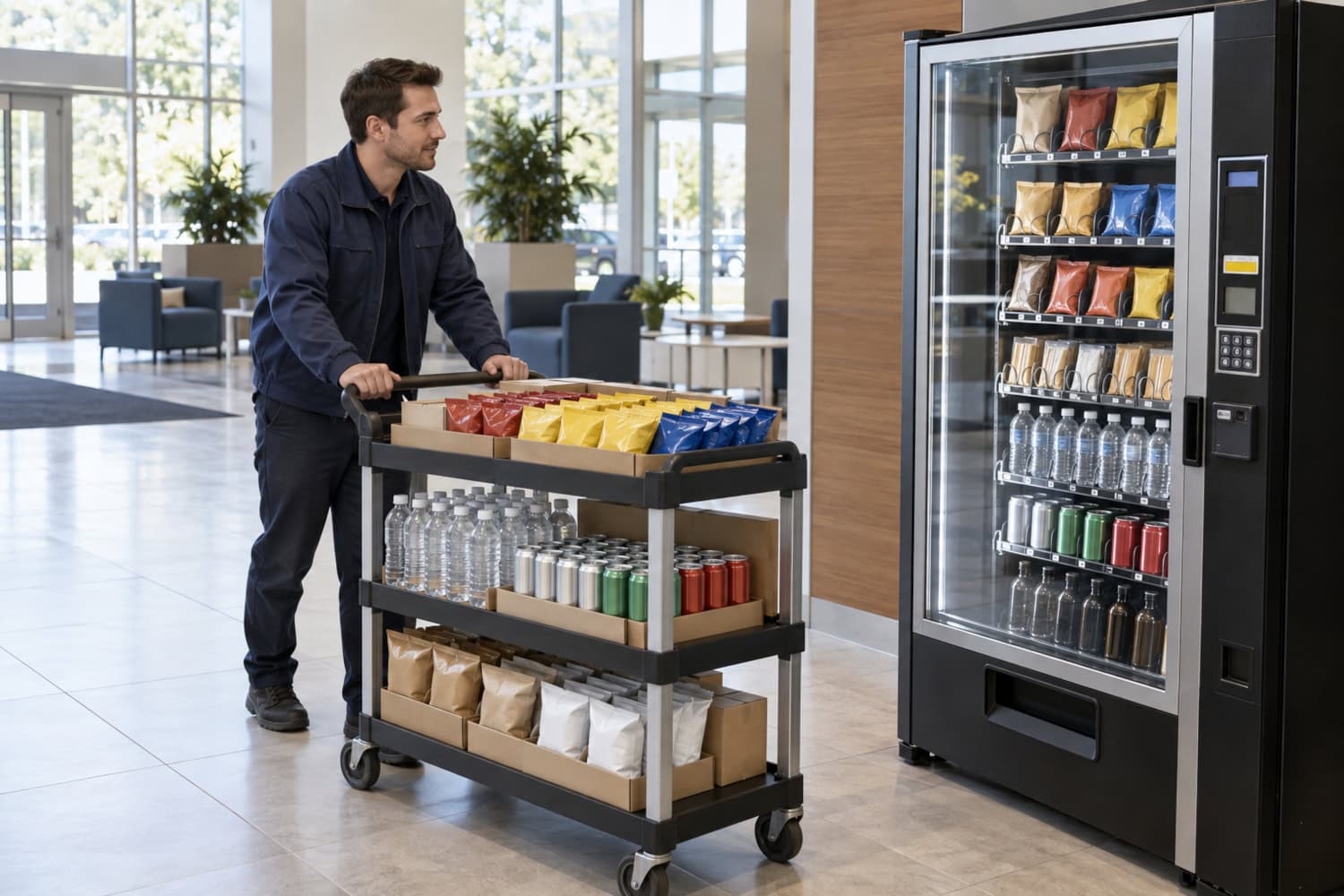
A vending operator earns revenue from purchases at unattended machines and takes responsibility for the products, payment system, equipment, and site relationship.
A full machine can still be an unprofitable one if too few items sell between service visits.
| Stage | Decision | Move forward when |
|---|---|---|
| Compare the formats | Which vending models could serve the intended buyers? | You understand the main equipment and product options. |
| Test demand and placement | Who will buy, how often, and under what access conditions? | The host is interested and you can match a format to the purchasing occasion. |
| Model the finances | Can conservative sales cover all costs and owner time? | Your low-sales case is affordable and your budget includes a reserve. |
| Set up and agree on terms | What registration, permits, insurance, and agreement are required? | The operating party and placement rights are clear in writing. |
| Acquire and operate | Which machine works at this site, and how will you service it? | Equipment, payments, stock, and a service plan are ready. |
| Improve or expand | Does each machine produce enough after service costs? | Actual records support keeping it, moving it, or adding another location. |
Buying an existing route is an alternative to prospecting for every site, but it brings a separate task: proving that the advertised earnings and location relationships will survive the purchase.
2. Vending machine formats and who they suit
A small workplace that needs a few choices has different equipment requirements from a busy site selling cold drinks throughout the day.
The format determines capacity, stocking needs, payment requirements, and the kind of failures an operator must handle.
| Format | Main upfront cost drivers | Suitable starting situation |
|---|---|---|
| Bulk vending | Machine condition, mechanism, initial stock | A location with demand for a narrow selection of low-complexity products |
| Snack machine | Capacity, dispensing mechanisms, payment upgrades | A site with repeat packaged-snack purchases |
| Beverage machine | Cooling, capacity, delivery, power | A site where cold drinks are a regular convenience purchase |
| Combo machine | Combined dispensing, cooling, capacity, service frequency | A smaller space needing both snacks and drinks |
| Specialty or healthy vending | Product handling, assortment, shelf life, machine features | A host whose customers actually purchase those items |
| Smart cooler or fresh-food unit | Refrigeration, access controls, payment technology, spoilage | A site with sufficient demand to justify tighter food handling and monitoring |
For a first conventional vending operation, focus on packaged snacks, beverages, or a combo machine unless the site provides clear evidence for a more specialized format.
A smaller footprint is useful only if its capacity and refill schedule work with the sales expected there.
3. Find customers before estimating vending sales
A building’s headcount, opening hours, and foot traffic are clues, not sales figures.
People buy when they need a convenient product, have access to the machine, and find the selection and price acceptable.
Office buildings, apartments, factories, gyms, schools, and laundromats all offer possible audiences. Their buying occasions differ.
A gym’s long opening hours do not prove that its members want snacks, while an office with shorter hours might have workers who buy every shift.
Use a short qualification checklist during site visits:
- Identify who can buy from the machine, including workers, residents, visitors, or customers.
- Observe when people are present and when food or drinks would be useful.
- Record the alternatives, such as a cafeteria, convenience store, free beverages, or existing machines.
- Ask the host what products people request and whether there is evidence of previous purchases.
- Check whether the location empties during weekends, holidays, or seasonal closures.
- Estimate how often servicing would be possible without disrupting the property.
If the site has an existing vendor, poor service may create an opening, but a replacement depends on the host’s preferences and contract.
Do not build projections around winning a location you have no right to serve.
4. Secure a location that can support the vending machine
The critical first asset in vending is a workable site, not an inexpensive machine.
A property manager can approve installation and still leave you with weak sales, restricted access, expensive rent, or no practical place to unload inventory.
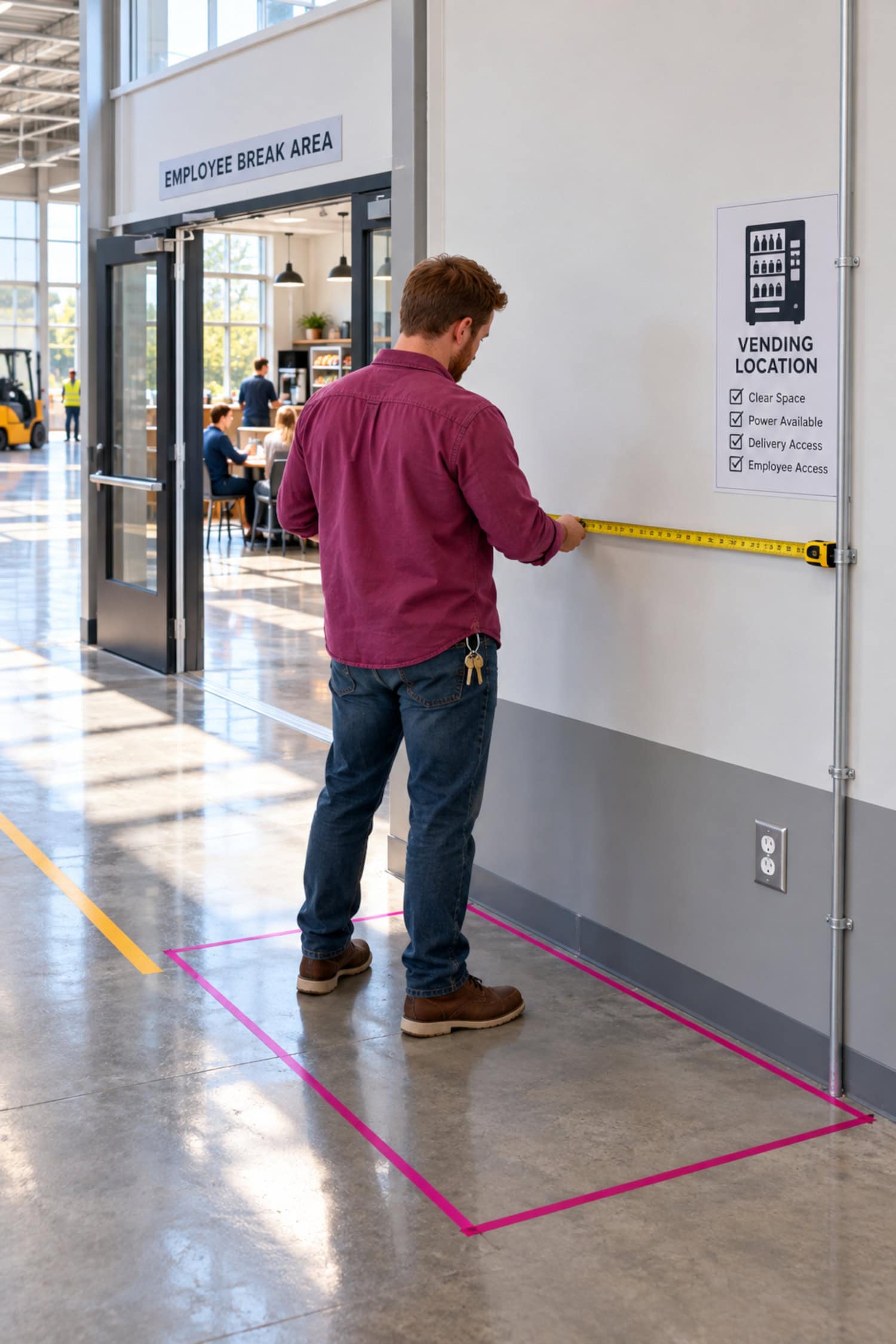
A suitable placement combines real buying demand with electricity, safe access, room for the equipment, and operating terms that leave enough revenue after costs.
Check the proposed spot itself, not merely the address.
| Factor | What to establish | Warning sign |
|---|---|---|
| Buyers | Repeated reasons to purchase | Plenty of people pass by but rarely stop |
| Visibility | The machine is easy for its intended users to notice | The only offered space is hidden or inconvenient |
| Access | You can reach it for refills, repairs, and refunds | A host controls access unpredictably |
| Competing choices | Customers lack a more convenient or cheaper substitute | Free or nearby alternatives cover the same needs |
| Site charges | Rent or commission fits the conservative sales model | Fixed fees consume much of expected revenue |
| Host relationship | A decision-maker handles access and problems | Messages go unanswered before installation |
The unresponsive manager who takes a week to discuss delivery probably will not become easier to reach when the machine jams or leaks.
Access and communication affect both customer service and the hours you spend solving problems.
When approaching a host, explain the products, space and power required, how payment and refunds work, who cleans the area, and how service requests will be handled.
Avoid guaranteeing a commission or promising substantial income before running the location’s economics.
5. Startup costs and vending machine profit
Your startup budget must cover more than the machine’s advertised price.
No defensible nationwide all-in range applies to every format, so compare complete quotes and model the actual location instead of treating a bargain listing as a launch budget.
| Cost category | What belongs in the budget | Cost behavior |
|---|---|---|
| Machine | New or used equipment and necessary repairs | Mainly upfront |
| Delivery and installation | Moving, placement, site preparation | Mainly upfront |
| Payment system | Reader, compatibility upgrades, processing and service charges | Upfront and recurring |
| Opening inventory | Products, backup stock, unsold items | Upfront and recurring |
| Business setup | Registration, applicable permits, insurance | Upfront and recurring |
| Placement | Host rent or sales commission | Recurring |
| Servicing | Fuel, travel, cleaning, maintenance, refunds | Recurring |
| Cash reserve | Repairs, downtime, expired stock, and weak early sales | Cash held back |
A financing or lease payment adds another fixed monthly obligation.
It can preserve cash at purchase while making a weak location harder to carry. Compare the total amount payable, not just the monthly installment.
A monthly profit example and stress test
Monthly economic profit = sales minus product costs, payment fees, site charges, connectivity, spoilage, repairs, travel, and the value of owner labor.
This measures what is left before income taxes and equipment financing.
The following are illustrative numbers, not a benchmark for vending revenue or costs.
Product costs and payment fees vary with sales. For the stress test, the other expenses stay unchanged.
| Per-machine monthly item | Planned sales | Sales at half the plan |
|---|---|---|
| Gross sales | $900.00 | $450.00 |
| Products at 45% of sales | -$405.00 | -$202.50 |
| Payment fees at 5% of sales | -$45.00 | -$22.50 |
| Site rent | -$100.00 | -$100.00 |
| Connectivity | -$20.00 | -$20.00 |
| Spoilage allowance | -$15.00 | -$15.00 |
| Repair allowance | -$30.00 | -$30.00 |
| Travel | -$40.00 | -$40.00 |
| Owner labor allowance (6 hours at $15 per hour) | -$90.00 | -$90.00 |
| Monthly economic profit or loss | $155.00 | -$70.00 |
At half the planned sales, product and percentage-based payment costs fall, but the fixed charges remain.
The machine goes from a modest surplus to a loss. Real spoilage or repair costs could be worse than this simple model.
An operator may see positive cash in the bank before paying themselves and conclude that the site is profitable.
Time spent driving, shopping, loading, cleaning, handling complaints, and repairing equipment has economic value.
Separate gross sales, cash left before owner pay, and profit after owner labor when comparing locations.
Keep money available for an unexpected repair and for the first slow stocking cycles.
A machine that uses every available dollar to launch leaves no room to solve its first problem.
6. Business registration and vending permits
Vending businesses in the United States must check state and local registration, tax, and placement requirements before selling.
There is no universal local permit that covers every machine, product, and jurisdiction.
A sole proprietorship and a limited liability company (LLC) are possible business structures.
Forming an LLC is not a blanket federal requirement for owning a vending machine.
The choice affects administration and potential liability exposure, not whether a poor location becomes profitable.
Check the following requirements with the named authority:
- Business registration and tax identity: Review business-name rules, entity filing if applicable, and whether an Employer Identification Number (EIN) is required with your state filing office and the Internal Revenue Service.
- Sales tax and resale documentation: Ask your state revenue department about seller permits, sales tax collection, and resale certificates for inventory purchases.
- Local licenses and placement rules: Check business licenses, zoning, and any vending or sign restrictions with the city or county where the machine will sit.
- Food and drink safety: Ask the local health department whether the proposed products, refrigeration, handling, or water vending require inspection or permits.
- School nutrition requirements: If vending in a participating school setting, check the U.S. Department of Agriculture (USDA) Smart Snacks standards and the school’s own purchasing restrictions.
- Accessibility and labeling: Check accessible placement with the host and applicable Americans with Disabilities Act requirements. Review Food and Drug Administration (FDA) vending calorie-labeling requirements if the scale of your operation makes them applicable.
- Insurance: Obtain quotes for general liability and relevant equipment or product coverage, then confirm the host’s insurance conditions before signing.
State and local requirements can change, and the appropriate permits depend on the goods and location.
For legal-structure or insurance decisions involving substantial exposure, discuss the proposed setup with a qualified attorney or licensed insurance professional.

7. Put vending location agreements in writing
A verbal invitation to install a machine leaves basic operating rights uncertain.
The placement agreement should identify the actual business operator, the host, the equipment, and what happens if either party wants to end the relationship.
Settle these terms before committing to delivery:
- Exact machine location, power supply, and permission to access it for service.
- Products or categories permitted, including any healthy-only restrictions.
- Fixed rent, sales commission, payment timing, and how sales are measured.
- Contract term, renewal, termination, removal deadline, and responsibility for moving costs.
- Damage, cleaning, insurance, refunds, service complaints, and responsibility for the surrounding area.
- Rules for transferring the arrangement if the machine or business is sold.
There is no standard commission percentage that automatically fits every site.
A fixed rent is especially painful when sales fall, while a percentage commission rises and falls with revenue.
Compare either offer against the low-sales column in Section 5.
Before signing, ask the decision-maker these questions:
- Who has authority to approve this placement and sign the agreement?
- When may the operator enter the building to restock or repair the machine?
- Are there existing vending, catering, or exclusive-supply contracts?
- Who provides and pays for power, and what placement restrictions apply?
- Are particular products, prices, or package sizes prohibited?
- What notice is required to end the arrangement or move the machine?
- Will the host recognize the placement agreement after a change of ownership?
8. Choose and inspect equipment for the site
The cheapest used machine can become the most expensive option if it cannot reliably vend, accept modern payments, or obtain replacement parts.
Choose equipment whose capacity, dimensions, refrigeration, and service needs match the confirmed placement.
New equipment may offer more predictable support at a higher purchase price.
Used machines can lower the entry cost, but condition matters more than cosmetic appearance.
Leased equipment reduces the purchase hurdle while creating continuing payment obligations.
Take this numbered checklist to a used-machine inspection:
- Record the exact manufacturer, model, serial number, and any known modifications.
- Confirm the seller owns the machine and can transfer it free of undisclosed claims.
- Ask for maintenance history, fault records, and what prompted the sale.
- Verify that service manuals and replacement parts are obtainable.
- Check dimensions, weight, doorway clearance, power, and delivery access at the host site.
- Test each dispensing selection with actual products or suitable test items.
- Test the coin mechanism and bill validator if installed.
- Confirm card-reader compatibility, including the machine’s communication interface and required upgrades.
- Verify any installed payment device can legally and technically move to your merchant account.
- Test refrigeration and temperature controls where needed.
- Examine seals, locks, cabinet damage, wiring condition, and signs of leaks.
- Get a written estimate for delivery, immediate repairs, and payment-system activation before paying.
If a technician cannot readily identify the model or its parts, a low asking price is a poor basis for purchase.
Have qualified technicians handle electrical or refrigeration work.
9. Operate the machine and account for every service visit
Vending is unattended selling, not hands-off ownership.
A card payment can be approved while a spiral fails to release the product, leaving the customer seeking a refund and the operator responsible for a repair.
The recurring work includes purchasing stock, transporting it, refilling selections, checking expiration dates, cleaning, collecting or reconciling payments, answering complaints, and troubleshooting failures.
Remote monitoring may reduce unnecessary inspection trips, but it brings equipment and service fees of its own.
Keep records by machine and location, not only by bank deposit.
For each visit, record units sold, sales value, stock added, expired or damaged items, time on site, distance traveled, and problems found.
These figures show whether a route stop earns enough to justify its service trip.
A cashless reader may be physically installed yet still linked to a previous owner’s payment account or incompatible with a new processor.
Confirm the merchant account, settlement destination, device ownership, subscription charges, and support arrangements before taking live customer payments.
10. Stock products people actually buy
A request for healthier snacks does not prove that buyers will choose them repeatedly.
A gym or workplace can prefer a healthy image while its customers purchase only a narrow selection of those products.
Start with a manageable assortment and make changes from item-level sales records.
Test price acceptance alongside sales volume: a product that sells only after a large price reduction may leave too little after buying, payment fees, and host charges.
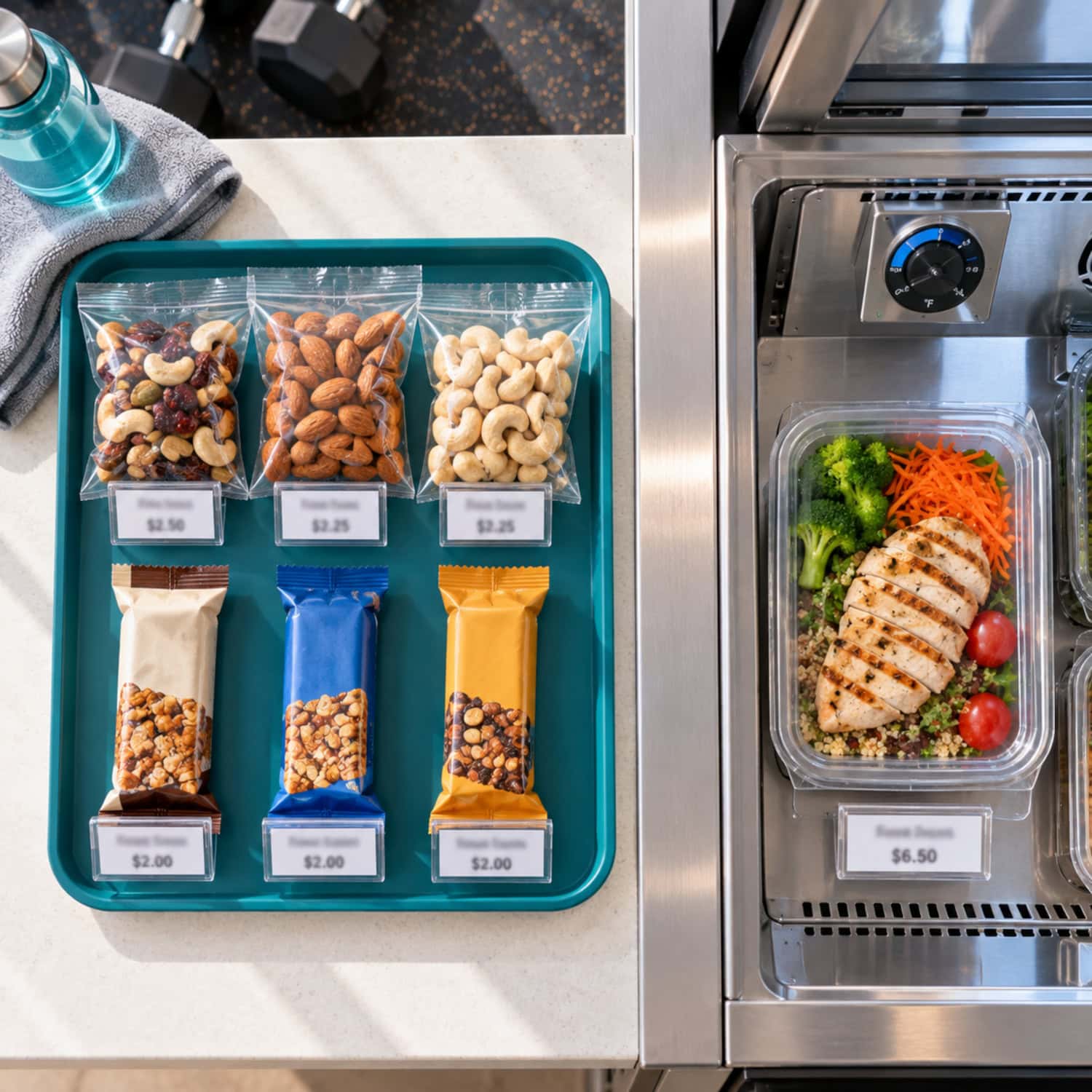
For healthy vending, distinguish shelf-stable nuts or protein bars from fresh meals needing dependable refrigeration.
The second category adds temperature control, spoilage, and potentially different health requirements.
Check the host’s restrictions before sourcing inventory and remove slow-moving products before their expiration becomes a routine expense.
11. Decide when to repair or move a weak location
Poor vending sales do not always mean the machine belongs in a different building.
A blocked view, repeated out-of-stock items, incorrect pricing, or unreliable payments can depress a site that otherwise has willing buyers.
Review machine-level results over a meaningful period, including any predictable slow weeks.
Compare the site’s sales, waste, rent, and service time with the projection from Section 5.
| What the records show | First response | When moving becomes reasonable |
|---|---|---|
| Frequently sold-out favorites | Increase capacity or replenish more often | Demand exceeds what the placement or equipment can economically serve |
| High waste in specific selections | Reduce or replace those items | The location lacks demand for an acceptable assortment |
| Payment or dispensing failures | Repair and verify successful transactions | Repair costs exceed the likely site’s future return |
| Low sales despite reliable service | Recheck visibility, buyers, and competing choices | Repeated low demand cannot cover fixed service costs |
| Access restrictions or rising site fees | Renegotiate practical terms | Continued operation has no workable agreement or margin |
A removal also has costs. Read the termination terms and budget moving expenses before deciding that relocation is free.
12. Build a vending route without wasting the day driving
Route profit depends on what remains after travel and labor, not on the number of machine keys.
Two sites near each other can share a supply trip, while one distant machine may consume much of its contribution in driving time.
Add a location only when the existing machines can be serviced reliably and the next stop has a sound stand-alone sales case.
Map the travel loop, loading time, expected refill frequency, and seasonal access.
A more distant site can still make sense when its actual sales justify the trip or it fits a group of nearby stops.
Review revenue per service trip and stock turnover as the route grows.
A machine count that looks impressive in an advertisement may describe more work rather than more income.
13. Check an existing vending route before buying it
Purchasing a vending route can provide installed equipment and existing sales, but the transaction is risky when the seller cannot establish ownership, cash flow, or durable site access.
A route’s past receipts do not automatically transfer its customers to a new operator.
Use this due-diligence sequence before committing funds:
- Obtain machine-by-machine sales records over enough months to show seasonal variation.
- Compare payment-system reports, cash records, deposits, and tax or accounting documentation where available.
- Reconstruct profit after inventory, host payments, service fees, repairs, travel, and realistic owner labor.
- List every machine, serial number, reader, lease, loan, and item included in the sale.
- Inspect the equipment in place and obtain repair estimates for problem units.
- Review each placement agreement for duration, termination, assignment, and transfer consent.
- Speak with authorized host decision-makers about continuing after the sale.
- Verify payment processors will accept and transfer the devices or price replacements.
- Travel the route at normal service times and assess actual access and workload.
- Identify revenue concentrated in one location and how the price holds up if that site disappears.
Imagine buying a route with busy-looking machines, only to learn that several sites were operating by handshake and a card-reader account remains with the seller.
The seller’s spreadsheet cannot solve either problem.
Do not value goodwill as secure recurring income until the site relationships and payment access are verified.
There is no defensible universal profit multiple for every vending route.
Purchase price must be judged against verified earnings, machine condition, future repair investment, and the realistic cost of servicing and keeping the locations.
14. Evaluate turnkey packages and paid location services
A package that offers machines, placement assistance, healthy-product guidance, or a supposed ready-made route can simplify some tasks.
Its value depends on what the contract delivers, and a guaranteed-looking location is not proof of profitable buyers.
| Sales claim or myth | Operating reality |
|---|---|
| Vending is passive income | Owners still refill, troubleshoot, reconcile, and respond to site managers. |
| Any available location can make money | Approval to install and sufficient purchase demand are different things. |
| Healthy products will automatically sell at gyms | Customer preferences and actual purchases must be checked separately. |
| A very cheap machine is a cheap business | Repairs, delivery, readers, and weak sales can overwhelm the purchase discount. |
| An existing route provides reliable income from day one | Sales records, ownership, location agreements, and owner labor require verification. |
Before paying a locator or turnkey provider, ask:
- What exact equipment, delivery, support, and training are included?
- Who selects the location, and who signs the placement agreement?
- What happens if the host withdraws or the machine cannot be installed?
- Is the placement exclusive, and what is its termination period?
- Are projected earnings based on this site or on unrelated examples?
- Who pays for failed placements, repairs, processing activation, and moving?
- Can the provider document the promised services and all refund conditions in writing?
Keep projected revenue separate from obligations you can enforce under the contract.
Payment in advance is a much bigger risk when the provider’s promised result cannot be measured.
15. Launch your first vending machine in order
A first vending launch should move from evidence to obligations to equipment, with an operating check before a single item goes on sale.
A machine can be ready for delivery while its payment account or access arrangements still prevent an opening.
- Before spending: Identify several potential sites, qualify their buyers and access, and select the likely vending format.
- Before choosing equipment: Build a complete purchase and monthly operating budget, including a half-sales stress test and repair reserve.
- Before signing: Set up the operating business, confirm applicable tax and permit requirements, and obtain insurance terms the host will accept.
- Before delivery: Sign a written placement agreement and confirm machine measurements, power, entry routes, ownership, and payment compatibility.
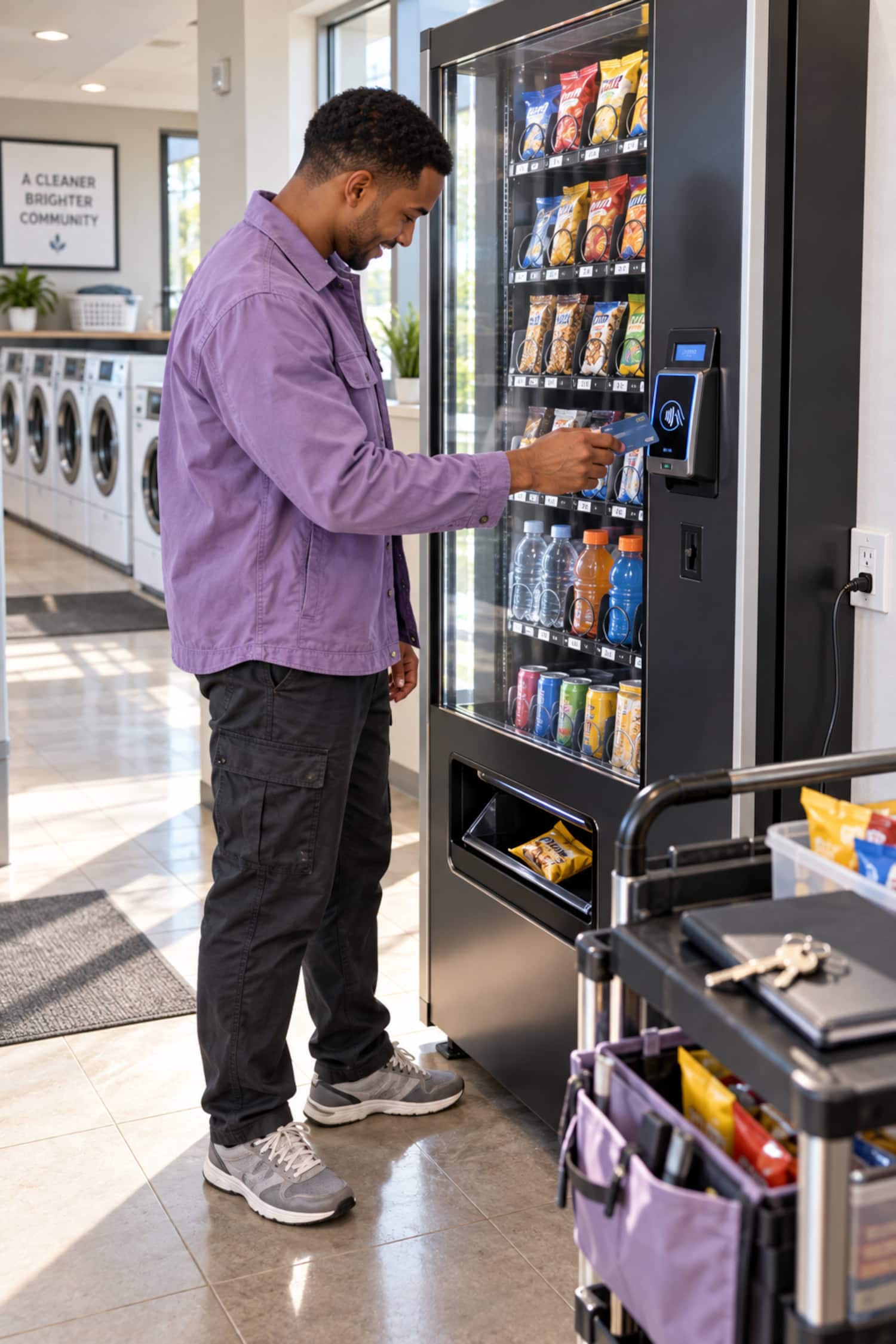
- Before opening: Test dispensing and settlements, stock a small assortment, display required information, and establish a refund contact.
- During the first service cycles: Track item sales, failed vends, waste, time spent, route mileage, and complaints by machine.
- Over the first 30 to 90 days: Adjust inventory and service frequency from actual results, then decide whether to keep, renegotiate, repair, or move the placement.
FAQ
How much does it cost to start a vending machine business?
It depends on the machine, delivery, payment setup, stock, permits, insurance, and placement charges, so a single nationwide startup range would be misleading.
Use the full cost table and cash reserve in Section 5.
Do I need an LLC to own a vending machine?
No, an LLC is not a blanket federal requirement for a vending operation.
Compare available structures and your registration responsibilities in Section 6.
Do vending machines need permits?
It depends on the jurisdiction, product, and site, with sales tax registration and local vending or food rules among the checks. See Section 6.
Can I run vending machines part-time?
Yes, if the number and locations of machines fit the time available for regular servicing, repairs, and customer issues. See Section 9.
Is healthy vending profitable?
It can be, when the customers buy the products at prices that cover stock, spoilage, and servicing. See Section 10.
How long does it take a vending machine to break even?
It depends on the actual upfront investment and monthly surplus, which may turn negative when sales disappoint. See Section 5.
Should I buy an existing vending route?
Only if machine ownership, sales, profit, location agreements, and payment transfers can be verified. See Section 13.
Conclusion
A vending business begins to make sense when a location has buyers, manageable service costs, and terms you can live with.
A bargain machine does little for you without those conditions.
- Confirm buying demand and reliable site access before purchasing a machine.
- Calculate profit after every recurring expense and a realistic value for your time.
- Verify written placement rights, equipment condition, and payment ownership before committing cash.
Further reading
- U.S. Small Business Administration: Review business formation, planning, and funding topics before setting up a vending operation.
- U.S. Food and Drug Administration: Find federal food-labeling information relevant to qualifying vending operations and their product assortments.
- How to Start a Vending Machine Business: Explore practical vending startup decisions covering machinery, placement, and business setup.
- Buying a Vending Machine Route: An equipment and vending-services seller’s overview of route purchase checks and transaction risks.
- Need Help Analyzing New Location for Newbie: Review a practitioner discussion about assessing demand, access, and seller claims at a proposed site.
- Trustworthy Location Finder Services: Read operator questions about the value and reliability of paid location-finding services.
- Healthy Vending at a Gym: Compare practical concerns about weak sales and the fit between gym customers and healthier stock.
- Buying Vending Machine Business: Examine the evidence and placement-agreement questions that matter when buying an established route.