For anyone sorting out CNA certification exam requirements and how to prepare, the first job is to identify the state, eligibility route, and testing provider that apply to you.
Then use the current candidate handbook to confirm which exam sections you must take, study the required knowledge areas, rehearse every testable skill against the official checklist, and verify test-day and retake rules before you register.
There is no single nationwide CNA exam format. Question counts, timing, skills selection, scoring, and eligibility can vary by state and provider.
Our recommendation is simple: prepare for the exact exam you are taking, not for a generic CNA test assembled from random videos and quizzes.
Last fact-checked: October 4, 2026
This guide covers the Certified Nursing Assistant state competency exam in the United States.
It is for first-time candidates, nursing students using an alternative eligibility route, and candidates preparing for a retake.
It focuses on requirements, written or oral testing, clinical skills, resource selection, test-day logistics, and retake planning.
1. Identify the CNA exam you are actually taking
A CNA candidate should match preparation to the state, eligibility route, testing provider, and current candidate handbook before studying in depth.
That sequence prevents a common and expensive mistake: practicing someone else’s version of the exam.
Use this route decoder before you buy a prep app or memorize a skills video.
| Stage | What to identify | Move forward when |
|---|---|---|
| State | The jurisdiction where you are seeking certification | You know which nurse aide program applies |
| Eligibility route | Approved training, nursing-school route, challenge route, waiver, or another allowed path | Your route is accepted for testing |
| Testing provider | The organization administering the exam | You have the correct provider page |
| Candidate handbook | The current rules for your program | You have read the exam and registration sections |
| Exam components | Written, oral, skills, or the required combination | You know exactly what you must pass |
Generic prep is cheap until it costs you a retest.
Prometric, Credentia, Headmaster, and other programs can use different procedures, formats, and skills expectations.
2. Confirm CNA exam requirements before registration
CNA exam eligibility is state-specific, so there is no honest national checklist that tells every candidate exactly what training, paperwork, or exam sections are required.
Confirm the rules for your route before paying or scheduling.
Use this verification checklist:
- Confirm whether your route requires a state-approved nurse aide training program.
- Check whether an alternative route applies, such as qualifying nursing-school coursework, a challenge option, or a waiver.
- Confirm which testing provider handles your state program.
- Read the provider’s current candidate handbook and application instructions.
- Verify whether you must take a written test, an oral option, a skills evaluation, or a combination.
- Check required identification, documents, registration steps, and test-day rules.
- Read the retake limits, waiting rules, fees, and grievance process before your first attempt.
A nursing student, a recent training-program graduate, and someone transferring certification from another state may face different routes.
If you are moving between states, look for the term “reciprocity” rather than assuming the certification transfers automatically.
3. Understand the knowledge and skills exams
Most CNA competency programs test two different things: what you know and what you can perform.
The exact structure varies, so treat any page that claims one universal question count, skill count, time limit, or passing score with suspicion.
The knowledge portion commonly centers on patient safety, infection control, resident rights, communication, basic nursing skills, restorative care, scope of practice, vital signs, and appropriate reporting.
Some programs provide an oral examination option.
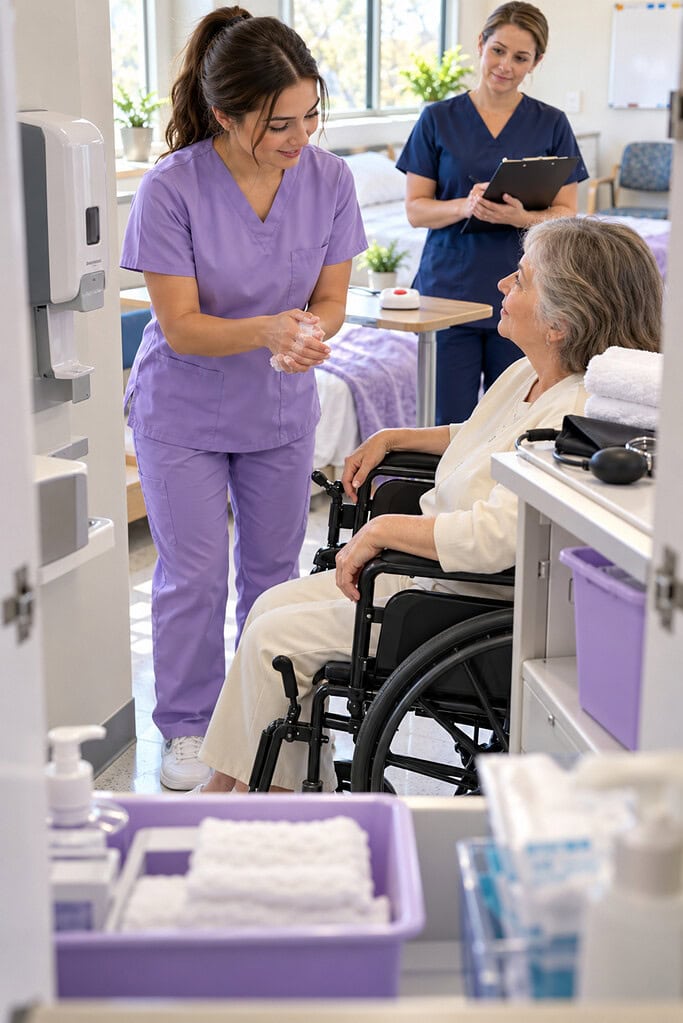
The clinical skills evaluation tests execution. Candidates may need to perform selected skills while an evaluator scores required steps.
The difficult part is often not the broad procedure.
It is remembering the required sequence, safety actions, infection-control steps, measurements, and documentation under observation.
Picture the familiar problem: you perform a transfer smoothly in class, then an evaluator starts watching and your brain suddenly misplaces the call light, the wheelchair lock, or the closing steps.
That is a performance problem, not proof that you never learned the skill.
4. Prepare for the written or oral CNA exam
The best knowledge-test preparation combines content review with provider-matched practice questions.
Do not rely on the idea that the exam is “just common sense.”
Two answers can look reasonable, and the test may be asking for the safest action within a CNA’s role.
When two choices seem plausible, work through a consistent logic:
- Protect resident safety.
- Respect resident rights and dignity.
- Stay within the CNA scope of practice.
- Follow infection-control principles.
- Observe, report, and escalate when the situation requires someone with greater authority.
Use practice questions to find weak areas, not to collect a giant pile of memorized answers.
A useful resource explains why the correct choice is better. Avoid any service promising the exact questions you will see.
For readiness, look for stable performance on practice material that matches your program.
You should also be able to explain why an answer is correct instead of recognizing it by shape.
5. Prepare for the CNA skills test
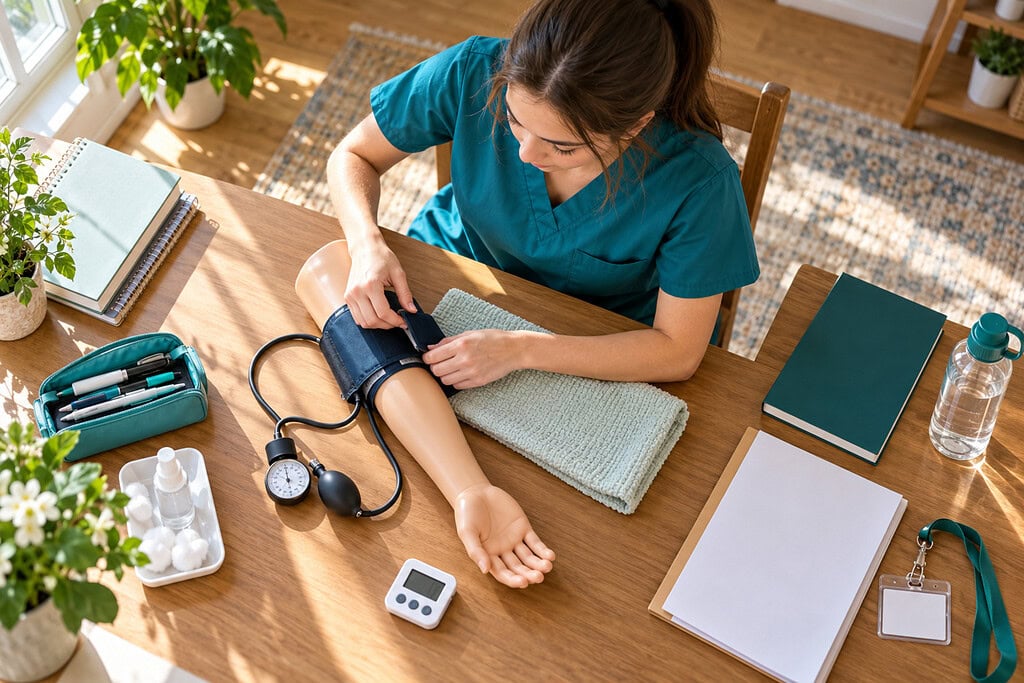
The most effective skills preparation is physical rehearsal against the official checklist. Skills memory is built with hands, not with tabs.
Use this practice loop:
- Open the official checklist for one skill.
- Read the full sequence and identify safety-critical or scored elements.
- Gather the supplies you would normally need.
- Perform the skill physically from beginning to end.
- Say relevant actions aloud when your testing rules expect verbalization.
- Record yourself or have another person score the attempt.
- Correct missed steps, then restart the skill from the beginning.
- Randomize the next skill and finish with timed mock sessions.
Do not prepare only the skills that strangers call “most common.” If your provider publishes a pool of testable skills, prepare that pool.
Also practice recovery. A candidate who notices a mistake and immediately panics can turn one problem into three.
Your handbook should tell you what the program allows regarding corrections or verbalization.
Equipment can add friction.
If you practiced blood pressure with one cuff and meet an unfamiliar setup on test day, the procedure has not changed, but your mental workload has.
Practice with safe variations when possible and focus on the checklist rather than a favorite piece of classroom equipment.
6. Prepare for test day and a possible retake
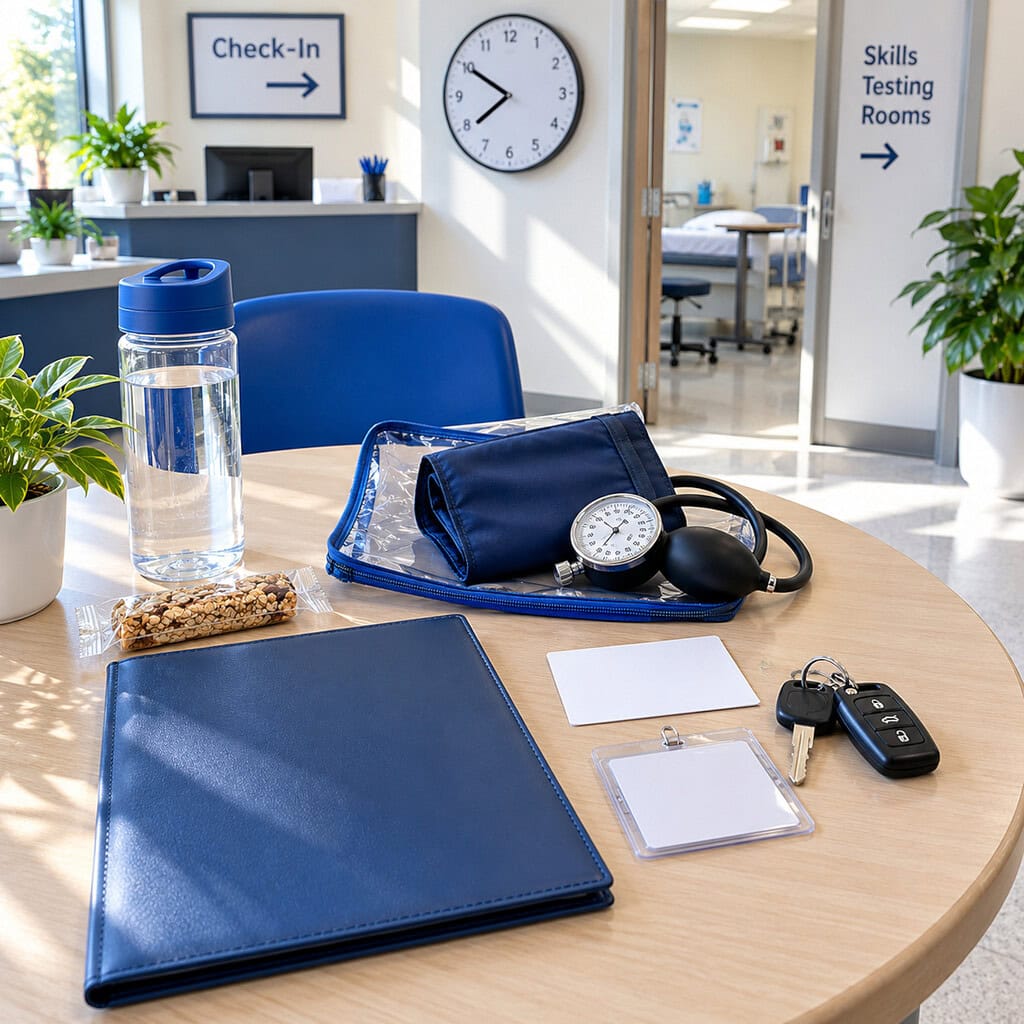
Test-day preparation includes logistics because a tired, rushed, hungry candidate is still expected to perform the same sequence.
Some candidates report long travel, limited testing dates, long waits, unfamiliar supplies, and missed work or classes.
Before test day:
- Confirm the location or online format and check-in time.
- Verify accepted identification and required documents.
- Confirm clothing rules and prohibited items.
- Plan travel, parking, food, water, and extra waiting time.
- Recheck the provider’s exam-day instructions.
- Know how results are delivered.
- Know what happens if you fail one section, including the retake and grievance process.
Imagine arriving early for an 8 a.m. appointment and not reaching the skills room for hours. That possibility changes what “be prepared” means.
Bring what the site allows, eat appropriately, and avoid building a schedule that collapses if testing runs late.
7. Avoid common CNA exam preparation mistakes
The most avoidable preparation mistakes are passive study, overconfidence about the knowledge test, and postponing logistics until the last minute.
| Myth or mistake | What actually helps |
|---|---|
| “The written test is only common sense” | Study the tested domains and practice decision logic |
| “Watching skills videos is enough” | Perform each skill and score it against the official checklist |
| “I only need the skills people say are common” | Prepare the official pool your program can test |
| “I’ll look at retake rules if I fail” | Read them before the first attempt because cost and scheduling can matter |
A second trap is practicing workplace shortcuts instead of the examination sequence.
For the test, follow the current official procedure your evaluator is scoring.
FAQ
Is the CNA certification exam the same in every state?
No. Eligibility, providers, exam format, skills procedures, scoring, and retake rules can vary. Start with Section 1.
Do I have to complete a CNA class before taking the exam?
It depends on your state’s eligibility routes.
Some candidates qualify through approved training, while other routes may exist for certain nursing students or challengers. See Section 2.
Is the CNA written exam hard?
It depends on your preparation and weak areas.
Treat it as a test of safety, rights, scope, communication, and care judgment rather than assuming “common sense” will carry you. See Section 4.
What skills should I practice for the CNA skills test?
Practice the official pool listed for your testing program.
Do not substitute a generic online list for your provider’s current checklist. See Section 5.
Can I correct a mistake during the skills test?
It depends on the testing program’s rules. Check the current candidate handbook for how corrections and verbalization are handled. See Section 5.
What happens if I fail one part of the CNA exam?
It depends on your program’s retake policy.
Check whether you retake only the failed section, how many attempts are allowed, and what registration rules apply. See Section 6.
Can I transfer CNA certification to another state?
Possibly, through a process commonly called reciprocity. The receiving state’s nurse aide program determines the requirements.
Conclusion
The safest CNA exam strategy is to identify your state, eligibility route, provider, and current handbook first, then build your preparation around that exact exam.
That keeps your study time focused and reduces avoidable surprises on skills day.
1. Verify your route before you register.
2. Practice skills physically against the official checklist.
3. Plan test-day logistics and retake rules before the first attempt.
Further reading
- Centers for Medicare and Medicaid Services: Federal information and program resources related to nursing homes and nurse aide requirements.
- Prometric Nurse Aide Frequently Asked Questions: Exam timing, identification, oral options, testing centers, clothing, and scoring information for Prometric programs.
- Prometric Nurse Aide Program Page: An example of a state-specific testing page with certification routes, testing requirements, fees, and skills materials.
- Credentia California Nurse Aide Testing: An example of Credentia’s state-specific candidate information and eligibility structure.
- Credentia Online Exam Day Guidance: Online testing setup, identification, check-in, and room requirements for the covered program.
- Registered Nursing CNA Certification Overview: A broader overview of CNA certification, state variation, exams, costs, and reciprocity.