A Business Development Manager (BDM) identifies and develops revenue opportunities, but the title does not describe one standardized job.
In one company, the BDM prospects, qualifies, negotiates, and closes. In another, the same title means managing prospectors, building partnerships, sourcing deals, or testing new markets.
The practical way to understand a Business Development Manager role is to inspect five things: who creates pipeline, who qualifies opportunities, who closes, who owns accounts, and how performance is measured.
Those answers tell you whether the role is sales, team leadership, partnerships, strategy, or origination. The main mistake is judging the job from the title alone.
“Manager” may describe commercial responsibility rather than people management, and a polished job description can still hide three separate jobs.

Last fact-checked: October 4, 2026
This guide is for people evaluating or defining a BDM role before an application, offer, or hiring decision.
It covers common role types, responsibilities, skills, and daily work.
It also covers performance measures, adjacent sales roles, career paths, and job-description red flags in English-language business-to-business (B2B) organizations.
1. What a Business Development Manager actually does
A Business Development Manager develops new commercial opportunities, but the exact work depends on the company’s operating model.
The role can sit anywhere from direct sales to partnerships, team management, market development, or deal origination.
The title is a label. The operating model is the job.
That distinction sounds obvious until a candidate joins a company expecting strategic partnerships and discovers that the calendar is mostly cold outreach.
The reverse also happens: someone expects a conventional quota-carrying sales role and lands in a long-cycle partnership position where progress depends on access, internal alignment, and patience.
Answer these five questions:
- Who is responsible for creating pipeline?
- Who decides whether an opportunity is qualified?
- Who owns proposals, negotiation, and closing?
- Who manages the customer or partner after the deal?
- What outcome determines whether the BDM is succeeding?
Those answers reveal whether the job is mainly sales, leadership, partnerships, strategic growth, or origination.
They also expose hybrid roles that combine several jobs under one title.
A hybrid role is not automatically bad. It can provide broad commercial exposure and real influence.
The problem starts when the company describes a three-job workload as one tidy title and sets expectations as if the scope were narrow.
2. The five common Business Development Manager role types
Business Development Manager roles usually fall into five broad archetypes. Some companies combine two or more, especially in smaller teams.
| BDM role type | Core job | Typical ownership | Main risk for candidates |
|---|---|---|---|
| Full-cycle new-business seller | Find prospects, run discovery, develop proposals, negotiate, and close | Pipeline through signed deal | “Business development” is simply a broader sales title |
| Prospecting team manager | Coach Sales Development Representatives or Business Development Representatives and manage activity, pipeline, and team performance | Team pipeline and prospecting output | “Manager” means people leadership, not personal closing |
| Partnerships and channel BDM | Build partner relationships and create indirect routes to revenue | Partner pipeline and relationship development | Revenue may take much longer to appear |
| Strategic growth BDM | Explore markets, channels, strategic relationships, and new revenue opportunities | Opportunity development and market hypotheses | Goals can be vague if leadership has not defined success |
| Deal sourcing and origination BDM | Find and open opportunities for another team to evaluate or execute | Relationship access and qualified opportunities | The BDM may influence deals without owning final execution |
The full-cycle seller is closest to an Account Executive in many organizations.
The partnerships BDM is closer to a relationship developer who creates access and commercial pathways.
Strategic growth roles can include market analysis, channel development, and cross-functional work that looks little like conventional outbound sales.
Deal origination is common in environments where the person sourcing the opportunity is not the person who later performs the detailed analysis or delivery.
The BDM’s value lies in finding suitable opportunities and opening the relationships that let another team evaluate or execute them.
The prospecting manager is the outlier that makes the word “Manager” especially unreliable.
A candidate can see “Business Development Manager” and assume an individual commercial role, only to find that success means coaching a team, inspecting activity, and improving pipeline generation.

3. Core responsibilities of a Business Development Manager
A Business Development Manager can own part or all of six major responsibility areas. The mix changes by role type.
Market selection
A BDM may research target markets, customer segments, and priority accounts.
The same role can also examine partners, competitors, and routes to revenue. In a strategic role, this work can be central.
In a pure sales role, it may be a lighter layer around a predefined ideal customer profile.
The practical question is whether the BDM receives a defined market or is expected to help decide where the company should play.
Opportunity creation
Opportunity creation can include outbound prospecting, referrals, and networking.
It can also come through conferences, partner development, and relationship building.
Some BDMs receive support from a Sales Development Representative (SDR) or Business Development Representative (BDR).
Others are expected to build the pipeline themselves.
This distinction changes the job dramatically.
A seller with strong closing skills can still struggle if the role suddenly requires building a pipeline from zero.
Qualification
A strong BDM determines whether an opportunity deserves further time and resources.
That means understanding fit, need, commercial potential, and timing.
It also means understanding stakeholder structure and the quality of the business problem.
Weak qualification fills the pipeline with opportunities that were never likely to move.
Deal development
Depending on the company, the BDM may run discovery, coordinate presentations or demos, and shape the offer.
The same BDM may also develop proposals, handle objections, negotiate terms, and close the deal.
The key phrase is “depending on the company.”
A partnerships BDM may create the relationship and then hand execution to sales, legal, product, or another commercial team.
Pipeline management
Pipeline management includes customer relationship management (CRM) records, next steps, follow-up timing, and stage discipline.
It also includes forecasting and reporting.
This administrative layer is easy to dismiss until the first forecast meeting reveals that half the pipeline has no clear next action.
A crowded calendar can still hide an empty pipeline.
Strategic feedback
Business development often sits close enough to the market to notice recurring customer needs, objections, competitor patterns, channel opportunities, and gaps in the company’s offer.
In more strategic roles, feeding those signals back to product, marketing, delivery, and leadership is part of the job.
4. Business Development Manager and adjacent sales roles
The cleanest way to compare revenue titles is by ownership, not hierarchy.
Titles vary too much across companies to assume that one is always senior to another.
| Role | Usually prospects | Usually qualifies | Usually closes | Usually manages existing accounts |
|---|---|---|---|---|
| SDR or BDR | Yes | Early-stage | Usually no | Usually no |
| Business Development Manager | Sometimes to heavily | Yes | Sometimes to often | Sometimes |
| Account Executive | Sometimes | Yes | Usually yes | Sometimes after close |
| Account Manager | Limited net-new prospecting | Existing-account opportunities | Expansion or renewals | Usually yes |
| Sales Manager | Oversees team activity | Coaches qualification | Supports or inspects closing | Usually manages the team, not the account |
SDR and BDR titles commonly refer to prospecting and early qualification roles.
A BDM can overlap with them when the BDM owns outbound creation, but a BDM may also be much broader.
An Account Executive (AE) commonly owns the sales process through close.
In many companies, a full-cycle BDM is effectively doing AE work under a different title.
An Account Manager typically focuses more on existing customers, retention, expansion, or renewals.
Some BDM positions include existing-account growth, which blurs that boundary.
A Sales Manager normally manages salespeople, but “Business Development Manager” does not reliably signal people management.
That is why asking how many direct reports the role has is more useful than guessing from the title.
5. The skills that make a strong Business Development Manager
Strong BDMs show observable commercial behaviors.
“Good communicator,” “people person,” and “strategic thinker” are too vague unless they translate into what the person can actually do.
| Skill | What competence looks like in practice | Why it matters |
|---|---|---|
| Qualification | Separates real fit from noise and is willing to disqualify weak opportunities | Prevents activity from being mistaken for pipeline |
| Discovery and listening | Finds the actual business problem instead of forcing a standard pitch | Improves relevance and deal quality |
| Pipeline generation | Creates opportunities through outbound, referrals, events, partners, or other channels | Reduces dependence on provided leads |
| Relationship development | Maintains context and relevance across long decision cycles | Supports complex B2B and partnership work |
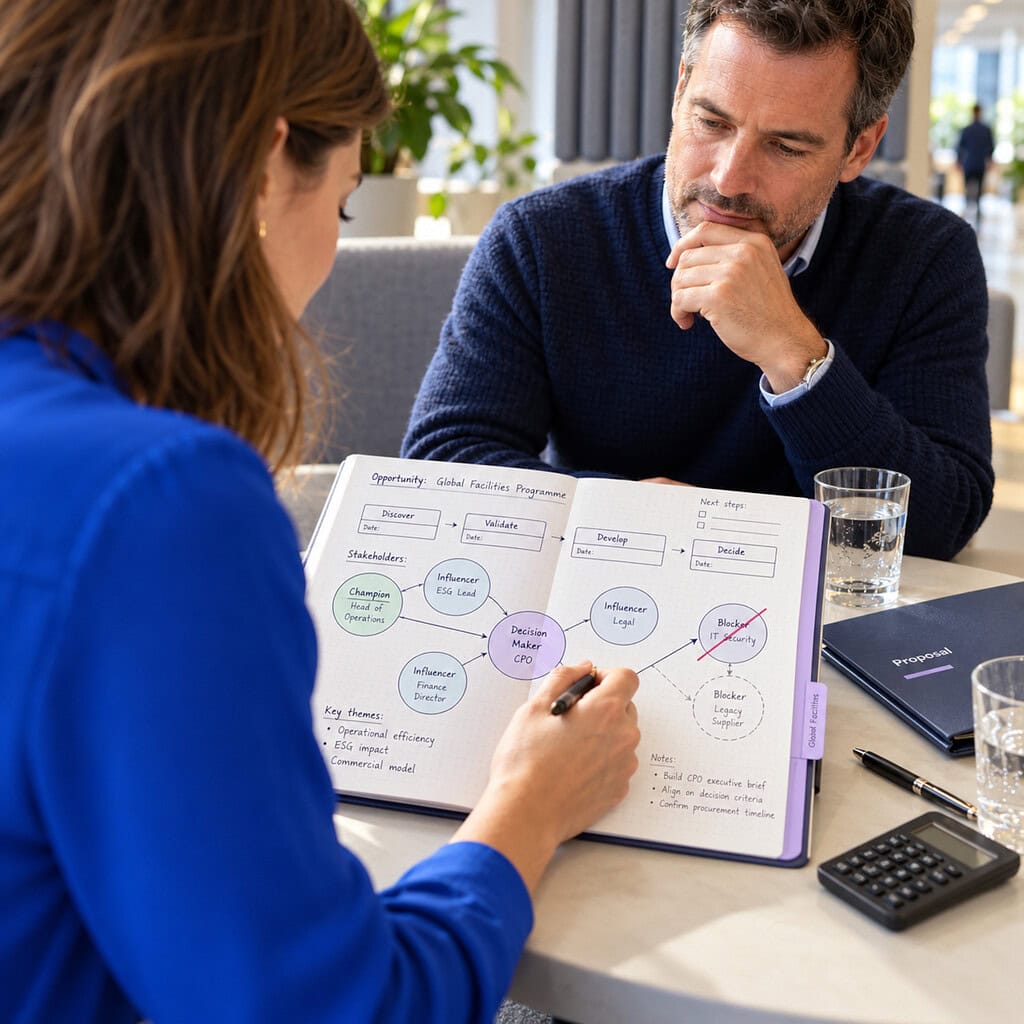
| Stakeholder mapping | Identifies decision-makers, influencers, champions, and blockers | Prevents one enthusiastic contact from being mistaken for organizational commitment |
| Negotiation and commercial judgment | Shapes viable offers and handles objections without reflexive discounting | Protects deal quality and commercial value |
| CRM and process discipline | Keeps records, next steps, stages, and forecasts usable | Makes execution visible and repeatable |
| Market understanding | Understands the customer’s environment, alternatives, and business value | Builds credibility and improves targeting |
| Cross-functional coordination | Brings in product, technical, legal, proposal, or delivery specialists at the right time | Reduces late-stage surprises |
| Resilience with judgment | Handles silence and rejection while knowing when to change approach or stop | Prevents both premature abandonment and endless chasing |
| Strategic thinking | Forms and tests ideas about markets, channels, partnerships, and growth | Matters when the role extends beyond direct sales |
Communication is still important, but the useful version is specific. Can the person ask a difficult question without making the conversation awkward?
Can they hear “not now” and determine whether the obstacle is timing, stakeholder access, value, or genuine lack of fit?
Picture a BDM who has a friendly champion and a promising proposal.
Then procurement appears, legal has concerns, finance wants different terms, and the executive sponsor was never actually involved.
Relationship building means understanding that map before the deal reaches the cliff.
6. What a Business Development Manager does day to day
A typical BDM day mixes external conversations with research, preparation, and follow-up.
It also includes CRM work, internal coordination, and pipeline review. The balance changes sharply by archetype.
A full-cycle BDM may spend the morning prospecting, the middle of the day on discovery calls, and the afternoon preparing a proposal or negotiating next steps.
A partnership BDM may spend more time researching organizations, coordinating introductions, preparing joint opportunities, and keeping long-running relationships warm.
Strategic growth roles can include market analysis, internal planning, and testing new commercial ideas.
A team-manager BDM may spend much of the day coaching prospectors, reviewing activity, listening to calls, and inspecting whether pipeline quality matches reported activity.
The unglamorous part is process.
Someone moving from a looser commercial environment into a structured organization can discover that the hardest adjustment is logging activity, updating stages, documenting next steps, and forecasting consistently.
That process work is not clerical theater when it is done well.
It lets the rest of the business see what is actually moving, what is stalled, and where support is needed.
A useful mental model is that the BDM owns commercial uncertainty.
The job is to turn a vague possibility into a clear next decision, even when that decision is “no.”
7. How Business Development Managers are measured
Business Development Manager performance should be measured against the role’s actual ownership.
A hard revenue quota fits some BDM jobs, while a long-cycle partnership role may need a broader set of leading and outcome measures.
| BDM role type | Useful performance measures | What can go wrong |
|---|---|---|
| Full-cycle seller | Qualified pipeline, conversion, deals closed, revenue | Activity targets can hide weak qualification |
| Prospecting team manager | Team pipeline, meetings, qualified opportunities, rep execution | Volume can be rewarded even when conversion is poor |
| Partnerships BDM | Qualified partners, activated relationships, partner-sourced pipeline, eventual revenue | Leadership may expect revenue before the channel has had time to mature |
| Strategic growth BDM | Validated opportunities, market or channel progress, qualified commercial pathways | Vague goals make performance subjective |
| Deal origination BDM | Qualified introductions, opportunities sourced, deals influenced | Credit can become unclear when another team executes the deal |
The metric needs to match the sales cycle.
In some partnership environments, development can take many months or longer before material revenue appears.
If leadership expects immediate revenue from a role built around long-cycle relationship development, the problem is not motivation.
The measurement model is broken.
The same issue appears in direct sales when meeting or call targets are disconnected from conversion math, market size, or sales-cycle reality.
Demanding targets still need a credible link to market size, conversion, and sales-cycle reality.
Candidates should ask how the target was built and how the current team performs against it. A vague quota is just anxiety with a spreadsheet.

8. How to evaluate a Business Development Manager job description
A good BDM job description should specify the role type, pipeline model, closing responsibility, and account ownership.
It should also explain target logic, support, and compensation structure.
| Criterion | What to establish before accepting the role | Warning sign |
|---|---|---|
| Actual role type | Seller, team manager, partnerships, strategic growth, origination, or hybrid | The description switches between several models without priorities |
| Pipeline ownership | Inbound provided, SDR-supported, shared sourcing, or self-generated | “Own growth” with no explanation of lead sources |
| Closing ownership | BDM closes, hands to an AE, or only creates introductions | Revenue quota without authority over the close |
| Account ownership | Net-new only, expansion, partner management, or a mix | New-business target plus a large service workload |
| Target model | Revenue, pipeline, meetings, qualified opportunities, partnerships, or another outcome | Success is described only as “drive growth” |
| Target realism | Team attainment, conversion, deal size, sales cycle, and prior performance | Nobody can explain how the quota was derived |
| Ramp expectations | When meaningful pipeline and revenue are expected | Immediate output in a long-cycle role |
| Market quality | Defined ideal customer profile, territory, account availability | “Build the market” with no clear customer definition |
| Resources | Marketing, SDR, presales, legal, proposal, and CRM support | One person is expected to prospect, close, market, and deliver |
| Compensation logic | Base and variable structure, attribution, accelerators, and long-cycle treatment | Commission credit is unclear when several teams touch a deal |
| Manager quality | Coaching, forecast expectations, support, and team stability | Management talks only about activity volume |
| Career path | AE, sales leadership, partnerships, Director of Business Development, go-to-market, or another track | The title sounds senior but the progression is undefined |
Ask these questions in the interview process:
- What does a normal week look like for the person in this role?
- What percentage of pipeline is expected to be self-generated?
- Who owns the deal from first conversation to signature?
- What happens to the account after the deal closes?
- Which target matters most, and how was it set?
- What is the typical sales or partnership cycle?
- How many people on the team are meeting the target?
- Which internal teams support proposals, technical work, legal review, and delivery?
- How is commission or credit handled when another team helps close the opportunity?
- What role has this position led to for strong performers?
Imagine the interview where the title says “strategic business development,” but the answers reveal 100% self-sourced outbound, a hard closing quota, no SDR support, and no authority over pricing.
That is a full-cycle sales job with strategic wallpaper.
Our editorial recommendation is to treat unexplained quota logic, pipeline ownership, or closing responsibility as a risk rather than an interview detail.
9. What employers should look for when hiring a Business Development Manager
Employers should look for evidence of commercial judgment, not adjectives.
The strongest candidate can explain what they did, why they did it, what changed, and where they stopped pursuing weak opportunities.
Instead of asking whether someone is a “great communicator,” ask them to walk through a discovery conversation that changed their view of an opportunity.
Instead of accepting “relationship builder,” ask how a relationship moved from initial contact to a commercial outcome.
Useful evidence includes:
- A clear example of creating qualified pipeline rather than merely generating activity.
- A case where the candidate disqualified an opportunity and can explain why.
- A stakeholder map showing how the candidate handled champions, blockers, and decision-makers.
- A negotiation example that did not depend on immediate discounting.
- Evidence of CRM discipline, follow-up, and forecast ownership.
- A market or channel hypothesis and how the candidate tested it.
- For manager roles, evidence of coaching and improving team execution rather than only personal selling.
A charismatic candidate can still be a weak BDM if the conversation never reaches qualification, commercial logic, or next steps.
Charm opens conversations. Judgment decides which conversations deserve a pipeline stage.

10. The difficult parts of business development work
Business development can be stressful because the role often combines uncertainty, rejection, delayed decisions, quota pressure, and ambiguous ownership.
The stress is worse when the company has not defined what success should look like.
Long sales cycles create a specific problem: work can be real before revenue is visible.
A partnership can require repeated conversations and internal coordination while leadership sees only a delayed number.
That gap between activity and visible outcome needs a measurement model that recognizes meaningful progress.
Rejection is another part of the job, but experienced BDMs learn to distinguish several forms of “no.” A prospect may mean no, not now, wrong stakeholder, wrong approach, or poor fit.
The skill is not endless persistence. It is diagnosing which situation exists and deciding what deserves another move.
Poor pipeline creates its own pressure. A BDM two months into a full-cycle role can be busy every day and still have too little qualified work ahead.
More activity does not automatically fix that. Better targeting and qualification may matter more.
The worst version of the job appears when scope and accountability are mismatched.
A BDM can be expected to source every lead, close every deal, support existing accounts, contribute to marketing, and still be judged against a quota designed for a narrower sales role.
That combination creates an overloaded role whose accountability is wider than its support.
11. Career paths into and out of business development
There is no single entry path into a Business Development Manager role.
People can move in from SDR or BDR positions, broader B2B sales, and customer-facing work.
Others arrive from account roles, partnerships, or adjacent commercial backgrounds.
An SDR-to-BDM path makes sense when the BDM role adds qualification, discovery, negotiation, or closing responsibility.
A customer-facing professional can also transition successfully if they already understand business problems, stakeholder communication, and commercial context.
The next step depends on the archetype.
Full-cycle BDMs may move toward Account Executive roles, larger or more complex sales territories, or sales leadership.
Partnerships BDMs may progress into partnerships leadership or broader go-to-market roles.
Strategic BDMs can move toward Director of Business Development, growth, market development, or other strategy-heavy commercial work.
Origination roles can lead toward senior sourcing positions or adjacent roles in investment and professional-services environments, depending on the company.
That flexibility is useful, but it also creates a resume problem. Two people can hold the same BDM title and have completely different experience.
When describing the role, spell out the commercial ownership rather than relying on the title to do the work.
12. How artificial intelligence changes the Business Development Manager role
Artificial intelligence (AI) can help a BDM with research, preparation, and process automation.
It does not replace judgment in qualification, trust, negotiation, or stakeholder management.
The useful boundary is routine acceleration versus commercial judgment.
A BDM can use automation to reduce time spent gathering account context, preparing for conversations, organizing notes, or handling repetitive process work.
The value is obvious when the alternative is spending an hour assembling information that can be reviewed quickly.
The harder parts remain human. A system can summarize a company, but it does not own the relationship when a stakeholder goes silent.
It does not decide whether the silence means timing, internal politics, weak value, or a dead opportunity.
It also does not carry the commercial consequence of a poor negotiation or a badly qualified deal.
Treat AI as leverage for preparation and administration. The BDM still has to understand the customer and make the call.

13. Common myths about Business Development Manager roles
Business development attracts vague language because the work sits between several functions. That makes a few myths especially persistent.
- “Business development is just sales.” Sometimes it is very close to sales, especially in full-cycle roles. In other companies, it centers on partnerships, market development, or origination.
- “Manager means people manager.” Often it does not. The title can describe responsibility for a territory, market, partnership portfolio, or commercial outcome.
- “A BDM should always close the deal.” Full-cycle BDMs often do. Partnership and origination roles may hand opportunities to another team.
- “Relationship building is mostly personality.” Effective relationship development requires context, follow-up, stakeholder mapping, qualification, and commercial judgment.
- “More meetings mean better performance.” Meeting volume can matter, but weak qualification can produce activity without useful pipeline.
- “Strategic business development has no sales pressure.” Strategic roles can still face hard expectations. The difference is that the output may include channels, partnerships, market progress, or sourced opportunities rather than only direct revenue.
FAQ
Is a Business Development Manager higher than a Business Development Representative?
It depends on the company.
A BDM often has broader commercial ownership than a Business Development Representative, but titles are inconsistent, so compare responsibilities rather than assuming a fixed hierarchy.
See Section 4.
Is a Business Development Manager the same as an Account Executive?
Sometimes.
A full-cycle BDM can perform essentially the same prospecting, discovery, negotiation, and closing work as an Account Executive, while other BDM roles focus on partnerships or strategy.
See Sections 2 and 4.
Does a Business Development Manager cold call?
It depends on the role type.
Full-cycle and pipeline-heavy BDM roles can involve substantial outbound prospecting, while partnership or strategic roles may rely more on relationship development and targeted outreach.
See Sections 2 and 3.
Does a Business Development Manager manage people?
Not necessarily. Some BDMs manage SDRs or junior commercial staff, but many are individual contributors with no direct reports. See Sections 2 and 4.
Does a Business Development Manager close deals?
Sometimes to often.
Full-cycle BDMs commonly own closing, while partnership, strategic, or origination roles may create and qualify opportunities before handing them to another team.
See Sections 2 and 3.
What are the most important Business Development Manager skills?
The core skills are qualification, discovery, pipeline creation, stakeholder management, and commercial judgment. See Section 5.
How is a Business Development Manager measured?
It depends on the archetype.
Direct sellers can be measured on pipeline and revenue, while partnerships or strategic roles may need partner, opportunity, and progress measures alongside eventual commercial results.
See Section 7.
Is business development a stressful career?
It can be.
Common pressures include quota, rejection, delayed decisions, unclear scope, and weak pipeline, while unrealistic expectations make them worse.
See Section 10.
Can someone become a Business Development Manager without first being a Sales Development Representative?
Yes. People also enter business development from broader B2B sales, customer-facing, account, partnership, and other commercial backgrounds.
See Section 11.
Do Business Development Managers use artificial intelligence?
Yes, mainly as a workflow aid for research, preparation, and process automation.
Judgment in qualification, negotiation, trust, and stakeholder management remains central. See Section 12.
Conclusion
A Business Development Manager title only becomes meaningful when you know who creates pipeline, who qualifies, who closes, who owns the account, and how success is measured.
Use that framework before judging the seniority, attractiveness, or fit of any BDM role.
1. Decode ownership first. Identify the pipeline, qualification, closing, and account responsibilities before you evaluate the title.
2. Judge skills by evidence.
Look for qualification, discovery, stakeholder management, negotiation, and process discipline instead of generic personality claims.
3. Match targets to the role. Evaluate quotas and performance measures against the actual sales cycle, resources, and commercial ownership.
Further reading
- Business Development Manager Role: A professional association overview of BDM scope and its overlap with sales, partnerships, and marketing.
- Business Development Manager Job Description: Employer-oriented examples showing how widely BDM responsibilities can vary.
- Business Development Manager Career Overview: A broad overview of responsibilities, skills, qualifications, and career progression.
- Business Development Manager Career: A career guide covering BDM work and adjacent revenue roles.
- Business Development Manager Job Profile: A role profile covering responsibilities, skills, working conditions, and career development.
- Business Development Manager Career Path: A university career resource covering skills, progression, compensation topics, and role fit.
- Business Development Discussion on DOU: Practitioner discussion of relationship development, stakeholder work, process, and AI in business development.
- Sales vs Business Development Discussion: Practitioner perspectives on the boundary between direct sales, partnerships, and longer-cycle business development.