To prepare for a job interview as an employer, define what success in the role looks like, decide what evidence would prove a candidate can deliver it, and build the interview around that evidence.
Then assign interviewer responsibilities, review the candidate’s materials, prepare core questions and follow-up probes, set scoring criteria, and be ready to explain the job honestly.
Our editorial recommendation is simple: build the interview backward from the job instead of forward from a question bank.
The interview is a decision system, not a question list. If the role, evidence, and scoring are vague, adding more questions will not fix the process.
That matters because the expensive mistake is rarely “the team forgot to ask about teamwork”; more often, the team hires the person who interviews best instead of the person most likely to do the work well.
A polished answer is packaging. Your job is to inspect what is inside.
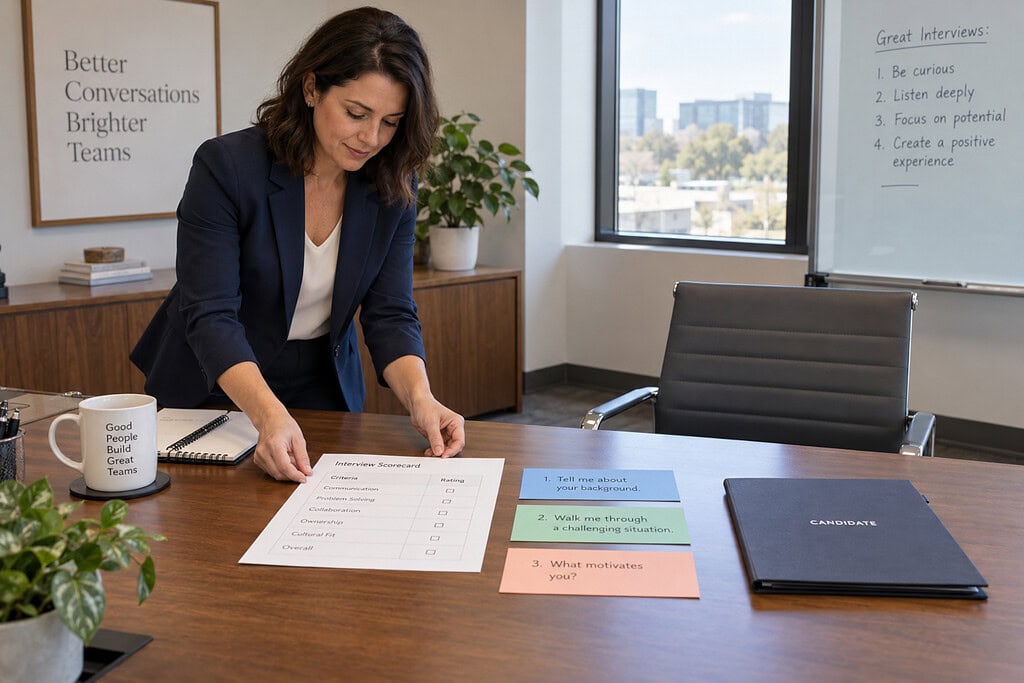
Last fact-checked: October 1, 2026
This guide is for employers, hiring managers, recruiters, and interview panelists preparing to interview candidates.
It covers how to design the interview and its questions, how to probe and score answers, and how to handle work samples, candidate experience, and debriefing.
Employment-law restrictions vary by jurisdiction, so validate sensitive topics with qualified HR (human resources) or legal guidance.
Interview formats at a glance
Different interview formats solve different problems. Do not add a format because another company uses it.
Add it because it gives you information you cannot get more efficiently another way.
| Format | Best use | Main risk | Preparation priority |
|---|---|---|---|
| Recruiter or initial screen | Basic fit, motivation, logistics, role expectations | Repeating questions the hiring manager will ask again | Define what the screen owns and what it does not |
| Hiring manager interview | Role depth, ownership, judgment, motivation | Turning into an unstructured conversation | Prepare core evidence questions and probes |
| Panel interview | Multiple perspectives on distinct competencies | Repetition, group dynamics, candidate fatigue | Assign each interviewer a clear area of ownership |
| Technical or skills interview | Job-specific competence and problem solving | Testing trivia instead of job performance | Match the task to real work and define scoring in advance |
| Work sample or exercise | Direct evidence of execution | Excessive unpaid effort or irrelevant difficulty | Use the shortest task that resolves a real uncertainty |
| Final conversation | Remaining risks, mutual fit, selling the role | Becoming an automatic extra round | State exactly what unresolved question this round must answer |
A small company does not need six formats. A complex role may need more than one.
The correct number is the smallest process that gives enough reliable evidence to make the decision.
What employers are actually trying to assess
An interview usually needs to cover more than technical skill.
The exact mix depends on the job, but these are the recurring dimensions worth translating into job-specific evidence.
| Area | What you are actually trying to learn |
|---|---|
| Job competence | Can the candidate perform the core work at the required level? |
| Depth of experience | Did the candidate actually do what the resume implies? |
| Ownership | What did the candidate personally own, decide, and deliver? |
| Judgment | How does the candidate choose when there is no obvious answer? |
| Problem solving | Can the candidate break down unfamiliar or messy problems? |
| Results orientation | What changed because of the candidate’s work? |
| Learning ability | How does the candidate respond to unfamiliar situations and mistakes? |
| Accountability | Can the candidate discuss failures without automatically blaming others? |
| Curiosity | Does the candidate investigate causes and ask useful questions? |
| Communication | Can the candidate explain work clearly at the level the audience needs? |
| Collaboration | How does the candidate handle disagreement, dependencies, and shared ownership? |
| Management ability | Can the candidate set expectations, coach, make difficult calls, and deliver through others? |
| Motivation | Does the actual work match what the candidate wants next? |
| Role compatibility | Does the candidate’s working style match genuine requirements of this team? |
| Self-awareness | Can the candidate describe limitations, mistakes, and improvement without performance theater? |
Do not score every role on every row. Select the dimensions that actually predict success in the job.
Otherwise the scorecard becomes too broad to guide a hiring decision.
The employer interview process at a glance
The order matters. Questions come after the job and evidence are defined, not before.
| Stage | Decision | Move forward when |
|---|---|---|
| 1. Define the role | What must this person accomplish? | The team agrees on the actual work and outcomes |
| 2. Identify success and failure conditions | What would make this hire work or fail? | The costly failure modes are explicit |
| 3. Define competencies | Which capabilities prevent those failures? | Each requirement is job-related and understandable |
| 4. Define evidence | What would prove the capability exists? | You can describe observable evidence, not just traits |
| 5. Assign interview ownership | Who evaluates each area? | Every important competency has an owner |
| 6. Review the candidate’s materials | Which claims need verification? | Each meaningful uncertainty has a prepared probe |
| 7. Prepare questions and probes | How will you uncover the evidence? | Core questions are comparable across candidates |
| 8. Decide on a work sample | What needs demonstration rather than discussion? | The exercise resolves a specific uncertainty |
| 9. Build the scorecard | What counts as weak, adequate, or strong evidence? | Interviewers can score without inventing standards later |
| 10. Prepare the employer side | What must the candidate understand about the job? | The panel can explain the role, trade-offs, and next steps |
| 11. Prepare logistics and candidate experience | Is the interview ready to run for the candidate? | Attendees, format, timing, and remote setup are confirmed |
| 12. Interview, record, and debrief | What does the evidence support? | Independent notes are complete before group discussion |

Build the decision before the conversation
The interview is a decision system, not a question list.
Start by asking what the person will need to accomplish after being hired. Then ask what tends to go wrong in this role.
Those two answers are more useful than a collection of generic interview questions because they define the actual hiring risk.
Suppose a previous employee missed deadlines because they waited too long to escalate blocked work. “Good communicator” is too vague to assess.
The useful requirement is closer to this: recognizes a blocked dependency, communicates it early, and proposes a next step.
That requirement can produce evidence. Ask for a real example of a project that became blocked. Then probe:
- When did you realize there was a problem?
- Who did you tell?
- What did you propose?
- What happened?
- What would you change now?
This is the basic conversion you want throughout the interview:
| Start with the job | Convert it into | Look for | Ask |
|---|---|---|---|
| A repeated responsibility | A capability | Specific past behavior or live performance | A concrete example tied to that responsibility |
| A previous failure mode | A risk-control behavior | Evidence the candidate has handled a similar problem | A failure, conflict, trade-off, or recovery example |
| A must-have skill | A demonstration standard | Depth, method, judgment, and result | A technical question, work sample, or detailed project probe |
| A working-style requirement | An observable behavior | How the candidate works with real constraints | A past example involving feedback, dependencies, or disagreement |
The conversion keeps the interview simple while replacing vague traits with behavior an interviewer can observe.
A trait does not become measurable just because it appears on a scorecard.
1. Define what success in the job looks like
Before interviewing anyone, confirm that the role is actually approved, funded, and available.
Clarify who can make the hiring decision and who owns compensation or logistical questions.
Running interviews for a job that may not exist wastes candidate time and hides an internal decision problem behind a recruiting process.
Write down the outcomes the new hire is expected to produce. Focus on work, not personality.
A useful definition includes the responsibilities that consume real time, the decisions the person will own, and the results the manager will actually care about.
For a new role, ask the manager what the person should have accomplished after the first few months.
For a replacement role, look at what the previous person actually did, not only what the old job description says.
Check the current work because job descriptions often lag behind the role.
Use these questions before touching the interview guide:
- What must this person deliver?
- Which responsibilities are routine and which are high stakes?
- What decisions will this person make without approval?
- Which mistakes would be expensive or difficult to reverse?
- Which skills must exist on day one?
- Which skills can reasonably be taught after hiring?
- What conditions make this role unusually difficult?
- Why is the role open?
The last question matters. A new growth role creates different risks from a role opened after repeated turnover.
If the job has defeated three people because priorities change weekly, the interview should test ambiguity, prioritization, and stakeholder management.
It should not quietly blame the fourth candidate for a management problem.
2. Identify success conditions and failure modes
Good preparation includes an uncomfortable question: “Why could this hire fail even if the resume looks good?”
Previous bad hires are useful here, provided the lesson is specific. “They lacked initiative” is still vague.
“They waited for instructions when customer issues fell outside the playbook” is something you can test.
List the five or six failure modes that would genuinely damage performance.
Then convert each one into a job-related capability. Keep the distinction between must-have and trainable requirements.
Otherwise, employers often reject a capable candidate for not already knowing a process the company could teach in a week.
A useful failure-mode worksheet looks like this:
| Failure mode | Capability that reduces the risk | Evidence to seek |
|---|---|---|
| Misses important deadlines without warning | Early escalation and prioritization | A real example of identifying a delivery risk before failure |
| Takes credit for team output | Clear ownership and accurate attribution | Specific description of personal contribution and dependencies |
| Freezes when requirements are unclear | Judgment under ambiguity | A situation where the candidate made progress without perfect information |
| Creates conflict across teams | Stakeholder management | An example of disagreement, negotiation, and resolution |
| Produces polished work that fails in practice | Practical execution | A work sample or detailed example showing method and trade-offs |
Do not turn this into a personality wish list.
“Confident,” “energetic,” “nice,” and “executive presence” are weak criteria unless you can explain the job behavior they represent.
3. Decide what evidence would convince you
For every important capability, define the evidence before meeting candidates.
This reduces the temptation to move the goalposts after a charismatic person walks into the room.
Past behavior is usually useful because it forces the conversation into specific events.
Live work can be useful when execution matters more than storytelling.
Hypothetical questions can still help, especially when the role regularly faces a particular scenario, but they should not be your only evidence.
Use three evidence types deliberately:
- Past behavior: What did the candidate actually do in a comparable situation?
- Demonstrated work: Can the candidate perform a representative task or reason through one live?
- Role understanding: Does the candidate understand the kind of work, trade-offs, and constraints the role contains?
The evidence should be difficult to fake with polished language alone.
This does not require an adversarial interview, only enough follow-up questions that the candidate’s actual involvement becomes clear.
Picture the common failure: a candidate gives a perfect STAR-style story (Situation, Task, Action, Result) about “leading” a project.
The answer has a beginning, middle, end, metrics, and a lesson learned. Then the interviewer asks, “What did you personally decide?” and the story suddenly becomes foggy. That follow-up is more valuable than five additional canned questions.

4. Assign interviewer ownership before the panel meets
Panel interviews become wasteful when every person receives the same instruction: “Talk to the candidate and tell me what you think.”
Assign each interviewer a clear area.
One person may own technical depth, another stakeholder management, another people leadership, and the hiring manager may own motivation and role expectations.
Some overlap can be intentional, but accidental duplication is just noise.
| Interviewer | Primary responsibility | What to avoid |
|---|---|---|
| Recruiter | Motivation, logistics, broad fit, process expectations | Re-testing deep skills owned by the manager |
| Hiring manager | Core role competence, judgment, ownership, motivation | Repeating the recruiter screen word for word |
| Functional peer | Collaboration, domain depth, day-to-day working patterns | Turning the interview into a popularity vote |
| Cross-functional partner | Dependencies, communication, stakeholder judgment | Testing technical details outside their expertise |
| Senior leader | Scope, judgment, leadership, mutual expectations | Adding a prestige round with no new decision value |
Five interviewers asking the same thing are not a panel. They are an expensive echo.
Send the interview plan before the candidate arrives.
Each interviewer should know the competencies they own, the core questions they are responsible for, what they should probe, and when feedback is due.
5. Review the resume and candidate materials
Read the resume before the interview. The step is obvious, but it is skipped often enough to deserve its own place in the process.
Mark the claims that need verification. Look for:
- projects relevant to the role
- changes in scope
- transitions
- results
- places where the wording leaves ownership unclear
Do not spend the interview rediscovering information already sitting on the page.
Prepare candidate-specific probes around meaningful uncertainties. These probes can vary while the core evaluation stays consistent.
For example, if the resume says “led migration to a new CRM,” meaning a customer relationship management system, prepare to ask:
- Who made the architecture decision?
- How many people were involved?
- What did you own?
- What went wrong?
- How was success measured?
The aim is to establish the boundary between “I did” and “my team did,” not to extract a confession.
One of the quickest ways to damage candidate trust is opening the resume for the first time while the candidate watches the interviewer scroll.
The candidate reads it as a sign that their preparation mattered more than the interviewer’s.
6. Prepare core questions and follow-up probes
Use the same core questions for candidates interviewing for the same role when those questions test the same requirements.
That gives you comparable evidence. Then individualize the follow-up probes based on each answer.
Standardize what you evaluate and how you score it, not every sentence of the conversation.
Good primary questions usually ask about real work:
- “Tell me about a project where you were personally responsible for an important result. What was your part?”
- “Tell me about a time you had to make a decision with incomplete information. What did you do?”
- “Describe a disagreement with a colleague or stakeholder that affected the work. How was it resolved?”
- “Tell me about a mistake or failed approach that changed how you work now.”
- “Give me an example of a problem you noticed before someone assigned it to you. What happened next?”
- “Tell me about a time priorities changed after work had already started. How did you decide what to do?”
The probe tree is where the real interview happens. Keep these follow-ups ready:
- What was your personal responsibility?
- What did you actually do first?
- Why did you choose that approach?
- What alternatives did you consider?
- Who else was involved?
- What was difficult or uncertain?
- What happened as a result?
- How do you know the result was successful?
- What would you change if you did it again?
Do not use every probe mechanically. Follow the evidence.
If the candidate has already explained ownership and outcome clearly, asking the same point three different ways makes the interview feel like cross-examination.
7. Decide whether a work sample will add new evidence
A work sample is valuable when the job requires something that conversation cannot assess reliably.
Writing, analysis, presentation, and coding can all be candidates for direct demonstration.
So can prioritization, role-play, and problem decomposition.
The test is simple: what uncertainty will this exercise resolve that the interview will not?
If you cannot answer that, skip the exercise. An exercise without a clear purpose still costs the candidate real time.
Keep the task representative and bounded.
Avoid assignments that resemble substantial unpaid company work, especially when the output could be used commercially.
State what will be evaluated, what resources the candidate may use, and what a reasonable level of completeness looks like.
A familiar bad scene is the “small” take-home that contains three deliverables, requires company research, and ends with a presentation to a panel.
The employer sees a test. The candidate sees a weekend disappearing into a hiring process that still has two rounds left.
If a short live exercise can answer the same question, it may be the better tool.
If normal work allows preparation and references, an artificial memory test may be measuring interview conditions rather than job conditions.

8. Build the scorecard before the interview
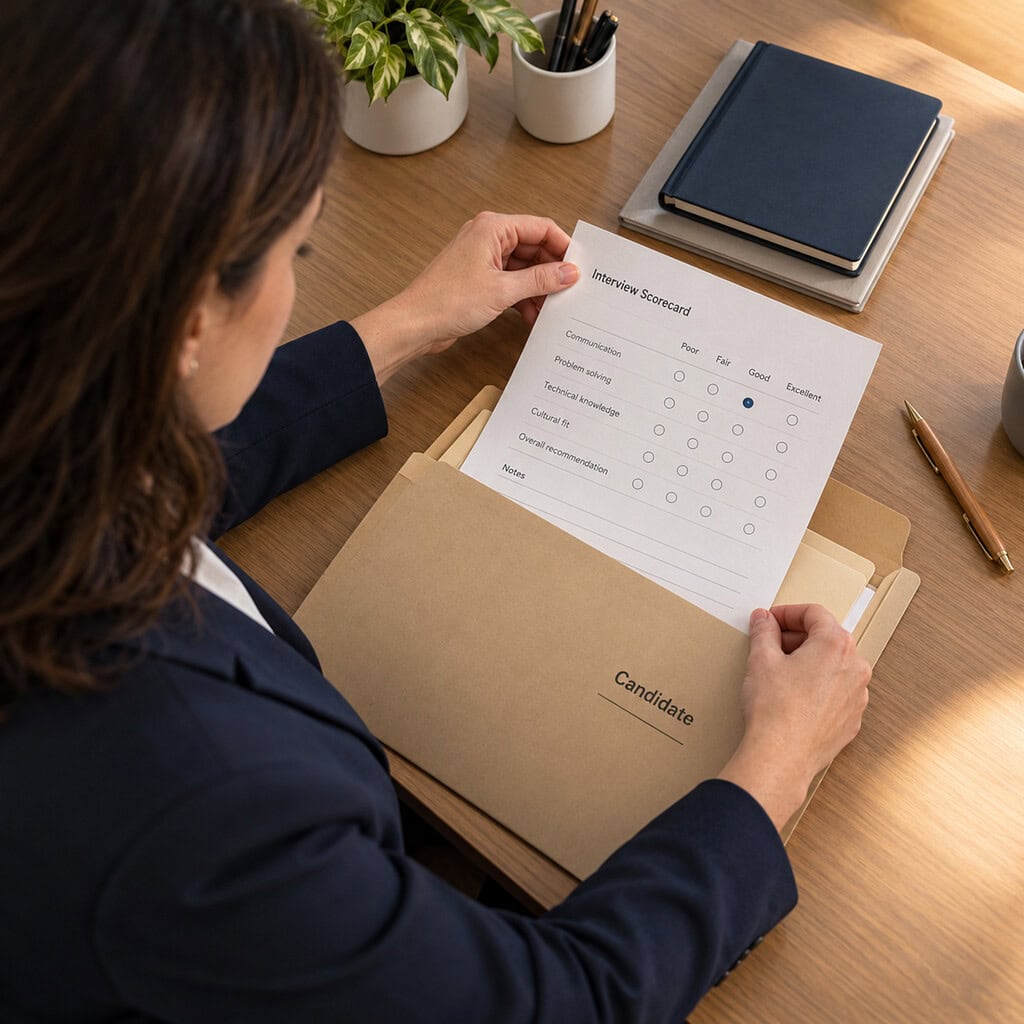
A scorecard should define what interviewers are evaluating and what different evidence levels mean.
Do this before meeting candidates. A scorecard written after the interview is just memory wearing a spreadsheet.
Avoid a single overall score such as “8/10” with no explanation.
Break the role into a small number of job-related dimensions. Then anchor the scale with observable evidence.
| Rating | Meaning | Example evidence |
|---|---|---|
| 1: weak evidence | The answer does not demonstrate the required capability | Vague example, unclear ownership, no relevant result |
| 2: partial evidence | Some relevant experience, but important gaps remain | Candidate contributed but did not own the critical decision |
| 3: solid evidence | Clear, relevant example at the required level | Specific ownership, sound reasoning, credible result |
| 4: strong evidence | Evidence exceeds the role’s normal requirement | Repeated examples with high complexity, strong judgment, and measurable impact |
| Not assessed | The interview did not produce enough evidence | The competency was not covered or remained unresolved |
“Not assessed” is a useful option because it is more honest than forcing a rating when the interview produced no evidence.
Score each competency from evidence, not general impression.
Notes should capture what the candidate said and what it demonstrates. For example, “great energy” records an impression.
“Explained how they identified a blocked dependency, escalated it two weeks before deadline, and proposed a revised sequence” records evidence.
9. Prepare to explain and sell the role
Strong candidates are evaluating the employer at the same time. Prepare for that deliberately.
Be ready to explain:
- why the role is open
- what success looks like
- what the difficult parts are
- who the person will work with
- how decisions are made
- what the process looks like from here
If compensation, schedule, travel, or location expectations are part of the role, the appropriate person should be able to explain them accurately.
Do not hide the unpleasant parts.
If the role includes frequent priority changes, difficult customers, legacy systems, or a manager who expects independent decisions, say so.
A candidate who rejects the real job before joining is cheaper than an employee who discovers the truth in month two.
Prepare genuine reasons a strong candidate might choose the role. Growth, autonomy, mission, and technical challenge can matter.
So can team quality, stability, schedule, and compensation. Use only what is actually true.
Both sides are checking whether the arrangement makes sense, so the conversation should run in both directions.
A useful reality check is the candidate who asks, “Why is this role open?”
and gets three incompatible answers from three interviewers. That moment shows the candidate how aligned the team really is.
10. Prepare the logistics and candidate experience
Operational sloppiness changes the interview result because it changes how the candidate behaves and whether they still want the job.
Before the interview, confirm:
- who is attending
- the format
- the expected length
- any exercise
- who will lead each segment
- for a remote interview, that the meeting link, access permissions, and interviewer setup work before the candidate joins
Start on time. Introduce the interviewers and explain the structure. Give the candidate enough context to understand what will happen.
Leave time for candidate questions. End with the next step and a realistic description of what happens after the interview.
Do not deliberately stress candidates unless handling stress in that specific form is genuinely part of the job.
Surprise hostility is not a sophisticated assessment method. It mostly demonstrates that the employer can create surprise hostility.
The same applies to trick questions. Difficulty only has value when it measures something the job needs.
11. A practical interview structure
A consistent structure helps the interviewer gather comparable evidence without making the conversation robotic.
The exact timing depends on the role and interview length, but the sequence can stay stable.
For a typical substantive interview:
- Open with brief introductions and explain the format.
- Give a concise description of the role and team.
- Ask the prepared core questions tied to the scorecard.
- Use follow-up probes to clarify ownership, reasoning, and results.
- Cover candidate-specific uncertainties from the resume.
- Run a work sample or job-relevant exercise if the process includes one.
- Give the candidate meaningful time to ask questions.
- Explain next steps and close on time.
Do not spend half the interview giving a company monologue.
The candidate needs enough context to answer well, but the interview still needs room to produce evidence.

12. How to get beneath polished or AI-assisted answers
AI (artificial intelligence) has made polished preparation cheaper.
Candidates can now generate resume language, behavioral examples, practice questions, and polished frameworks quickly.
Polished answers are not automatically suspicious, but surface fluency is now weaker evidence.
The right response is deeper verification rather than a campaign against the tools candidates use.
Ask for specifics that are easier to answer from real experience than from a memorized script:
- What did you personally own?
- What happened first?
- Which decision was yours?
- What did you disagree about?
- What data or information did you use?
- What changed after your decision?
- What did another person on the project do?
- What would that colleague say you were responsible for?
- What failed before the final result worked?
- What would you do differently now?
Look for internal consistency across the conversation.
Real experience usually has texture: trade-offs, imperfect information, specific decisions, dependencies, and details that connect.
Fabricated or inflated experience often becomes vague when the interviewer asks how the work actually happened.
Do not confuse hesitation with incompetence. A candidate may need a moment to remember details. The goal is depth, not speed.
13. How to assess “culture fit” without hiring your mirror
“Culture fit” is too vague to score safely or usefully unless you define what it means for the work.
Translate it into observable behavior. If the team depends on frequent peer review, assess how the candidate gives and receives feedback.
If the job requires conflict across functions, assess disagreement and stakeholder management.
If reliability matters, ask about commitments, escalation, and follow-through.
Avoid using conversational chemistry as a shortcut.
A candidate who shares your humor, background, hobbies, or communication style may feel comfortable without being more capable.
Picture the debrief where one interviewer says, “I loved them. Great culture fit.”
Ask the next question: “What did they do or say that predicts success in this role?”
If the answer is mostly “the conversation flowed naturally,” the comment describes the interviewer’s comfort, not the candidate’s capability.
Charisma may matter in some roles, but it should be evaluated as a job-related communication capability when relevant.
It should not silently become the master score for everything else.
14. Should you give interview questions in advance?
Sometimes. The right choice depends on whether advance preparation resembles the actual job.
Sharing questions can reduce unnecessary anxiety, improve accessibility, and produce more thoughtful answers.
It makes particular sense when the role normally allows people to prepare before important discussions.
The trade-off is that answers can become heavily rehearsed. AI makes that easier.
If the role requires spontaneous response under real-time pressure, some unshared questions may be more representative.
A sensible compromise is to share the interview themes or competencies in advance while keeping some follow-up probes live.
If you share the exact questions, evaluate depth through specifics rather than rewarding polished wording.
The goal is valid evidence about job performance, not surprise.
15. How many interview rounds should you use?
Use another round only when it will resolve a specific uncertainty that remains important to the hiring decision.
An additional round adds no certainty if it produces the same evidence.
Before scheduling an additional interview, write down the unanswered question.
Examples include technical depth, people management, executive stakeholder judgment, or a work sample that has not yet been evaluated.
Then assign the right person or exercise to resolve it.
Do not add a round because the panel “isn’t sure” in a general sense.
Uncertainty can come from weak criteria, conflicting evidence, or poor note-taking. More interviews do not automatically fix any of those problems.
Candidates notice repetition.
By the fourth conversation, a strong candidate may be telling the same project story to another person who has not read the previous notes.
Repeated interviews also signal poor internal coordination to candidates.
Keep the process as short as the decision allows.
16. Keep interview questions job-related and legally review sensitive areas
Employment-law restrictions vary by jurisdiction, and the exact boundaries can change.
The practical preparation rule is to define the job-related information you need, phrase the question around that need, and validate sensitive topics with qualified HR or legal guidance where necessary.
For example, if a role requires availability for a specific shift, ask whether the candidate can work that schedule.
Do not wander into relationship status, family plans, ethnicity, health history, or appearance just because the conversation feels friendly.
The same applies to other personal areas unrelated to the job.
Train interviewers before they participate.
Many inappropriate questions come from an untrained manager who improvises a personal conversation and forgets it is still an employment decision, rather than from a deliberately discriminatory process.
Also prepare a consistent accommodation process for candidates who need one.
Accessibility should not depend on whether an individual interviewer happens to understand the request.
17. Take notes without turning the interview into transcription
Notes should capture evidence tied to the scorecard.
Write down the concrete example, the candidate’s role, key decisions, result, and any unresolved concern.
Avoid vague judgments such as “not senior enough” unless you can connect them to evidence.
Replace them with the missing behavior: “Could not provide an example of owning a decision at the required scope.”
That is easier to discuss and easier to challenge if another interviewer saw stronger evidence.
Do not record irrelevant personal information.
If a candidate casually mentions something unrelated to the job, leave it out of the notes; it is not hiring evidence.
Complete the scorecard while the interview is still fresh, because memory becomes less precise over time even as it feels more certain.
18. Debrief evidence, not vibes
Have interviewers record their views independently before the group debrief.
Otherwise, the first confident opinion can become the room’s opinion before everyone has articulated their own evidence.
During the debrief, go competency by competency. Ask what evidence supports each rating.
Separate disagreement about facts from disagreement about standards.
If one interviewer says the candidate showed strong ownership and another says ownership was weak, compare the examples they heard.
Perhaps one candidate answer was stronger than another.
Perhaps the interviewers are using different definitions. That is exactly why anchored criteria matter.
Do not compare candidates only against each other. Compare each candidate against the role.
A weak candidate pool does not make the least weak person a good hire, and an unusually strong candidate should not cause the team to invent new requirements for everyone else.
If doubts remain, identify the exact unresolved issue.
Decide whether the existing evidence is enough, whether a reference or work sample can resolve it, or whether the uncertainty is acceptable.
Do not default to another interview because making a decision feels uncomfortable.

19. Employer interview preparation checklist
Use this before the candidate enters the process.
- Confirm why the role is open.
- Write the main outcomes the person must deliver.
- Identify the most expensive failure modes in the role.
- Separate must-have capabilities from trainable skills.
- Convert each important requirement into observable evidence.
- Decide which evidence should come from past examples and which needs live demonstration.
- Assign each interviewer a clear evaluation area.
- Review the candidate’s resume and mark specific uncertainties.
- Prepare the same core evidence questions for comparable candidates.
- Prepare follow-up probes for ownership, reasoning, trade-offs, and results.
- Decide whether a work sample is necessary and keep it tightly scoped.
- Define scorecard criteria and rating anchors before the interview.
- Prepare an honest explanation of the role, team, hard parts, and expectations.
- Confirm logistics, interviewer attendance, and candidate instructions.
- Decide how notes, independent scoring, debriefing, and next steps will work.
- Validate sensitive interview topics with HR or legal guidance for the relevant jurisdiction.
- Leave enough interview time for the candidate to evaluate the employer.
- Remove any round, question, or exercise that does not add useful decision evidence.
If you cannot complete the first five items, the interview is not ready.
It may still be a pleasant conversation, but it will give you little evidence to base a decision on.
20. Common interview failures and how to fix them
| Failure | What is really wrong | Better preparation |
|---|---|---|
| “A good candidate will be obvious when they arrive” | No defined selection model | Define outcomes, evidence, and scoring first |
| Every interviewer asks whatever they want | Low comparability | Use shared core criteria and assigned ownership |
| Everyone tests the same competency | Panel duplication | Divide responsibilities before the interview |
| Nobody tests a critical skill | Ownership gap | Map every must-have to an interviewer or exercise |
| Candidate gives polished but vague answers | Surface fluency is being mistaken for depth | Use specific follow-up probes |
| “Culture fit” dominates the debrief | Likeability has replaced job evidence | Translate fit into observable work behaviors |
| Interviewer has not read the resume | Preparation time was shifted onto the candidate | Review materials and mark uncertainties in advance |
| Every concern triggers another interview | The team has not defined what would resolve the doubt | Name the unresolved variable before adding a round |
| Take-home work becomes substantial | Candidate burden exceeds information value | Use the shortest representative exercise |
| Interviewers debate before scoring | Group opinion can shape individual memory | Record independent evidence first |
| Candidate gets no time for questions | The employer treats hiring as one-way evaluation | Reserve time for mutual due diligence |
| The interview ends without next steps | Candidate uncertainty is avoidable | Explain the remaining process before closing |
FAQ
What should an employer do before interviewing a candidate?
Define the job and the evidence before writing any questions.
Then assign interviewer areas, review the candidate’s materials, prepare questions and probes, set scoring anchors, and plan how to explain the role; see the checklist in Section 19.
Should every candidate be asked the same questions?
Yes, for the core questions, when candidates interview for the same role.
Follow-up probes can vary because different answers and resumes create different uncertainties; see Section 6.
What interview questions should employers ask?
Job-specific questions that produce concrete evidence.
Ask for real examples of decisions, trade-offs, failures, and disagreements, and probe what the candidate personally contributed and achieved; see Section 6.
How do you know whether a candidate actually did the work they describe?
Probe ownership.
Ask what the candidate personally decided, what they did first, who else was involved, what changed because of their work, and what they would do differently now; see Sections 6 and 12.
Should employers use a work sample?
Yes, when a short representative exercise resolves an important uncertainty that conversation cannot.
Skip it when it duplicates information you already have or demands disproportionate candidate effort; see Section 7.
How should interviewers score candidates?
Against predefined job-related competencies, using evidence anchors.
Use “not assessed” when the interview did not produce enough information instead of inventing a rating; see Section 8.
How many interview rounds are enough?
The fewest rounds that cover the important decision variables.
Add another round only when you can state the unresolved question and how that round will answer it; see Section 15.
Should employers share interview questions in advance?
Sometimes.
Share them when preparation resembles the real job or improves accessibility without destroying the signal you need, and keep live follow-up probes to test depth and ownership; see Section 14.
How do you reduce bias in an interview?
Use job-related criteria, consistent core questions, anchored scorecards, independent notes, and evidence-based debriefs.
Do not let conversational chemistry or similarity substitute for demonstrated capability; see Sections 13 and 18.
What should employers avoid asking in an interview?
Personal questions that are not necessary to determine whether the candidate can meet job requirements.
Because legal restrictions vary by jurisdiction, validate sensitive topics with qualified HR or legal guidance; see Section 16.
Conclusion
The interview is a decision system, not a question list. Treat it that way, and the interview becomes easier to run and easier to defend.
You may still make a bad hire, because hiring contains uncertainty.
The decision will at least rest on evidence connected to the job rather than charisma, improvisation, and collective memory.
Three rules are worth keeping:
- Define the job and the evidence before writing questions.
- Probe for ownership, reasoning, and results instead of rewarding polished answers.
- Make every interviewer, exercise, and extra round justify the information it adds.
Further reading
Employer interview preparation and question design
- How to Conduct a Job Interview – Indeed
- How to Conduct a Job Interview – Indeed for Employers
- How to Interview Someone for a Job – Indeed
- Interview Checklist – Indeed
- How to Conduct a Job Interview – Robert Half
- How to Conduct an Effective Job Interview – KVK
- The Best Interview Questions to Ask Candidates – SEEK
- How to Be a Good Interviewer – Ask a Manager
- How to Be a Good Interviewer – Ask a Manager
Structured interviews, scorecards, and interviewer alignment
- Interview Scorecard Guide – AIHR
- Structured Hiring: Interviewing and Reviewing Feedback – Greenhouse
- How to Prepare Hiring Managers for Interviews – Interviewer Signal
- What to Prepare for a Job Interview That I Am Going to Conduct – The Workplace Stack Exchange
- Panel Interview Responsibilities and Selling the Role – The Workplace Stack Exchange
- Interviewing When the Job Is Effectively Unavailable – The Workplace Stack Exchange
- How Many Interview Rounds Do You Need – AssessFit
Candidate depth, AI, work samples, and process length
- A Candidate Used My Experience as Hers on an Interview Panel – Ask a Manager
- How Does Your Job Interviewer Find Out What You Are Really Like – Ask a Manager
- Should We Stop Sending Interview Questions in Advance Since Candidates Are Running Them Through AI – Ask a Manager
- Want a Job? Cool, There Are 17 Interviews – Ask a Manager
- First Time Conducting Interviews – r/managers
- Hiring After Previous Bad Hires – r/managers
- Hiring Managers: What Do You Really Look For – r/managers
- Interview Dos and Don’ts, Fixed Questions, Notes, and Scoring – r/managers
- Hiring Manager Red Flags in Candidate Answers – r/interviews
- Management Wants an Interview Guide but Has Not Defined What Managers Assess – r/recruiting
- Take-Home Assignment Discussion – r/recruiting
- How AI Is Changing Recruiting – r/recruiting
- Providing Interview Questions Beforehand – r/humanresources
- How Many Interview Rounds Are Too Many – r/recruitinghell