To start a candle business, build and burn-test a repeatable candle system, identify a specific buyer, and choose a sales channel.
Then model full unit economics, complete the business and safety setup required where you sell, and launch with controlled inventory.
The central rule is to prove the candle and the economics before you invest heavily in branding or stock. Budget beyond wax, wicks, fragrance, and vessels. Include freight-in, packaging, labor, and selling fees.
Add testing waste, overhead, insurance, and fulfillment. Business registration, sales tax, home-business rules, labeling, and insurance requirements vary by location and channel.
Local markets can reduce the sensory problem, while online selling can work when descriptions, reviews, sampling, and marketing replace what shoppers cannot smell.

Last fact-checked: October 6, 2026
This is for US beginners moving from hobby candle making into a small commercial brand. It covers product testing, demand, sales channels, economics, and compliance, plus the operational path from suppliers through launch and wholesale. The focus is practical decisions rather than candle recipes.
1. How a candle business works
A candle business turns a tested product system into repeatable sales.
The job is to control inputs, costs, inventory, customer acquisition, and fulfillment well enough to repeat the result.
| Stage | Decision | Move forward when |
|---|---|---|
| Business format | Make candles, private label, resell, or use print-on-demand | The model fits your control, capital, and production goals |
| Product readiness | Decide which wax, wick, fragrance, and vessel combinations are sellable | The chosen combinations have been tested and documented |
| Customers and demand | Define who is likely to buy and why | You can name a reachable audience and a purchase reason |
| Sales channel | Choose local markets, a marketplace, your own store, or wholesale | The channel fits how customers discover and evaluate the product |
| Economics | Calculate full unit costs and channel contribution | The required price leaves room after real costs |
| Compliance | Check registration, tax, labeling, safety, and insurance needs | The requirements for your location and channel are understood |
| Supply and operations | Set suppliers, equipment, records, and inventory rules | Inputs are available and production can be repeated |
| Launch and growth | Release a controlled assortment and learn from sales | Strangers buy, preferred scents emerge, and replenishment works |
Each stage reduces a different type of uncertainty.
The sequence matters because channel, pricing, inventory, and scaling decisions get expensive when earlier assumptions are wrong.
2. Candle business formats
A candle business can be built around making the product yourself or around sourcing a finished product.
The right format determines how much testing, inventory, supplier dependence, and production work you inherit.
| Format | What you control | Main burden | Best for |
|---|---|---|---|
| In-house production | Formula, scent line, vessels, batches, brand | Testing, equipment, raw materials, production consistency | Makers who want direct product control |
| Private label | Brand, assortment, merchandising | Supplier selection, minimum orders, differentiation | Founders who want a brand without developing every formula |
| Wholesale resale | Selection, merchandising, channel | Lower product control and less exclusivity | Retail-first concepts that do not need original formulations |
| Print-on-demand | Design and storefront | Platform dependence and limited sensory control | Testing a brand concept without holding finished inventory |
The main focus is in-house production, where testing creates the hardest beginner decisions.
Private label and resale reduce formulation work but leave pricing, channel, inventory, compliance, and customer-acquisition problems.
3. Candle product readiness before branding and inventory
For an in-house candle business, prove the candle and the economics before you invest heavily in branding or stock.
A candle can look finished and still be commercially unfinished, because the wax, wick, fragrance, and vessel behave as one system.
Changing one part can change the whole result. A new fragrance can require a different wick choice.
A new vessel can change burn behavior. A wax change can force another testing cycle.
Scent throw, meaning how strongly the fragrance is perceived, also needs to be evaluated as part of the finished system rather than as a label claim.
Picture the failure mode: the launch photos look immaculate, the first customer lights the candle, and the burn behaves badly halfway through use.
That customer experiences the candle’s performance, not the effort behind the label.
Use a documented testing gate before a candle becomes sellable:
- Freeze one test combination of wax, wick, fragrance, fragrance level, and vessel.
- Change one important variable at a time so you can identify what caused the result.
- Record the exact materials and test observations for each combination.
- Repeat the process for each scent or vessel combination you plan to sell.
- Retest when a material, supplier batch, vessel, wick, or wax change can affect performance.
- Keep flawed testers out of customer inventory, even at a discount.
The point is repeatability.
If you cannot explain which tested combination produced the candle in the box, you do not yet have a reliable commercial process.
4. Customers and demand for a candle business
A candle business needs a reachable buyer with a reason to choose it.
Competitive anxiety is real, but the useful question is not whether too many candles exist.
It is whether you can reach people who care about your scent style, use case, story, aesthetic, or local connection.
Friends telling you to sell is encouragement, not demand validation. Compliments are cheap. Inventory is not.
A stronger signal is a stranger choosing the product, paying the required price, and showing enough interest to buy again or recommend it.
Local markets combine selling with customer research. A shopper can smell several jars, compare scents, and show you which descriptions make sense.
The same event reveals which products attract attention and which scents people actually take home.
Before producing deep inventory, answer these questions:
- Who can you reach without depending entirely on paid advertising?
- What use case or preference makes the product relevant to that buyer?
- Which scents or formats fit that buyer instead of trying to please everyone?
- Where can that buyer encounter the candle with the least friction?
- What evidence would convince you that demand comes from more than friends and family?
A niche is useful when it narrows the buyer and the reason to purchase. Do not treat a clever scent name as sufficient differentiation.

5. Sales channels for a candle business
The best first sales channel for a candle business depends on how customers discover the product and how much sensory uncertainty the channel creates.
Local markets make smelling easy. Online channels make reach easier to scale, but the product page has no scent.
| Channel | Strength | Main limitation | What must work |
|---|---|---|---|
| Local markets | Smelling, live feedback, first-customer discovery | Vendor fees, event variability, time on site | Audience fit and booth economics |
| Online marketplace | Existing marketplace traffic and simple setup | Competition, platform fees, limited customer ownership | Listings, reviews, pricing, fulfillment |
| Own online store | Brand control and direct customer relationship | You must create the traffic | Marketing, scent descriptions, trust, repeat sales |
| Wholesale | Larger recurring orders and retailer reach | Lower unit revenue and production pressure | Wholesale margin, capacity, packaging, reorder reliability |
Online-only can work. It moves more work into discovery, photography, scent description, and reviews.
Referrals, sampling, and marketing then have to reduce the sensory gap.
A vague listing that says only “cedar, amber, smoke” asks a stranger to buy an invisible sensory experience on faith.
For a beginner with no audience, the lower-risk editorial choice is one feedback-rich channel plus one simple reorder path.
That can mean markets plus an online store instead of many channels at once.
6. Startup costs and unit economics for a candle business
There is no useful universal startup-cost number for a candle business because the production model, testing burden, inventory depth, and sales channel change the answer.
Packaging and insurance add more variation. Budget by category before committing to a large launch.
| Cost category | What belongs in it |
|---|---|
| Product development | Samples, test materials, failed batches, retesting |
| Production | Wax, wicks, fragrance, vessels, labels |
| Inbound cost | Supplier freight and other costs to get materials to you |
| Selling | Market fees, marketplace fees, payment fees, website costs |
| Packaging and fulfillment | Boxes, protective materials, shipping supplies |
| Business overhead | Insurance, basic business setup, storage, equipment |
| Labor | Time spent producing, packing, listing, and fulfilling |
Do not price from wax and jar cost alone.
The useful number is contribution after the costs that rise with each sale, followed by a check that total contribution can cover fixed overhead.
Contribution per candle = selling price – variable cost per candle
Monthly operating result = units sold x contribution per candle – fixed monthly costs
Illustrative numbers, not a benchmark:
| Item | Amount |
|---|---|
| Selling price per candle | $28.00 |
| Materials and inbound freight | $7.00 |
| Packaging | $1.50 |
| Labor | $2.50 |
| Selling and payment fees | $1.00 |
| Variable cost per candle | $12.00 |
| Contribution per candle | $16.00 |
| Fixed monthly costs | $400.00 |
| Sales at 50 candles | $1,400.00 |
| Contribution at 50 candles | $800.00 |
| Illustrative monthly operating result | $400.00 |
Now stress-test the same setup at half the expected sales. At 25 candles, contribution falls to $400 while the $400 of fixed costs remains.
The illustrative operating result becomes $0. That is why a price that looks generous per candle can still produce a thin business at low volume.
Keep a cash reserve for testing mistakes, slow inventory, supplier changes, and channel experiments.
Avoid borrowing heavily for unvalidated scents or finished stock because the debt remains even when demand does not.
7. Business setup and candle safety
A US candle business must treat business registration, tax, product safety, labeling, and insurance as separate decisions.
State and local requirements vary, so check the agencies that govern the place where you make and sell the product before taking orders.
At minimum, check the business registration or entity filing that applies to your setup, the sales-tax rules for your state, and any local business or home-occupation requirements.
If you use a marketplace, also review its seller rules.
If you operate from home, zoning or home-business restrictions can matter even when production seems small.
For product safety, use U.S. Consumer Product Safety Commission guidance and review relevant ASTM International candle fire-safety standards, including ASTM F2058 and ASTM F2417.
Treat warning labels and documented product testing as parts of the commercial product, not as decoration added after the jar is finished.
Product liability and general liability insurance deserve a pre-sale decision. Some markets may ask vendors for proof of coverage.
Discuss your actual needs with a licensed insurance professional rather than assuming a warning label or business entity replaces insurance.
If you plan to protect a brand name, check trademark registration separately from business-name registration.
The paperwork belongs to a different question from whether the candle itself is safe and compliant.
8. Candle suppliers and equipment
For a candle business, supplier selection affects landed cost, testing burden, and the chance that you can reproduce the product.
Compare the delivered cost and the operational consequences of inconsistent batches or forced retesting.
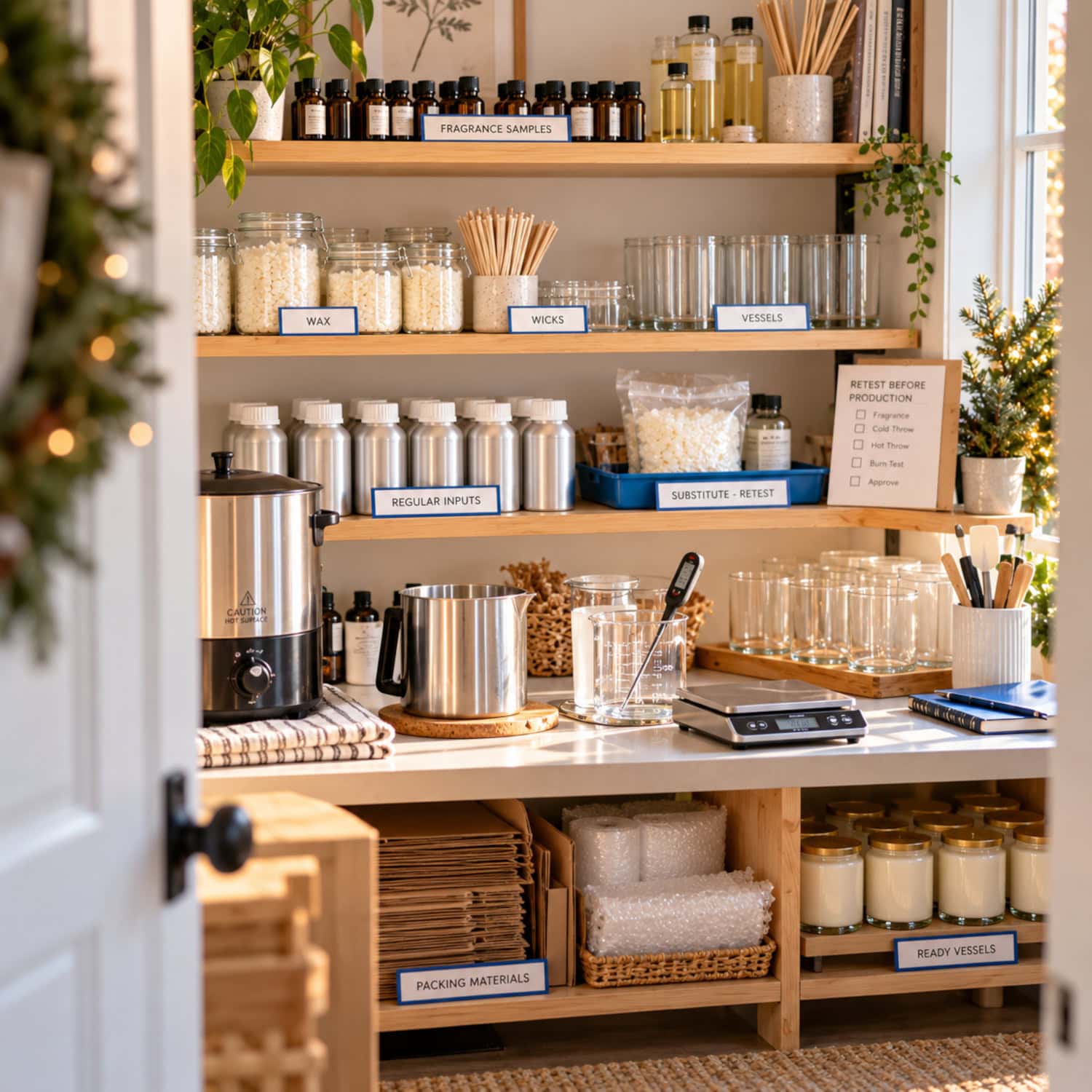
Core production equipment commonly includes a scale, thermometer, pouring setup or wax melter, and the vessels or molds used for the product.
Buy enough to test the process safely and consistently before buying for imagined volume.
Use this purchasing checklist for every important input:
- Buy sample quantities first when the supplier offers them.
- Calculate landed cost, including inbound shipping rather than comparing item price alone.
- Check minimum order quantities and whether larger tiers make sense only after demand exists.
- Check stock continuity and lead time for wax, wicks, fragrance, and vessels.
- Look for evidence of batch consistency and clear product documentation.
- Confirm that you can reorder the same vessel or an equivalent without casually changing the tested system.
- Keep at least one backup sourcing option for inputs that would stop production if unavailable.
The ugly scene is familiar: the jar that looked cheapest disappears from stock, a replacement arrives with different dimensions, and the entire wick and burn-testing question is open again.
Saving pennies on the original vessel can buy you another round of testing.
9. Candle business operations and records
Candle operations are a record-keeping problem disguised as a craft business.
You need enough batch, test, inventory, and sales information to know what was made, what sold, and what should be repeated.
Track each stock keeping unit, or SKU, by scent, vessel, and size when those differences create separate inventory.
Keep production records tied to the materials used, then track units made, units sold, channel, selling price, and customer problems.
The goal is not paperwork for its own sake. It is being able to trace a weak result back to a batch or input.
Inventory should follow the channel rather than a generic launch number.
A busy market may justify more finished stock than an online store with no existing audience.
A shelf can be full of slow fragrances while the two popular scents are sold out.
That is a useful signal to shift purchasing toward products customers are actually choosing.
Review sales by scent and channel before increasing production depth.
Replenishment speed matters as much as opening inventory because it determines how much cash must sit in finished candles.
10. Candle product line and pricing
A first candle line should be small enough to test, stock, photograph, list, and replenish without turning every scent into its own administrative department.
Community discussions often cluster around roughly 4 to 8 launch scents, but that range is a heuristic rather than a rule.
Start smaller if you cannot test and replenish the assortment reliably. Expand only when sales reveal a reason.
The desire to offer “a little something for everyone” usually creates more fragrance inventory, more labels, more finished stock, and more dead stock before it creates more customers.
Pricing should start with the full cost model in Section 6, then be checked against the channel.
A simple markup multiple can be a sanity check, but it cannot rescue a product whose required selling price does not fit the intended buyer or whose channel takes too much of the margin.
Build wholesale headroom before you offer wholesale.
If the direct-to-consumer price only works because every sale happens at full retail, a retailer asking for a large discount will expose the problem immediately.
11. Candle shipping and fulfillment
Shipping is part of candle product design because candles combine weight, breakable vessels, temperature sensitivity, and a relatively modest selling price.
Package dimensions, vessel choice, wax behavior, target geography, and selling price should be considered together.
Test the packed product, not just the candle on a workbench.
A summer shipment can spend hours in a hot vehicle, while a glass vessel can survive production perfectly and still fail in transit.
Sellers often reduce hot-weather exposure by shortening transit time and avoiding unnecessary weekend dwell, but the right approach depends on carrier service and destination.
Include shipping supplies and the labor required to pack orders in your economics.
If customers will not pay the actual shipping charge, you still pay it somewhere, either through a higher product price or a lower margin.
12. Candle wholesale and scaling
Wholesale only works when the candle still contributes enough after the retailer takes its margin.
Wholesale exposes weak pricing fast, because a product that looks healthy at full retail can become pointless when sold for roughly half that price.
Use the Section 6 example as a scenario. A $28 retail candle sold wholesale at $14 leaves only $2 after the same $12 variable cost.
That may be unacceptable once larger-order handling, packaging, and production pressure are considered.
The exact retailer margin is negotiable, but the math has to work before you say yes to the opportunity.
Before accepting a wholesale order, check:
- The wholesale price and your contribution per unit.
- The minimum order quantity that makes batching practical.
- Who pays shipping and what packaging the retailer expects.
- Whether your suppliers can support the larger batch.
- Whether you can make the order without delaying direct customers.
- Whether the retailer has a credible path to reorders rather than a one-time experiment.
Scale purchasing only after demand becomes repeatable.
Bulk pricing can improve unit cost, but large purchases can trap cash if the scent line changes or the channel fails.
13. Common candle business traps
Common candle business traps add complexity faster than they add evidence of demand or margin.
The table below shows where apparently productive choices create extra cost or hide a weak assumption.
| Myth | What actually happens |
|---|---|
| More scents make the brand look more complete | More scents also create more testing, labels, inventory, and replenishment work |
| A website creates online demand | A store still needs traffic, trust, scent communication, and repeat-purchase mechanisms |
| Materials are the cost of the candle | Freight, labor, packaging, fees, waste, and overhead can materially change the economics |
| Wholesale is just retail in bigger quantities | Wholesale changes the price structure and can expose weak margins |
| Friends liking the candles proves demand | Paying strangers provide a stronger validation signal |
Treat turnkey claims and dramatic revenue stories as anecdotes, not planning assumptions.
The useful question is whether your own tested product, price, channel, and workload can produce a repeatable sale.

14. Candle business launch plan
A good candle business launch plan limits irreversible spending until the product and channel earn more commitment.
Use this sequence so each step produces information needed by the next.
- Choose the business format and decide whether you are making candles in-house or sourcing finished products.
- Build a small test system and document the combinations you intend to sell.
- Define a reachable buyer and choose the smallest assortment that fits that buyer.
- Pick the first sales channel and estimate its fees, fulfillment burden, and sensory limitations.
- Build the unit-economics model and stress-test it at half your expected sales.
- Check business registration, sales tax, home-business rules, labeling, safety guidance, and insurance for your location and channel.
- Select suppliers based on landed cost, consistency, availability, and sample access.
- Produce launch inventory based on the channel rather than a generic candle count.
- Launch, capture customer reactions, and record sales by scent and channel.
- During the first 30 to 90 days, cut weak products, replenish proven ones, and fix packaging or pricing problems before adding more inventory.
- Add wholesale or deeper online investment only after the product, channel, and operations produce repeatable demand.
Use the first launch to learn what sells before increasing finished inventory.
FAQ
How much does it cost to start a candle business?
It depends on your production model, testing burden, inventory depth, equipment, and sales channel.
Build the budget from the categories in Section 6 instead of relying on a universal startup figure.
Is a candle business profitable?
It can be, but profitability depends on full unit cost, required selling price, channel fees, and sales volume.
Use the contribution model and half-sales stress test in Section 6.
How many scents should I launch with?
Roughly 4 to 8 is a common beginner heuristic, but the right number is the amount you can test, stock, and replenish reliably. See Section 10.
Should I start at local markets or online?
Either can work, but local markets reduce the scent barrier and produce fast customer feedback while online selling requires stronger discovery and scent communication.
See Section 5.
Do I need a limited liability company to sell candles?
It depends on whether a limited liability company (LLC) fits the legal structure you choose and your state’s rules.
An LLC does not replace sales tax, local permit, safety, or insurance decisions, so see Section 7.
Do I need liability insurance to sell candles?
It depends on the market, sales channel, and coverage requirements that apply to you.
Some markets may require proof of coverage, so decide insurance before selling and see Section 7.
Should I sell test candles at a discount?
No. Keep flawed or incomplete test candles out of customer inventory because the customer experiences the product, not your internal testing label.
See Section 3.
When should I buy candle supplies in bulk?
It depends on repeat demand and supplier reliability. Buy in bulk only when both justify the extra inventory, as explained in Section 12.
Conclusion
A durable candle business still comes back to the same rule: prove the candle and the economics before you invest heavily in branding or stock.
Then let real customers tell you which scents, channels, and production decisions deserve more capital.
1. Test before you sell. Document the exact candle system and retest meaningful material changes.
2. Price from full costs. Include the channel, labor, freight, packaging, and overhead before deciding what margin exists.
3. Scale evidence. Put more money into products and channels only after paying customers show repeatable demand.
Further reading
- U.S. Consumer Product Safety Commission: Start here for federal consumer-product safety information and candle-related safety guidance.
- U.S. Small Business Administration: General US guidance on business planning, registration, funding, and local assistance.
- Internal Revenue Service: Federal tax information for businesses, including employer identification and filing resources.
- Shopify candle business guide: A broad startup overview covering product, market, channels, safety, and e-commerce.
- CandleScience candle business blueprint: Candle-specific startup guidance with emphasis on product development and selling.
- Craft Server testing discussion: Practitioner discussion about candle testing and how material changes affect the process.
- Soap Making Forum pricing discussion: Community discussion about pricing, costs, labor, and margin decisions.
- Printify candle business guide: An alternative view of starting a candle brand through DIY production or print-on-demand.