To start a photo booth business, validate local demand, choose one customer segment, define a clear package, model the full economics, set up the business and insurance, and only then buy the minimum reliable equipment needed to deliver it.
The main beginner mistake is buying the booth before proving local demand. A lean to standard first setup can land around $2,000 to $5,500 based on the launch models available in the market, while premium formats can run much higher.
Licensing and local business requirements vary by location, and venues may require proof of liability insurance.
Long-term success depends less on owning impressive hardware than on getting profitable bookings and delivering them without technical chaos.
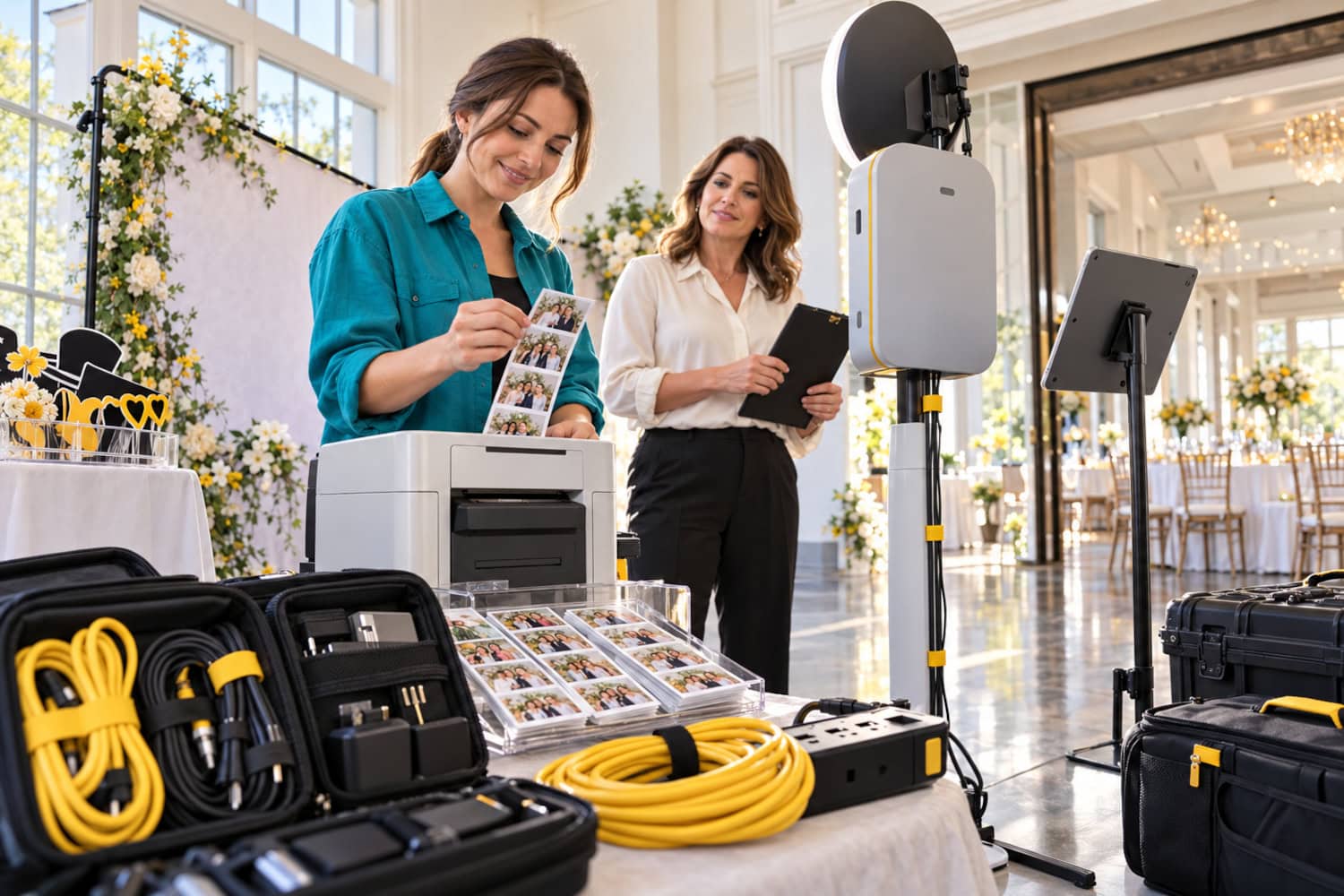
Last fact-checked: October 5, 2026
This guide is for US beginners starting a local photo booth rental business for weddings, parties, schools, and corporate events. It covers formats, demand validation, startup economics, business setup, contracts, equipment, pricing, event operations, customer acquisition, and scaling.
1. How a photo booth business works
A photo booth business sells a packaged event experience rather than a piece of equipment.
You combine a booth format, software, optional printing, setup and teardown, event support, and a reliable booking process into a service that clients can compare and buy.
The launch sequence should follow the actual dependencies of the business.
At this stage, delay the hardware purchase until the earlier decisions are settled.
| Stage | Decision | Move forward when |
|---|---|---|
| 2. Choose a format | Decide what experience you want to sell | You can explain the offer and its operational trade-offs |
| 3. Validate demand | Check whether local buyers will pay for that offer | You see a plausible segment, price range, and competitive opening |
| 4. Choose sales channels | Decide where bookings will come from | You have at least one measurable acquisition path |
| 5. Model economics | Calculate startup cost and contribution per booking | The numbers still work under a conservative scenario |
| 6. Set up the business | Handle registration, licenses, insurance, and tax basics | You can contract and operate under the required local rules |
| 7. Prepare contracts | Define payment, access, cancellation, damage, and delivery terms | Clients and venues can see exactly what each side must provide |
| 8. Buy and test equipment | Build the minimum reliable setup | The complete workflow works repeatedly before a paid event |
| 9. Standardize operations | Plan load-in, support, backups, and teardown | A predictable checklist replaces improvisation |
| 10. Set services and pricing | Build packages that cover the real work | Price covers labor, travel, consumables, marketing, and replacement risk |
| 11. Review weak offers | Fix, reposition, or stop spending | You know whether the problem is demand, price, acquisition, or delivery |
| 12. Scale | Add equipment or staff only when capacity is tight | Lost bookings or calendar pressure justify more capacity |
| 13. Avoid common traps | Reject shortcuts that weaken the model | Growth is based on bookings and reliable delivery rather than hype |
| 14. Launch | Move from validation to repeatable paid events | The whole system is ready, not just the booth |


2. Photo booth business formats
The best first format depends on what your local customers value and what you can transport, support, and troubleshoot reliably.
iPad, DSLR or mirrorless, 360, mirror, print, and digital-only setups create different products even when every seller calls them a photo booth.
| Format | What it sells | Main advantage | Main trade-off | Best fit |
|---|---|---|---|---|
| iPad digital booth | Fast capture and sharing | Simple and portable | Can face heavy price competition | Lean social-event entry |
| DSLR or mirrorless booth | Higher photo quality and a more premium presentation | Stronger quality positioning | More components and technical complexity | Weddings and premium social events |
| Print booth | Physical photo strips plus digital output | Guests leave with a tangible keepsake | Printer, media, and print workflow add failure points | Weddings and events where prints matter |
| 360 booth | Short video experience | Distinctive entertainment format | Crowded low-barrier market in many areas | Parties and activation-style events |
| Mirror booth | Large visual centerpiece | Premium visual presence | Higher transport and setup burden | Luxury and formal events |
| Digital-only drop-off | Self-service capture without printing | Lower labor and simpler logistics | Reliability and remote support matter more | Simple unattended rentals |
Our editorial view is to start with one format you can explain, transport, and support without heroics.
Keep the first catalog narrow enough to deliver reliably.

3. Demand validation for a photo booth business
The main beginner mistake is buying the booth before proving local demand. The booth is the easy part because bookings are the business.
Start by looking at your actual local market. Compare operators serving weddings, birthdays, schools, corporate events, and brand activations.
Record visible package structures, whether prints are included, whether an attendant is standard, and how competitors differentiate beyond price.
Then choose one primary buyer. A wedding client may care about prints, aesthetics, backdrop choices, and an attendant.
A corporate buyer may care more about branded overlays, sharing, reliability, and smooth coordination with a venue or planner.
Trying to sell both with one vague package usually produces a generic offer that gets compared on price.
A useful validation test is whether you can answer three practical questions before spending heavily:
- Who is most likely to book this format in your market?
- What would make that buyer choose you over a cheaper booth?
- Which local channel can put your offer in front of that buyer repeatedly?
Do a small proof event if you need portfolio material, but make it earn something useful.
A free event without reviews, content, or introductions is just unpaid labor.
4. Sales channels for a photo booth business
A photo booth business usually wins its first stable bookings through local visibility and relationships rather than passive social posting.
Common channels include a Google Business Profile, reviews, venue relationships, wedding and event planners, referrals, targeted Meta advertising, networking, and selected free or sponsored events.
Treat every channel as a test. Track inquiries, booked events, acquisition cost, and which customer type each channel attracts.
Facebook Marketplace may generate attention, but community discussions often associate it with stronger price pressure.
That can be useful for testing demand, but it is a weak foundation if your goal is premium positioning.
Venue walkthroughs can do two jobs at once.
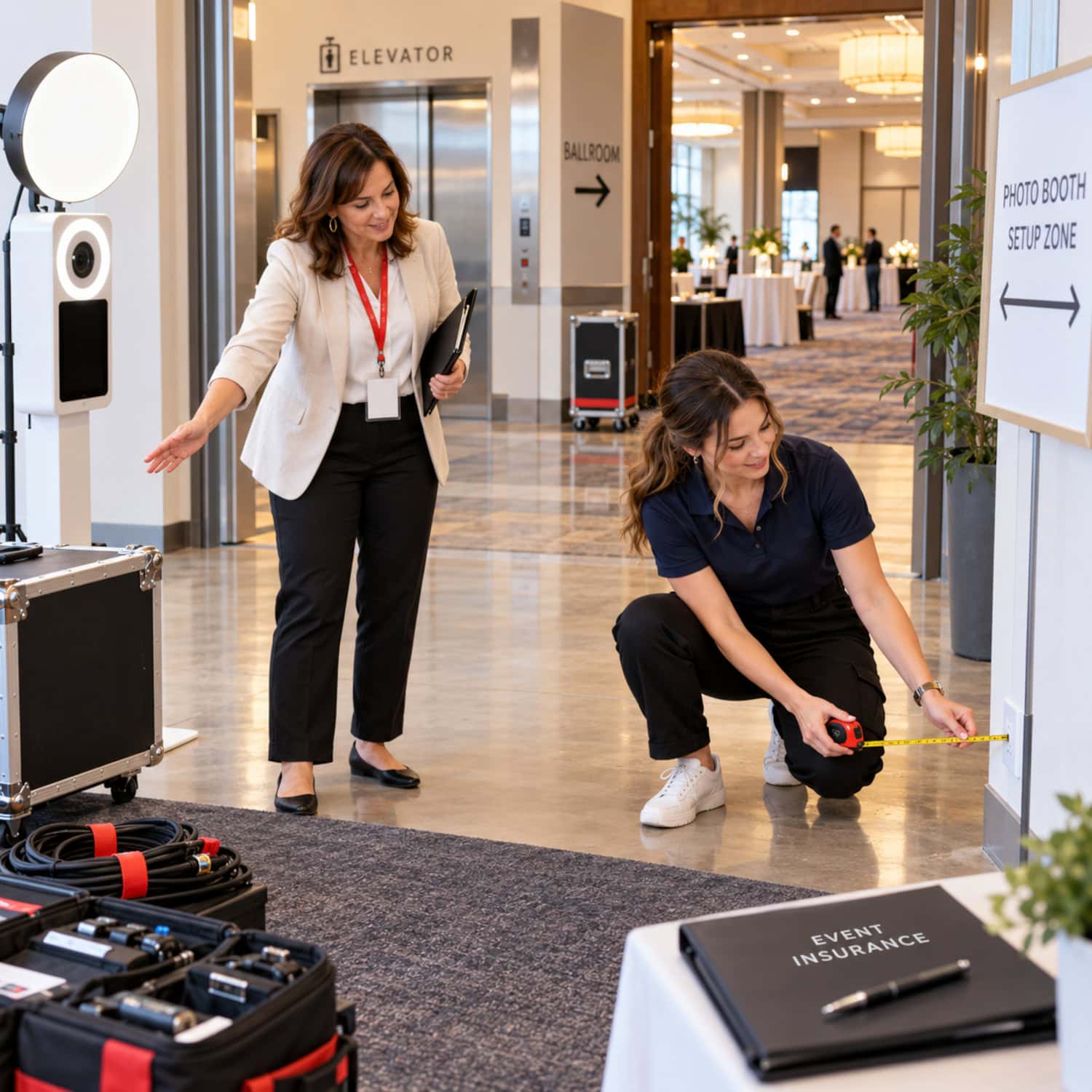
You confirm parking, load-in, stairs, elevators, power, booth placement, and setup access while meeting the coordinator who may refer future clients.
A venue manager who sees you arrive prepared is more valuable than another week of posting stock photos to Instagram.
Reviews matter because they reduce uncertainty for the next buyer.
After each successful event, ask for a review, permission to use appropriate event images where your agreement allows it, and an introduction when the planner or venue relationship went well.


5. Startup costs and unit economics for a photo booth business
A lean to standard first setup can be built around roughly $2,000 to $5,500, while premium booth formats can push startup spending toward $25,000.
Those figures describe broad market launch models, not a guaranteed budget for every operator.
Your real startup cost is wider than the booth shell.
Include the camera or tablet, software, lighting, printer if used, print media, backdrop, props, cases, cables, backup components, insurance, website or booking tools, initial marketing, and transport needs.
Do not use someone else’s event price as your business model. Calculate contribution per booking instead.
Contribution per booking = package price minus event-specific costs minus booking acquisition cost
Then estimate payback:
Break-even bookings = total startup cost / contribution per booking
The following example uses illustrative numbers, not a benchmark.
| Item | Illustrative amount |
|---|---|
| Total startup cost | $5,000 |
| Package price | $700 |
| Event-specific labor, travel, and consumables | $150 |
| Acquisition cost allocated to the booking | $100 |
| Contribution per booking | $450 |
| Break-even bookings | 12 bookings |
The math is $5,000 divided by $450, which is 11.1, so you need 12 full-contribution bookings to recover the illustrative startup cost.
Now stress-test the plan.
If you book half as many events as expected, the contribution per event may stay similar, but the calendar time needed to recover the initial investment doubles.
If weak demand also forces lower pricing or more advertising, payback stretches further.
Reported income and margin claims vary too widely across markets, formats, and maturity levels to support one honest average.
Model your own local price, booking volume, labor, travel, consumables, marketing, maintenance, and equipment replacement instead.


6. Business setup and insurance for a photo booth business
A US photo booth operator should handle basic business registration, tax setup, local licensing, and insurance before taking on venues that expect formal paperwork.
Requirements vary by state and city, so check with your state business and revenue agencies and your local licensing office.
An LLC is one possible business structure, not a universal requirement for starting a photo booth business.
An Employer Identification Number, or EIN, is a federal tax identifier that may be useful or required depending on how the business is structured and operated.
Liability insurance is a practical gate for many event businesses because venues may ask for a certificate of insurance, commonly called a COI, before load-in.
Equipment coverage can also matter because the booth travels, sits in public event spaces, and may spend time in a vehicle between jobs.
Ask the insurer specifically how attended and unattended rentals are treated.
A drop-off model creates a different risk profile because the client is using equipment without your operator standing beside it.
Photo booth work also touches media and event rules.
If you use copyrighted music, client logos, third-party graphics, or guest images in marketing, confirm that your contract and release process cover the rights you actually need.
Local requirements can change, so use a qualified attorney, CPA, or licensed insurance professional when the decision has legal, tax, or coverage consequences.
7. Client and venue contracts for a photo booth business
A photo booth contract should make the operational promises visible before the event.
The agreement is where the package stops being a sales page and becomes a set of responsibilities.
At minimum, address the service window, payment and deposit terms, cancellation or rescheduling, and travel charges.
Also cover overtime, damage, setup access, power and space requirements, service inclusions, and what happens when venue access or connectivity fails.
Before signing, ask the venue or client:
- What time can you enter for load-in, and is that different from the event start time?
- Where can you park or unload, and are there stairs, elevators, loading docks, or long carries?
- What power and floor space are available at the booth location?
- Does the venue require a COI or specific insurance wording?
- Is reliable Wi-Fi available, and does the network restrict guest devices or sharing tools?
- Who has authority on site if the planned booth location becomes unavailable?
That last question matters more than it sounds.
Corporate venues can have congested Wi-Fi or firewall restrictions, so a sharing feature that worked perfectly at home may fail when hundreds of guests arrive.
8. Equipment and software for a photo booth business
Choose equipment as a complete operating stack, not as separate attractive components.
Camera or tablet compatibility, software stability, printing, lighting, power, cables, cases, sharing, and supplier support all affect whether the booth can survive a paid event.
Supplier support has real economic value.
Cheap hardware is less cheap when a proprietary component fails and nobody can tell you what replacement fits before Friday’s wedding.
For software, prioritize compatibility and reliability before feature count.
Confirm that it supports your camera or tablet, printer workflow, template needs, sharing method, and offline fallback.
QR, SMS, email, GIF, video, galleries, and cloud tools are useful only after the core capture workflow is dependable.
Before the first paid event, run this pre-purchase and pre-launch checklist:
- Confirm the camera or tablet works with the chosen software.
- Test the complete capture-to-delivery workflow repeatedly.
- If you print, test the printer, media, ribbon, cut format, and connection method under event-like volume.
- Test lighting in both bright and dim rooms.
- Verify every cable, adapter, power strip, charger, and extension lead you plan to carry.
- Pack spare cables and the small components most likely to stop the workflow.
- Test internet-dependent sharing and an offline fallback.
- Confirm the booth is physically stable and safe around guests.
- Time the real setup and teardown, including cases and backdrop.
- Load the entire kit into the vehicle you will actually use.
- Confirm the software license works on the event device without a last-minute login surprise.
- Write a failure plan for the camera, printer, software, power, and internet.
Cheap gear becomes expensive the first time it fails in front of a client.
A new operator can survive two small tests and still discover at a large event that the ribbon errors, the venue access window was misunderstood, or the preferred software suddenly needs replacing.
9. Photo booth event operations
A photo booth business is operational work wrapped in a fun product.
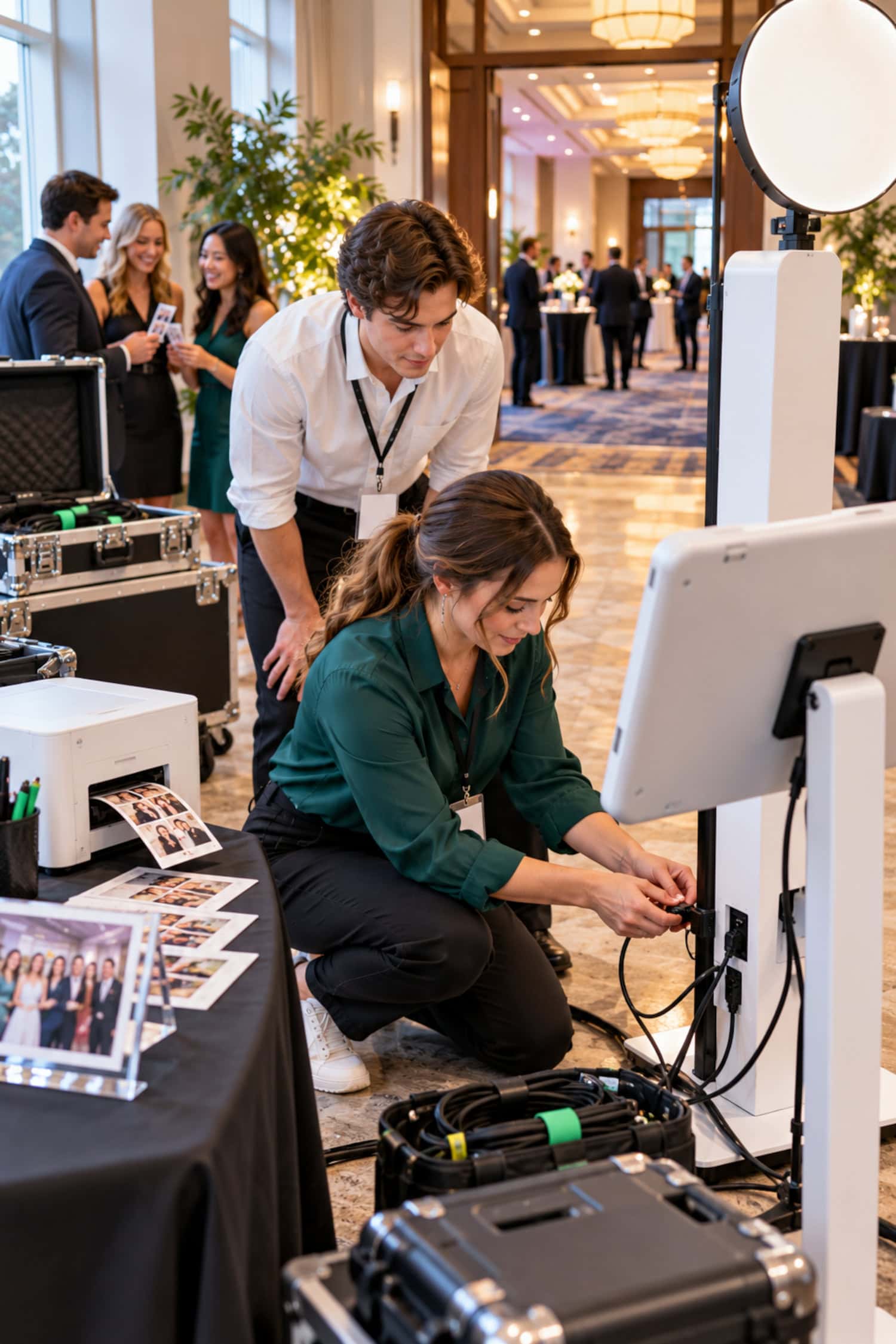
Every event adds travel, parking, load-in, setup, troubleshooting, guest support, teardown, file handling, and post-event follow-up.
Arrive early enough for the venue, not just for your normal setup time.
A ten-minute assembly can still become an hour-long problem if parking is remote, the elevator is shared with caterers, or the ballroom is on the other side of a convention center.
Build backups around single points of failure.
You do not need two copies of every expensive item, but you do need a credible fallback for power, cables, the capture device, software access, printing, and sharing.
If an unattended booth is part of the model, remote troubleshooting instructions and a client contact procedure become part of the product.
Corporate work raises the execution bar.
Branded overlays, custom sharing, lead capture, venue networking, and tighter reliability expectations can justify higher-value work, but they also create more ways to fail publicly.
Social events are often the cleaner training ground before you promise a complex brand activation.
10. Photo booth services and pricing
Photo booth pricing should be built around the delivered package and its true cost, not around the cheapest competitor’s headline number.
Clients compare duration, attendant service, prints, digital sharing, backdrop, templates, gallery access, travel, setup, and booth type.
Keep packages easy to compare.
A simple structure might separate a digital package, a print package, and a premium package with higher-end capture or customization.
The exact lineup should follow your market rather than a generic menu copied from another city.
Price has to cover more than event time.
Include setup and teardown labor, travel, print media, software, equipment wear, marketing, insurance, admin, and the cost of replacing damaged or obsolete gear.
If adding unlimited prints materially increases consumables or staffing, account for that instead of treating the word “unlimited” as free decoration.
Avoid racing to the bottom just to create activity.
Low pricing can attract a segment that keeps comparing you with the next cheaper operator, which makes later repositioning harder.
11. Fixing a weak photo booth offer
A weak photo booth offer should be diagnosed before you spend more on equipment.
Separate four problems: not enough local demand, poor positioning, weak acquisition, and unreliable delivery.
If inquiries are scarce, test the channel and message before assuming the booth format is wrong.
If inquiries arrive but few people book, review the package, price clarity, proof, and response process.
If events book but margins disappear, revisit travel, labor, consumables, acquisition cost, and replacement allowance.
Do not solve a marketing problem by buying another booth.
If the offer is unclear or the acquisition channel is weak, additional equipment will not fix it.
12. Scaling a photo booth business
Scale after the first setup has a repeatable booking and delivery system.
The clearest triggers are lost bookings on dates you are already committed, consistent calendar pressure, or a format that clients repeatedly request and your current booth cannot deliver.
A second unit creates more than extra revenue capacity.
It also creates scheduling conflicts, duplicate backup needs, more storage, more transport, more software or printer management, and eventually staff training.
Before adding equipment, document the event process so another attendant can follow it.
Standardize packing, setup, client handoff, troubleshooting, teardown, file delivery, review requests, and post-event follow-up.
A second booth does nothing for a calendar that is still mostly empty.
13. Photo booth business traps and myths
Photo booth businesses attract optimistic shortcuts because the product looks simple from the guest side.
The expensive lessons usually appear behind the curtain.
| Myth | What actually happens |
|---|---|
| Buy the booth and bookings will follow | Customer acquisition usually requires local search visibility, reviews, planners, venues, referrals, advertising, or networking |
| The cheapest setup is the safest way to start | Low purchase price can be offset by poor support, weak reliability, and replacement trouble |
| Digital-only means almost no operations | Drop-off reduces labor at the event but raises the importance of remote support and a stable unattended workflow |
| A 360 booth is automatically a strong opportunity | Low barriers to entry can produce heavy local competition and price pressure |
| More software features mean a better system | Compatibility, stability, printing, sharing, and support matter more than a long feature list |
| Free events are always good marketing | They are useful when they produce portfolio material, reviews, introductions, or referrals |
| A turnkey booth package solves the startup problem | A hardware bundle still leaves demand validation, positioning, pricing, acquisition, insurance, contracts, and operations to the owner |
| Revenue tells you whether the business is healthy | Profit depends on acquisition, labor, travel, consumables, maintenance, insurance, and replacement costs |
14. Photo booth business launch plan
A practical launch plan keeps spending tied to evidence.
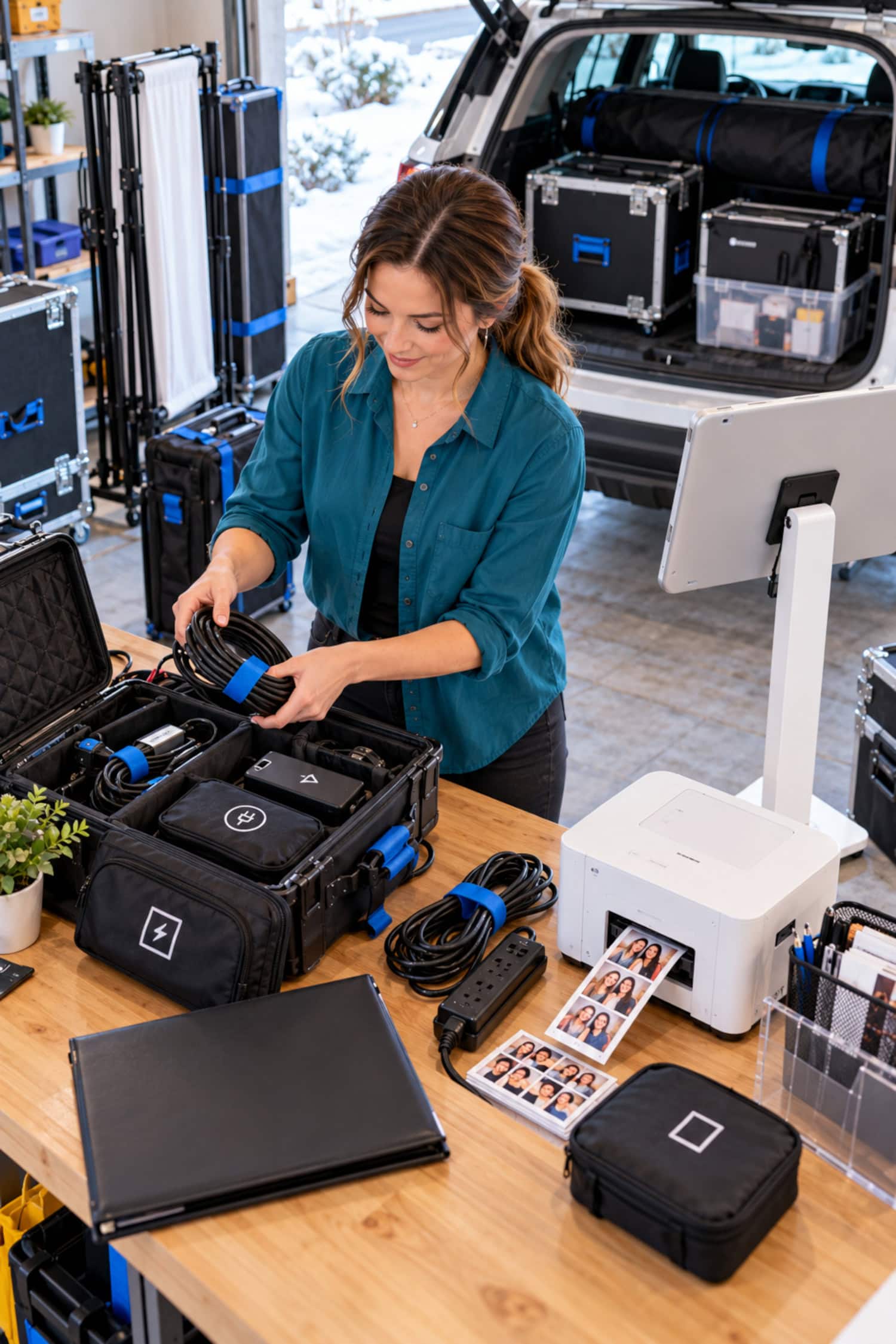
The goal is to reach the first paid events with the smallest reliable system that can deliver the promised experience.
- Pick one primary customer segment and one booth format.
- Map local competitors, visible package structures, and obvious price pressure.
- Define what makes your package different from a cheaper alternative.
- Choose one or two acquisition channels you can measure.
- Build a complete startup-cost model, not just an equipment budget.
- Calculate contribution per booking and a conservative break-even target.
- Complete business registration, tax setup, local licensing checks, and insurance conversations.
- Prepare the client agreement and venue questions before accepting serious bookings.
- Buy or assemble the minimum equipment needed for the chosen offer.
- Test capture, printing if used, sharing, power, cables, software, setup, transport, and backups as one system.
- Run a proof event that can produce useful portfolio material, reviews, or introductions.
- Publish clear packages and a simple booking path.
- Start selling through the chosen channels and track inquiries through booked events.
- After each event, record failures, delays, client questions, and costs while they are still fresh.
- Reinvest only when bookings or operational evidence justify the next upgrade.
FAQ
How much does it cost to start a photo booth business?
About $2,000 to $5,500 can cover a lean to standard first setup, while premium formats can cost much more.
See Section 5 for what belongs in the full budget.
Do I need an LLC for a photo booth business?
No, an LLC is one possible structure rather than a universal requirement.
See Section 6 for the business setup and local checks to handle before operating.
Do I need insurance for a photo booth business?
Often, yes, especially when venues require a certificate of insurance.
See Section 6 for liability, equipment, and unattended-operation considerations.
Should I start with an iPad booth or a DSLR booth?
It depends on the experience you want to sell and the complexity you can support.
See Section 2 for the main trade-offs between simple digital setups and higher-quality camera systems.
Are prints worth offering?
Yes, when your target clients value a physical takeaway enough to support the added printer, media, and workflow.
See Sections 2 and 8 for the operational trade-off.
How do I get my first photo booth bookings?
Start with a measurable local channel such as venue relationships, planners, Google visibility, referrals, or targeted advertising.
See Section 4 for how to turn early events into reviews and repeatable acquisition.
Is a photo booth business profitable?
It can be, but there is no dependable universal margin or income figure.
See Section 5 and model your own contribution per booking, acquisition cost, labor, travel, and replacement needs.
Can I run a photo booth business with a full-time job?
Yes, if your event schedule, transport, setup, support, and administrative work fit around that job.
See Section 9 for the workload that exists outside the event itself.
Conclusion
The main beginner mistake is buying the booth before proving local demand.
Build the business in the same order the risk appears: market, offer, economics, setup, reliable delivery, and only then scale.
1. Prove demand before committing heavily to equipment.
2. Price the full job, including acquisition, labor, travel, consumables, and replacement risk.
3. Treat reliability and repeatable bookings as the two gates that justify expansion.
Further reading
- U.S. Small Business Administration: Federal starting point for business planning, registration guidance, funding resources, and local assistance.
- Internal Revenue Service: Official federal information on EINs, business taxes, and tax responsibilities.
- PhotoBoothTalk getting started guide: Practical industry material on photography fundamentals, booth setup, and event workflow.
- PhotoBoothTalk startup guide: Industry overview of business planning, marketing, positioning, and sales skills.
- Photo Booth Training startup guide: Practical discussion of equipment, software testing, and operating reliability.
- Snappic photo booth business guide: A commercial guide comparing booth formats, startup costs, software, and customer segments.
- BoothLedger photo booth business guide: A commercial guide focused on startup economics, profitability models, business planning, and launch steps.
- Reddit discussion on starting a photo booth business: Community discussion covering equipment, planners, marketing, reviews, and early events.
- Reddit discussion on photo booth insurance: Operator discussion of insurance questions around attended and unattended booths.