To start a beverage company, define the customer and use case, test whether people will pay, and turn the winning concept into a production-ready formula.
Then choose the processing method and package together, model the full channel economics, and run a controlled commercial pilot with a compatible manufacturer.
Our editorial recommendation is to require paid demand evidence before you commit to a large first run.
There is no useful universal startup-cost figure because formula work, processing, packaging, and minimum order quantity can change the cash requirement dramatically.
Testing, freight, storage, and sales channels add another layer. Food labeling and production rules must be checked before launch, and alcoholic beverages add a separate federal and state licensing layer.
Long-term success depends on repeat customer buying, retailer reorders, and enough cash to fund the next production cycle.

Last fact-checked: October 7, 2026
This guide is for US first-time founders building a packaged beverage brand, especially nonalcoholic products using a contract manufacturer. It covers validation, formulation, processing, packaging, manufacturing, unit economics, compliance, first-channel sales, distribution, and scaling. Alcohol is covered only where its compliance path materially differs.
1. How a beverage company works and the launch sequence
A beverage company turns a consumer proposition into a repeatable product, a manufacturable specification, and a sales system that can fund the next run.
The hard part is not inventing a flavor. It is keeping product, process, and package synchronized.
Manufacturing, cash, and demand must move with them as each commitment becomes harder to reverse.
A co-packer is a contract manufacturer that produces the beverage for the brand.
Sell-through means product moving from a retail or channel account to the end customer.
| Stage | Decision | Move forward when |
|---|---|---|
| 1. Business model | Decide what kind of beverage company you are building | The target customer, use case, and basic product format are clear |
| 2. Beverage format | Choose refrigerated, shelf-stable, carbonated, still, or another architecture | The format fits the intended channel and practical distribution footprint |
| 3. Demand | Test whether the product solves a real buying problem | People show paid interest, repeat interest, or credible account demand |
| 4. Sales channel | Choose the first route to customers | The channel fits the product, geography, founder selling capacity, and margin structure |
| 5. Economics | Cost the whole path from production to sale | Unit economics remain viable after manufacturing, freight, channel deductions, promotions, and likely returns |
| 6. Compliance | Set up the company and identify product, facility, label, and insurance requirements | The legal party can sign contracts and the compliance path is defined |
| 7. Contracts | Protect formula ownership and define supplier, manufacturer, and distributor obligations | Ownership, minimums, lead times, quality terms, payment terms, and exit rights are in writing |
| 8. Production system | Match formula, process, package, suppliers, and co-packer | The manufacturer confirms capability, package fit, run size, timing, and quality requirements |
| 9. Pilot operations | Run and evaluate commercial product | The finished beverage meets the approved specification and can be stored, shipped, sold, and reordered |
| 10. Product and price | Keep the launch assortment and price commercially workable | Each stock keeping unit has a purpose and survives the channel economics |
| 11. Go or no-go | Decide whether to revise, pause, or continue | Product performance, sell-through, and cash needs remain within an acceptable range |
| 12. Scale | Add accounts, geography, or stock keeping units | Reorders, production, supply, and unit economics are repeatable |
| 13. Trap check | Test common assumptions before they become contracts or inventory | The plan does not rely on a distributor, bundled-service vendor, or oversized run to solve weak demand |
| 14. Launch plan | Convert the decisions into an operating sequence | Each dependency is resolved before the next irreversible commitment |
A founder who jumps between these stages creates loops.
The package gets designed before the filling line is known, the formula changes after label work, or a manufacturer quote looks attractive until freight and channel costs appear.
Sequence mistakes usually create extra formulation, packaging, freight, or production work.
2. Choose the beverage format before locking the formula or package
The beverage format determines much of the technical and commercial path, including processing, packaging, storage, and freight.
Shelf-life expectations and manufacturer fit follow from those choices.
A refrigerated local drink and an ambient carbonated can may both be beverages, but they are different operating systems.
| Format | Main operating consequence | Best fit for a first launch |
|---|---|---|
| Refrigerated beverage | Cold storage and cold-chain distribution shape geography and channel choice | Founders who can sell locally and service a tighter footprint |
| Shelf-stable still beverage | Processing, formula stability, and package compatibility must work together | Brands that need a wider distribution radius without refrigeration |
| Carbonated packaged beverage | Carbonation level, filling equipment, container format, and process compatibility narrow the manufacturer pool | Founders who already know their intended package and production method |
| Alcoholic beverage | Product development is joined by federal and state alcohol licensing and distribution rules | Teams prepared for a separate regulatory and channel structure |
This guide focuses on packaged nonalcoholic beverages made through a co-packer.
The same decision logic still applies to self-manufacturing, but self-production adds facility, equipment, staffing, food-safety, and maintenance responsibilities.
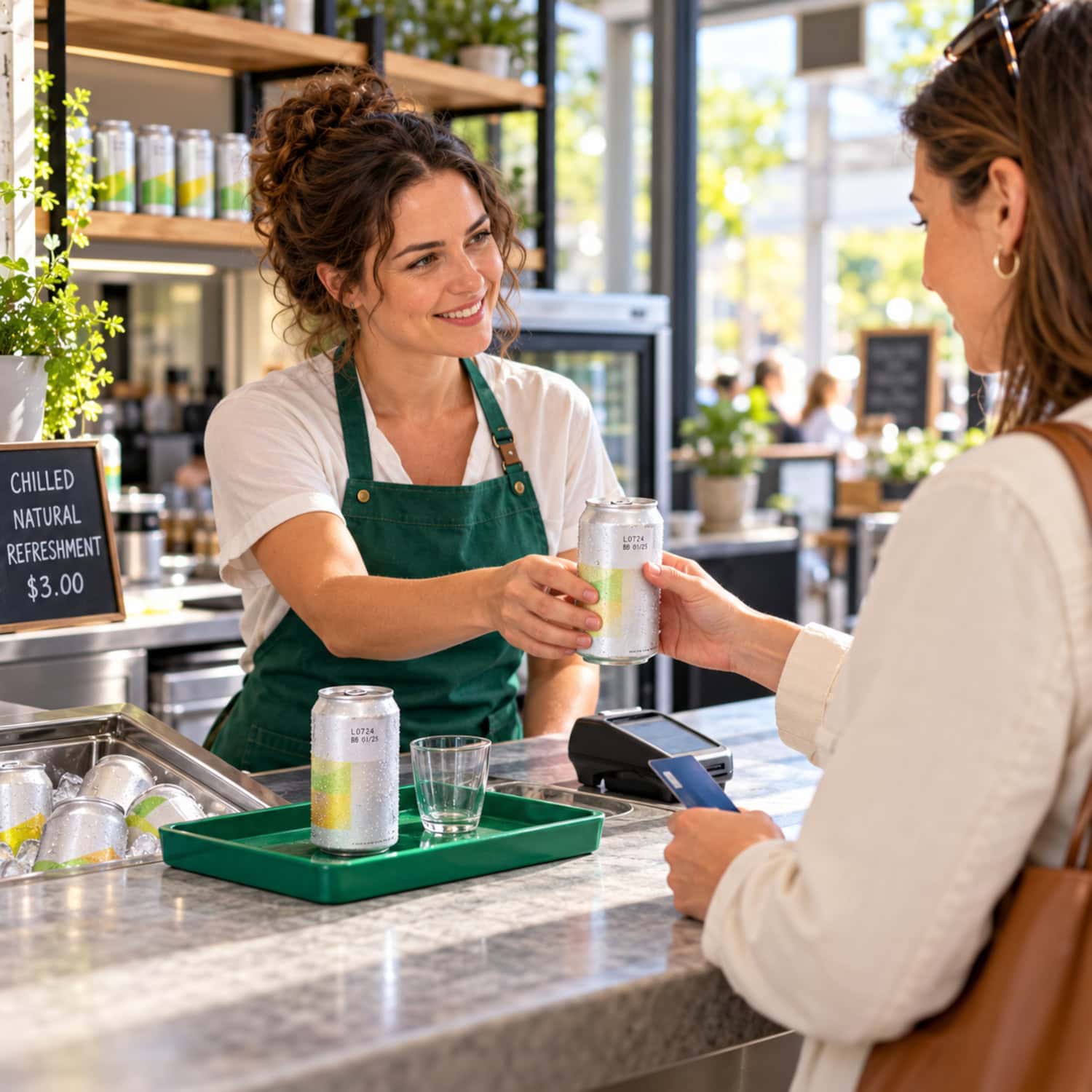
Do not treat packaging as the final cosmetic layer.
A sleek can, glass bottle, or polyethylene terephthalate bottle, usually called PET, can determine which filling lines are available and which processing methods are practical.
The founder who pays for finished artwork before confirming line compatibility may end up redesigning the package after learning that the selected line does not run that format.
3. Validate demand before expensive commercialization
For a beverage company, validation belongs before expensive commercialization. The useful question is not whether people say the drink tastes good.
It is whether a specific customer will pay the intended price, come back, or create a credible order signal strong enough to justify the next commitment.
Free sampling is useful for product feedback, but free product creates weak commercial evidence.
People are generous with compliments when the cost is zero.
Stronger signals include paid trials, repeat purchase, retailer reorders, sustained local sell-through, and customers buying without extreme discounting.
| Signal | What it tells you | Main limitation |
|---|---|---|
| Positive tasting feedback | Flavor and concept may have appeal | It does not prove willingness to pay |
| Paid trial | Someone will exchange money for the product | One purchase does not prove repeat demand |
| Repeat purchase | The product may be solving a recurring need or preference | Small samples can still be misleading |
| Retailer reorder | Product is moving well enough for the account to restock | One account does not prove a wider market |
| Stable local sell-through | The product may have repeatable demand in a defined channel | Geography and channel can change the result |
Before formal formulation work, define the target customer, use occasion, expected package, target selling environment, and the claims or attributes that are actually part of the proposition.
A product requirement document can be simple, but it should prevent the project from becoming “make it taste good and figure out the rest later.”
A common scene is the founder with a kitchen recipe that friends love.
The first commercial conversation suddenly includes shelf life, ingredient specifications, process conditions, package compatibility, and transferability between manufacturers.
The recipe did not become bad. It simply stopped being enough.
4. Pick the first sales channel and launch geography
A beverage company’s first sales channel should maximize learning while keeping freight, storage, selling effort, and channel deductions under control.
Local direct sales, independent retail, foodservice, direct-to-consumer sales, and distributor-led retail all create different economics and different evidence.
Direct-to-consumer, usually shortened to DTC, can give the brand direct customer feedback and control over the transaction.
Heavy liquid, however, can make shipping economics painful.
Independent retail can create real shelf-level evidence and retailer reorders, but the founder usually has to sell the accounts and support the product.
Foodservice can fit beverages tied to a meal, cafe, gym, workplace, or hospitality use occasion.
The channel can also simplify consumer trial because the beverage appears where the intended customer is already buying something else.
Distribution becomes more useful after the brand has account density or demonstrated pull.
A distributor can move cases through a network, but it does not replace founder-led demand creation.
One ugly version of the problem is a founder celebrating new doors while cases sit on shelves.
Shelf placement still has to turn into sell-through and reorder.
Choose geography with freight and serviceability in mind.
A technically capable co-packer several states away can still be a poor economic fit if packaging must travel in, finished cases must travel out, or refrigerated freight limits where the product can go.
5. Startup costs and unit economics for a beverage company
Startup cost is best built from quotes and cash timing, not from a generic total.
A beverage launch can require cash for product work, packaging, production, logistics, and selling before customer money returns to the business.
Minimum order quantity (MOQ) is the smallest run or purchase quantity a supplier or manufacturer will accept.
The conflict is obvious: the founder wants the smallest reversible test, while the manufacturer wants a run that makes setup, labor, and line time economical.
A lower unit cost on a larger run can still be the worse decision if the extra inventory sits in storage or expires before it sells.
Your cost model should separate cost of goods sold (COGS), meaning the direct cost to produce the beverage, from the other costs required to get it sold.
Freight, distributor or broker deductions, and trade promotions can sit outside a factory quote.
Discounts, returns, warehousing, and sampling can consume more margin.
Contribution is the money left from net revenue after variable selling costs and before fixed overhead. Use one operating formula consistently:
Contribution before fixed overhead = units sold x (net revenue per unit minus variable cost per unit)
The variable cost per unit should include every cost that rises with selling another unit, not just the liquid and container.
| Illustrative numbers | Amount |
|---|---|
| Units sold | 2,000 |
| Net revenue received per unit | $3.00 |
| Manufacturing COGS per unit | $1.10 |
| Freight per unit | $0.25 |
| Distributor or broker deductions per unit | $0.35 |
| Promotions, discounts, and returns per unit | $0.20 |
| Contribution per unit | $1.10 |
| Contribution before fixed overhead | $2,200 |
| Fixed monthly overhead | $1,800 |
| Operating remainder | $400 |
These are illustrative numbers, not a benchmark.
If sales fall to half the estimate, the same example produces $1,100 of contribution before fixed overhead.
With $1,800 of fixed overhead, the operating remainder becomes negative $700.
That stress test is more useful than a heroic forecast because beverage cash problems often appear between runs.
You may need to pay for ingredients, packaging, deposits, freight, and storage before the previous production cycle has fully turned into cash.
A cheap first run that cannot be reordered is expensive in disguise.
Plan funding around the next production decision, not just the first invoice.
The relevant question is how much cash remains after the pilot, how long inventory lasts, and whether the business can finance a reorder without forcing expansion simply to clear stock.
6. Beverage company compliance and business setup
A beverage company needs ordinary business setup plus product-specific compliance, and the exact obligations depend on the product, process, facility, and claims.
Sales channel and jurisdiction add another layer.
Lock the compliance path before final labels and commercial production, because late changes can affect both packaging and manufacturing.
| Product or situation | Key compliance check | Where to check |
|---|---|---|
| Packaged food or beverage | Food-facility obligations, food-safety requirements, labeling, ingredient statements, Nutrition Facts, and claims | U.S. Food and Drug Administration and the responsible state or local food authority |
| Self-manufacturing facility | Zoning, local health approvals, fire requirements, and facility permits | Local zoning, health, fire, and business licensing agencies |
| Specialized processing | Process validation and any category-specific safety review | Appropriate regulator plus qualified process or food-safety professionals |
| Products with meat or poultry ingredients | Whether U.S. Department of Agriculture inspection rules apply | U.S. Department of Agriculture |
| Alcoholic beverage | Federal alcohol permits plus state licensing and distribution rules | Alcohol and Tobacco Tax and Trade Bureau and the state alcohol regulator |
| Direct retail or wholesale sales | Sales-tax, resale, and local business requirements | State revenue department and local licensing agencies |
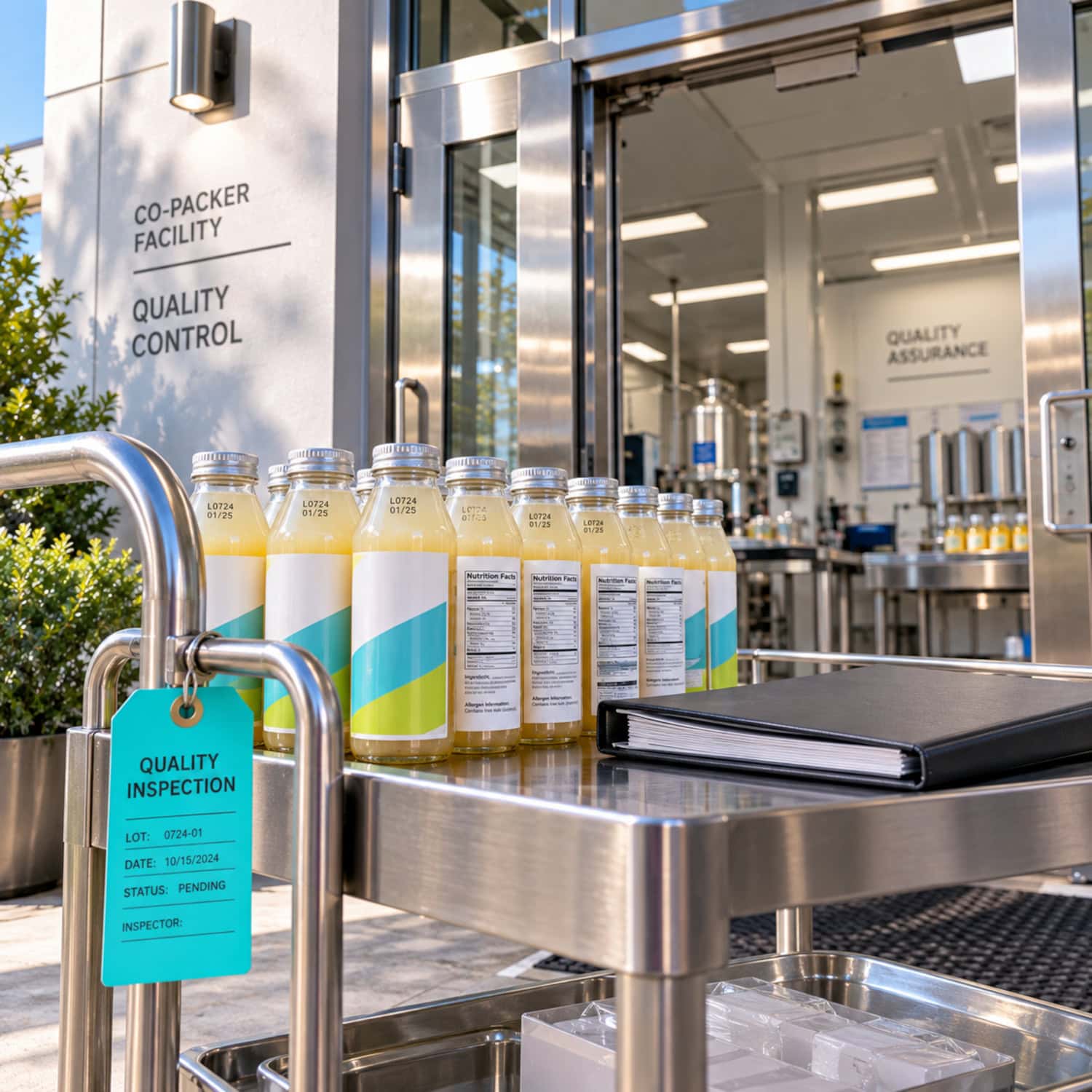
A co-packer’s compliance program does not eliminate the brand owner’s responsibility to understand what appears on the label and what claims are being made.
Confirm who prepares the Nutrition Facts panel, ingredient statement, and allergen information.
Also assign responsibility for claim support, lot coding, and final label review before artwork is released.
If the beverage uses a processing path that requires specialized validation, involve the qualified process professional before production is scheduled.
The expensive version of checking later is a finished package that cannot legally or safely be used as planned.
Choose the business structure, banking setup, and insurance before signing production or distribution contracts in the company’s name.
Structure choice is separate from beverage compliance. Insurance needs vary with the actual operation.
Ask a licensed commercial insurance professional to price coverage for the business you will run rather than copying another brand’s policy list.
For a launch with unusual claims, alcohol, or a technically demanding process, get qualified regulatory or process advice before the label and production method become expensive to change.
7. Contracts and formula ownership
Contracts should make the beverage portable enough that one supplier problem does not trap the entire company.
Formula ownership, flavor systems, and ingredient specifications belong in writing before meaningful money changes hands.
Packaging inventory, manufacturing terms, and distributor obligations need the same treatment.
Ask these questions before signing with a formulator, flavor house, co-packer, or other key supplier:
- Who owns the final commercial formula, specifications, process notes, and test results?
- Can another qualified manufacturer reproduce the beverage if the relationship ends?
- Are any flavors or ingredients available only from one supplier, and what happens if that supplier changes price or availability?
- Who may approve substitutions to ingredients, packaging, or process conditions?
- What MOQ, deposit, cancellation, storage, and leftover-material obligations apply?
- What happens if a commercial run fails the agreed quality specification?
- Who owns artwork files, print plates, tooling, labels, or unused packaging inventory?
- What lead times, production-priority rules, and notice periods apply when the brand needs a reorder?
- What confidentiality and intellectual-property provisions survive termination?
- What transition help is required if the brand moves to another manufacturer?
Do the same with a distributor. The agreement should cover:
- Territory and channels.
- Margin, fees, and payment timing.
- Promotions, deductions, and returns.
- Reporting and account visibility.
- Termination terms and the brand’s own demand-generation duties. Distributor terms matter because fees, deductions, and promotional obligations can change the channel economics.
A founder can also create lock-in accidentally through a proprietary flavor blend.
The formula may technically belong to the brand while a critical flavor can only be bought from the developer that created it.
That is why portability must be tested as a practical question, not just an ownership sentence in a contract.
8. Build the beverage production system
For a beverage company, the right co-packer can reliably make this beverage in this process, in this package, at a workable run size, on a useful schedule, in a geography the economics can support.
A directory match is only a lead. Production fit is the decision.
Use this screening checklist before spending weeks on calls:
- Define whether the beverage is still, carbonated, emulsified, or another relevant liquid type.
- Define whether the finished product is ambient, refrigerated, or frozen in distribution.
- Confirm the required processing path, such as pasteurization or high-pressure processing (HPP), where relevant.
- Confirm the container format, size, closure, and decoration method the line can run.
- Ask for the MOQ quoted for your planned run and the smallest pilot or commercial run the facility will consider.
- Confirm ingredient sourcing responsibilities and whether founder-supplied materials are accepted.
- Review quality-assurance requirements, testing responsibilities, and release criteria.
- Ask about lead time, scheduling, changeovers, and how smaller brands are prioritized during busy periods.
- Cost inbound packaging freight, outbound finished-goods freight, and any storage requirement created by the run.
- Confirm what must be locked before scheduling, including formula, package, labels, ingredients, and production documentation.
A co-packer can be technically capable and still be wrong for a startup.
A facility asking for a run far above validated demand creates inventory risk.
A facility that runs the right liquid but not the intended can shape creates a redesign.
A facility with the perfect line but poor availability can leave the launch waiting for a slot while packaging and ingredients sit elsewhere.
Supplier geography matters for the same reason. Empty containers, labels, ingredients, and finished beverages all move.
Finished beverage is heavy, so freight can erase the apparent advantage of a distant supplier or manufacturer.
9. Pilot production and beverage operations
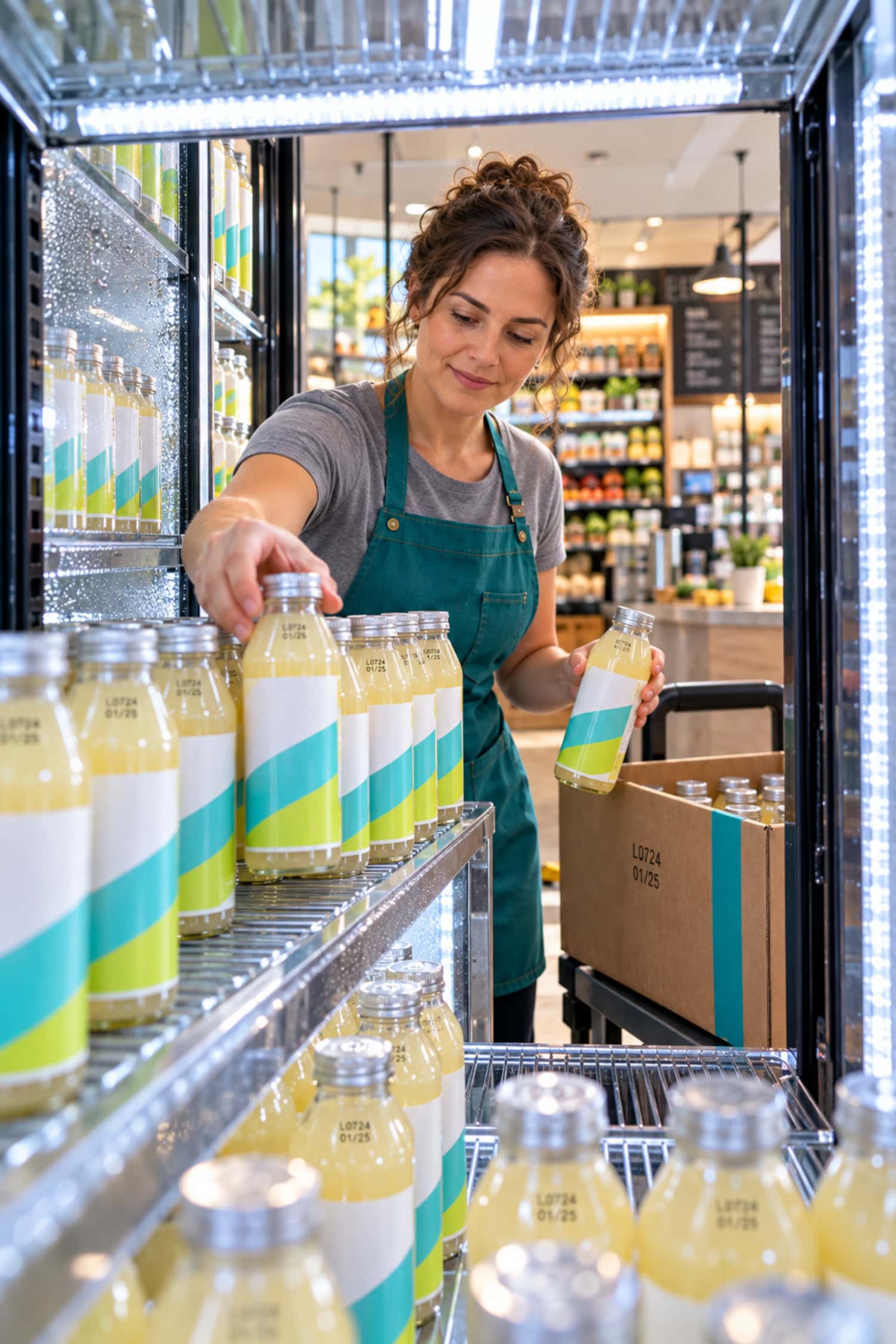
For a beverage company, the first commercial run should prove that the whole system works together, not merely that the beverage can be filled.
Evaluate product consistency, package performance, storage, and freight.
Then review lot tracking, order fulfillment, customer response, and the speed at which the next run can be organized.
Before releasing a pilot, define the approved product specification and the acceptance checks.
The founder and manufacturer should know what counts as an acceptable run, who can release product, how deviations are documented, and what happens to rejected or questionable inventory.
The first run is a systems test wearing a label. A bottle may taste right on filling day and show separation later.
A case can leave the plant correctly and still create problems if warehouse conditions, freight handling, or retailer storage do not match the product’s requirements.
Those failures are operational information, not branding problems.
Track at least four operating streams from the first run:
- Production performance, including yield, quality deviations, and finished quantity.
- Inventory and shelf-life exposure by lot and location.
- Sales and reorders by account or channel.
- Cash timing from deposits through customer payment and the next production commitment.
Co-packer responsiveness also becomes visible here.
A small brand may find that a supplier is enthusiastic during onboarding but difficult to reach when the reorder is small or the production calendar is crowded.
Measure response time and reliability as operating variables, not as personality quirks.
10. Product mix and beverage pricing
A beverage company should launch with the fewest stock keeping units (SKUs) needed to prove the proposition.
Each additional flavor or package can create another formula, ingredient set, label, and packaging commitment.
It can also add MOQ exposure, inventory, and another reorder decision.
Every extra SKU is another inventory bet.
Three flavors can look like variety to the customer and look like three separate cash problems to the operator.
Add variants when there is evidence that the core product sells and the new SKU solves a real customer or channel need.
Set pricing backward from channel economics as well as forward from production cost.
A shelf price has to support the retailer, any distributor or broker, promotional activity, and freight.
It also has to leave contribution for the brand while making sense to the customer. A factory quote by itself cannot answer whether the price works.
Do not copy another beverage’s shelf price without understanding its scale, package, channel, and distributor terms.
Promotional spend and production arrangement can change the economics further.
Two cans beside each other in a cooler can have completely different economics behind the label.
11. Set stop conditions for a beverage launch
A beverage founder needs explicit stop conditions because sunk cost makes weak plans feel strangely persuasive.
Revise or pause when the technical system, demand signal, channel economics, or cash cycle fails a condition that the business cannot fix cheaply.
Warning signs include:
- The commercial formula cannot meet the required stability or process conditions without changing the proposition.
- The desired package eliminates practical manufacturing options or forces an unworkable MOQ.
- The first viable co-packer quote leaves no reasonable contribution after channel costs.
- Paid trial does not convert into repeat purchase or retailer reorder.
- The product only moves under discounts that the economics cannot sustain.
- A larger run is being justified mainly because the unit cost looks better.
- The next production cycle requires cash that the business cannot finance without overexpanding.
Pausing a bad configuration can preserve the company while you change the part that failed.
The correct move may be a different package, fewer SKUs, or a tighter geography.
It may also require another channel, a different process, or a smaller manufacturer.
The goal is to change the variable that failed instead of adding more volume to the failure.
12. Scale after sell-through becomes repeatable
Scaling a beverage company means repeating a working system across more accounts, more production, or more geography without destroying cash, quality, or service.
The evidence to watch is repeat ordering, stable production, supplier reliability, manageable freight, and contribution that survives the larger channel stack.
Distribution is most useful when repeat sales already exist.
If the brand cannot show reorder behavior, account support, or consumer pull, a larger distributor can make the weak signal harder to diagnose while adding another economic layer.
Expand in the dimension that is already strongest.
If local independent retail produces repeat orders, add similar accounts before adding distant geography.
If one SKU clearly leads, deepen its distribution before multiplying flavors.
If production is the bottleneck, secure repeatable capacity before a sales push creates commitments the supply chain cannot meet.
Picture the opposite: a brand wins a larger retail opportunity, orders a bigger run, pays for more packaging, and starts promotions at the same time.
If sell-through arrives slower than planned, the brand is left carrying a larger cash problem.
The useful scaling question is what must stay true when volume doubles.
The answer usually includes product consistency, service levels, margin, cash availability, and reorder reliability.
13. Common beverage startup myths and traps
Turnkey offers are vendors that bundle several development, production, or launch services into one relationship.
Beverage startups attract advice that sounds clean because the messy dependencies have been removed.
Test the attractive shortcut against the operating system you actually have to run.
| Myth | What actually happens |
|---|---|
| A great kitchen recipe is ready for production | Commercialization still has to address scale, stability, ingredients, process, documentation, and manufacturing fit |
| The distributor will sell the product for me | The brand still needs demand, account support, promotion, and evidence that product moves |
| Packaging is mainly a branding decision | Package format can constrain the process, supplier MOQ, filling line, freight, and co-packer pool |
| A bigger first run is safer because the unit cost is lower | Unit cost can improve while inventory exposure, storage, expiration risk, and cash needs get worse |
| Turnkey means the founder can stop checking details | Formula ownership, supplier lock-in, MOQ, quality terms, compliance responsibilities, and channel economics still require review |
Be especially careful with “full-service” offers that blur who owns the formula or require proprietary flavors without a clear transition path.
Convenience has value, but dependence is part of the price.
Also be skeptical of any plan where distribution is supposed to rescue weak validation.
A manufacturer can make cases. A distributor can move cases. Neither can make a customer want the second purchase.

14. Beverage company launch plan
A beverage company launch plan should resolve dependencies in order and keep early commitments reversible.
Do not schedule commercial production until the product, process, package, and economics are aligned.
The compliance path and manufacturer must also be confirmed.
Before major spending
- Define the target customer, use occasion, problem, and intended sales environment.
- Build the kitchen prototype far enough to test the concept honestly.
- Run paid trials and track price acceptance, repeat interest, and account demand.
- Choose the basic beverage architecture, including refrigerated or shelf-stable and still or carbonated.
- Pick the first channel and launch geography based on serviceability and economics.
Before signing production contracts
- Define what the commercial formula must include, who owns it, and whether another manufacturer can reproduce it.
- Choose the processing path and confirm that it fits the intended shelf life, product proposition, and package.
- Screen co-packers for process, package, MOQ, geography, capacity, quality requirements, and startup fit.
- Obtain real quotes for formulation, ingredients, packaging, production, freight, storage, and channel costs.
- Run the contribution model and the half-sales stress test.
- Form the business, set up banking and insurance, and identify the applicable food, label, facility, and tax requirements.
- Put supplier, co-packer, and distributor terms in writing before committing to material inventory.
Before the first commercial run
- Lock the production-ready formula and approved ingredient specifications.
- Confirm package compatibility with the filling and processing line before final artwork or large packaging orders.
- Complete label review and any required process or product validation.
- Confirm ingredient and packaging availability for the run.
- Define quality checks, release criteria, lot tracking, and responsibility for deviations.
- Confirm warehouse, freight, fulfillment, and storage conditions before finished product exists.
During the first 30 to 90 days
- Sell actively in the chosen channel instead of treating placement as the finish line.
- Track paid sell-through, repeat purchase, retailer reorders, discounts, returns, and account-level economics.
- Review product stability, complaints, quality deviations, and package performance by lot.
- Reforecast cash before placing the next production order.
- Add accounts, geography, or SKUs only when production and reorder behavior are repeatable.
FAQ
How much does it cost to start a beverage company?
There is no useful single startup-cost figure because product work, package, production, and logistics vary too much.
Build the budget from quotes and the cash needed through the next reorder cycle; see Section 5.
Do I need an LLC to start a beverage company?
No. An LLC is only one possible business structure, and entity choice is separate from beverage-product compliance.
Choose the legal structure before signing major contracts; see Section 6.
Do I need a co-packer?
No. A co-packer is not mandatory if you can legally and operationally self-manufacture.
Self-production shifts facility, equipment, staffing, food-safety, and quality responsibilities onto you; see Sections 2 and 8.
Can I start a beverage company from home?
It depends on the beverage, production method, and local food rules.
Check the applicable food and facility requirements before treating a home kitchen as commercial production; see Section 6.
Is a beverage company profitable?
Yes, it can be, but profitability depends on contribution after production, freight, channel deductions, and promotions.
Returns and fixed overhead can reduce the result further; see the worked example and stress test in Section 5.
How long does it take to launch a beverage company?
It depends on formulation, stability work, packaging, and co-packer capacity.
Compliance and production scheduling add more variability; see the dependency order in Sections 1 and 14.
Should I get a distributor immediately?
Usually no. A distributor works best when the brand already has enough demand, account density, and channel economics to make distribution useful; see Sections 4 and 12.
How many flavors should I launch?
As few as practical.
Each added flavor can multiply formulation, packaging, inventory, and MOQ exposure, so add variants after the core product shows repeatable demand; see Section 10.
Conclusion
For a beverage company, evidence should come before commitments that are expensive to reverse.
A beverage company becomes much easier to manage when each step earns the right to create the next layer of formula work, packaging, inventory, channel cost, and scale.
1. Lock the product system. Treat formula, processing method, package, and manufacturer as one connected production decision.
2. Cost the route to market. Judge the business on fully loaded contribution and cash through the next reorder, not on the factory invoice alone.
3. Scale what already repeats. Add distribution, geography, or SKUs only after production and sell-through show a pattern you can reproduce.
Further reading
- U.S. Food and Drug Administration: Federal food and beverage regulation, labeling, facility, and food-safety information.
- U.S. Department of Agriculture: Federal guidance for products and ingredients that fall under USDA oversight.
- Alcohol and Tobacco Tax and Trade Bureau: Federal alcohol permitting, labeling, and industry guidance for alcoholic beverages.
- Starting a Beverage Company: A commercialization roadmap covering validation, formulation, processing, economics, co-packer selection, and launch.
- How to Start a Beverage Company: A broad beginner overview of funding, product development, suppliers, testing, distribution, and branding.
- 5 Things CPG Founders Should Know: Practical consumer packaged goods guidance on channel economics and margin decisions.
- Looking for Beverage Co-Manufacturers: A specialist discussion showing how package, product state, processing, and labeling requirements narrow manufacturer fit.
- What Does a Commercial Formula Actually Entail: A founder discussion about commercial formulation, portability, scale-up, and production readiness.