To start a bottled water business, choose the operating model, identify recurring buyers, validate committed volume, and confirm the water source and compliance path.
Then model landed economics and only after that lock in production and distribution. The central rule is simple: prove recurring demand before you commit cash to production capacity or finished inventory.
Startup cost has no useful single range because an own plant, private-label brand, and 5-gallon delivery route have fundamentally different capital profiles.
Bottled water is a food product, so check U.S. Food and Drug Administration (FDA) requirements, source approval and testing, labeling, and state and local health rules before production.
Freight, minimum order quantities, working capital (cash needed for inventory and day-to-day operations), buyer margin, and repeat orders usually decide whether the business survives.
Last fact-checked: October 7, 2026
This guide is for US beginners evaluating bottled water as an operating business, including private-label or contract bottling, an owned bottling plant, and local 5-gallon delivery. It covers demand, distribution, economics, compliance, equipment, packaging, operations, acquisition, and scaling. It does not assume that one model fits all three.
1. How a bottled water business works and the launch sequence
A bottled water business makes money by delivering water in a form, location, and service model that buyers will reorder.
The price must then cover production, packaging, logistics, channel costs, and overhead.
The physical water matters, but commercial viability depends on the whole path from source to repeat order.
The three common entry models are different enough that they should be planned separately.
An owned plant carries source, facility, production, packaging, and utilization risk.
Private-label or contract bottling shifts much of production to a co-packer.
A co-packer is a contract manufacturer that bottles the product for you, but the model adds minimum-order constraints and supplier dependence.
A 5-gallon route concentrates the problem around local density, reusable containers, sanitation, and service reliability.
| Stage | Decision | Move forward when |
|---|---|---|
| 1 | Define how the business will work | You can name one operating model and its main buyer |
| 2 | Choose the format | The format fits the buyer, geography, and capital profile |
| 3 | Validate demand | Buyers show credible repeat-volume intent, not just enthusiasm |
| 4 | Choose the sales channel and geography | The path to the buyer is specific and logistically workable |
| 5 | Model startup cost and unit economics | Landed contribution stays positive under a conservative sales case |
| 6 | Confirm setup, licenses, permits, and insurance | The relevant agencies and compliance steps are identified |
| 7 | Put key contracts in writing | Volume, price, quality, delivery, and payment terms are clear |
| 8 | Select equipment and suppliers | Capacity and packaging match validated demand and actual supplier capability |
| 9 | Build operating routines | Production, storage, delivery, sanitation, and records have owners |
| 10 | Finalize products and pricing | The offer preserves both your margin and the buyer’s reason to reorder |
| 11 | Set exit triggers | You know when to change a route, channel, package, or account |
| 12 | Scale the working part | Reorders and route or plant utilization justify more capacity |
| 13 | Evaluate acquisitions if relevant | Existing demand and assets survive due diligence |
| 14 | Reject common traps | The plan does not depend on equipment, branding, or optimistic volume alone |
| 15 | Execute the launch plan | Spending follows proof, compliance, contracts, and a controlled first run |
The order matters. Water is heavy, buyer attention is scarce, and packaging can lock up cash surprisingly fast.
A pallet does not care how good the logo is.
2. Bottled water business formats
The right bottled water format depends on what you are actually trying to sell: production capacity, a branded packaged product, or a local replenishment service.
Mixing these models in one forecast makes the numbers look more certain than they are.
| Format | Capital profile | Main operating burden | Best fit |
|---|---|---|---|
| Owned bottling plant | Highest fixed-capital exposure | Source, treatment, facility, filling line, packaging, compliance, utilization | Operators with defensible demand and enough volume to keep equipment productive |
| Private-label or contract bottling | Lower plant investment but meaningful working-capital exposure | Co-packer minimum order, packaging, lead times, freight, sales, and supplier coordination | Founders testing B2B or branded demand without building a plant |
| 5-gallon refill and delivery | Local asset and route exposure | Containers, sanitation, delivery density, bottle recovery, recurring service | Local markets with concentrated repeat customers such as offices or buildings |
For a first launch, our editorial preference is the model that lets you validate a specific buyer and delivered economics with the least irreversible capital.
That often favors contract production or a tightly local route over building a plant, but only when the minimum order and logistics still make sense.
3. Demand validation for a bottled water business
For a bottled water business, prove recurring demand before you commit cash to production capacity or finished inventory.
Treat verbal interest as a preliminary signal only, because it does not cover storage, freight, or financing costs.
Start with one or two buyer segments. Hotels, restaurants, offices, and events do not buy for the same reasons.
Neither do gyms, retailers, institutional accounts, and households.
A hotel may value custom branding, an office may care about dependable replenishment, and a retailer may care about sell-through and channel margin.
The sales motion changes with the buyer.
Use a working validation checklist before you order product:
- Name the specific buyer segment and the person who actually approves suppliers.
- Ask how the buyer purchases water now, including order size and reorder rhythm.
- Identify the reason the buyer would switch or add a supplier.
- Test whether the buyer still wants the offer at a delivered price that leaves you margin.
- Ask what minimum service level, packaging, and delivery schedule the buyer expects.
- Separate verbal interest from a purchase order, deposit, letter of intent, or credible recurring-volume commitment.
- Estimate the first reorder date and what would cause the buyer not to reorder.
- Compare committed or highly credible volume with the minimum quantity your producer or route needs.
Picture the common failure: a founder has cases stacked in a warehouse, the labels look finished, and the distributor calls are going nowhere.
Storage and financing costs continue every week. The problem arrived months earlier, when production was treated as proof of a business.
4. Bottled water sales channels and delivery geography
A bottled water sales channel must work economically at the actual order size and distance involved.
The same case can be viable on a dense local route and uneconomic when it moves through small, irregular freight shipments.
Direct business-to-business sales can offer better control over relationships and repeat orders, but the person who likes the product may not control purchasing.
A restaurant owner can love a custom label while procurement keeps the incumbent supplier.
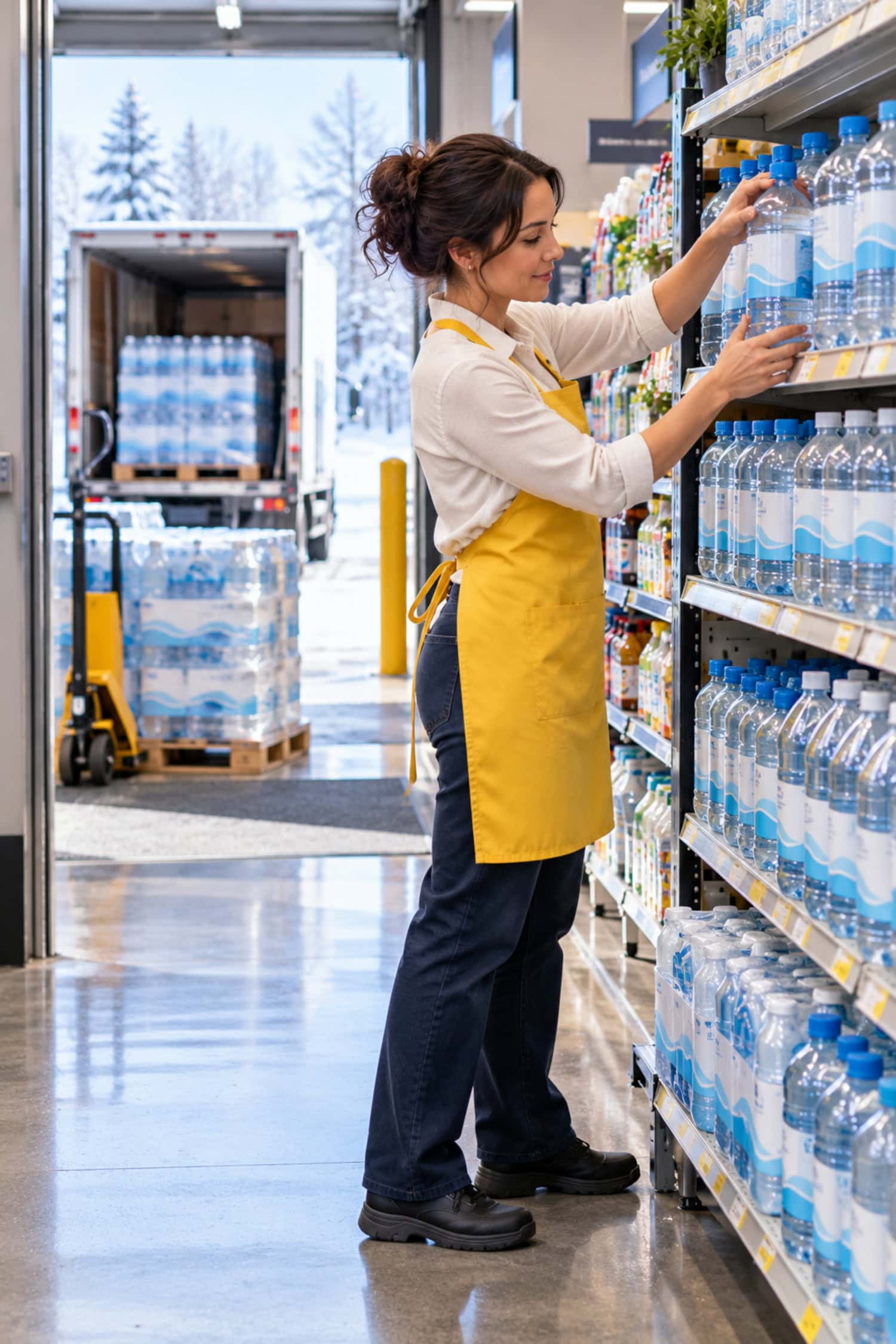
Retail adds another gate: shelf access, distributor relationships, authorization, and sell-through all matter before a brand becomes a repeat order.
Geography belongs in the sales plan because water is heavy relative to its selling value. Heavy products punish vague geography.
Real freight quotes by lane, pallet size, and shipment frequency are more useful than a generic shipping assumption.
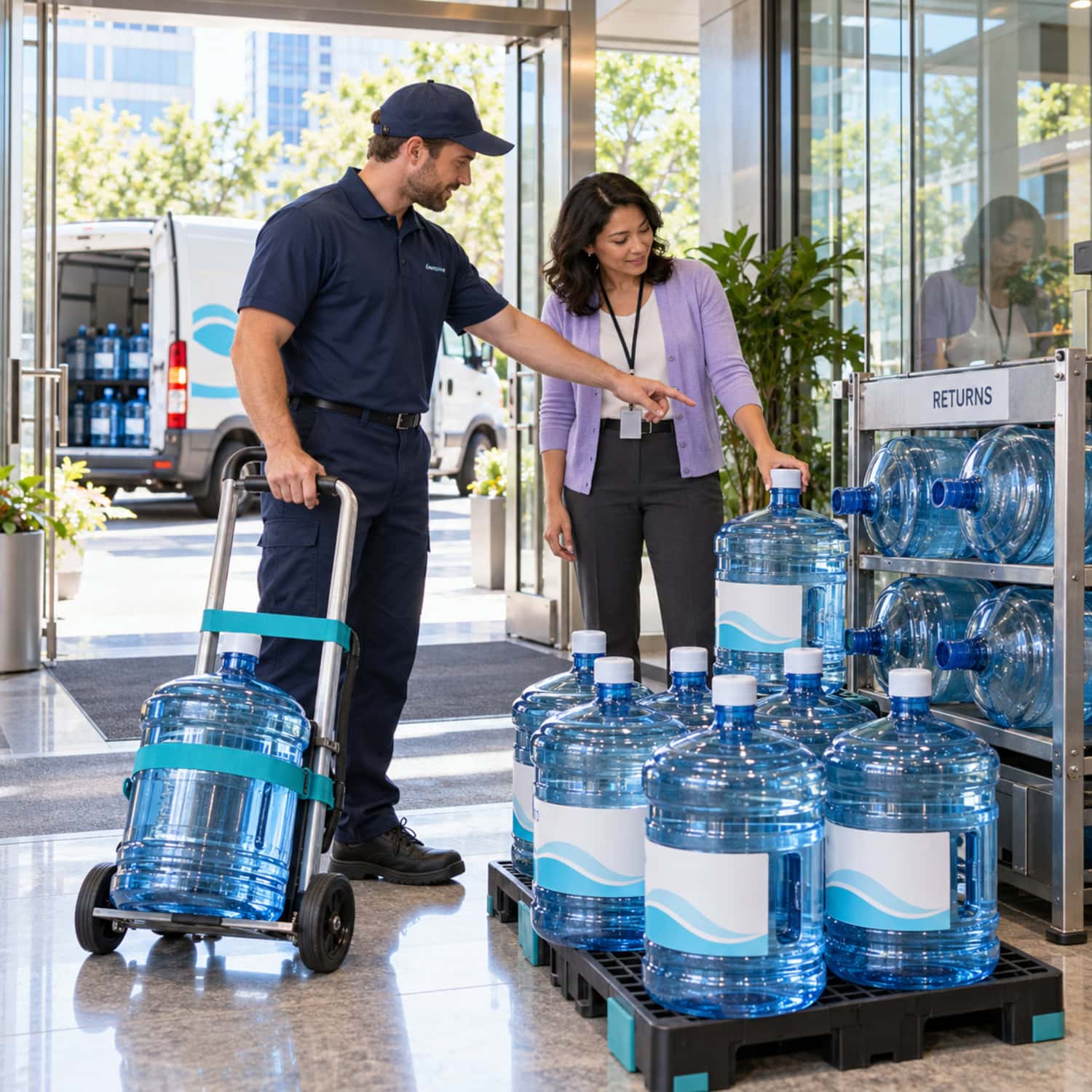
For local 5-gallon delivery, density matters even more.
Ten customers in one office building can be operationally better than ten customers scattered across a large area.
A route that looks healthy on revenue can become ugly after driver time, failed deliveries, bottle collection, and repeat visits are counted.
Before committing to a channel, answer these questions:
- Who authorizes the purchase?
- Who physically receives the order?
- What order size is normal for that buyer?
- How often is the order likely to repeat?
- What delivery radius can you serve without destroying contribution margin?
- Does the buyer require a distributor, broker, or approved-vendor process?
- What happens if the first channel underperforms for 60 to 90 days?
5. Startup costs and bottled water unit economics
Bottled water startup cost should be modeled by business format, not forced into one headline number.
A private-label test and a bottling plant have such different capital profiles that one universal range would be misleading.
| Cost area | Owned plant | Private label or co-packer | 5-gallon delivery |
|---|---|---|---|
| Water source and treatment | Major design input | Usually embedded in supplier relationship | Depends on refill source and treatment setup |
| Filling and packaging equipment | Major capital item | Usually avoided | Smaller refill and sanitation equipment |
| Packaging inventory | Bottles, caps, labels, secondary packaging | Often a major minimum-order and working-capital item | Reusable bottles and caps become tracked assets |
| Facility and storage | Production plus warehouse needs | Storage may still be needed | Refill space plus route staging |
| Freight and delivery | Inbound and outbound logistics | Often a major landed-cost component | Vehicle and route time dominate |
| Compliance and testing | Plant and source dependent | Shared with supplier but still requires verification | Local health and sanitation requirements matter |
| Working capital | Raw materials, packaging, payroll, receivables | Deposits, production runs, storage, freight, receivables | Containers, fuel, labor, replacements, receivables |
Use landed contribution rather than factory cost alone.
Landed cost is the variable cost of getting a sellable case to the buyer or channel. Use this formula:
Monthly operating contribution = cases sold x (net selling price per case minus variable landed cost per case) minus monthly fixed operating costs
The variable landed cost should include the costs that rise with each sale, such as production, packaging, freight allocation, handling, and channel costs.
Fixed operating costs stay fixed in the stress test.
| Illustrative numbers only | Amount |
|---|---|
| Cases sold per month | 500 |
| Net selling price per case | $16 |
| Variable landed cost per case | $10 |
| Contribution before fixed costs | $3,000 |
| Monthly fixed operating costs | $2,500 |
| Monthly operating contribution | $500 |
If sales fall to half the estimate, the same example becomes 250 x ($16 minus $10) minus $2,500 = -$1,000.
That is the stress test that matters. A business that looks attractive only at full forecast volume is asking optimism to do accounting’s job.
Working capital deserves its own downside case.
One founder report described roughly $8,000 to $10,000 of bottled inventory still sitting after distribution failed. That is not a market benchmark.
It is a useful picture of why finished goods, storage, and financing exposure belong in the model before the first run.
6. Business setup and bottled water compliance
A US bottled water business needs a compliance path that matches the water source, production model, facility, package, and sales channel.
Bottled water is regulated as a food product, and own-plant operations carry more direct compliance responsibility than a simple resale model.
At minimum, identify the compliance areas that apply to your model:
- FDA food regulation and food facility registration where applicable.
- Current Good Manufacturing Practice (cGMP).
- Source approval and water testing.
- Labeling requirements.
- State and local health permits and zoning.
- Environmental requirements.
Rules can vary by state and locality, so confirm the current requirements with the FDA, your state or local health department, and the relevant environmental or water agency before production.
If you use a co-packer, do not treat the supplier’s compliance as a magic shield.
Verify who is responsible for source compliance, labels, production records, product release, and corrective action.
The contract should match those responsibilities.
For an owned plant, source questions come early.
A spring, well, borehole, or municipal source can create different treatment and approval needs, and equipment design should follow actual source testing rather than a brochure diagram.
Choose the business entity, tax setup, and insurance with qualified legal, tax, and insurance professionals where needed.
Business structure is a separate legal and tax choice, and state filing details can change.
What matters operationally is that the legal party, insurance, contracts, permits, and bank records all describe the same business.
7. Contracts for a bottled water business
Bottled water contracts should turn assumptions about volume, packaging, delivery, quality, and payment into written obligations.
This matters most when another company controls production or when a buyer’s promised volume is the reason you are placing a large order.
For a co-packer or bottler, put the main commercial and operating terms in writing:
- Minimum order quantity (MOQ).
- Supported bottle and package formats.
- Production lead time.
- Tolling or per-unit pricing, meaning the fee charged for running and filling the product.
- Quality and testing responsibilities.
- Payment timing.
- Treatment of unused packaging.
If custom packaging needs special tooling, put ownership, maintenance, and reuse terms in writing.
For buyers or distributors, document pricing, delivery terms, payment terms, damage handling, and any volume commitment that materially supports your production plan.
A friendly conversation gives you context, but only written commercial terms belong in the forecast.
Ask a prospective co-packer these questions before signing:
- What bottle, cap, label, and case formats already run on the line without custom tooling?
- What is the MOQ for the exact format I want?
- Which costs are included in the quoted unit or tolling price?
- What packaging must I buy separately, and in what minimum quantity?
- What lead time applies from approved artwork and materials to finished goods?
- Who handles water testing, quality release, and production records?
- What payment is due before production?
- Where will finished goods and unused packaging be stored?
- What happens if my forecast falls below the planned run?
- What changes when volume grows beyond the first production level?
8. Bottled water equipment and supplier selection
Bottled water equipment should be sized to the proven source, package, and realistic production need.
Buying line speed first and hoping sales appear later reverses the engineering and commercial sequence.
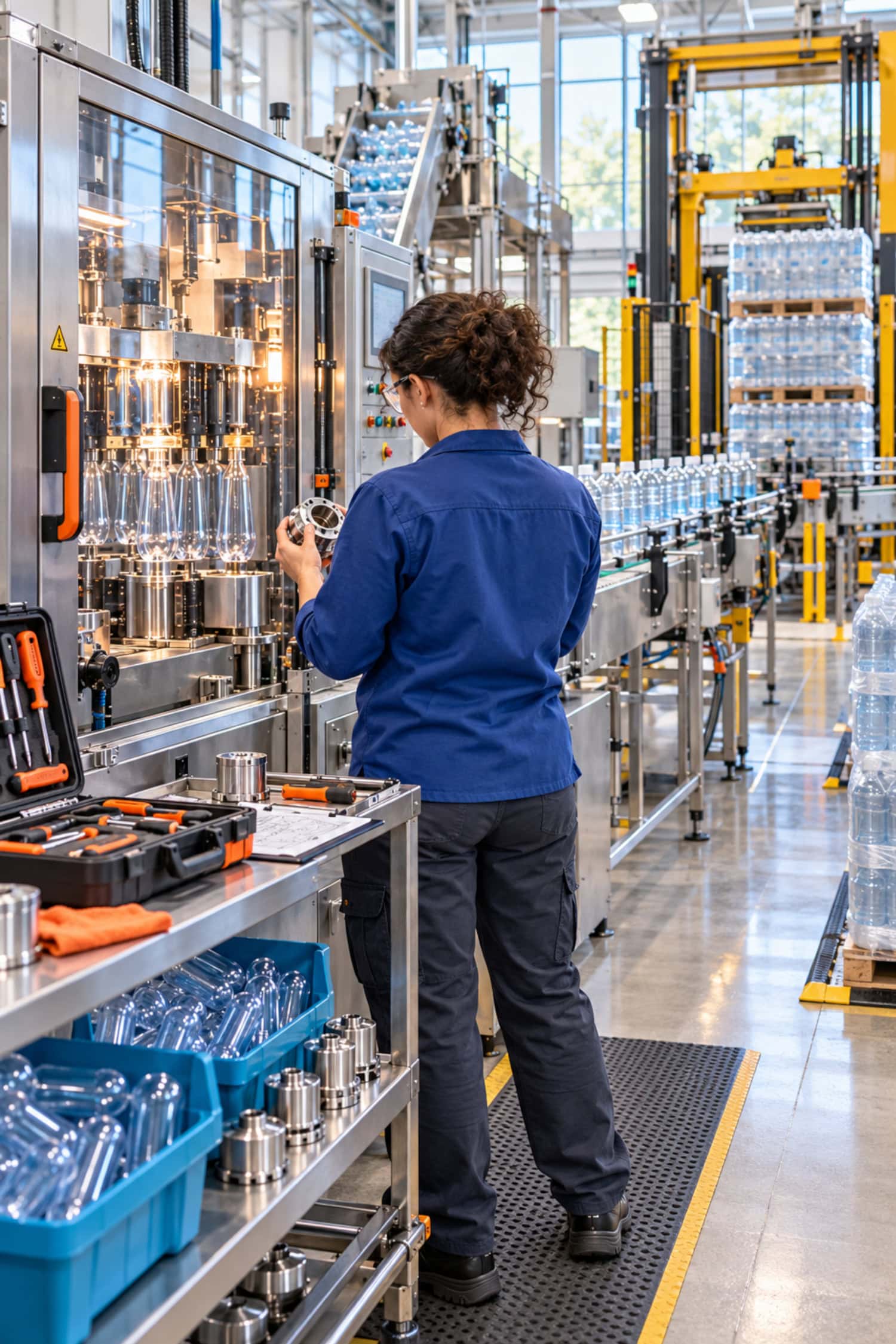
A plant can involve sediment filtration, activated carbon, softening, and reverse osmosis (RO).
It may also use ultraviolet treatment, ozone treatment, and storage.
The filling side may include bottle blowing from polyethylene terephthalate (PET) preforms, rinsing, filling, and capping.
Labeling, date coding, secondary packing, conveyors, and pallet handling can follow. The exact line depends on the source, package, and product claim.
Capacity is often described in bottles per hour (BPH) or liters per hour (LPH).
Those numbers are useful only when linked to demand and real operating time. Unused capacity has excellent polish and terrible cash flow.
Use this pre-purchase checklist for equipment or a turnkey line sold as an integrated production system:
- Confirm the source-water test and treatment requirement before final equipment design.
- Define the bottle sizes and packaging formats the line must run.
- Translate validated sales volume into realistic daily and hourly output needs.
- Check whether quoted output assumes uninterrupted ideal conditions or normal production conditions.
- Verify utilities, drainage, floor space, sanitation access, and material flow for the facility.
- Confirm which machines are included from treatment through final packing.
- Ask what change parts are required for each bottle or cap format.
- Verify installation, commissioning, training, warranty, and spare-parts support.
- Check whether local technicians can service the equipment and controls.
- Price the full line with conveyors, coding, packing, and handling rather than the filler alone.
- Compare the equipment plan with the expected utilization in the first year.
- Refuse custom packaging that forces disproportionate tooling unless buyers will pay for the difference.
Imagine approving a distinctive bottle, then learning that the intended filling line cannot run it without special tooling or slower production.
For a first product, compatibility with existing equipment usually deserves more weight than visual novelty.
9. Bottled water operations and working capital
Day-to-day bottled water operations revolve around production coordination, packaging inventory, storage, and quality controls.
Order fulfillment, delivery, and cash timing complete the operating picture.
The operating standard is simple: make the same acceptable delivery reliably enough that customers reorder.
Private-label operators can spend much of their time coordinating the manufacturer, labels, pallets, trucking, and buyer requirements.
Delivery windows add another constraint.
Own-plant operators add production scheduling, source treatment, sanitation, maintenance, and capacity utilization.
Route operators add vehicle time, customer service, reusable-container control, and repeated collections.
The 5-gallon model has an easy-to-miss asset problem.
Reusable bottles can disappear into customer sites, sit in closets, or become disputed when accounts close.
Over time, the bottle pool itself can absorb meaningful cash, so track issued, returned, damaged, and retired containers by customer.
Cash timing matters across every model.
Packaging and production may be paid before the buyer pays you, while inventory and freight still consume cash.
Supplier payment terms can therefore become painful when customer payments are slow.
Track the operating measures that expose cash and service problems:
- Order size and reorder interval.
- Landed cost.
- Delivery cost by account or route.
- Inventory aging and packaging stock.
- Reusable-container loss.
- Receivables.
- Capacity utilization.
Focus on measures that show whether another order improves or worsens cash flow.
10. Bottled water product and pricing decisions
Bottled water pricing has to preserve value for both the customer and your own distribution chain.
Better water, heavier packaging, or a custom bottle can raise cost without raising the buyer’s willingness to pay.
PET bottles, glass, cans, and reusable large bottles change the economics in different ways.
PET is strongly cost-sensitive. Canning and specialized formats can bring larger minimums.
Reusable large bottles add return logistics. Custom bottle geometry can require tooling or slower low-volume filling.
Choose the product by buyer job, not by founder taste.
A restaurant private-label bottle has to improve the venue’s experience without damaging its resale margin.
An office-delivery offer has to make replenishment easier. A retailer needs a reason for the product to earn shelf space and reorder.
Pricing should start from net selling price and landed cost, then work backward through the channel.
If a distributor or retailer needs margin, treat that as part of the economics rather than an unpleasant surprise after production.
The same rule applies to promotional accounts that want custom labels: customization only matters commercially if the account values it enough to cover the added delivered cost.
11. When a bottled water offer stops working
A bottled water offer should be changed or stopped when repeat demand, delivery economics, or working-capital behavior stays weak after a fair test.
Do not continue producing into weak demand merely because the equipment already exists.
Set triggers before the launch. Review an account, route, or product when any of these warning signs persists:
- Reorders consistently miss plan.
- Freight absorbs the contribution.
- Buyers need discounts that erase margin.
- Packaging inventory grows faster than sales.
- A distributor repeatedly fails to open the expected channel.
For 5-gallon delivery, watch route density and service time.
A few high-volume buildings can support a clean route, while scattered low-volume accounts can consume a day for the same revenue.
For private label, watch second orders.
A first custom run can reflect curiosity, while a second order gives stronger evidence that the account found recurring value.
For an owned plant, low utilization is the alarm.
Capacity should expand because the working business needs it, not because a larger machine has a more impressive brochure.
12. Scaling a bottled water business
A bottled water business should scale the buyer segment, geography, package, and production method that already produces repeatable orders.
Scaling everything at once makes it hard to distinguish growth from expensive motion.
Start by comparing customer groups on which buyers place a second order, how long that takes, how large the reorder is, and what service cost comes with it.
Compare customer groups such as hotels, offices, restaurants, retailers, or event accounts on repeat behavior rather than on initial enthusiasm.
Then scale the bottleneck that is actually limiting the business.
That could mean adding route density, negotiating better production terms, moving to a more efficient package, increasing a co-packer run, or adding plant capacity.
The sequence depends on where profitable demand is constrained.
An operating bottler can shift toward corporate, hotel, and promotional work and still experience inconsistent months.
Surviving for years does not eliminate the demand problem.
Scaling should therefore focus on the customer segment that already reorders and can be served efficiently.
13. Buying an existing bottled water business
Buying an existing bottled water business can shortcut setup only if the buyer verifies that customers, source access, production capability, and route economics survive the ownership change.
Equipment without durable demand is just a faster way to own equipment.
Use this due-diligence checklist before valuing the deal:
- Separate revenue by customer type, product format, and sales channel.
- Verify which customers reordered and how often over the last operating periods available.
- Identify the largest accounts and whether their purchasing relationship transfers.
- Review gross revenue against landed product, freight, delivery, storage, and channel costs.
- Inspect inventory aging and any slow-moving custom packaging.
- Verify source rights, testing records, permits, and the compliance responsibilities of the facility.
- Match equipment capacity with actual historical utilization.
- Review maintenance, spare-parts availability, and any custom tooling tied to current packages.
- Map delivery routes and compare account density with service time.
- Count reusable bottles or other returnable assets and reconcile them with customer records.
- Review co-packer, distributor, supplier, lease, and major buyer agreements for transfer restrictions.
- Build a downside case in which one major account leaves after closing.
Value the deal around transferable demand and usable assets, not around a customer list that no longer produces repeat orders.
14. Common bottled water traps and myths
Because the product is familiar, bottled water often looks simpler to launch than its economics justify.
| Myth | What actually happens |
|---|---|
| Good water will sell itself | Buyers compare price, recognition, convenience, reliability, and their own margin along with product quality |
| A co-packer removes the startup risk | It removes plant ownership but introduces MOQ, packaging commitments, lead times, upfront cash, and supplier dependence |
| Custom packaging creates differentiation by itself | A special bottle can add tooling, MOQ, and filling complexity without creating enough buyer value |
| Distributor interest means distribution is solved | Access depends on actual authorization, relationships, warehouse economics, sell-through, and repeat orders |
| Bigger production capacity creates better economics | Low utilization can make a larger line an expensive fixed-cost problem |
| A national market means national shipping makes sense | Heavy, low-value product can make long, irregular shipments uneconomic |
| Premium inputs justify premium pricing | Higher water or packaging cost helps only when a buyer values the difference and will reorder at the required price |
The category is neither automatically bad nor automatically attractive.
Viability changes with channel, geography, repeat-account behavior, and delivered economics, so those factors should drive the launch decision.
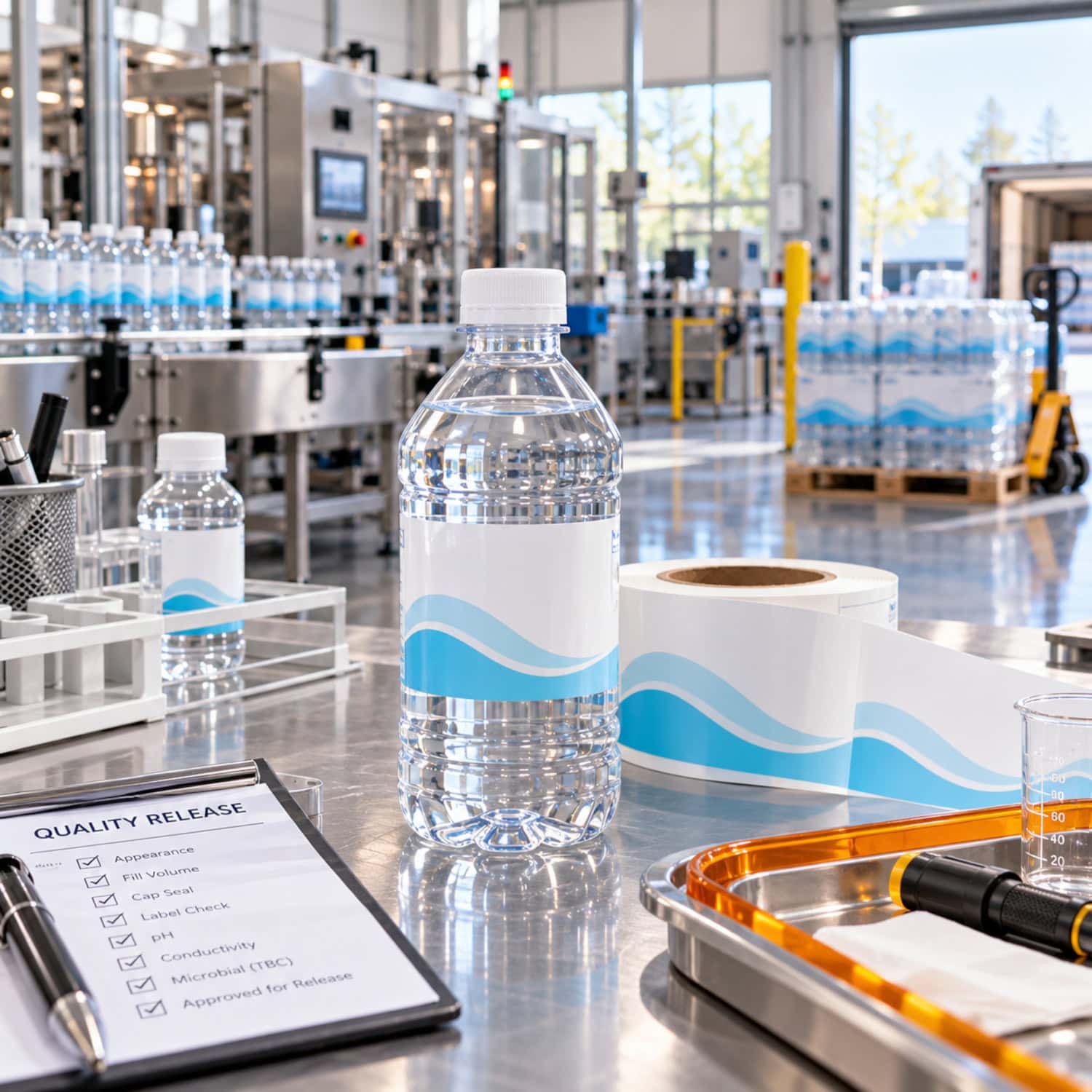
15. Bottled water launch plan
A bottled water launch should move from model choice to buyer proof, then to compliance and contracts, and finally to a controlled first production run.
The plan below keeps irreversible spending behind the decisions that can still kill the idea.
Before spending heavily
- Choose one model: owned plant, private-label or contract bottling, or 5-gallon delivery.
- Select one or two buyer segments with a clear repeat-purchase reason.
- Interview actual buyers and identify the person who approves suppliers.
- Test pricing with delivery and channel costs included.
- Estimate realistic order frequency and geography.
- Compare the expected volume with co-packer MOQ, route density, or plant utilization needs.
Before signing production or facility contracts
- Confirm the water source and product format.
- Verify the applicable FDA, state, local health, zoning, and environmental requirements.
- Obtain real production, packaging, freight, and storage quotes.
- Build the landed-contribution model and half-sales stress test from Section 5.
- Confirm that the package runs on the intended production equipment.
- Put material buyer commitments, supplier terms, and production responsibilities in writing.
Before the first production run
- Finalize approved labels and packaging.
- Confirm testing, quality release, and record responsibilities.
- Set the first run against credible demand rather than the maximum discount tier.
- Reserve storage and delivery capacity for the actual first shipment.
- Define inventory-aging and cash-exposure limits.
- Create the customer reorder follow-up process before the first delivery goes out.
During the first 30 to 90 days
- Track first-order to second-order conversion by buyer segment.
- Measure actual landed cost against the forecast.
- Measure route or freight cost by account and geography.
- Watch slow inventory and packaging commitments closely.
- Record customer objections, procurement blocks, and reasons for non-reorder.
- Cut or redesign channels that fail the pre-set triggers from Section 11.
- Increase volume only where repeat behavior supports it.
FAQ
How much does it cost to start a bottled water business?
It depends on the model, because an owned plant, contract-bottled brand, and 5-gallon route have different capital requirements.
Build costs from the categories in Section 5 rather than relying on a universal headline range.
Is a bottled water business profitable?
It can be, but profitability depends on landed cost, repeat orders, buyer and channel margins, freight, and utilization.
Use the worked example and stress test in Section 5 before committing capital.
Do I need a license to start a bottled water business?
Yes, a bottled water operation can require food, source, facility, labeling, and environmental compliance depending on the model and jurisdiction.
Start with the agencies and requirements described in Section 6.
Do I need an LLC for a bottled water business?
No. A limited liability company (LLC) is a separate legal and tax choice, not a bottled-water licensing requirement.
Align the entity, contracts, permits, insurance, and tax setup as described in Section 6.
Should I build a bottling plant or use a co-packer?
Use a co-packer when avoiding plant investment improves the test and its MOQ still fits credible demand.
Consider owned production only when the source, compliance, utilization, and distribution case can support the fixed capacity described in Sections 2 and 8.
Can I start a bottled water business from home?
It depends on the activity and local rules, because food production, storage, zoning, sanitation, and facility requirements can restrict home-based operations.
Check the compliance path in Section 6 before treating a home address as a production site.
What makes private-label bottled water different from a normal water brand?
Private-label water sells customization and account-specific value, while a consumer brand asks the market to choose the brand itself.
The distinction matters because the buyer, MOQ, sales motion, and margin logic differ in Sections 2, 3, and 10.
What should I ask a bottled water co-packer?
Ask about supported packages, MOQ, total cost, lead time, and quality responsibility.
Use the full numbered checklist in Section 7 for the rest of the commercial terms.
Conclusion
The decisive rule is to prove recurring demand before you commit cash to production capacity or finished inventory.
Bottled water can work, but the winning version is the one whose buyer, delivered cost, compliance path, and repeat order survive contact with reality.
1. Validate buyers before production. Get credible repeat-volume evidence before ordering more water or equipment than the channel can absorb.
2. Price the delivered business. Include full landed cost plus working capital and fixed costs before calling a sale profitable.
3. Scale only the repeatable part. Add route density, production volume, or equipment capacity only after reorders and utilization justify it.
Further reading
- U.S. Food and Drug Administration: Federal food-regulation resources and agency guidance relevant to bottled water production and labeling.
- U.S. Small Business Administration: General US business planning, startup, and financing resources.
- U.S. Environmental Protection Agency: Federal environmental information relevant to water, facilities, and environmental permitting questions.
- How to Start a Bottled Water Company: A plant-oriented overview covering source, permits, equipment, capacity, cost, and distribution.
- How to Start a Bottled Water Business: A production-focused walkthrough from market choice through source, packaging, capacity, and supplier selection.
- How to Start a Bottled Water Company: Equipment-vendor guidance on capacity, production setup, investment, and supplier decisions.
- Selling Bottled Water: A commercial look at private label, own bottling, reseller models, and routes to market.
- Low MOQ Co-packer Discussion: Beverage-industry discussion of pilot production, co-packer minimums, packaging compatibility, and startup-scale constraints.
- Bottled Water Inventory and Distribution Discussion: A founder discussion illustrating the risk of producing inventory before distribution is secure.