To start a custom T-shirt business, choose the customer and business model, validate demand, and pick a sales channel.
Then calculate full unit economics, set up the business, and choose a production method that fits real order volume.
Our editorial recommendation is to choose the customer and business model before buying equipment.
A local custom-print service, a print-on-demand brand, and a home decorator using outsourced transfers are different businesses with different bottlenecks.
There is no useful universal startup-cost figure because the production model changes what you must buy.
Licensing varies by location, so check registration, tax requirements, and local operating rules with the relevant state and local agencies before selling.
Long-term success depends more on customer acquisition, reliable quality, pricing discipline, turnaround, and cash flow than on owning the most impressive printer.

Last fact-checked: October 6, 2026
This guide is for US beginners starting a custom apparel service, online T-shirt brand, personalized store, or home-based decorating business. It covers demand, sales channels, production choices, unit economics, and business setup. It also covers order controls, suppliers, quality, scaling, and when bringing production in-house makes sense.
1. How a custom T-shirt business works
A custom T-shirt business turns an audience or client need into a decorated garment.
It then manages design, production, payment, fulfillment, and reorders.
The difficult part is coordinating those pieces at a margin that survives shipping, mistakes, labor, and customer acquisition.
Behind one shirt can sit artwork approval, blank availability, a production queue, a late purchase order, and a three-shirt reorder after a 100-shirt job.
| Stage | Decision | Move forward when |
|---|---|---|
| 1. Model | Map the order flow | Buyer-to-delivery workflow is clear |
| 2. Format | Choose the operating model | Buyer, order type, and production approach are clear |
| 3. Demand | Verify buyer interest | You have inquiries, preorders, or paid tests |
| 4. Channel | Choose acquisition | The channel fits the buyer and is testable |
| 5. Economics | Price the full job | Contribution remains after variable costs |
| 6. Setup | Complete required setup | Legal and buyer requirements are covered |
| 7. Terms | Set order rules | Approval is documented before production |
| 8. Production | Select method and suppliers | They fit volume, artwork, quality, and turnaround |
| 9. Operations | Build the workflow | Jobs can be repeated consistently |
| 10. Offer | Narrow products and pricing | The assortment avoids excessive inventory |
| 11. Review | Fix or drop weak offers | The repeated constraint is clear |
| 12. Scale | Add proven capacity | Workload shows what is missing |
| 13. Buy | Evaluate an existing shop | Customers, assets, and economics survive diligence |
| 14. Traps | Test business claims | Economics survive conservative demand |
| 15. Launch | Put decisions in order | You can accept a paid job without improvising |
Capacity without orders is expensive furniture.
The table is deliberately demand-first because production choices only make sense after you know what work the business needs to perform.


2. Custom T-shirt business formats
Choose the customer and business model before you buy equipment.
The phrase “custom T-shirt business” covers several operations that share a product but not the same economics.
| Format | How it works | Capital burden | Best fit |
|---|---|---|---|
| Local custom apparel service | Organizations order jobs to specification | Varies with outsourcing and equipment | Founders with local relationships and repeat orders |
| Online T-shirt brand with print on demand | A provider produces and ships online orders | Lower equipment burden, more provider dependence | Creators with an audience or niche |
| Personalized ecommerce store | Buyers customize product elements | Depends on platform and fulfillment | Sellers centered on personalization |
| Home-based hybrid decorator | The owner presses outsourced transfers onto blanks | Moderate and adjustable | Beginners wanting more control without a full print system |
| In-house print shop | The business owns production equipment | Highest equipment and maintenance burden | Operators with recurring volume |
Print on demand, or POD, means a third party produces an item after the customer orders it.
Direct-to-film, or DTF, transfers are printed onto film and then applied to garments with heat.
Direct-to-garment, or DTG, prints ink directly onto the garment. Heat transfer vinyl, or HTV, uses cut vinyl applied with a heat press.
For a first launch, favor the format that proves the buyer and job type before large fixed production costs.
Outsourcing can be a temporary way to learn what deserves investment.


3. Customers and demand for custom T-shirts
Demand for a custom T-shirt business should be tested around a specific buyer and use case, not around the vague idea that “people wear T-shirts.”
Local organizations, niche communities, event buyers, teams, and consumers buying identity-driven designs behave differently.
A narrow customer definition improves almost every later decision.
It tells you whether orders are likely to be one-offs or repeats, whether deadlines are hard, whether buyers need invoicing, and whether a three-shirt reorder is normal or annoying.
Use this demand-validation sequence before making major equipment purchases:
- Define one buyer group you can realistically reach, such as local teams, small companies, event organizers, or a specific online community.
- Define the job that group is buying, such as staff shirts, event merchandise, team apparel, or personalized gifts.
- Talk to potential buyers about order size, deadline, artwork needs, preferred garment quality, and how often they reorder.
- Test the offer through direct outreach, existing relationships, a small marketplace listing, or another low-cost channel that fits the buyer.
- Record actual inquiries and orders instead of treating likes, compliments, or mockup reactions as demand.
- Use the first jobs to learn what buyers object to, what they reorder, and which details create production friction.
- Delay major production expansion until the workload repeats often enough to reveal a real bottleneck.
A founder can spend a week comparing printers while the real problem is that nobody has been asked to buy anything.
A printer is not demand. It is capacity.
The market can feel saturated because generic T-shirts are easy to find. That does not prove every niche or local service is saturated.
The more useful question is whether you can reach a defined buyer with an offer that solves a specific apparel job.
4. Sales channels for a custom T-shirt business
For a custom T-shirt business, the right sales channel follows the customer.
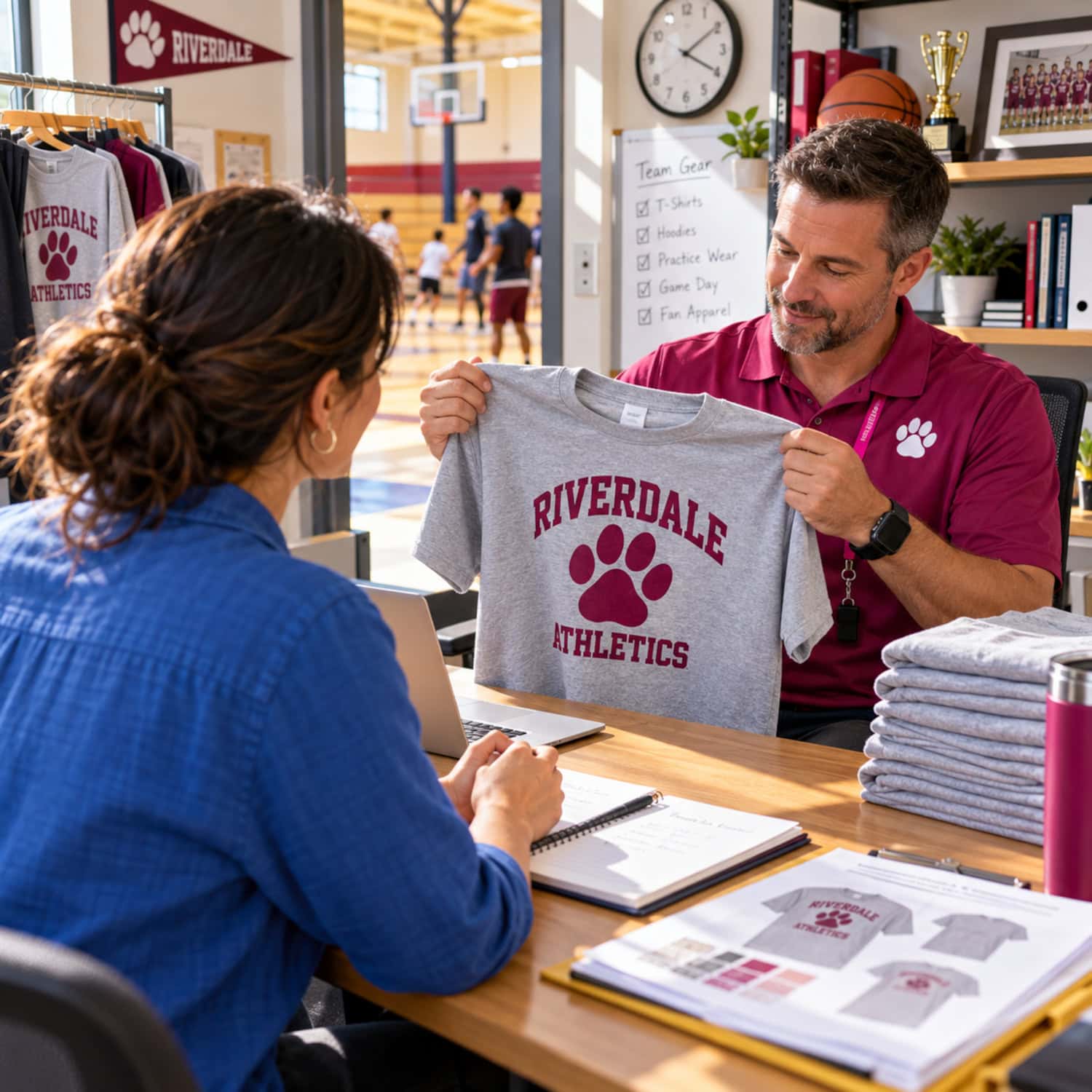
Local custom-print work often comes from relationships and direct outreach, while a consumer brand usually depends more on marketplaces, social content, niche communities, or its own online store.
For local service work, focus on channels where the buyer already has a reason to order.
Schools, teams, companies, and event organizers often care about dependable communication and deadlines as much as a flashy storefront.
For an online brand, marketplaces can provide traffic, but the seller still needs differentiation and workable margins.
An independent store gives more control but does not create demand by itself. A beautiful website with no acquisition path is a digital waiting room.
Track which channel produces inquiries and orders, not just views.
If a channel attracts attention but no buyers, change the offer, audience, or channel before increasing ad spend.
For personalized ecommerce, make customization clear before checkout. More customization also makes proofing and error control more important.
5. Startup costs and unit economics
Startup cost for a custom T-shirt business depends mainly on the production model.
POD can avoid printing equipment and inventory. A heat-press setup adds equipment and transfer costs.
In-house DTF or screen printing adds machinery, maintenance, workspace, and operator time.
There is no useful universal startup range because each model creates a different cost structure.
Build the budget from the costs your chosen format actually creates.
| Cost category | What to include | Why beginners miss it |
|---|---|---|
| Product | Blank garment and packaging | The visible blank can dominate the cost estimate |
| Decoration | POD charge, transfer, ink, setup, or outsourced print | Setup can make tiny reorders expensive |
| Fulfillment | Shipping, labels, packing, and delivery | Small outsourced orders can lose margin here |
| Selling | Marketplace, platform, and payment fees | Base product cost excludes these fees |
| Labor | Artwork, proofing, production, packing, and support | Owner time is easy to omit |
| Acquisition | Ads, promotional samples, commissions, or outreach | Sales cost is often omitted |
| Errors | Failed prints, reprints, damaged blanks, and recovery | Custom mistakes consume margin |
| Overhead | Software, insurance, workspace, and maintenance | Fixed costs sit below gross sales |
A useful formula is:
Monthly operating contribution = units sold multiplied by contribution per unit, minus fixed monthly overhead
Where contribution per unit is selling price minus the variable costs attached to that sale.
The following numbers are illustrative, not a benchmark:
| Illustrative item | Amount |
|---|---|
| Selling price per shirt | $30 |
| Blank garment | $5 |
| Decoration | $4 |
| Fulfillment and shipping subsidy | $5 |
| Platform and payment fees | $2 |
| Labor | $4 |
| Customer acquisition | $3 |
| Expected reprint allowance | $1 |
| Contribution per shirt | $6 |
| Monthly fixed overhead | $300 |
| Expected monthly volume | 100 shirts |
| Monthly operating contribution | $300 |
At 100 shirts, the example produces $600 of contribution before fixed overhead and $300 after the illustrated $300 overhead.
At half the expected sales, 50 shirts produce $300 of contribution, which is entirely consumed by the same $300 fixed overhead.
That stress test matters because fixed costs remain when sales fall. Revenue is not profit. It is the top line.
Cash timing matters too. A POD provider can charge production before marketplace funds are available, while an organizational client may pay later.
Keep enough working capital to buy the job you already sold.
If you finance equipment, treat the payment as a fixed cost and compare it with continued outsourcing.


6. Business setup and legal basics
A custom T-shirt business may need business registration, state tax registration, local licensing, and home-occupation or zoning approval, depending on how and where it operates.
Check the relevant state revenue office and city or county before taking the first orders.
You do not automatically need a limited liability company (LLC) just because you sell custom T-shirts.
Business structure is a separate decision from printing method, and state filing requirements vary.
Choose the structure based on liability, tax, ownership, and administrative needs rather than treating an LLC as a piece of production equipment.
Check whether you need a sales-tax permit or resale certificate. Home-based operators should verify home-business and zoning rules.
If you lease space, confirm the planned printing activity is allowed before signing.
Artwork rights are a separate gate.
Do not assume a movie quote, character, logo, or image is commercially usable because it can be found online or because a customer sent it to you.
Clarify who owns the artwork and what rights you have to reproduce it. Business-name registration also does not by itself create trademark rights.
Get insurance quotes appropriate to your operation.
Some institutional clients can also require proof of coverage, vendor paperwork, bids, or purchase orders, so ask before quoting a deadline that assumes immediate approval.
7. Client agreements and order controls
A custom T-shirt business needs written order controls because the product can be correct by one definition and wrong by another.
The safest workflow documents the artwork, garment, quantity, and placement. It also records color, price, and timing before production.
Imagine a customer approving a proof on Monday, then saying after pickup that the blue was supposed to be darker.
Without a saved approval, the dispute becomes much harder to resolve.
Put these items in the quote, order form, or client agreement:
- Exact garment style, color, sizes, and quantities.
- Final artwork and placement approval.
- Print colors or the agreed tolerance for color variation.
- Price, deposit, balance due, and accepted payment method.
- Turnaround promise and what starts the production clock.
- Rules for customer changes after approval.
- Reorder terms, especially for very small replacement runs.
- Responsibility for customer-supplied artwork and claimed rights.
- Pickup, shipping, or delivery terms.
- Reprint or correction policy for production errors.
For schools, companies, and other organizations, ask these questions before you accept the job:
- Does the customer require a purchase order before work begins?
- Who has authority to approve artwork and quantities?
- When can the customer legally or procedurally release payment?
- Does the customer require proof of insurance or vendor registration?
- Who receives the finished order and confirms delivery?
Turnaround is part of the product. If the workflow cannot reliably hit the promised date, the quote is incomplete no matter how good the print looks.
8. Equipment and production methods
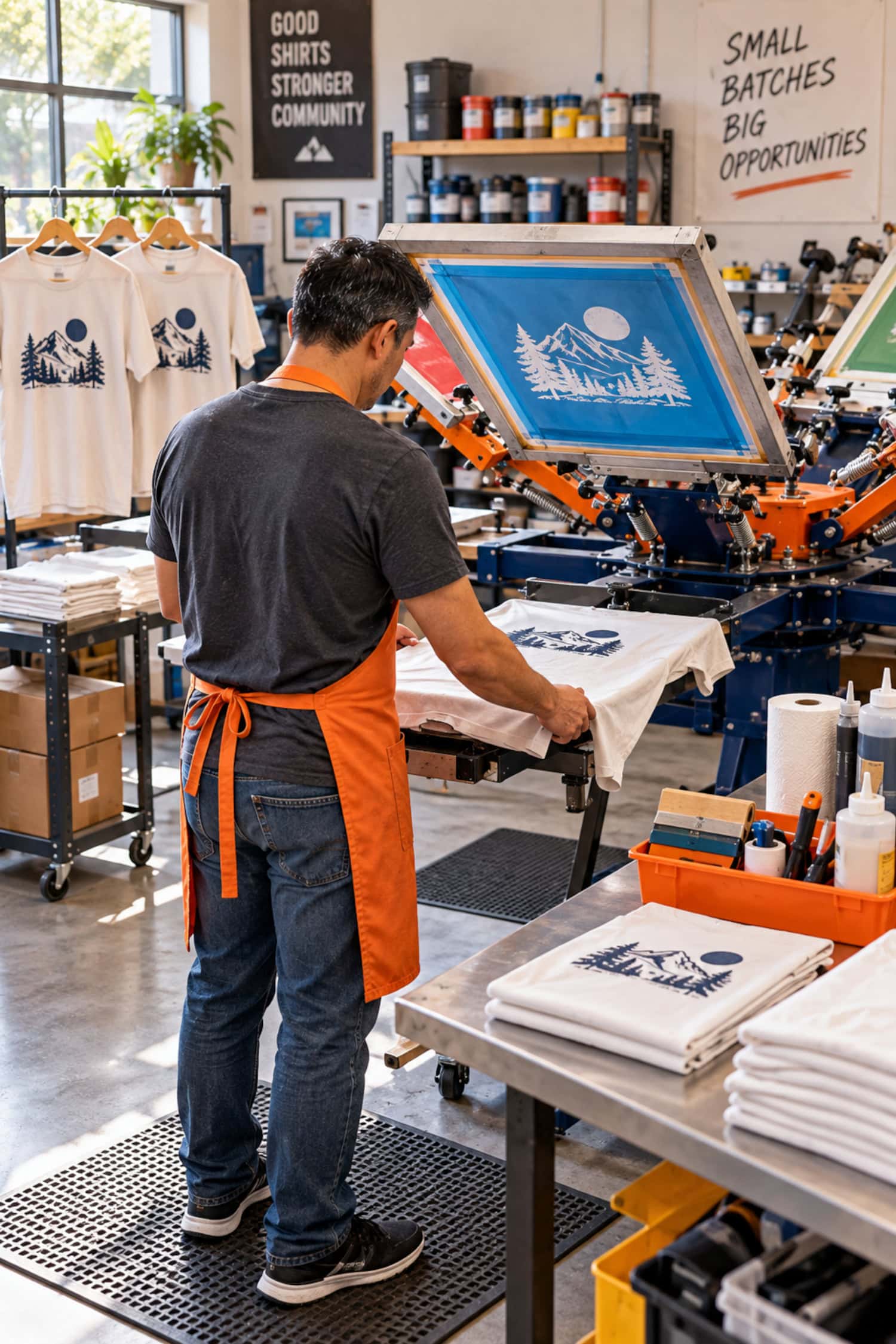
A custom T-shirt business should choose production by order volume, artwork complexity, garment type, and setup labor.
Then weigh throughput, quality expectations, and reorder behavior. No method is universally superior across all custom T-shirt jobs.
| Method | Strong fit | Main tradeoff |
|---|---|---|
| Print on demand | Testing designs without print equipment | Less control and more provider dependence |
| Outsourced DTF plus heat press | Short runs and full-color work | Shipping, supplier consistency, and pressing affect margin |
| In-house DTF | Repeated work with enough volume | Maintenance, supervision, downtime, and capital |
| Screen printing | Larger runs with simpler color counts | Small reorders and complex art can be inefficient |
| DTG | Direct printing on suitable garments | Maintenance, preparation, and operator time |
| HTV | Small personalized jobs and simple graphics | Manual work can limit throughput |
| Sublimation | Compatible polyester products | Material compatibility limits use |
Small reorders are a useful test.
A method that looks efficient for 100 shirts can become painful when the same client wants three replacements next week.
That is one reason many operators mix methods instead of defending one technology like a sports team.
Before buying equipment or committing to a supplier, use this checklist:
- Write down the real jobs the equipment must handle, including garment sizes, artwork complexity, and expected run sizes.
- Check whether the press or printer can produce those jobs consistently, not merely technically.
- For a heat press, evaluate platen size, temperature stability, pressure consistency, and recovery during repeated use.
- Calculate what you already spend on outsourced production and shipping over a meaningful period.
- Add maintenance, consumables, operator time, workspace, and downtime to the ownership case.
- Decide what happens when the machine is unavailable and customer deadlines continue.
- Order physical samples from shortlisted transfer, POD, or blank suppliers.
- Check print detail, color, garment feel, and placement. Then check wash durability and consistency between repeat samples.
- Confirm supplier turnaround, stock continuity, shipping geography, and reprint process.
- Buy only when the equipment removes a bottleneck that already exists in paid work.
A printer can improve production control, but it can also turn one owner into a machine operator while sales inquiries sit unanswered.
Ownership is useful when it solves a recurring workload problem.


9. Operations and quality control
Operations determine whether a custom T-shirt business remains profitable after the first exciting orders.
The workflow needs a repeatable path from inquiry through production. It should also control payment, quality checks, fulfillment, and reorders.
For manual decoration, process one job carefully enough that names, sizes, and placements do not drift across orders.
A simple job sheet can prevent a stack of nearly identical garments from becoming an expensive memory test.
Quality control should happen on the physical product.
A mockup can confirm layout, but it cannot tell you whether the print feels rough, the color washes out, the blank shrinks oddly, or the provider repeats the same quality next week.
Selective sampling is more useful than either sampling everything or trusting everything.
Picture the POD sample arriving with washed-out color while the store mockup looks perfect.
That mismatch only becomes obvious on the physical product.
For in-house equipment, include cleaning, maintenance, preprocessing, postprocessing, and supervision in the workflow.
Machine time can crowd out sales time in a one-person business.
If production becomes the full day, the owner still needs a plan for quotes, follow-up, customer service, and new demand.
Track buyer type, units, production time, and supplier by order.
Also record reprints, shipping cost, and actual contribution. That history shows which work is worth repeating.
10. Products and pricing
A custom T-shirt business should keep the first assortment narrow enough to control quality, stock, and quoting.
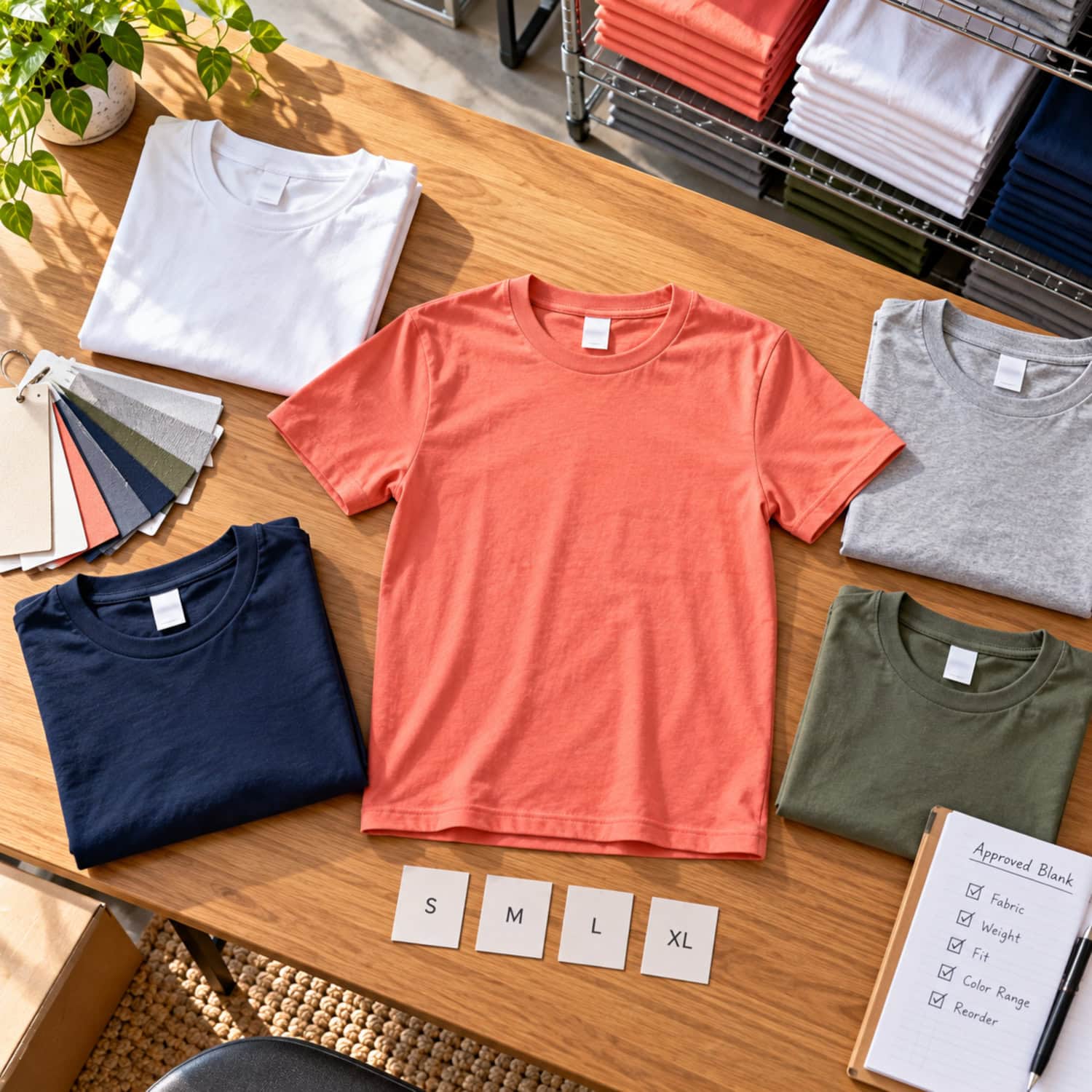
Blank shirts differ in fit, fabric feel, weight, and color range. Size availability, stock continuity, and print compatibility matter too.
Do not choose a blank only because it is cheap.
If the preferred color disappears whenever a repeat client reorders, the original saving can return wearing a much larger invoice.
Inventory should follow repeat demand. Hold proven sizes and colors when supplier lead times repeatedly delay jobs.
Broad speculative inventory ties cash to variants that may never sell.
Price the complete job, not the visible materials.
Use the cost model in Section 5, then adjust for order size, artwork or setup work, personalization, turnaround pressure, and the service level you are providing.
Do not copy a competitor’s shirt price without matching the competitor’s blank, production method, order size, and service.
A cheap 100-piece screen-print job and a three-piece personalized reorder are not the same unit of work.
If the price required for a healthy contribution seems too high for the target buyer, the answer is not automatically to accept a bad margin.
Revisit the product, production method, channel, order size, or buyer segment.
11. When to fix or drop an offer
A weak custom T-shirt offer should be changed when the problem is repeated and identifiable, not because one design had a quiet week.
Look for the constraint that keeps showing up across paid work.
Fix the offer if buyers want it but the blank, supplier, method, or turnaround creates repeated friction.
Change channels when attention does not become orders, and drop variants that create inventory or mistakes without meaningful demand.
Change production methods when the jobs change. Small full-color reorders can justify a different process from larger simple runs.
Repeated supplier failures also deserve action because customers experience the failure as yours.
12. Scaling a custom T-shirt business
Scale a custom T-shirt business by removing a measured bottleneck.
Common bottlenecks include customer acquisition, pressing capacity, supplier lead time, and owner time.
Others include transfer cost, artwork approval, fulfillment, and inventory availability.
If you outsource DTF transfers, compare historical transfer and shipping spend with the full cost of ownership before buying a printer.
Include maintenance, supervision, consumables, space, and a contingency for downtime.
There is no universal volume threshold that makes ownership correct for every shop.
The same logic applies to a second press, inventory, staff, or commercial space.
Add resources when paid work repeatedly hits the limit they would remove.
One operator can have repeat clients but still lack larger accounts.
Another can have demand but weak profit because production consumes the day. Identify the real constraint before spending against it.
Keep the product line disciplined as volume grows.
Expand because customers repeatedly ask for something profitable, not because a supplier catalog contains it.
13. Buying an existing custom T-shirt business
Buying an existing custom T-shirt business can provide customers, equipment, supplier relationships, and operating history.
The value depends on what actually transfers, so verify both the customer list and the assets.
Use this due-diligence checklist:
- Review order history by customer, job type, volume, and repeat rate rather than relying on total revenue alone.
- Rebuild order-level economics for representative jobs using the same full-cost logic as Section 5.
- Identify how much revenue depends on the seller’s personal relationships and whether those buyers are likely to stay.
- Inspect equipment condition, maintenance history, consumables, software, and any production bottlenecks.
- Verify supplier accounts, pricing arrangements, stock dependence, and whether favorable terms transfer to a new owner.
- Review open orders, deposits, credits, and reprints. Then review complaints and customer obligations that could follow the sale.
- Check leases, insurance requirements, vendor approvals, and contracts that need consent before assignment.
- Review artwork files, customer approvals, brand assets, and rights to designs included in the sale.
- Confirm how customer data, ecommerce accounts, domains, marketplace accounts, and payment systems can be transferred.
- Decide whether the purchase solves a real entry problem or simply bundles equipment you would not have bought separately.
The most valuable asset may be repeat demand rather than presses. If customers disappear with the seller, the acquisition problem remains.
14. Common traps and myths
Custom T-shirt businesses attract simple-looking promises because the product is familiar.
| Myth | What actually happens |
|---|---|
| Buy the right printer and customers will follow | Production capacity does not create a buyer or acquisition channel |
| POD means passive income | POD removes much of production, but design, marketing, support, supplier quality, cash timing, and returns still require management |
| The lowest competitor price is the market price | Different blanks, methods, quantities, and service levels can make headline prices incomparable |
| A mockup proves the product is ready | Physical samples reveal print, garment, color, placement, and wash issues that mockups cannot |
| Owning production is always cheaper | Ownership adds maintenance, operator time, workspace, consumables, and downtime risk |
| More products create more sales | More variants can also create inventory, quoting, quality-control, and fulfillment complexity before demand is proven |
Be skeptical of turnkey offers that package equipment, designs, and storefront setup as a finished business.
Ask how customers are acquired, how the economics are calculated, and what happens when order volume is lower than assumed.
The recurring beginner mistake is paying for a solution before the business has exposed the problem.
Equipment can solve capacity, but not an undefined customer, weak pricing, or a missing sales channel.

15. Custom T-shirt business launch plan
A custom T-shirt business launch should reduce uncertainty in sequence, reach paid work, and invest against what the first jobs reveal.
Before spending heavily
- Choose one business format from Section 2.
- Define the first buyer group and the job they are buying.
- Validate demand through real conversations, inquiries, or small paid tests.
- Choose the sales channel that can reach that buyer without heavy fixed spending.
- Build the unit-cost model before setting prices.
Before signing contracts or buying equipment
- Complete the business registrations and local checks that apply to your operation.
- Clarify artwork ownership and commercial-use rights for the designs you will print.
- Define proof approval, deposits, payment timing, turnaround, and reorder terms.
- Test shortlisted blanks, transfers, POD providers, or printers with physical samples.
- Compare outsourcing with ownership using real expected work, not hypothetical future scale.
Before opening for orders
- Create a repeatable order form or job sheet for garment, size, quantity, and artwork. Record placement, price, and approval too.
- Set one realistic turnaround promise and make the production workflow capable of meeting it.
- Limit the first assortment to products and methods you can control consistently.
- Decide how errors, reprints, shipping problems, and late customer changes will be handled.
During the first 30 to 90 days
- Track which buyer groups, channels, products, and job types create paid repeat demand.
- Record actual labor, shipping, supplier costs, mistakes, and contribution by order.
- Review which constraint appears most often before adding equipment, inventory, staff, or space.
- Keep the methods that fit the work and stop forcing every order through the same production process.
FAQ
Is a custom T-shirt business profitable?
It depends on full unit economics and repeatable demand.
A positive gap between sale price and blank cost is not enough if shipping, fees, labor, acquisition, and reprints consume the difference.
See Section 5.
How much does it cost to start a custom T-shirt business?
There is no useful single startup range across all formats.
POD avoids most production equipment, while home decoration and in-house printing add progressively more equipment, maintenance, workspace, and working-capital needs.
See Sections 2 and 5.
What equipment do I need to start?
It depends on the production model.
A POD seller may need no printing equipment, a hybrid decorator may begin with a heat press and outsourced transfers, and an in-house shop needs method-specific production gear.
See Section 8.
Do I need an LLC to sell custom T-shirts?
No, an LLC is not automatically required just because you sell custom T-shirts.
Business structure and local registration requirements are separate decisions. See Section 6.
Can I start a custom T-shirt business from home?
Yes, many custom-apparel models can operate from home if the workspace and local rules allow the activity.
Check home-occupation, zoning, licensing, shipping, and customer-access requirements before committing. See Section 6.
Is DTF better than screen printing for a startup?
It depends on order size, artwork complexity, garment type, and the quality the customer wants. Reorders and throughput matter too.
DTF often fits short full-color work, while screen printing can fit larger simpler runs. See Section 8.
How long does it take to get the first sale?
There is no useful universal timeline.
Existing audience access, local relationships, offer quality, and the chosen acquisition channel matter more than a calendar estimate.
See Sections 3 and 4.
Should I order samples before selling POD shirts?
Yes, selectively test the products and providers whose quality matters to the offer.
A physical sample can reveal color, print, garment, placement, and wash problems that a mockup cannot. See Section 9.
Conclusion
Choose the customer and business model before you buy equipment.
A custom T-shirt business gets stronger when each new expense answers a proven operating need instead of a hypothetical future one.
1. Prove demand first. Get evidence that a reachable buyer wants a specific apparel job before making major production commitments.
2. Price the whole order. Include every variable cost and fixed overhead before deciding whether the sale is worth taking.
3. Scale the bottleneck. Add equipment, inventory, people, or space only when paid work repeatedly shows what capacity is missing.
Further reading
- U.S. Small Business Administration: Federal starting point for business planning, registration, permits, and small-business operating guidance.
- U.S. Patent and Trademark Office: Official information on trademarks and the distinction between business identity and trademark protection.
- Shopify guide to starting an online T-shirt business: Covers niche selection, production methods, validation, store setup, pricing, and marketing.
- Wix guide to starting a T-shirt business: A broad startup walkthrough covering ecommerce, POD, products, pricing, and scaling.
- Printful guide to starting a T-shirt business: Useful for understanding a POD-first launch and supplier selection criteria.
- DTF Database custom T-shirt business guide: Compares production models through budget, volume, and design complexity.
- Signs101 discussion on direct-to-garment printer economics: Practitioner discussion of maintenance, preparation, postprocessing, and operator time.
- Reddit discussion on outsourcing versus in-house DTF: Operator perspectives on the volume and workload question behind bringing DTF production in-house.