To start a sticker business, choose a specific audience, test a small set of original designs, pick a low-commitment production model, calculate each real order, then choose a sales channel and shipping method that preserve margin.
Test demand and order economics before buying equipment or deep inventory. You can produce at home, use print-on-demand, or order from a commercial printer. Each route trades cash, control, labor, and inventory risk differently.
Licenses and tax requirements vary by location and selling method, so check local business rules, home-business permissions, sales tax obligations, and marketplace requirements before launch.
The ongoing challenge is rarely making one attractive sticker. It is generating repeatable demand while keeping production, fulfillment, and customer acquisition from consuming the margin.

Last fact-checked: October 6, 2026
This guide is for US beginners launching an original sticker line online, from home, at events, or through small retail channels. It covers production choices, demand testing, pricing, shipping, basic compliance, equipment, supplier checks, and the point where growing sales should change how you produce.
1. How a sticker business works and the launch sequence
A sticker business turns original designs into low-ticket physical products, then earns money by selling them through marketplaces, owned stores, events, or retail channels.
The operational sequence matters because a cheap product leaves little room for expensive mistakes.
| Stage | Decision | Move forward when |
|---|---|---|
| 1. Business model | Decide how the sticker business will operate | You understand the full sequence from demand to fulfillment |
| 2. Production format | Choose do-it-yourself (DIY), print-on-demand, or outsourced printing | The format fits your cash, control, labor, and inventory tolerance |
| 3. Demand | Validate a niche and initial designs | Real buyers show interest without requiring deep inventory |
| 4. Sales channel | Choose where buyers will discover the products | The channel has a credible traffic source and workable fees |
| 5. Economics | Calculate a complete order, not just sticker cost | The price leaves contribution after production and fulfillment |
| 6. Legal setup | Check registration, tax, home-business, and product rules | Required registrations and permissions are clear for your location |
| 7. Supplier terms | Verify outsourced production or platform terms | Samples, minimums, turnaround, and total landed cost are acceptable |
| 8. Equipment and quality | Validate tools, materials, and durability claims | The workflow repeatedly produces saleable stickers |
| 9. Operations | Set packing, shipping, records, and replenishment | Orders can move without constant improvisation |
| 10. Product and pricing | Build singles, sheets, bundles, or custom offers | Each offer has a price supported by its real cost structure |
| 11. Scaling | Change production when labor or stock becomes the bottleneck | Proven demand justifies more capacity or outsourcing |
| 12. Traps | Remove weak assumptions before spending more | The business does not depend on copied pricing or borrowed intellectual property |
| 13. Launch | Open with a controlled test and measure what sells | You can track sales, cost, traffic, and fulfillment problems |
Buying a cutter before knowing what buyers want reverses the sequence. So does ordering a large batch before you know which designs deserve a reorder.

2. Sticker business production formats
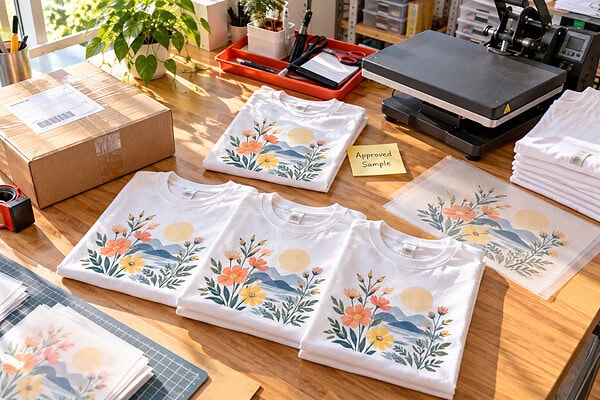
A sticker business can start with home production, print-on-demand, or outsourced commercial printing.
For a first launch, our editorial recommendation is to choose the route that makes a wrong guess cheapest to reverse, not the route with the most impressive equipment list.
| Production format | Upfront commitment | Inventory risk | Owner workload | Best fit |
|---|---|---|---|---|
| Home print-and-cut | Equipment, materials, test waste | Low to moderate | High | Small tests, frequent design changes, hands-on control |
| Print-on-demand | Low equipment commitment | Low | Low to moderate | Testing designs without stocking finished inventory |
| Small outsourced batches | Samples plus finished inventory | Moderate | Moderate | Proven designs when home production is inconvenient |
| Larger commercial runs | Larger inventory commitment | High | Lower production labor | Repeat sellers with stable demand and predictable reorders |
Home production gives control, but its apparent unit cost can hide labor, failed sheets, maintenance, and finishing time.
Print-on-demand removes much production work but can be harder to fit into a low-price product.
Outsourcing reduces labor, while minimum orders increase inventory risk.
These routes do not have to be permanent. Proven designs can move to higher-volume production later.
3. Sticker demand and early inventory
The central rule for a new sticker business is simple: test demand and order economics before buying equipment or deep inventory.
A pile of finished stickers proves that you can manufacture inventory, not that customers want it.
Define an audience narrowly enough that a buyer can recognize the product as meant for them.
Useful design signals include relatability, humor, visual appeal, nostalgia, and specific interests.
Generic art competes with everything. Specific art only has to matter to the right people.
Use a shallow launch rather than a deep one.
Spread limited cash across several promising designs, observe which ones attract clicks, event interest, or sales, then reorder the winners.
The scene to avoid is painfully ordinary: 50 copies of one design sitting in a drawer because the larger quantity looked cheaper per unit.
A simple validation sequence works well:
- Define the audience for each design in one sentence.
- Choose several distinct designs rather than many minor variations of one idea.
- Test them through a channel where the intended audience already spends attention.
- Record which designs get views, saves, questions, or purchases.
- Reorder or expand only the designs that show repeatable interest.
Offline results need context. A weak event can reflect the audience rather than the product itself.

4. Sales channels for a sticker business
A sticker business needs a discovery system, not merely a checkout page.
Marketplaces, owned stores, events, and retail channels solve different parts of the customer-acquisition problem.
| Channel | Main advantage | Main limitation | Best fit |
|---|---|---|---|
| Etsy | Existing search demand and familiar checkout | Fees and heavy competition | Sellers who need marketplace discovery |
| Owned store | Brand and customer relationship control | You must generate traffic | Sellers with an audience or repeat buyers |
| Art fairs and conventions | Direct visibility with a concentrated audience | Event fit can vary sharply | Designs tied to a clear community or interest |
| Retail and wholesale | Access to someone else’s foot traffic | Lower control over presentation and margin | Proven designs with reliable replenishment |
Opening an owned store because marketplace fees are annoying does not solve the traffic problem.
A storefront without traffic is just a well-decorated waiting room.
If you already have an audience, the economics change because you are not asking the store to create demand from nothing.
A crowded marketplace can still be useful when buyers already search there.
Compare the cost of marketplace access with the cost of generating qualified traffic yourself.
5. Startup costs and sticker unit economics
Sticker startup cost depends heavily on production format, so a single number is less useful than a complete cost map.
The economic test is whether a realistic order leaves enough money after production, waste, labor, selling costs, and fulfillment.
| Cost area | DIY | Print-on-demand | Outsourced batch |
|---|---|---|---|
| Production setup | Printer, cutter, materials, possible finishing tools | Samples and account setup | Samples and initial order |
| Inventory | Flexible materials and finished stock | Usually minimal finished stock | Finished stock before sale |
| Waste | Misprints, cutting errors, calibration loss | Lower owner-side production waste | Defects and unsold inventory |
| Labor | Printing, laminating, cutting, packing | Design, listing, customer service | Design, receiving, packing |
| Fulfillment | Packaging and postage | Provider or seller fulfillment model | Packaging and postage |
| Selling costs | Platform or payment fees | Platform, provider, and payment costs | Platform or payment fees |
For a low-ticket product, the dangerous calculation is “sticker cost versus sticker price.”
The useful calculation is the order after every cost. A cheap sticker can become an expensive hobby one envelope at a time.
Operating profit per order = order revenue – production – expected waste – packaging – selling fees – postage – labor – allocated fixed overhead
The following figures are illustrative numbers, not a benchmark.
| Term | Illustrative amount |
|---|---|
| Order revenue | $12.00 |
| Production | $3.00 |
| Expected waste | $0.50 |
| Packaging | $0.75 |
| Selling fees | $1.25 |
| Postage | $1.50 |
| Labor | $2.00 |
| Fixed overhead allocated at 20 orders | $1.50 |
| Operating profit per order | $1.50 |
If expected monthly fixed overhead is $30 and sales fall from 20 orders to 10, allocated overhead rises from $1.50 to $3.00 per order.
With the other illustrative numbers unchanged, operating profit falls to $0.00 per order.
That is why a stress test at half the expected sales matters.
Bundles can improve the picture because one payment and one fulfillment event can carry several stickers.
Price each bundle from its own cost structure.


6. Legal basics for a sticker business
A US sticker business should check business and tax rules, home-business rules, intellectual property, marketplace requirements, and product rules before launch.
Requirements can vary by state, city, selling channel, and the way the product is marketed.
| Item | When it matters | Where to check |
|---|---|---|
| Business registration and local license | When your location or business form requires registration | Your state business portal and local licensing office |
| Sales tax registration | When your selling activity creates a collection obligation | Your state revenue department and marketplace documentation |
| Home occupation rules | When producing or storing inventory at home | Your city or county zoning and licensing office |
| Marketplace rules | When selling through Etsy or another platform | The platform’s current seller policies |
| Copyright and trademark rights | Before selling art based on characters, logos, names, or other protected work | The rights holder, a qualified attorney, and the U.S. Patent and Trademark Office |
| Children’s product rules | If the sticker product is specifically marketed for children | The Consumer Product Safety Commission |
| Skin-applied or cosmetic-style products | If the product moves beyond ordinary surface stickers | The relevant federal and state product regulator |
| Product labeling and claims | When you make durability, use, or material claims | The regulator that covers the product category and your supplier documentation |
Fan art deserves special caution. Seeing other shops sell recognizable characters does not create permission for your shop.
Build the core catalog around original work or work you have a clear commercial right to use.
An LLC (limited liability company) is a separate decision from whether you can sell stickers at all.
Choose a structure for liability, tax, ownership, and administrative needs.
Use a certified public accountant (CPA) or attorney when those consequences matter.
7. Supplier and platform terms
A sticker business that outsources production should evaluate the landed result, not the quoted price per sticker.
Minimum orders, sample quality, landed cost, turnaround, and reorder flexibility can matter more than a headline unit price.
Before placing a meaningful production order, ask the supplier:
- What is the minimum order quantity for each design and each finish?
- Can one production run be split across several designs?
- What does the landed cost include after shipping and other charges?
- Can I order or approve a sample before a larger run?
- How consistent are color, cutting, adhesive, and finish between reorders?
- What is the normal turnaround for an initial order and a reorder?
- What happens if part of the batch is defective or cut incorrectly?
- How much flexibility do I have to reorder only the designs that sell?
A low quote with a large minimum can be worse than a higher quote that lets you test several designs in shallow quantities.
The first purchase tests both quality and inventory risk.
Platform terms matter too. Check selling fees, payment handling, listing rules, intellectual-property enforcement, and shipping expectations.
Verify current platform restrictions before you price the catalog.
8. Equipment and sticker quality
A DIY sticker business needs a reliable workflow, not simply a printer and a cutter.
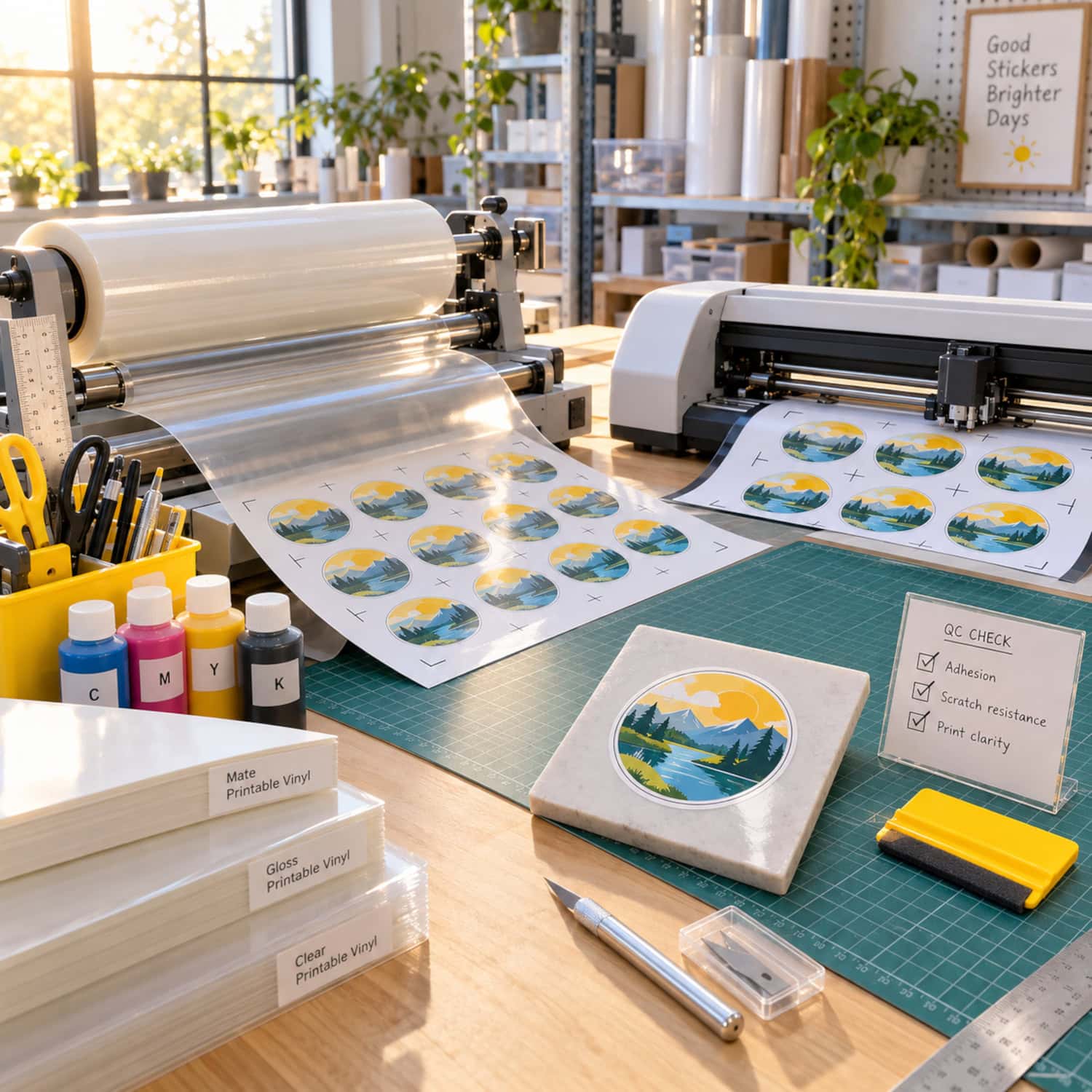
Print-and-cut alignment, calibration stability, material compatibility, finishing, and usable throughput determine how many saleable stickers you actually get from your time and materials.
Brands such as Cricut, Silhouette Cameo, Brother, and Epson EcoTank appear in sticker workflows, but the brand does not answer the operational questions.
Test the full process on the material and finish you plan to sell.
Use this pre-purchase and pre-launch checklist:
- Print several sheets and confirm color is consistent enough for your product.
- Run repeated print-and-cut tests and check alignment around the full sheet.
- Test the actual matte, gloss, clear, or printable vinyl stock you intend to use.
- Check whether glossy media or registration marks create scanning problems.
- Measure how many saleable sheets you can produce in an hour, including setup.
- Confirm the software workflow is understandable and repeatable for you.
- Include failed prints, blades, mats, ink, cleaning, and maintenance in the cost model.
- Decide whether the intended use requires lamination or another finishing step.
Imagine a cutter missing the design by about a millimeter across a full sheet.
The material did not become cheaper because the machine technically completed the job.
A cutter that behaves in tutorials but wastes sheets on Tuesday is part of your cost structure.
Quality also needs a use case. Water exposure, sunlight, scratching, adhesive behavior, and expected lifespan are separate questions.
Do not use “waterproof” or similar language as a vague quality badge when your specific material and print process have not earned the claim.


9. Sticker operations and shipping
A sticker business becomes operationally real when orders must be packed, shipped, recorded, and replenished without consuming every available hour.
Sticker sales still require traffic, production or supplier management, fulfillment, customer service, and restocking.
The lighter the product, the easier it is to underestimate fulfillment because each task looks trivial in isolation.
Shipping is unusually important because the product price can be close to the cost of protected or tracked delivery.
Cheap untracked letter mail can preserve order economics, but it raises delivery uncertainty.
More protective or tracked shipping can reduce that uncertainty while taking a larger share of a small order.
Choose a shipping policy by order value, packaging needs, loss exposure, destination, and customer expectations.
Test the actual package before publishing prices. Expensive fulfillment may require a different price, minimum order, or bundle.
Keep records for revenue, production cost, waste, and labor time. Track fulfillment costs and refunds separately.
Use the records to see whether the business still makes money after fulfillment.
10. Sticker products and pricing
A sticker business can sell single die-cut stickers, kiss-cut sheets, bundles, packs, or custom work.
The strongest product mix is the one that matches buyer behavior while keeping fulfillment and production effort proportional to order value.
Price from your cost structure rather than from the cheapest competing listing.
Another seller may have different manufacturing costs, shipping assumptions, volume, labor valuation, or a loss-leading product.
Copying the visible price copies none of those hidden variables.
Bundles deserve special attention because fixed fulfillment costs are spread across more revenue.
A “pick several” offer can also let customers build a set without forcing you to manufacture a preselected bundle in deep inventory.
Customization needs its own math.
If every order requires layout work, proofing, printing, and one-off cutting, more orders can create nearly linear labor growth.
Charge for the work or redesign the offer so repeated steps can be batched.
Pricing can feel uncomfortable because a physically small object can require a price that seems large beside its size.
Size is not the cost model. Sustainable pricing has to pay for the whole order.


11. When to change production and scale
A sticker business should change production methods when proven demand makes owner labor, equipment throughput, or stock availability the main constraint.
Scale the winner, not the optimism.
Watch for repeated stockouts, production hours crowding out design or selling work, and rising waste from process limits.
A seller spending late nights producing proven designs has a capacity problem, not a demand-testing problem.
At that point, compare the value of your production hours with the landed cost of outsourcing.
Commercial printing can become attractive even when its quoted unit cost is higher than raw DIY materials because it buys back labor and capacity.
Do not scale every design equally.
Deepen proven designs first, keep experiments shallow, and retire products that occupy cash or labor without earning their place.
Higher volume magnifies good economics and bad economics with equal enthusiasm.
12. Sticker business traps and myths
A sticker business is easy to open badly because the individual purchases look small.
The main traps come from treating equipment, platform choice, low prices, or popular intellectual property as substitutes for validated demand and complete economics.
| Myth | What actually happens |
|---|---|
| Buy a cutter first and figure out products later | Equipment creates capability, not customers, and calibration can add waste and troubleshooting |
| The cheapest unit cost is always the best production choice | Labor, minimum orders, shipping, waste, and unsold inventory can reverse the comparison |
| Moving from Etsy to an owned store fixes weak sales | The store gives control, but traffic still has to come from somewhere |
| Free shipping is automatically better | On low-price orders, shipping can consume the remaining contribution |
| DIY always has the highest margin | DIY can become labor-heavy once printing, laminating, cutting, maintenance, and restocking grow |
| Fan art is safe because other shops sell it | Common practice does not create commercial permission |
| More designs always make the shop stronger | Broad testing helps, but a catalog full of weak products ties up attention and inventory |
Replace these myths with records from real orders, production, and customer response.
Marketing folklore hates spreadsheets because spreadsheets have poor manners.

13. Sticker business launch plan
A sticker business should launch as a controlled test with clear checkpoints for demand, production quality, pricing, fulfillment, and compliance.
The goal of the first launch is to learn which products and processes deserve more capital.
- Choose one audience and write down why the first designs should matter to that group.
- Build a small catalog of original or properly licensed designs.
- Choose DIY, print-on-demand, or outsourced production based on reversible risk.
- Produce samples and test material, color, cutting, finish, and intended-use claims.
- Calculate the full cost of a realistic order, including labor and fulfillment.
- Check local registration, home-business, sales tax, marketplace, and product requirements.
- If outsourcing, complete the supplier questions in Section 7 before a meaningful order.
- If producing at home, complete the equipment checklist in Section 8 across repeated runs.
- Choose one primary sales channel with a credible source of buyer discovery.
- Set single, bundle, and custom pricing only after the order economics work.
- Test packaging and shipping with the actual package size and order value.
- Launch shallow inventory, track sales by design, and reorder proven winners first.
- Review labor, waste, stockouts, and fulfillment problems before adding equipment or volume.
During the first 30 to 90 days, track which designs convert, which channel produces buyers, which order sizes remain profitable, and which production steps create recurring waste.
Reward signals that justify the next spend.
FAQ
These answers cover the most common starting questions about a sticker business without repeating the full operating sections.
Is selling stickers profitable?
It can be profitable if the selling price covers production, labor, fulfillment, selling costs, and overhead with money left over. See Section 5.
How much does it cost to start a sticker business?
It depends on the production model because DIY adds equipment, print-on-demand minimizes equipment commitment, and outsourced production adds inventory.
See Sections 2 and 5.
Do I need a Cricut to start a sticker business?
No. A sticker business can use home cutting equipment, print-on-demand, or an outsourced printer, so the cutter is a production choice rather than a prerequisite.
See Sections 2 and 8.
Can I start a sticker business from home?
Yes, if your production and storage fit the space and local home-business rules allow the activity.
Check the relevant local requirements described in Section 6.
Is Etsy or an owned store better for stickers?
It depends on whether you need marketplace discovery or already have a reliable audience. See Section 4.
How many sticker designs should I launch with?
There is no universal number, but a shallow test across several distinct designs reduces the risk of overbuying one unproven design. See Section 3.
Should I offer free shipping on stickers?
Only if the order economics support it, because postage can consume a large share of a low-price order. See Sections 5 and 9.
How long does it take to start selling stickers?
There is no useful universal timeline because launch speed depends on production testing, supplier turnaround, compliance checks, and the sales channel.
Use the sequence in Section 13.
Conclusion
A durable sticker business starts by testing demand and order economics before buying equipment or deep inventory, then scales only what buyers have already validated.
The product is small, but the business still has all the usual moving parts: demand, cost, operations, rights, and traffic.
1. Prove demand cheaply. Keep early quantities shallow until specific designs earn reorders.
2. Price the whole order. Include production, waste, labor, fees, packaging, shipping, and overhead before deciding what looks competitive.
3. Change production when the bottleneck changes. Use equipment or outsourcing to solve proven capacity problems, not to manufacture a sense of progress.
Further reading
These resources help a sticker business owner check setup, intellectual property, product safety, production, and selling choices.
- U.S. Small Business Administration: Start with federal small-business guidance, then follow the links relevant to registration, planning, and local requirements.
- Internal Revenue Service: Use the IRS for federal tax information and employer identification number guidance when your business setup requires it.
- U.S. Patent and Trademark Office: Check federal trademark information before building products around names, logos, or brand identifiers.
- U.S. Consumer Product Safety Commission: Review product-safety requirements if your sticker product is specifically marketed for children.
- Etsy Community intellectual property guide announcement: A marketplace starting point for understanding Etsy’s intellectual-property guidance and enforcement context.
- How to Make and Sell Stickers: A practical overview of sticker production, formats, pricing, and selling channels.
- Start a Sticker Business: A practical comparison of home production, print-on-demand, and outsourced printing.
- Lamination Recommendation for Small Scale Stickers: Professional discussion of small-scale lamination, materials, and finishing considerations.