To start a greeting card business, choose a specific buyer and occasion, make a small sellable batch, test paid demand, calculate contribution per order, and commit to one sales channel before you scale production.
Our recommendation is simple: validate paid demand and unit economics before you build inventory. Then choose a production method: handmade, home-printed, outsourced, or print-on-demand.
Base that choice on labor, quality, reorder speed, and the price customers will accept. There is no useful universal startup-cost figure because the production model changes the cost structure.
Check state and local registration, sales-tax, home-business, and zoning requirements before selling. The long-term constraint is usually not design talent.
It is whether production time, shipping, channel fees, and inventory still leave enough money per order.
Last fact-checked: October 6, 2026
This guide is for US beginners turning illustration, stationery, or handmade cardmaking into a small business. It covers physical greeting cards sold online, at markets, through local shops, and eventually wholesale, with an emphasis on low-risk validation before larger print runs.
1. How a greeting card business works and the launch sequence
A greeting card business turns designs into repeatable products, then sells them through direct or retail channels at a price that covers production, fulfillment, selling costs, and the owner’s time.
The right launch sequence is driven by what must be proven before the next commitment.
| Stage | Decision | Move forward when |
|---|---|---|
| 1. Model | Choose handmade, home print, outsourced print, or print-on-demand | You know what work happens per order |
| 2. Format | Choose standard, niche, personalized, or bundle-led cards | The offer has a clear buyer and use case |
| 3. Demand | Test whether strangers will pay | You have paid sales, not just compliments |
| 4. Channel | Choose the first place to sell | Buyer behavior fits the channel |
| 5. Economics | Calculate contribution per order | The price covers variable costs and labor |
| 6. Setup | Handle registration, taxes, permits, and insurance | The business can legally sell in its location and channel |
| 7. Contracts | Set retailer, supplier, or consignment terms | Responsibilities and payment terms are clear |
| 8. Production | Buy or commit to equipment and suppliers | Quality and reorder capacity match proven demand |
| 9. Operations | Build fulfillment and inventory routines | Orders can be repeated without chaos |
| 10. Assortment | Expand products and pricing carefully | New designs solve known buyer needs |
| 11. Cut decisions | Drop weak designs or channels | Sales evidence shows where effort is wasted |
| 12. Scale | Increase batches or enter wholesale | Winners reorder reliably and margins survive volume |
| 13. Traps | Remove model mistakes | Claims and shortcuts have been stress-tested |
| 14. Launch | Execute the first 30 to 90 days | Decisions are based on sales evidence |
Branding can wait until the commercial model is coherent.
A beautiful logo cannot rescue a card that takes an hour to make and sells at a price that barely covers postage.
2. Greeting card business formats
A greeting card business can use handmade, home-printed, outsourced, print-on-demand, or personalized production.
For a first launch, choose the format that tests demand without locking you into a large catalog.
| Format | Main advantage | Main constraint | Best for |
|---|---|---|---|
| Fully handmade | Strong uniqueness and tactile value | Labor per card can overwhelm the selling price | Small premium runs and highly distinctive work |
| Home-printed | Small batches and fast replenishment | Printer limits, ink cost, finishing time, consistency | Testing many designs with low inventory |
| Outsourced print | Consistent finish and lower production labor | Minimum quantities, turnaround, shipping, supplier dependence | Proven designs with repeat demand |
| Print-on-demand | Little or no finished inventory | Higher unit cost and less control over fulfillment | Broad testing when holding stock is the main risk |
| Personalized or hybrid | Higher specificity and differentiation | More messages, revisions, and labor per order | Hard-to-find recipient and occasion combinations |
Handmade maximizes human input, while repeatable printing makes scale easier.
A maker who enjoys creating one new card each evening may feel differently after the fiftieth repeat of the same bestseller.
3. Validate demand before building inventory
For a greeting card business, validate paid demand and unit economics before you build inventory.
A compliment is useful feedback, but a paid order is the test that matters.
Start with a narrow hypothesis: a recipient, an occasion, and a clear reason this card is easier to choose than a generic alternative.
Examples include a specific relationship, cultural or religious occasion, military connection, personalized message, or a card that doubles as a small art print.
For an early physical test, 5 to 10 copies per design is a sensible editorial starting point when that quantity is practical.
Use a small set of designs, then sell them where the intended buyer already appears.
A craft market can show whether people stop, pick up the card, read it, and pay. A local shop can expose whether the product fits its audience.
An online listing can reveal whether the design attracts search traffic and converts.
Picture the familiar scene: three friends say, “You should sell these,” and all three disappear when the checkout link arrives.
Compliments are applause, not purchase orders. Keep printing decisions tied to paid behavior.
Track sales by design, not just total revenue.
The winning design is the one customers reorder or buy repeatedly, not necessarily the one you most enjoy making.

4. Choose the first sales channel
A greeting card business has no universally best sales channel because card buying is shaped by urgency, shipping cost, audience fit, and discovery.
Pick one primary validation channel first so weak demand does not get confused with weak execution across five channels.
| Channel | Strength | Weakness | Use it first when |
|---|---|---|---|
| Etsy or another marketplace | Existing search demand | Fees, price competition, shipping friction, listing work | Buyers search for the niche online |
| Craft fairs and markets | Fast feedback and no shipping on the sale | Event quality and audience fit vary sharply | You need direct reactions and local testing |
| Local shops and boutiques | Cards can be bought near the moment of need | Retailer margin and reorder requirements | The product fits a specific store audience |
| Own website | Control over presentation and customer relationship | You must create your own traffic | You already have demand or a reliable audience source |
| Wholesale | Larger orders and repeat retailer relationships | Lower trade price and more operational requirements | Direct sales already prove the assortment |
Shipping deserves attention before you commit to online direct-to-consumer sales.
If a modestly priced card is followed by a delivery charge that feels nearly as large, the product may be fine while the order economics are broken.
Bundles can spread fulfillment cost across several cards and serve buyers who want attractive cards ready for future occasions.
Test them when single-card shipping is the main obstacle.
At a market, warm praise can coexist with weak sales. Treat that as evidence about audience fit, offer clarity, or price.
5. Startup costs and unit economics
Greeting card startup cost depends more on production method and channel than on a universal budget.
The important job is to separate one-time setup, variable cost per order, and fixed monthly costs before deciding whether the business is viable.
Plan for production materials and tools, envelopes and packaging, selling fees, shipping or fulfillment, and overhead such as storage or insurance.
A home printer can reduce minimum order risk, but ink and owner time still count.
Outsourcing can reduce hands-on labor, but freight and minimum quantities can turn a cheap print quote into expensive stock.
Use this formula for planning:
Monthly operating contribution = orders x (average order revenue – variable cost per order) – monthly fixed costs
The result is not final accounting profit.
It is a practical operating measure for testing whether the model has room to breathe before taxes and other business-level costs.
| Illustrative numbers | Amount |
|---|---|
| Monthly orders | 40 |
| Average order revenue | $18.00 |
| Variable materials, packaging, fees, fulfillment, and labor per order | $10.00 |
| Contribution per order | $8.00 |
| Monthly fixed costs | $120.00 |
| Monthly operating contribution | $200.00 |
With half the expected sales, 20 orders produce $160 of order contribution before fixed costs.
After the same $120 of fixed costs, only $40 remains. That is the stress test: volume can disappoint while fixed costs remain.
Price from your own cost structure, not from the cheapest card you can find online.
Some sellers undercount labor, packaging, fees, or shipping. Copying their price can copy their mistake.
For handmade cards, time is the dangerous line item.
If one card takes 20 to 60 minutes of manual work, the acceptable retail price may collide with what the buyer expects to pay.
Change the production method, simplify the handmade element, raise the value of the offer, sell bundles, or choose a different niche before accepting unpaid labor as the business model.


6. Business setup and legal basics
A US greeting card business should check the legal requirements for its location, sales channel, and structure before taking orders.
State and local rules vary, so use official agencies for your address and selling method.
Check these areas before launch:
- Business registration and entity choice, including whether a sole proprietorship or limited liability company (LLC) fits your situation.
- Sales-tax registration and resale documentation where required by your state.
- Local business licensing, home-occupation rules, zoning, or event-vendor requirements where applicable.
- Marketplace rules for the platforms you use.
- Copyright, trademark, font, illustration, and other intellectual property permissions for anything included in the card.
- Insurance appropriate to your equipment, inventory, events, employees, and retailer requirements.
You do not need to treat an LLC as the starting gun for every card business.
Structure choice affects liability, taxes, and administration, so compare options rather than using entity formation as a substitute for demand validation.
If a legal or tax choice materially changes your obligations, use a qualified attorney, certified public accountant (CPA), or licensed insurance professional at that decision point.
7. Retailer and supplier contracts
Greeting card retailer and supplier agreements matter once another business controls stock, money, production, or fulfillment.
In wholesale, the retailer buys inventory. In consignment, the seller may keep ownership until a card sells.
Before stock changes hands or production is committed, answer these questions in writing:
- What pack quantity and trade price apply?
- When is payment due, and how are reorders placed?
- What happens to unsold, damaged, or missing stock?
- How will consignment inventory be tracked?
- How can either side end the arrangement?
- For a printer or supplier, who approves quality, and what are the turnaround and reorder terms?
Wholesale exposes pricing fantasies quickly.
Before approaching shops, stress-test the card at a materially lower trade price and confirm that production still leaves a contribution for you.
A boutique buyer may like the design and immediately ask, “What is the pack size, trade price, and reorder time?”
If those answers do not exist yet, the product is not wholesale-ready even if consumers love it.
8. Production equipment and suppliers
Greeting card production should follow proven demand.
Choose equipment and suppliers that can reproduce the product consistently at the volume you actually need.
Use this pre-purchase and supplier checklist:
- Print the exact cardstock or material you plan to sell and confirm reliable feeding, color, and finish.
- Time the complete production process, including printing and finishing, assembly, personalization, and packing.
- Calculate materials, packaging, spoilage, and shipping costs rather than looking only at the headline print price.
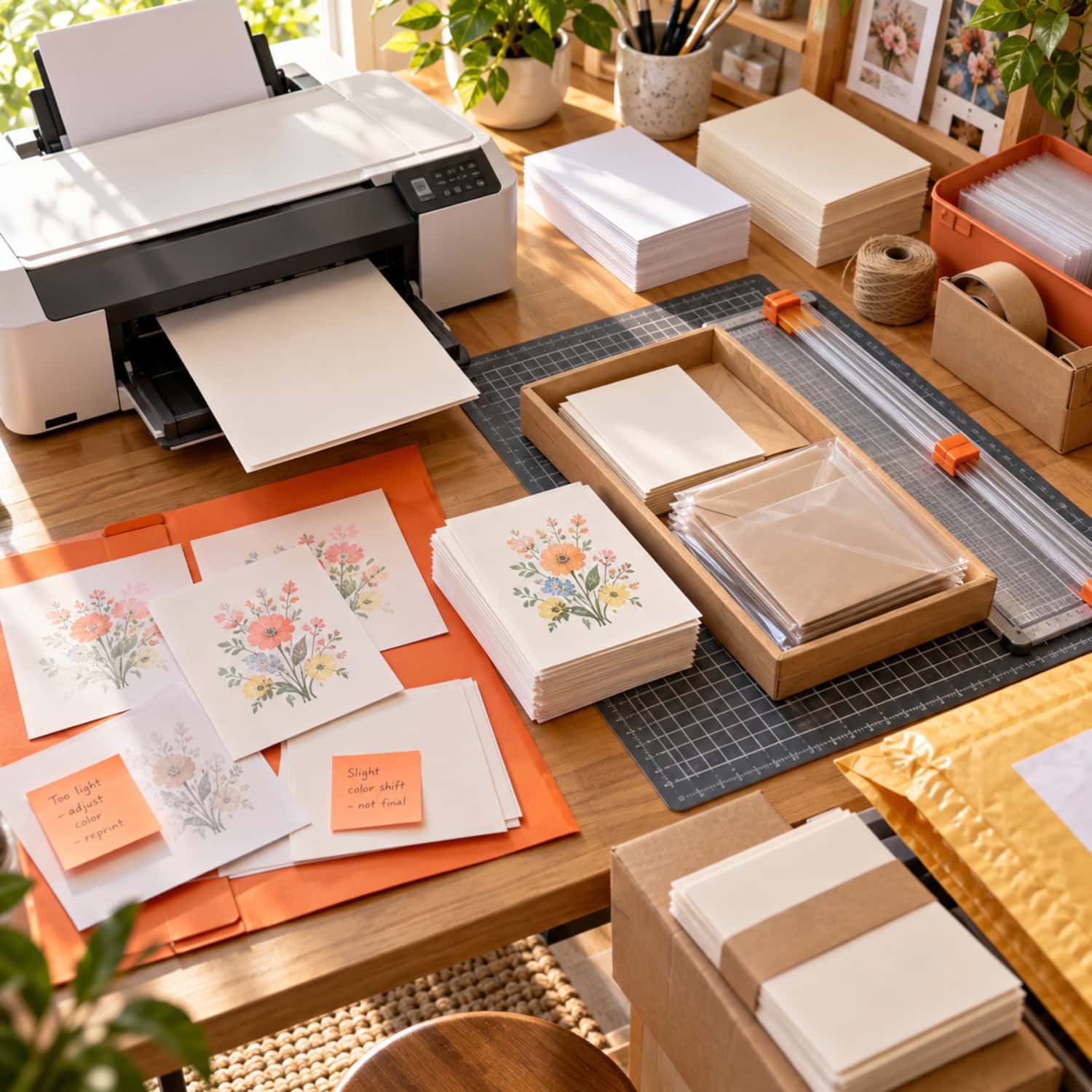
- Ask an outside printer about minimum quantities, turnaround, reorders, sample approval, and shipping.
- Check whether color and finish stay consistent across repeat batches.
- Confirm that a bestseller can be replenished fast enough for your strongest channel.
- Keep a fallback plan for a supplier delay, printer failure, or discontinued paper stock.
The glamorous version of production is a stack of perfect cards beside a latte.
The operational version is a printer refusing thick stock on the night before a market. Test the boring parts early.
A cheap print run can become expensive storage.
Move proven winners to larger outsourced batches only when the lower unit cost is worth the cash commitment and inventory risk.
9. Greeting card operations and fulfillment
A greeting card business becomes operationally difficult when the catalog grows faster than the systems behind it.
Each new design creates more inventory, listings, display space, fulfillment work, and reorder decisions.
Keep the first operating system simple. Give each design a consistent internal name or stock-keeping unit when needed.
Track quantity on hand, units sold, channel, reorder point, and production method. Add barcodes when a retailer, channel, or scale makes them useful.
Batch repetitive work. Batch printing and finishing, packing, photography, and personalization rather than resetting the workspace for every order.
Handmade work can still feel personal without making every card from scratch after checkout.
A catalog grows faster than the shelf space it needs.
One hundred designs sound like choice until you must transport, display, count, photograph, and restock them.
Fulfillment should also match the product price.
Use packaging that protects the card without creating a shipping method so expensive that the buyer abandons the order.


10. Products and pricing
Greeting card customers often shop for a recipient and occasion rather than for “nice art” in the abstract.
Build products around a clear use case, then let style and illustration differentiate the choice.
A useful product formula is recipient plus occasion plus distinctive theme or message.
The more specific the use case, the easier it can be for the right buyer to recognize the card.
Hard-to-find occasions, cultural moments, relationships, and personalization can create stronger purchase intent than another generic birthday design.
Blank cards still have a place, especially when the artwork itself carries value or the buyer wants a multipack.
Their advantage is versatility. Occasion-specific cards are easier to choose when the buyer has an immediate job to do.
Bundles can raise average order value and make shipping more tolerable.
Personalized cards can support a higher perceived value, but every customization step adds conversation, proofing, and production time.
Price that labor instead of treating it as a free bonus.
11. When to cut a design or change a channel
A greeting card design should earn more inventory only after it proves sales.
Keep weak products on a short leash because every slow design occupies cash, space, attention, and listing effort.
Separate a traffic problem from a conversion problem. An online listing with almost no views has not been fairly tested for conversion.
A design that gets plenty of qualified views or physical pickup but few purchases points more strongly toward price, message, audience fit, or product mismatch.
At a market, watch what people touch, read, buy, and ask for. In a shop, watch reorders.
Online, watch qualified traffic, conversion, and repeat purchase.
When the same design stays weak across a fair test, stop printing it instead of protecting the idea with more stock.
Old stock can be bundled, discounted carefully, moved to another channel, or retired.
Do not keep expanding the catalog merely to avoid admitting that some ideas lost.


12. Scale with proven designs and wholesale readiness
Scale a greeting card business by increasing efficiency around proven winners.
When a design sells repeatedly, compare home production with an outsourced batch using landed cost, turnaround, quality, storage, and cash tied up in inventory.
Wholesale becomes attractive when the retail price leaves room for a lower trade price and you can replenish consistently.
Retailers may expect pack quantities, invoices, product codes, stable packaging, and coherent public pricing.
Add that infrastructure when the channel demands it.
Keep channel pricing deliberate. A shop that stocks your card may object if you undercut it publicly at every market.
Agreements and local relationships differ, so decide how direct pricing, promotions, and retail pricing will coexist before promising terms.
For personalized work, standardize repeatable steps, limit the customization menu, and track labor per order.
More sales help only when each additional sale still improves the business.
13. Greeting card business traps and myths
Greeting card business mistakes often begin when a creative product is treated as proof of demand.
Use these myths as warning labels, not as instructions.
| Myth | What actually happens |
|---|---|
| “Friends love my cards, so demand is proven” | Paid sales from the intended buyer are stronger evidence than compliments |
| “The cheapest competitor sets my price” | Their labor, fees, shipping, and profit targets may be completely different |
| “Handmade automatically means premium” | Handmade value matters only when buyers will pay enough to cover the labor |
| “Etsy solves marketing” | A marketplace can provide demand, but listings still compete for discovery and conversion |
| “More designs mean more sales” | A broad catalog can create dead stock, display problems, and production drag |
| “Wholesale is just a bigger order” | Lower trade pricing, pack quantities, reorders, and retailer terms change the economics |
Treat physical card sales as active operations. Production, listings, fulfillment, inventory, and retailer relationships require recurring work.

14. Greeting card business launch plan
A greeting card business should use the first 30 to 90 days to learn which buyer, design, price, production method, and channel deserve more capital while irreversible spending stays low.
- Define one target buyer, one or two occasions, and the specific reason your cards are easier to choose.
- Choose the initial production model based on labor, quality, repeatability, and inventory risk.
- Create a small test collection rather than a broad catalog.
- Make a limited sellable batch, using 5 to 10 copies per design when that quantity fits your production model.
- Calculate the full variable cost per order, including labor, packaging, fees, and fulfillment.
- Choose one primary validation channel and prepare the product for that buyer context.
- Complete the state and local business, tax, licensing, home-business, and insurance checks that apply to your setup.
- Sell to strangers, record which designs move, and separate traffic problems from conversion problems.
- Reprint only the designs that prove demand, then test bundles, personalization, or a second channel where the evidence supports it.
- Approach retailers only after the price works at a lower trade price and production can support reorders.
- Move repeat winners to more efficient production when owner time becomes the bottleneck.
- Review the first 30 to 90 days by design, channel, contribution, and labor, then cut what is not earning its complexity.
The first launch exists to discover which small part of the business deserves to become established.
FAQ
Greeting card business FAQs should be answered from the production model, channel, and economics rather than from a universal benchmark.
Is a greeting card business profitable?
It depends on contribution per order, labor, shipping, and channel costs. A viable model still works when sales are below plan. See Section 5.
How much does it cost to start a greeting card business?
It depends on the production method and sales channel.
Build the budget from the cost categories and stress test in Section 5 rather than relying on one universal startup number.
Do I need an LLC to start selling greeting cards?
No, an LLC is not a universal requirement for starting a greeting card business.
Compare entity choices and local requirements before registering. See Section 6.
Should I make greeting cards by hand or print them?
It depends on whether buyers will pay for the labor and whether repeatability matters. Compare the formats in Section 2.
Is Etsy better than craft fairs for greeting cards?
It depends on buyer behavior.
Etsy adds search demand and shipping friction, while markets provide physical discovery and fast feedback. See Section 4.
How many greeting card designs should I launch with?
It depends on how many distinct buyer or occasion hypotheses you can test without heavy inventory.
Let paid sales determine what expands. See Section 3.
Should I offer free shipping on greeting cards?
No, not automatically. Model order contribution with and without a shipping subsidy. See Section 5.
Do I need social media followers before I launch?
No, follower count does not prove willingness to buy. Judge demand from actual sales in a suitable channel. See Section 3.
Conclusion
A greeting card business becomes viable when creativity is paired with disciplined testing, repeatable production, and channel economics.
Validate paid demand and unit economics before you build inventory, then scale the designs and channels that keep proving themselves.
1. Sell before you scale: make small batches and let paid orders decide what deserves inventory.
2. Price the whole order: include labor, fees, packaging, shipping, and retailer margin before calling a sale profitable.
3. Scale winners, not complexity: expand production, channels, and catalog only when proven demand can support them.
Further reading
- U.S. Small Business Administration: Official starting point for US business planning, registration, local assistance, and general small-business guidance.
- Internal Revenue Service: Official federal resource for business tax responsibilities, employer identification numbers, and recordkeeping topics.
- Shopify greeting card selling guide: Overview of selling greeting cards online, including store setup, product presentation, payments, and marketing.
- Printify greeting card business guide: Practical material on print-on-demand, pricing, production choices, and selling channels.
- Printful greeting card business guide: A print-on-demand focused view of niche selection, ecommerce channels, fulfillment, and production decisions.
- Greeting Card Universe card title guidance: Platform-specific guidance on matching recipient, occasion, message, and descriptive themes.
- Small Business discussion on testing greeting card demand: Community discussion about testing sales before committing to larger inventory.
- UK Business Forums discussion on expanding greeting cards to wholesale: Practitioner discussion about wholesale readiness, product codes, and retailer expectations.