To start a soap business, first choose how you will produce the product, prove that each formula is repeatable, determine how the product is regulated, model the full economics, validate real demand, and then choose a sales channel.
The core rule is simple: prove that the soap is repeatable and sellable before you spend heavily on branding, inventory, or channels.
There is no useful universal startup-cost number because a home producer, a private-label brand, and a custom-formulation brand have very different cost structures.
Federal classification depends on composition, what provides the cleansing action, and the claims you make.
Ongoing success depends on pricing, cure-aware inventory, customer acquisition, and repeat purchases rather than the beauty of a first batch.
Last fact-checked: October 6, 2026
This guide is for US beginners moving from soapmaking or a soap-brand idea into commercial sales. It covers production models, readiness, federal classification, demand validation, economics, channels, assortment, inventory, supplier decisions, wholesale, and launch planning. Our recommendation throughout is to favor small, reversible tests over early scale. State and local requirements vary and must be checked where you operate.
1. How a soap business works and the launch sequence
A soap business converts a repeatable product into a repeatable commercial system. The work continues after the bar comes out well.
The business also has to survive regulation, full-cost pricing, inventory lag, channel fees, and the unglamorous habit of asking customers to pay.
The safest sequence is to move through a series of gates.
Each gate answers a different question, and failing one is cheaper than discovering the same problem after you have bought packaging for twelve scents.
| Stage | Decision | Move forward when |
|---|---|---|
| Production model | Make in-house, private label, or use custom manufacturing | You know who controls formulation, production, and lead times |
| Product readiness | Decide whether the soap is commercially ready | You can reproduce batches and have observed how the product behaves over time |
| Regulatory fit | Classify the product and review claims and labels | You know which federal framework applies and what state or local checks remain |
| Demand | Confirm that strangers will buy the product | You have purchase behavior or another concrete demand signal |
| Economics | Model the full cost and realistic selling price | The price can cover production, labor, overhead, and channel costs |
| Positioning | Define the buyer and reason to choose the product | The offer is more specific than handmade or natural |
| Channel | Pick the first place to sell | The channel economics and buying behavior fit the product |
| Equipment and suppliers | Buy only the capacity the plan requires | Workspace, storage, supplier lead times, and batch control are workable |
| Operations | Build inventory and record systems | Cure or supplier lead time is built into stock planning |
| Optimization | Fix or remove weak products and channels | You can distinguish attention from profitable repeat demand |
| Scale | Add volume, wholesale, or more products | Core products and processes remain reliable as demand grows |
| Risk review | Check the common failure points | Claims, range size, channel assumptions, and records have been challenged |
| Launch plan | Put the decisions into operating order | The first 90 days can be measured without overbuilding inventory |
This order matters because later decisions depend on earlier ones. A sales channel changes your costs.
A claim can change how the product is regulated. A cure schedule changes how much inventory cash sits on a shelf waiting to become sellable.


2. Choose the production model before buying equipment
A soap brand can produce in-house, use private-label manufacturing, or pay a manufacturer for a custom formulation.
The right model changes your control, startup burden, lead times, supplier dependence, and the type of operational work you will own.
| Production model | What you control | Main burden | Best fit |
|---|---|---|---|
| In-house production | Formula, batch process, packaging, and production schedule | Skill, safety, workspace, repeatability, cure planning, and inventory | Makers who want direct process control |
| Private label | Brand, packaging direction, assortment, and sales | Minimum orders, supplier vetting, lead times, and less production control | Founders who want to focus more on selling than making |
| Custom manufacturing | Brand, target product, and custom specifications | Development work, manufacturer selection, minimum orders, and lead times | Brands that want a differentiated formula without owning production |
Do not buy mixers, molds, racks, packaging systems, or bulk raw materials merely because the unit price looks attractive.
Capacity bought before demand is validated is just inventory with better hardware around it.
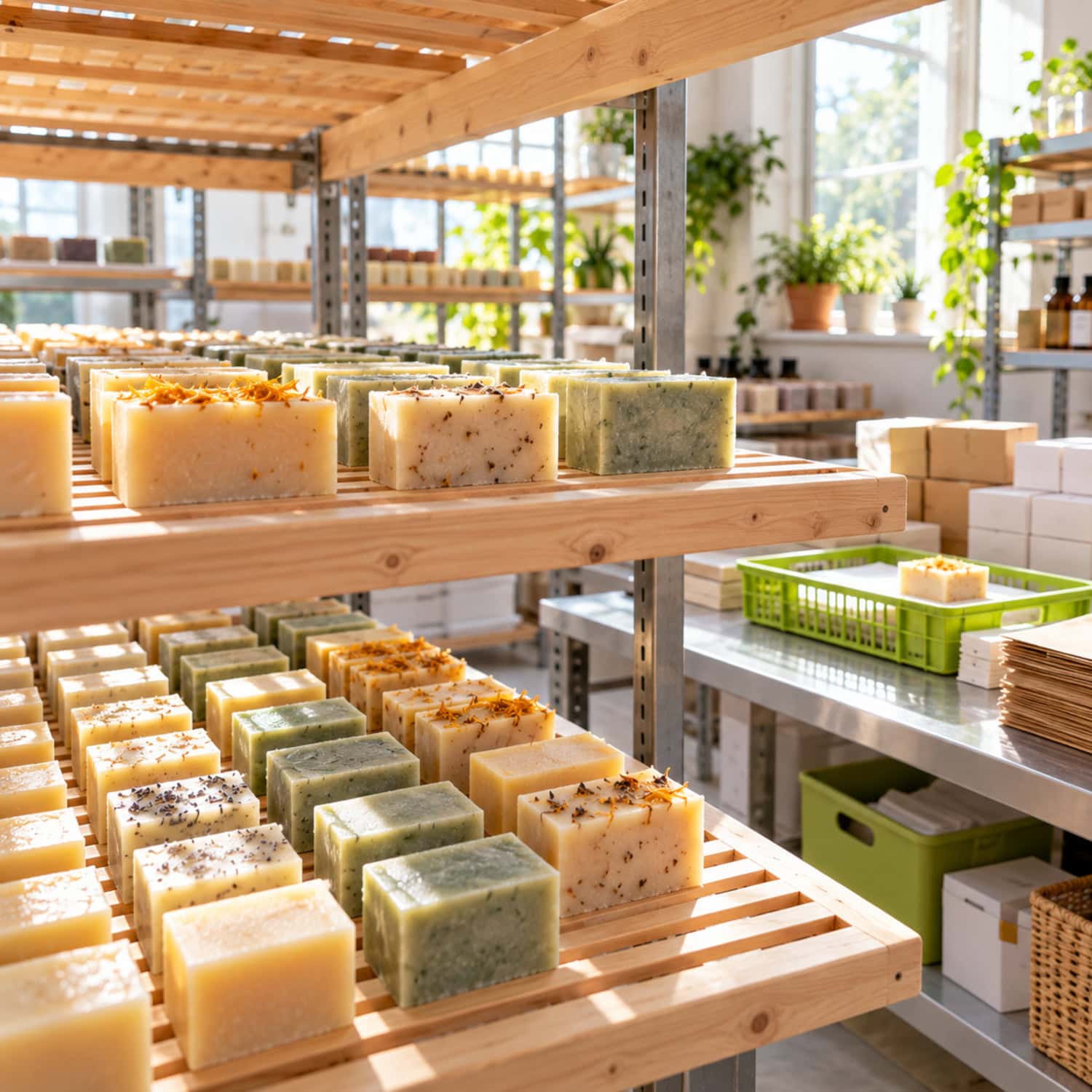
For in-house production, the production method also affects launch timing.
Cold-process sellers have to plan around cure time, while any method still requires consistency, storage, and batch discipline before commercial scale makes sense.
3. Prove product readiness before commercial launch
The central decision in a soap business is whether the product is ready to survive repeated production and customer use, not whether friends like the first batch.
Commercial readiness means you can make the same product again, understand how it behaves over time, spot defects, answer basic product questions, and manage the records and labeling needed to sell it responsibly.
Experienced soapmakers treat this as a recurring problem because new sellers often confuse a successful batch with a stable product.
Shelf behavior, cure, consistency, and repeatability matter because problems can appear after the day a bar looks finished.
Use this readiness check before you print labels or accept orders:
- Make the same formula in repeated batches and confirm that the process and finished result are consistent.
- Observe the soap over time rather than judging it only when it is newly made.
- Confirm that the product can complete its required cure or waiting period before sale.
- Record ingredients and batch details well enough to trace what went into a specific production run.
- Identify defects or changes that would make a batch unsuitable for sale.
- Test packaging and storage under the conditions you expect to use.
- Make sure you can explain the product without drifting into claims you have not classified or supported.
- Review labeling, insurance, and local operating requirements before commercial distribution.
One impressive batch can prove craft skill, while a reliable sellable product requires reproducibility.
Customers see the finished bar, so batch records need to preserve what happened during production.

4. Classify the soap and set legal boundaries
US soap sellers must determine how each product is classified before deciding what to say on the label or in marketing.
Federal treatment depends on the product’s composition, what provides the cleansing action, and its intended use and claims.
Traditional products that meet the federal conditions for “true soap” fall under the Consumer Product Safety Commission.
Products that function or are marketed as cosmetics fall under Food and Drug Administration (FDA) rules, and claims about treating conditions can move a product into drug territory.
This distinction matters because a sentence that sounds like clever marketing can change the compliance question.
Claims about acne, eczema, or other conditions deserve particular caution. Write the product description after you understand the classification.
Most cosmetic products and cosmetic ingredients do not require premarket FDA approval, although certain color additives are an exception.
The Modernization of Cosmetics Regulation Act, or MoCRA, also created registration and product-listing obligations with exemptions that can apply depending on the business and product.
State and local requirements can add another layer.
Depending on where and how you operate, you may need business registration, sales-tax registration, a local business or home-occupation approval, or other permits.
Those rules vary, so check your state business and revenue agencies and your city or county licensing office before selling.
Business structure is a separate decision.
If you are considering an LLC (limited liability company), check state registration rules and tax consequences instead of treating it as a universal soap-selling requirement.
If you manufacture beyond a simple home setup, check industrial zoning and any applicable Occupational Safety and Health Administration workplace rules or Environmental Protection Agency permitting.
If you market a product specifically for children, check the applicable Consumer Product Safety Commission requirements before launch.
Product liability insurance is another practical gate.
Sellers repeatedly worry about allergic reactions and customer injury because soap is used on the body.
Ask a licensed insurance agent what coverage fits your production model, sales channels, and claims, and confirm whether markets or retailers impose their own coverage requirements.
Marketplace rules can also restrict listings or claims even when a statement is not itself a licensing question.
If brand protection matters, check trademark availability separately from business-name registration.
If a classification, claim, or insurance question could materially affect liability, get advice from a qualified attorney or licensed insurance professional before launch.
5. Validate demand before building a large range
A soap business needs evidence that people will pay for the product at a price that can support the business.
Compliments from friends, followers, or craft-fair visitors are weak validation unless they turn into purchases.
One craft-fair seller reported bringing 60 bars and selling fewer than 20 even though visitors stopped, smelled the soap, and said positive things.
The useful lesson is that interest and purchase behavior are different signals. A compliment is not demand. A purchase is.
Run small tests before committing to a large launch:
- Offer a narrow range to people outside your immediate friend and family circle.
- Track which products get actual purchases rather than the most compliments.
- Record the price at which buyers hesitate, buy one bar, or buy multiple products.
- Note which scent or product descriptions customers understand immediately.
- Test whether bundles or samples reduce hesitation for buyers who cannot smell the product online.
- Compare first purchases with later repeat orders before expanding the range.
The goal is to find a specific group that chooses your product and can explain why.


6. Model startup costs and soap economics
Soap economics have to include more than ingredients.
A useful model includes raw materials, packaging, labor, overhead, channel costs, and shipping where the seller absorbs it.
Wholesale requires additional room because the retailer also needs a workable margin.
There is no dependable universal startup range here because the production model changes the entire capital structure.
An in-house maker can tie money up in ingredients, equipment, packaging, and curing inventory.
A private-label or custom-manufacturing brand can tie the same money up in minimum orders and supplier lead times instead.
Use one operating formula for a launch cycle:
Cycle result = units sold x (selling price – variable cost per sold bar) – labor – allocated overhead – channel costs
The point is to show how quickly weak sales can erase the margin while fixed operating costs remain.
| Illustrative numbers | Amount |
|---|---|
| Bars produced | 100 |
| Bars expected to sell in the cycle | 70 |
| Selling price per bar | $10 |
| Variable cost per sold bar | $3 |
| Labor for the cycle | $160 |
| Allocated overhead | $40 |
| Channel costs | $50 |
| Expected revenue | $700 |
| Variable cost on 70 sold bars | $210 |
| Fixed modeled costs | $250 |
| Expected cycle result | $240 |
These numbers are illustrative only. If sales are half the estimate and 35 bars sell, revenue falls to $350 and variable cost falls to $105.
Labor, overhead, and channel costs stay at $250, so the cycle result becomes negative $5.
If 100 bars were made, 65 also remain in inventory, tying up additional cash until they sell.
That stress test is why “my ingredients only cost a few dollars” tells you very little about whether the business works.
The real question is how efficiently you turn finished inventory into paid orders.
Pricing can expose uncomfortable mismatches.
In one real seller discussion, a full-cost calculation produced a price of about $22 per bar while the seller was looking at a market closer to roughly $8 to $16.
That does not automatically mean the seller should accept a bad margin.
It means the production method, labor per bar, batch size, ingredients, packaging, product size, channel, or positioning may need to change.
Do not solve a bad cost structure by pretending your time is free.
If the model works only after founder labor disappears from the calculation, put labor back in and recalculate the price, process, or channel.
7. Build a focused product range and reason to buy
A first soap range should be small enough to produce, track, store, and replenish without freezing cash in slow-moving stock.
Sellers frequently feel pressure to offer “something for everyone,” but that usually multiplies fragrances, packaging, and curing inventory before there is evidence that the extra choice creates extra sales.
A crowded scent table is often just more ways to be out of stock.
Start with a compact core that represents distinct use cases, scent directions, or customer preferences, then rotate or add products based on actual sell-through and repeat behavior.
Differentiation also has to be clearer than “handmade” or “natural.”
At crowded markets, lavender, mint, honey, and other familiar ideas can look interchangeable unless the customer sees a specific reason to choose your version.
The reason might come from the audience, scent concept, presentation, format, bundle, gift use, or another product characteristic you can explain honestly.
Professional presentation helps because buyers cannot fully evaluate soap at a booth or from a product photo.
Consistent packaging, clear ingredients, coherent product naming, and confident answers reduce perceived risk.
Presentation cannot rescue a weak product, but it can stop a good product from looking improvised.
Use sales data to decide what stays.
A product that photographs well but rarely sells twice is giving you a different answer than a plain-looking bar that customers reorder.

8. Choose the first sales channel and commercial terms
Markets, online marketplaces, an owned website, local retail, and wholesale are different businesses wearing the same soap label.
Choose the first channel by customer access, margin, sensory experience, shipping burden, fees, and your willingness to sell face to face.
| Channel | Main advantage | Main constraint | What to test first |
|---|---|---|---|
| Craft fairs and local markets | Customers can see and smell the product | Booth cost, competition, long selling days, and conversion skill | Sales per event and conversion by product |
| Etsy or another marketplace | Existing shopping traffic and broad reach | Visibility, competition, fees, photos, search, and shipping | Order economics after fees and shipping |
| Owned website | Full control of presentation and customer relationship | You must create your own traffic | Cost and effort to acquire each order |
| Local retail | Access to established local shoppers | Lower margin and retailer acquisition work | Reorders and sell-through by store |
| Wholesale | Larger orders and fewer direct retail transactions | Lower unit margin, minimums, delivery, and capacity demands | Contribution per order and production load |
Online selling has a specific problem with a low-ticket physical product.
One seller described shipping for a single bar as costing roughly twice the soap itself. That rate is anecdotal.
The useful point is the channel risk: single-bar orders can look absurd once postage enters the room.
Shipping has no respect for the romance of handmade soap.
Markets have the opposite advantage because people can smell the product, but the founder becomes part of the sales system.
A maker who loves formulation and hates selling may find that a busy booth exposes the role mismatch immediately.
Before paying for an event or agreeing to wholesale, ask:
- How many direct soap competitors will be present or stocked nearby?
- What fees, commissions, shipping, or delivery costs apply?
- What order volume would cover those channel costs?
- Can customers smell, sample, or otherwise evaluate the product before buying?
- Does the channel require insurance, special packaging, or documentation?
- For wholesale, what minimum order and lead time can you support without disrupting direct customers?
- How will you measure repeat orders rather than only first-time sales?
A channel is useful only when the numbers and customer behavior work together.
Measure purchases, contribution after channel costs, and repeat orders instead of traffic alone.


9. Buy equipment and suppliers for the plan you proved
Equipment and suppliers for a soap business should support a validated production model. Let the validated model define what you buy.
For in-house production, the practical requirements are safe production, repeatable batches, enough curing and storage capacity, and reliable access to ingredients and packaging.
Bulk purchasing can lower unit costs, but small sellers often lack the volume that unlocks the biggest discounts.
Buying more simply to chase a lower unit price can move the problem from “high cost” to “cash trapped in supplies.”
Use this pre-purchase check before committing to equipment or large supply orders:
- Confirm the production method and the batch size you actually need.
- Check whether the workspace can support safe production and storage.
- Make sure the setup lets you keep batch records and separate production runs clearly.
- Confirm that curing or finished stock has enough protected storage space.
- Check supplier lead times before setting customer promises.
- Compare minimum orders with realistic sales forecasts.
- Confirm that packaging and ingredients can be reordered consistently.
- Avoid adding capacity that only makes sense after wholesale or another unproven channel succeeds.
Bulk orders only save money when the inventory is actually used before the product range or demand changes.
10. Run inventory around cure time and real sales
Soap operations need batch records, cost tracking, inventory status, purchasing, and replenishment rules.
For products with cure time, inventory planning starts before the shelf looks empty because a stockout cannot always be fixed by making another batch that evening.
Cure time is inventory with a calendar attached.
A seller can have dozens of bars physically present and still have nothing available to ship because the next batch is not ready.
Track at least three inventory states: ingredients and packaging on hand, product in production or cure, and finished sellable stock.
Then connect those states to sales velocity by stock-keeping unit, or SKU, meaning one distinct sellable product variation.
A simple operating rhythm is to review each SKU for current finished stock, units curing or inbound, recent sales, and the next date production must start.
Seasonal products need longer planning because the selling window can arrive before a late batch is ready.
Record keeping also protects pricing.
If ingredient costs, packaging, labor, or channel fees change and your cost records do not, the margin on the spreadsheet becomes fiction with nice formatting.
11. Fix weak products and weak channels before adding more
A soap business should change or drop products when sales, repeat behavior, margin, or production burden no longer justify keeping them.
The same applies to channels that create traffic but poor economics.
Use four questions for each SKU and channel:
- Does it sell at a useful rate, or only attract attention?
- Do customers reorder it?
- Does the margin survive the real channel costs?
- Does keeping it create disproportionate production, storage, or purchasing complexity?
When a SKU sells slowly, diagnose demand, channel fit, bundling, and production complexity before changing the label.
The right answer may be to simplify the range, move the product, bundle it, or discontinue it.
The same logic applies to events.
A market that looks busy can still be poor for soap if it accepts too many similar vendors, charges a fee the sales cannot support, or attracts visitors who browse rather than buy.
12. Scale with wholesale only after the core system works
Scaling a soap business means increasing volume without breaking consistency, cash flow, or the founder’s workload.
Wholesale can help because orders are larger, but lower unit margins, minimum-order expectations, delivery, and production capacity become more important.
Before approaching more retailers, confirm that the core range is stable, the production schedule can absorb larger orders, suppliers are dependable, and the wholesale price leaves room after labor and overhead.
A retailer relationship can be poor growth if it forces rushed batches or starves the direct channel of inventory.
Bulk purchasing can improve costs at higher volume, yet it also increases working capital tied up in raw materials.
Scale should improve economics through a more efficient process rather than through larger piles of inventory.
Private label or custom manufacturing can also become a scaling path when in-house production becomes the bottleneck.
Revisit the trade-offs from Section 2 before switching because minimum orders, lead times, and control change along with capacity.
13. Common traps and myths in a soap business
Common soap-business mistakes are less dramatic than a failed recipe. They are usually ordinary decisions made in the wrong order.
| Myth | What actually happens |
|---|---|
| Friends love it, so demand is proven | Social encouragement is weaker than purchases and repeat orders from real customers |
| More scents mean more customers | More SKUs can increase inventory, supply, storage, and replenishment complexity before demand is known |
| A full-cost price must be accepted by the market | If the price is too high, production efficiency, positioning, channel, or product format may need to change |
| Etsy solves customer acquisition | Marketplace visibility still depends on competition, presentation, search, advertising, and shipping economics |
| Handmade and natural are enough differentiation | Crowded markets force the buyer to compare your soap with many similar-looking alternatives |
| Medical-sounding claims make the product more compelling | Claims can change regulatory implications and should be reviewed before use |
Another trap is treating bookkeeping as something to solve after growth.
Cost of goods sold, or COGS, means the direct cost of producing the goods you sell.
If the business cannot track COGS, labor, inventory, and sales by channel, it cannot tell which growth is helping and which growth is merely louder.

14. Launch plan for the first 90 days
A soap launch should minimize irreversible spending while increasing certainty at each step.
Use the plan below as an operating sequence. Do not let a calendar force you to sell before the earlier gates are complete.
- Choose in-house production, private label, or custom manufacturing.
- Reduce the first assortment to a manageable core range.
- Complete repeated-batch and long-term product-readiness checks.
- Classify the product under the applicable federal framework and review claims and labels.
- Check state and local business, tax, and home-production requirements where you operate.
- Price product liability insurance for the planned sales channels.
- Run a small demand test with buyers outside your immediate personal circle.
- Build a full-cost model that includes labor, overhead, packaging, and channel costs.
- Choose one primary sales channel and define the metric that will decide whether it works.
- Set production and replenishment dates that account for cure or supplier lead time.
- Launch with enough stock to test demand without overbuilding slow-moving inventory.
- Track sales, repeat orders, margin, and stock movement by SKU and channel during the first 30 to 90 days.
- Discontinue, revise, or move weak products before adding new ones.
- Consider wholesale, broader distribution, or larger production only after the core range is predictable.
A disciplined first launch can be smaller than the brand you eventually want.
The first 90 days should show which products, prices, and channels deserve more capital.
FAQ
The most common soap-business questions come down to cost, regulation, structure, channels, and range size.
How much does it cost to start a soap business?
It depends on the production model, assortment, packaging, inventory, channel, and compliance burden, so there is no reliable universal range here.
Build a full-cost model before spending heavily. See Section 6.
Do I need a license to sell soap?
It depends on your jurisdiction and product classification.
Check federal classification first, then state and local business, tax, and home-operation rules. See Section 4.
Do I need FDA approval to sell soap?
No. Most cosmetics and cosmetic ingredients do not require premarket FDA approval, although certain color additives are an exception. See Section 4.
Do I need an LLC to start a soap business?
No. Selling soap does not inherently require an LLC, but state registration rules, tax treatment, and liability planning can affect the structure you choose.
See Section 4.
Is a soap business profitable?
It can be, but profitability depends on full costs, achievable price, sales volume, channel economics, and repeat demand.
Stress-test the model before scaling. See Section 6.
Where should I sell handmade soap first?
It depends on your customers and economics.
Markets favor sensory trial, online channels add visibility and shipping challenges, and wholesale trades margin for larger orders. See Section 8.
How many soaps or scents should I launch with?
Start with a small core range that you can produce and replenish reliably.
Add products only when sales and repeat behavior justify the extra inventory complexity. See Section 7.
Can I start a soap business from home?
It depends on local rules, the production method, and the workspace.
Check state and local home-business requirements and make sure the space can support safe production and storage. See Sections 4 and 9.
Conclusion
The core rule remains the same: build the soap business only after the product is repeatable, legally sellable, economically workable, and supported by real customer purchases.
That order protects cash, reduces compliance surprises, and makes later growth easier to diagnose.
1. Prove readiness before promotion: Reproduce the product, observe it over time, and understand its classification before you sell it.
2. Make the economics survive weak sales: Include labor, overhead, channel costs, and inventory lag before you trust the margin.
3. Scale only what customers repeat: Keep the products and channels that earn purchases, reorders, and workable contribution after real operating costs.
Further reading
These pages are useful for federal classification, product readiness, pricing, channels, and real seller operating problems.
- FDA Frequently Asked Questions on Soap: Federal guidance on when a product is treated as soap, a cosmetic, or a drug based on composition and intended use.
- U.S. Consumer Product Safety Commission: The federal agency that oversees traditional soap meeting the applicable “true soap” conditions.
- Are You Ready to Sell Your Soap: A long-running maker discussion about repeatability, cure, shelf behavior, labeling, insurance, and commercial readiness.
- Pricing Soap: Community discussion of pricing with materials, labor, overhead, wholesale, and retail economics in view.
- Soap Sales Channels Discussion: Seller experiences comparing face-to-face markets, online sales, local retail, and wholesale.
- Single-Bar Shipping Economics: A seller discussion showing how shipping can distort the economics of low-ticket online orders.
- Craft Fair Sales Lessons: A practical account of praise, conversion, product differentiation, and booth presentation at an in-person event.