To start a perfume business, choose the perfume business model and the parts of the value chain you will own before buying bottles or inventory.
Then validate demand with strangers and samples, settle formula and production rights, and build the economics around the full delivered cost of each sale.
Complete the legal and compliance checks for your route, then launch through a channel where customers can realistically smell or sample the product.
There is no useful universal startup-cost figure because production method, minimum order quantities, and packaging can move the budget dramatically. Sampling, shipping, and the cost of getting customers can move it again.
Build the first budget from actual supplier quotes and a small validation plan rather than a generic startup number.
For a US launch, verify cosmetics rules, state and local business requirements, workspace restrictions, insurance, and carrier rules for alcohol-based perfume before production.
Our editorial recommendation is to keep the first launch narrow enough that unsold inventory cannot become the business plan.
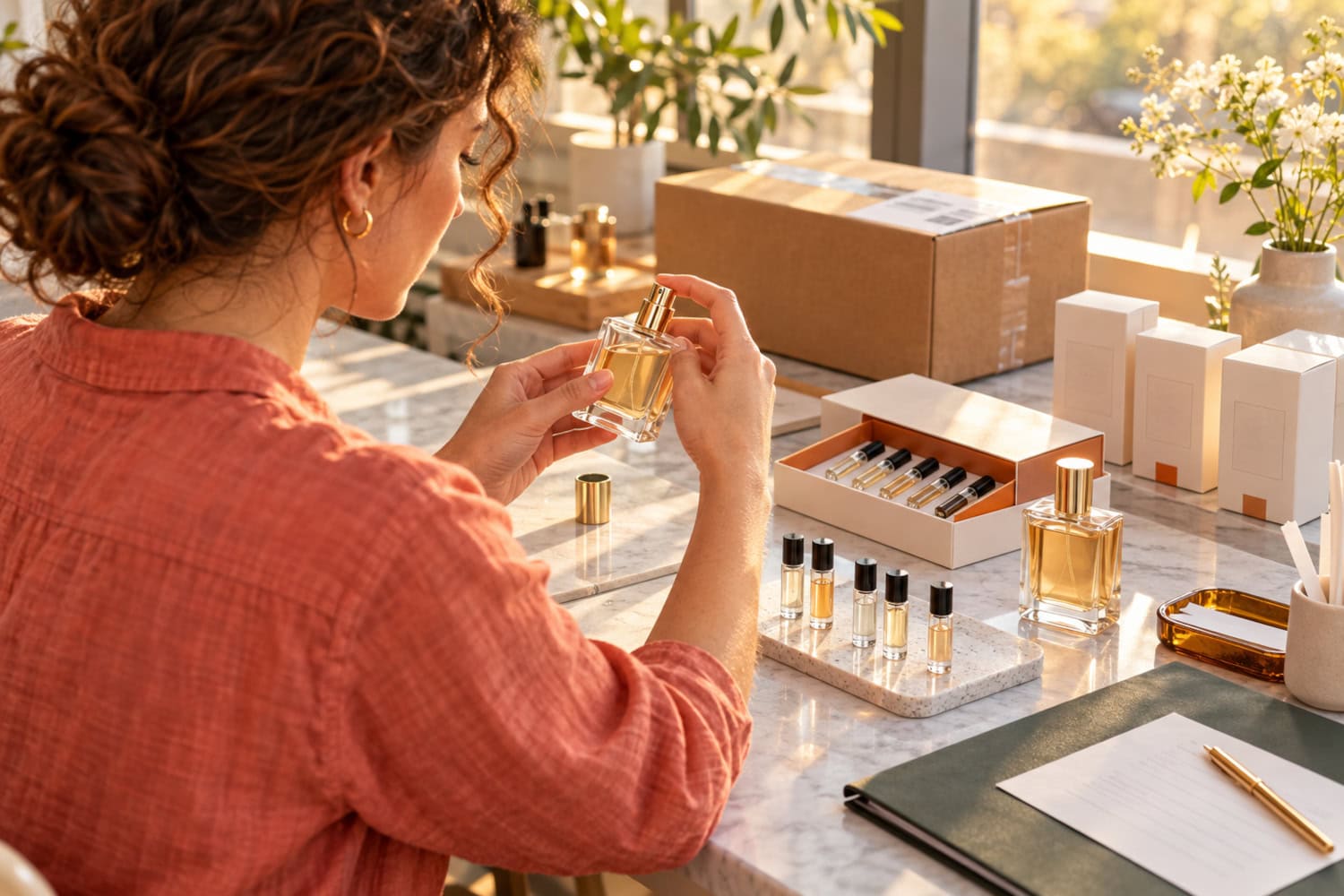
Last fact-checked: October 6, 2026
This guide is for US first-time founders evaluating an original fragrance brand, a supplier-produced branded launch, or a resale model. It covers route selection, demand validation, formula rights, production, packaging, economics, compliance pointers, sampling, sales channels, operations, and scaling. Retail-store buildout and perfume-making technique are outside the scope.
1. How a perfume business works and the launch sequence
A perfume business combines product creation or sourcing with packaging, compliance, and distribution.
It also requires sampling and customer acquisition.
The first serious decision is which perfume business you are building and which parts of formulation, production, packaging, and selling you will own.
That distinction matters because beginners often imagine one continuous activity called “making perfume.”
In practice, the work can be split among a perfumer who develops the scent and a compounder who produces the fragrance mixture.
A filler or bottler can turn bulk liquid into finished units, while packaging suppliers provide the physical components.
One partner may handle several roles, but the contract still needs to say what is actually included.
| Stage | Decision | Move forward when |
|---|---|---|
| 1. Map the business | Define the operating model and production roles | You can name who handles each part of the finished product |
| 2. Select the format | Original formula, custom development, supplier-produced branded product, or resale | The format matches your skill, control needs, and operating capacity |
| 3. Validate demand | Test the customer and the sampling path | Strangers show behavioral interest, not just compliments |
| 4. Select channels | Decide how customers will smell, sample, and buy | The channel can be tested and measured without excessive friction |
| 5. Model the economics | Product, packaging, sampling, shipping, and acquisition | A realistic sale still leaves contribution after variable costs |
| 6. Complete setup | Registration, tax, insurance, compliance, workspace, and shipping checks | The chosen operation can move forward under the applicable rules |
| 7. Contract key partners | Set formula rights, supplier terms, production scope, and quality expectations | Responsibilities and exit terms are in writing |
| 8. Approve inputs | Test bottles, atomizers, labels, boxes, and production support | Samples pass quality checks and the order fits cash and storage limits |
| 9. Build operations | Set up inventory, fulfillment, records, and support | Orders can be processed consistently |
| 10. Set the offer | Finalize product mix, samples, and pricing | Each product has a clear role and workable economics |
| 11. Set stop rules | Define what weak performance will trigger a change | Reorder decisions can use actual sales and conversion behavior |
| 12. Set scaling criteria | Define what would justify more volume, outsourcing, or wholesale | Existing demand and operations provide measurable thresholds |
| 13. Consider acquisition as an alternative | Check demand, rights, supply, and inventory before buying | The acquired assets and relationships are transferable and useful |
| 14. Reject shortcuts | Test turnkey claims and common assumptions against the operating model | The offer survives contract and economics review |
| 15. Launch in sequence | Spend only after the cheaper dependencies are resolved | The business can launch, measure, and learn without oversized commitments |
The sequence protects cash.
Ordering thousands of boxes before proving that strangers will pay for the fragrance is a surprisingly elegant way to turn a spare room into a warehouse for your optimism.


2. Perfume business formats
The main perfume business formats differ in creative control, speed, operating complexity, and capital exposure.
Those differences change which suppliers, contracts, and compliance questions matter.
Suppliers use “private label” and “white label” for offers built around existing or standardized products, often with different degrees of customization.
Resale and decant businesses focus on existing fragrances rather than creating a new formula.
The exact supplier terminology varies, so judge each offer by its contract and deliverables.
| Format | What you control | Main dependency | Best for |
|---|---|---|---|
| Original founder-formulated brand | Formula, brand, packaging, sales | Founder skill and consistent production | Founders with real perfumery capability who want maximum creative control |
| Custom brand with a professional perfumer | Brief, brand direction, commercial decisions | Clear perfumer and production agreements | Founders who want an original scent without becoming the perfumer |
| Private label | Brand and selected options from a supplier’s existing system | Supplier terms, minimums, and documentation | Faster launches with less product-development work |
| White label | Branding on a largely standardized product | Supplier product quality and commercial terms | Testing a market before investing in deep customization |
| Resale or decant business | Selection, sourcing, customer experience | Authentic supply and viable margins | Sellers who want to market existing fragrances instead of creating a new formula |
Most of the decisions below concern a small brand selling its own fragrance product, whether the scent is founder-formulated, developed with a perfumer, or sourced through private label.
Resale follows a different supply and margin logic where noted.
3. Customers and demand for a perfume business
Demand validation for perfume has to test buying behavior, not appreciation.
Compliments from friends are useful for morale, but the more valuable signal is whether unfamiliar people will sample, pay, come back, join a waitlist, or buy a full bottle after trying the scent.
Perfume has a built-in commercial problem: the feature that matters most cannot be transmitted through a product photo.
Perfume is a sensory product trying to survive on a screen. That makes sampling and in-person testing more important than in many consumer categories.
A practical first validation can be small.
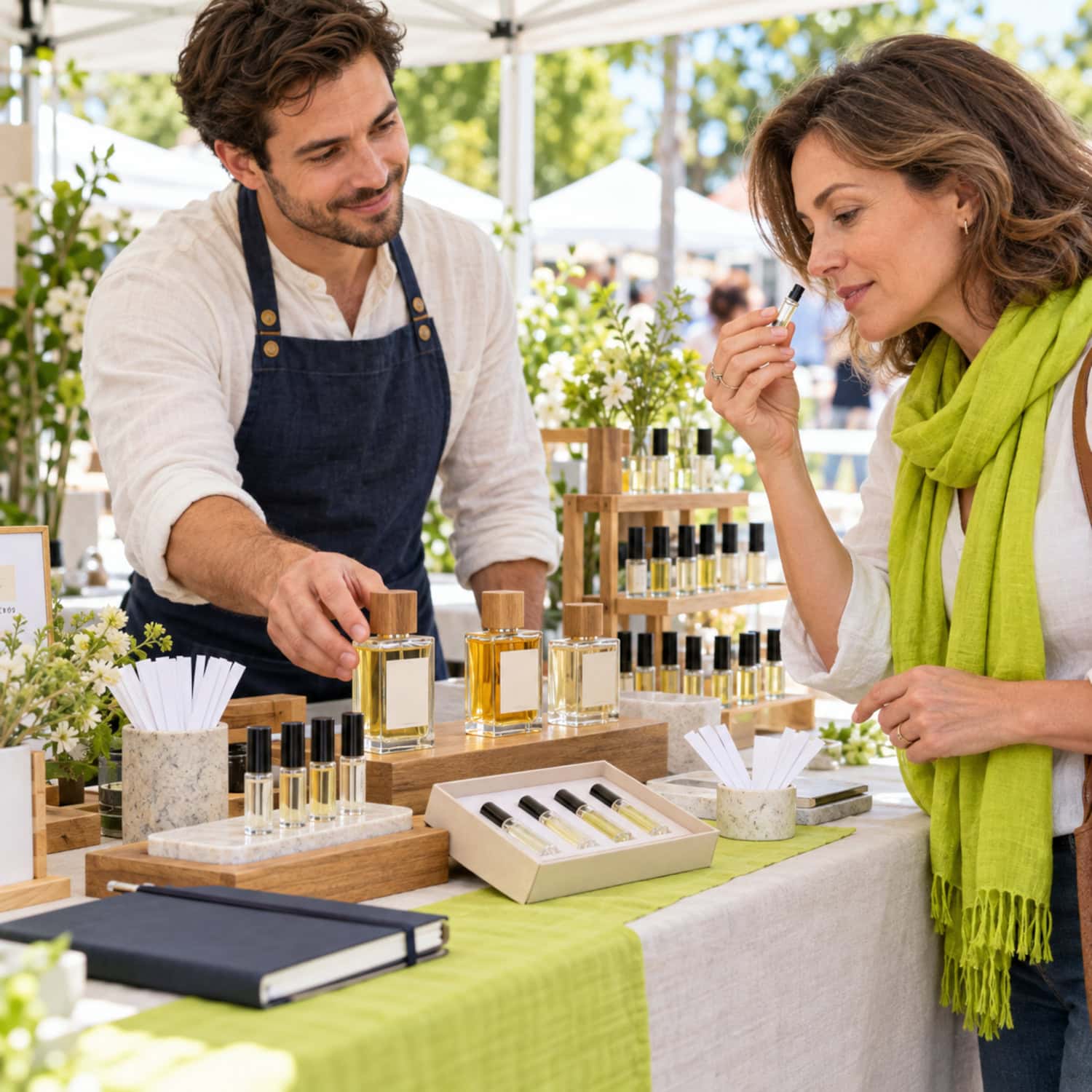
Put the fragrance in front of strangers through local markets, pop-ups, small paid sample offers, or a discovery set of small samples.
Track what people do after smelling it.
A table of compliments is not as useful as a list of paid orders, repeat purchases, email signups, or customers who convert from sample to bottle.
A founder standing behind a market table learns more from ten strangers who smell, ask the price, and either buy or walk away than from a week of enthusiastic group-chat feedback.
If people like the scent but hesitate at the price, that hesitation is useful demand data.
Also track sell-through, meaning how quickly available inventory actually sells, at the scent level. Use these signals before increasing inventory:
- Paid sample or discovery-set orders.
- Sample-to-full-bottle conversion.
- Repeat purchase or reorder behavior.
- Waitlist or preorder demand tied to a specific scent.
- Scent-level sales compared with total social engagement.
Avoid treating followers, likes, or positive comments as proof of demand. They can support awareness, but they do not pay the manufacturer.
Treat the category as selection-sensitive: a crowded market does not make success impossible, but it punishes weak differentiation and expensive customer growth.

4. Sales channels for a perfume business
For a perfume business, the strongest first sales channel is the one that lets customers experience the scent without making the cost of getting customers absurd.
In-person selling reduces the sensory barrier, while direct online sales offer greater reach but usually need a sampling path.
Local markets and pop-ups can work well for early validation because customers can smell before buying and the founder can hear objections directly.
The tradeoff is labor. Every event requires setup, attendance, stock handling, and travel.
What validates a product at small scale may become an exhausting distribution system later.
Online sales through a brand website or marketplace can scale farther, but the sampling problem moves into fulfillment.
Free samples feel frictionless to the customer, yet someone still fills the vial, packs the parcel, pays postage, answers the email, and hopes the sample becomes a bottle sale.
A discovery program needs to be measured as a customer-acquisition channel, not treated as promotional confetti.
Wholesale to boutiques can reduce the number of individual customer transactions, but it creates a different problem.
The brand has to leave enough margin for the retailer while keeping its own economics healthy.
A product that only works financially at direct retail pricing may not be ready for wholesale.
Paid advertising deserves the same skepticism. Paid traffic can still fail to produce profitable customers.
Before increasing ad spend, track customer acquisition cost, meaning what you spend to win a new customer, across the path from click to sample, sample to bottle, and bottle to repeat purchase.
5. Startup costs and per-bottle economics for a perfume business
There is no defensible universal startup-cost range for a perfume business.
Early cash needs depend first on the production route, minimum order quantity, packaging choices, and inventory depth.
Sampling, shipping, compliance work, and customer acquisition add another layer before repeat sales exist.
Minimum order quantity, usually shortened to MOQ, is the smallest order a supplier will accept.
MOQs are where attractive per-unit prices often become unattractive startup decisions.
A low unit price can still create a high launch cost when the supplier requires enough boxes to consume the budget and half a closet.
Budget by category instead of chasing one headline number:
| Cost category | What belongs here | Main risk |
|---|---|---|
| Product development | Perfumer fees, formula work, prototypes, revisions | Paying for development without clear rights or acceptance criteria |
| Production | Fragrance concentrate, compounding, filling, or finished private-label units | Ordering more units than demand can absorb |
| Packaging | Bottles, atomizers, caps, labels, boxes, inserts | MOQ, freight, leaks, breakage, and storage |
| Compliance and setup | Business setup, professional advice, documentation, insurance | Discovering requirements after inventory is committed |
| Sampling | Vials, sprayers, discovery packaging, postage, labor | High acquisition cost with weak bottle conversion |
| Sales and fulfillment | Ecommerce fees, payment costs, pick and pack, outbound shipping | Margin that disappears after the order is placed |
| Marketing | Content, events, ads, creators, photography | Paying for attention that does not convert |
| Working reserve | Reorders, replacements, freight surprises, slow sell-through | Running out of cash while inventory still exists |
Here, contribution means what a sale leaves after the variable costs tied to that sale.
The most useful beginner formula is contribution per full-bottle sale:
Contribution per bottle = selling price – variable product and packaging cost – variable selling and fulfillment cost – attributable sampling or acquisition cost
The example below uses illustrative numbers, not a market benchmark.
| Illustrative item | Amount |
|---|---|
| Selling price | $70 |
| Product and packaging cost | $20 |
| Selling and fulfillment cost | $7 |
| Attributable sampling or acquisition cost | $13 |
| Contribution per bottle | $30 |
| Contribution at 100 bottles | $3,000 |
The $30 contribution per bottle still has to cover fixed development and overhead.
If sales reach only half the estimate, 50 bottles produce $1,500 of contribution under the same assumptions.
Fixed development, setup, and unsold inventory do not magically shrink with sales. A beautiful bottle cannot rescue arithmetic.
This is why the cheapest supplier quote is not automatically the best economic choice.
A slightly higher unit cost at a workable MOQ can preserve cash, reduce storage, and let the founder learn before committing to a larger run.
There is no universal best financing route for a perfume launch. Any borrowed payment burden should still fit the half-sales stress test.
6. Business setup and perfume compliance
A US perfume business needs ordinary business setup plus product, workspace, and shipping checks that depend on what the business actually does.
The exact requirements vary by jurisdiction and production model, so use the responsible government agencies and licensed professionals for the final determination before launch.
For a founder selling fragrance as a cosmetic product, check the US Food and Drug Administration’s current cosmetics requirements, including any obligations that apply to the product, business, or manufacturing arrangement.
Do not substitute a manufacturer’s marketing page or a forum discussion for the regulator’s current rules.
State and local requirements can include business registration, tax registration, local licensing, zoning, and home-occupation restrictions.
These rules vary and can change. Check your state business and tax agencies plus the city or county authorities that govern the workspace.
If alcohol-based perfume will be stored, blended, or filled at home or in a small studio, check the workspace before moving material into it.
Verify zoning, fire-code, workplace-safety, and insurance implications with the responsible authorities and providers.
A room that is fine for a laptop is not automatically approved for storing flammable product.
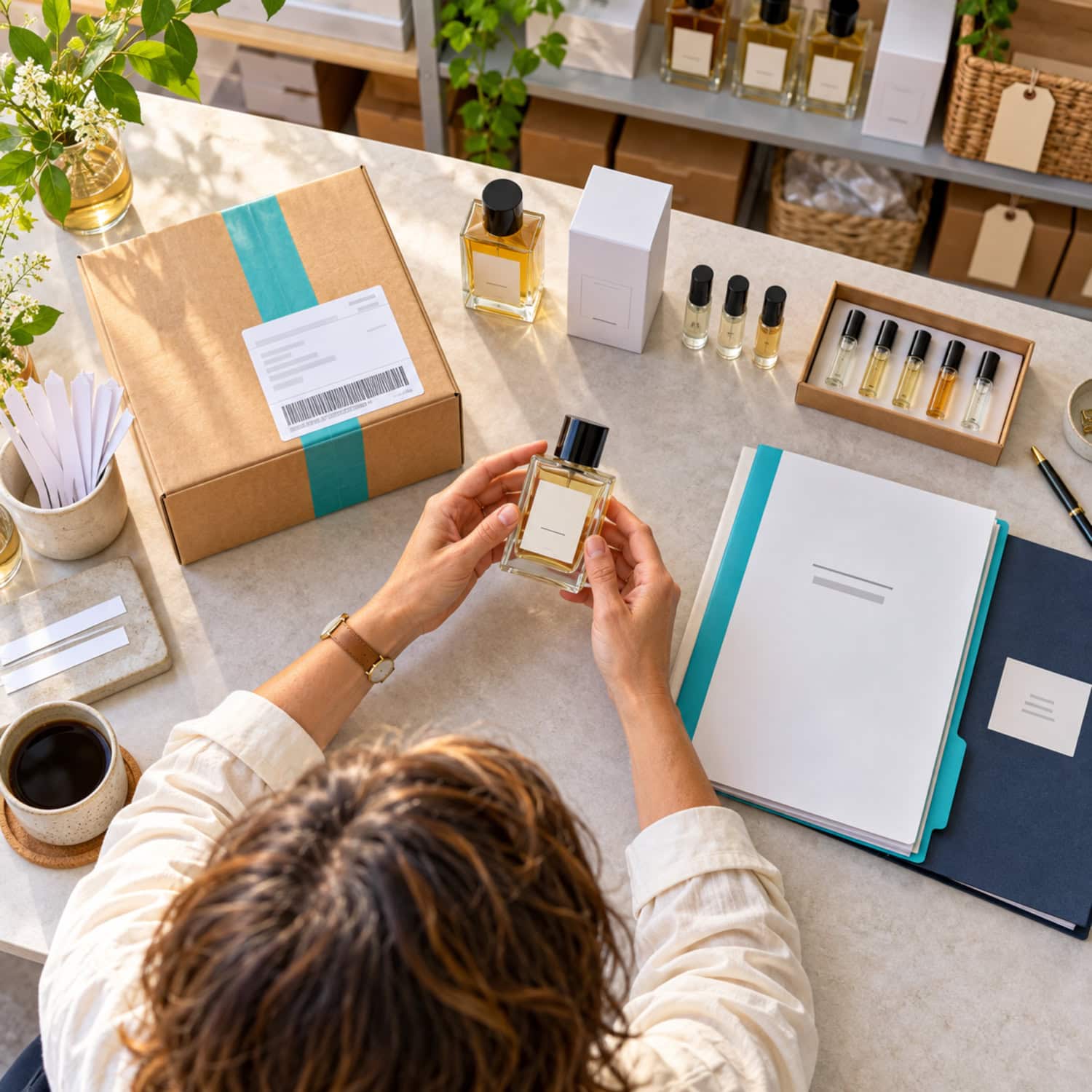
Shipping adds another compliance layer because alcohol-based fragrance can face carrier and dangerous-goods restrictions.
Confirm accepted packaging, service levels, and destination limits with the carriers you plan to use before promising shipping options to customers.
Insurance should match the operating model.
Discuss the business’s product, inventory, premises, and manufacturing or home-business exposures with a licensed insurance agent.
If legal interpretation, formula ownership, labeling, or manufacturing responsibility is unclear, use an attorney or qualified compliance professional at the decision point instead of guessing.
Industry standards and legal rules also need to stay separate in your head.
IFRA, the International Fragrance Association, publishes fragrance-safety standards used by the industry, while legal obligations come from the applicable regulators and jurisdictions.
Supplier documentation may be important for safety, retail, manufacturing, or insurance purposes even when a document is not itself a license.
A reseller has a different compliance path.
Verify state tax and resale requirements, supplier legitimacy, product authenticity, and any distribution restrictions before building the catalog.
7. Contracts and formula rights for a perfume business
The most important perfume contracts define who owns what, who does what, and what happens when the relationship ends.
Settle formula ownership, exclusivity, and manufacturing rights before serious development money changes hands.
The agreement should also address minimums, documentation, and portability to another supplier.
A custom fragrance can be commercially awkward if the brand discovers later that it paid for development but does not control the formula or cannot move production.
The problem tends to appear at the least charming moment, such as when the current supplier raises minimums or cannot meet demand.
For a perfumer, compounder, filler, private-label supplier, or contract manufacturer, put these points in writing:
- Whether the formula is owned, licensed, or retained by the creator.
- Whether the fragrance is exclusive and, if so, what exclusivity means.
- Who may manufacture or compound the fragrance.
- What happens to the formula if the relationship ends.
- Which documents and batch information the supplier provides.
- Minimum orders, lead times, payment terms, and change procedures.
- Quality expectations for liquid, filling, packaging, and finished goods.
- Responsibility for damaged, leaking, short, or rejected production.
Formula rights are especially important when a founder wants the freedom to change manufacturers later.
Paying for a scent concept and owning a portable production formula are not automatically the same transaction.
8. Equipment and suppliers for a perfume business
A first perfume launch usually needs less custom equipment than beginners imagine and more supplier diligence than they expect.
The critical purchases are the components and production services that turn fragrance into a consistent finished product.
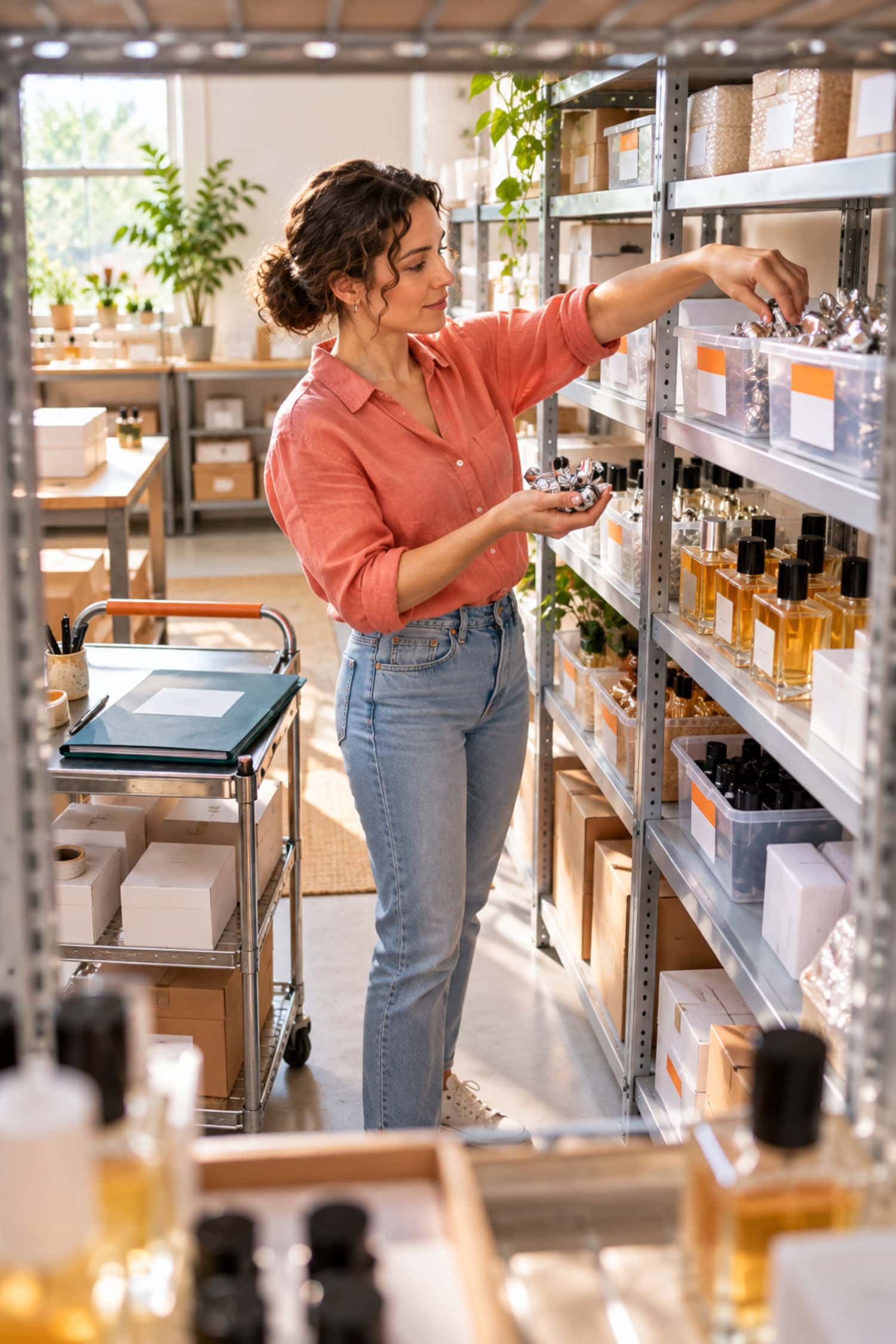
For packaging, that commonly means bottles, atomizers, caps, labels, and boxes. Filling support may be a separate production service.
At startup scale, custom luxury packaging usually increases minimums and cash exposure.
Custom glass and deeply customized packaging can create freight exposure and storage problems before demand is proven.
Stock bottles with strong labeling and disciplined presentation are often the more forgiving place to begin.
A supplier sample does not prove the full production run will match it.
The sample bottle may spray beautifully, while the production run arrives with inconsistent pumps, printing variation, or a cap fit that feels wrong.
Inspect the exact combination of components, not isolated pieces.
Before placing a significant packaging or production order, use this checklist:
- Order physical samples of the exact bottle, atomizer, cap, label material, and box configuration you intend to use.
- Test the spray, leakage, closure fit, handling, and compatibility of the complete package.
- Confirm the MOQ for every component, not just the bottle.
- Calculate landed cost, meaning the total cost after freight and other order-level charges.
- Confirm what must match between the approved sample and the production run.
- Ask what safety, batch, material, and product documentation will be supplied.
- Confirm production lead time, replacement terms, and treatment of damaged units.
- Check whether the order fits your actual storage space before paying the deposit.
- Place the smallest commercially sensible test order before committing to a large custom run.
That last storage check is not trivial.
A founder can solve the unit-price problem and still create a household logistics problem when several thousand empty components arrive at once.
9. Day-to-day perfume business operations
Operating a small perfume brand means repeating the unglamorous work reliably.
Typical founder tasks include inventory control, packing, customer support, shipping, and bookkeeping.
Production coordination, supplier communication, content, events, and restocking fill the rest of the week.
The workload becomes obvious during sampling.
Picture a founder finishing a batch of discovery sets late at night, printing labels, checking addresses, replacing one leaking vial, and realizing the postage bill is larger than expected.
Even a tiny sample can require substantial labor.
Keep records by scent and batch so you can see what sells, what gets returned or replaced, what needs reordering, and which component causes problems.
If production is outsourced, record supplier batches and finished-goods receipts consistently enough to investigate a quality issue later.
Operational control also means setting service expectations that the business can meet.
Indie fragrance buyers care about stock availability, clear websites, predictable turnaround, and shipping that does not feel mysterious.
A gorgeous brand loses credibility quickly when every order becomes an email asking where the parcel is.
Make-to-order production can reduce finished inventory exposure, while batch production may fit the production process better.
Long turnaround can frustrate customers, so choose the approach by cash available, production needs, and the fulfillment time you can reliably promise.

10. Product mix and pricing for a perfume business
A first perfume collection should be designed around learning, not around proving that the founder can name 12 scents.
Each additional fragrance adds formula work or sourcing, packaging inventory, and sample inventory.
It also adds content, forecasting, and another chance to stock the wrong thing.
Start with a product mix small enough to understand scent-level demand.
The correct number depends on the route and economics, so there is no honest universal launch count.
What matters is that each scent can earn its place through sampling, conversion, and repeat purchase.
Sampling should be treated as a product system with its own economics.
Buyers evaluate sample size, delivery format, price, shipping cost, and packaging convenience.
Some also value a discovery-set purchase that can be credited toward a full bottle. Those choices affect both conversion and cost.
Pricing should begin with the contribution economics in Section 5. Then test whether the price fits the brand position and sales channel.
If wholesale matters, leave room for the retailer’s margin before assuming the direct retail price works everywhere.
Do not copy another perfume brand’s price and call the work finished.
Its formula costs, packaging volume, and freight may be different from yours. Marketing efficiency, retailer mix, and repeat rate can differ too.
11. When to fix or stop a perfume offer
A perfume offer needs intervention when sales activity consumes cash without producing repeatable customer behavior.
Weak sell-through, poor sample-to-bottle conversion, repeated packaging defects, high acquisition cost, or persistent supplier problems are signals to change something before ordering more inventory.
Diagnose the bottleneck before changing the fragrance itself.
If people enjoy the scent but abandon after seeing shipping, the problem may be fulfillment.
If discovery sets sell but bottles do not, the issue may be scent fit, price, positioning, or the conversion path.
If customers reorder but ads lose money, the acquisition channel deserves scrutiny.
Set a decision point before reordering.
Review actual sell-through, inventory on hand, cash needed for the next run, and whether the current supplier or package is still the right fit.
Inventory is cash wearing an atomizer. Treating it as a trophy collection is expensive.
12. Scaling a perfume business
Scale a perfume business after demand and operations become repeatable, not because a supplier offers a lower unit price at a larger MOQ.
More volume can improve production economics, but it also raises the cost of being wrong.
Useful scaling signals include sustained sell-through, repeat purchasing, and reliable sampling conversion.
Manageable customer acquisition, stable supplier quality, and excessive founder fulfillment time can strengthen the case for scaling.
At that point, compare the cost and control of buying more equipment with outsourcing compounding, filling, packing, or fulfillment.
The same logic applies to wholesale.
Retail distribution can expand reach, but it changes margins, production planning, documentation expectations, and cash timing.
Make sure the business can produce consistently and still make money at wholesale terms before chasing shelf space.
A common transition point feels less glamorous than founders expect. The founder is no longer asking how to make one more bottle.
The question becomes whether spending Friday filling orders is the best use of Friday when a qualified partner can do it more consistently.
13. Buying an existing perfume business
Buying an existing perfume brand or resale operation can skip some early setup, but it replaces startup uncertainty with due-diligence risk.
The key question is whether the buyer is acquiring durable demand, usable rights, reliable supply, and saleable inventory rather than a logo attached to old stock.
Before buying, verify these items in order:
- Review sales by product and channel rather than relying on total revenue alone.
- Check repeat purchase and inventory aging by scent.
- Confirm ownership or transferability of trademarks and formula rights.
- Review manufacturing, perfumer, supplier, and packaging contracts for transfer restrictions.
- Verify the authenticity and documentation of inventory and raw materials.
- Inspect packaging quality, storage conditions, and obsolete components.
- Rebuild the unit economics using the prices and supplier terms available to the buyer.
- Identify which sales depend on the seller personally, including events or wholesale relationships.
- Have the purchase documents reviewed by qualified legal and financial professionals before closing.
An existing brand with recurring customers and transferable supplier relationships can be more valuable than one with impressive historical sales and no durable operating system.
14. Perfume business traps and myths
Perfume attracts beautiful branding, romantic origin stories, and a steady supply of shortcuts.
The expensive mistakes usually happen when the founder treats presentation as proof that the underlying business model works.
| Myth | What actually happens |
|---|---|
| A great fragrance will sell itself | Customers still need a reason to discover it, smell it, trust it, and buy it |
| Premium packaging should come first | Heavy customization can trap cash in MOQs before demand is proven |
| Private label removes the hard work | It reduces formulation work but leaves positioning, economics, compliance, sampling, and customer acquisition |
| A supplier’s label defines the service | Private label, white label, custom formulation, compounding, filling, and packaging can overlap, so the contract matters more than the term |
| More inventory lowers risk because unit cost falls | Lower unit cost can increase total cash exposure and storage risk |
| Online ads solve discovery | Paid traffic can fail if customers still need sampling or if acquisition cost exceeds contribution |
Turnkey offers, meaning bundled launch packages, deserve the same discipline as any supplier. Ask these questions before paying:
- What is actually included in the package?
- Who owns or controls the formula?
- What minimum orders apply?
- What documentation is provided?
- What happens if the supplier relationship ends?
- Which costs sit outside the advertised package?
The phrase “everything included” is particularly talented at hiding the word “except.” Read the scope line by line.
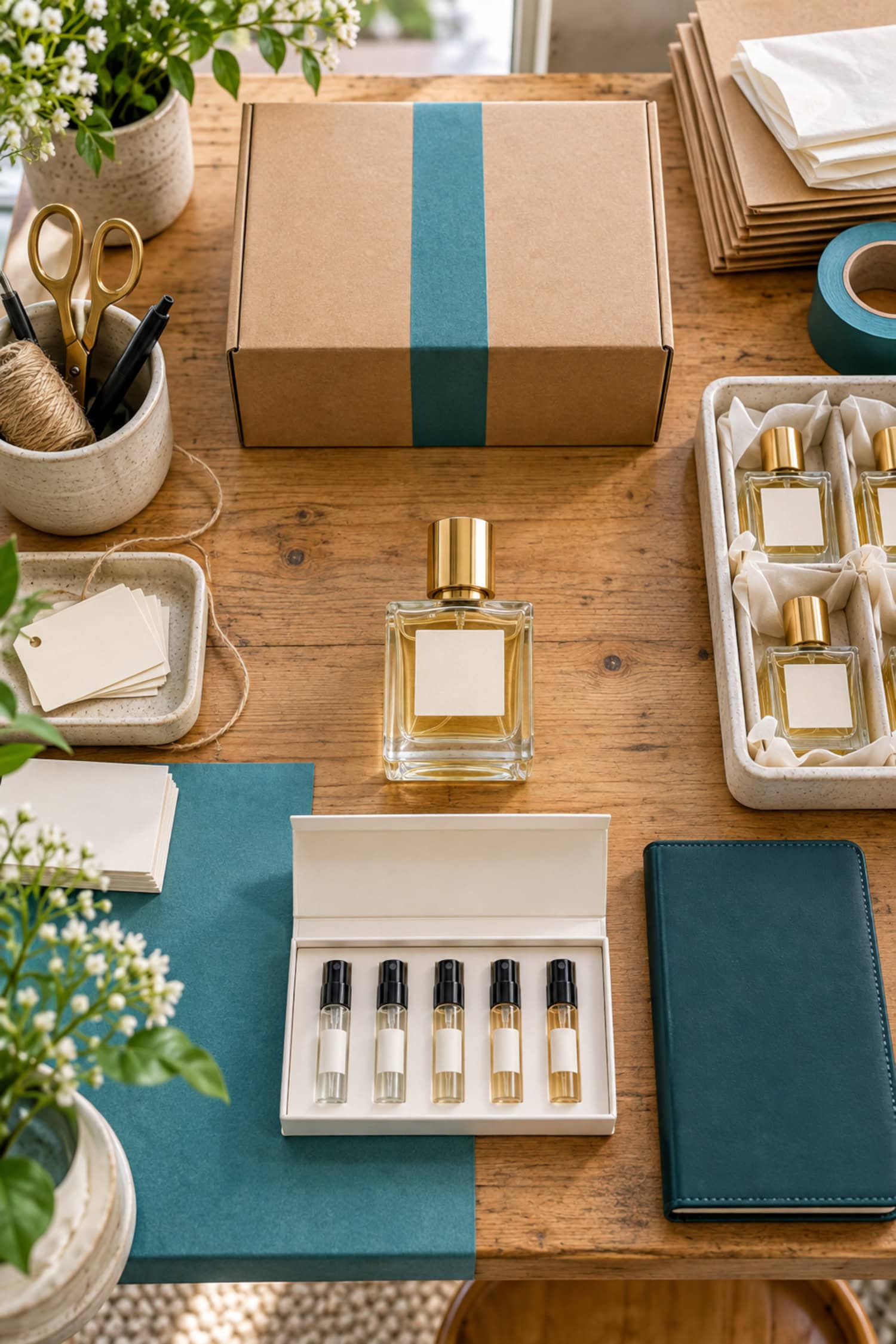
15. A practical perfume business launch plan
A perfume launch works best when spending follows proof.
Use the sequence below to keep irreversible commitments until after the business has answered the cheaper questions.
- Write a one-page operating brief that names the chosen format and assigns responsibility for formulation, manufacturing, packaging, and sales.
- Define the target customer and the reason that customer would choose this fragrance rather than another unknown bottle.
- Select the formulation route and identify the professional roles you actually need.
- Settle formula ownership, licensing, exclusivity, and portability before expensive development work.
- Create or source testable fragrance samples before committing to custom packaging.
- Put samples in front of strangers and track paid demand, signups, and conversion behavior.
- Build the contribution model using actual supplier quotes plus realistic sampling and fulfillment costs.
- Complete the business, tax, and workspace checks for the chosen route. Then verify insurance, cosmetics, and shipping requirements.
- Order physical packaging samples and test the full bottle, pump, cap, label, and box combination.
- Sign production and supplier agreements only after scope, minimums, documentation, quality expectations, and remedies are clear.
- Place a launch order small enough that weak sell-through will not freeze the business’s cash.
- Prepare the sampling path, website or sales materials, fulfillment process, customer support, and recordkeeping before announcing the launch.
- Launch through one or two channels you can measure instead of scattering attention across every marketplace and social platform.
- Review scent-level sell-through, sample conversion, and contribution before reordering. Check repeat purchase, defects, and customer questions at the same decision point.
- Scale only the parts that have demonstrated demand and operational stability.
The first 30 to 90 days should produce better numbers, not merely more content. Pay attention to what customers smell, buy, and reorder.
Also record what they reject, return, and ask about. That information should determine the second production decision.
FAQ
How much does it cost to start a perfume business?
It depends on the production route, packaging, inventory, sampling, and customer acquisition, so there is no useful universal startup figure.
Build the budget from the cost categories and worked economics in Section 5.
Do I need a limited liability company to start a perfume business?
No. A limited liability company is not universally required just because you sell perfume, and business-formation rules vary by jurisdiction.
Choose the legal structure with appropriate tax and legal advice, then complete the registrations described in Section 6.
Do I need a license to sell perfume?
It depends on the business activity and jurisdiction, because cosmetics, local business operations, tax registration, workspace rules, and resale activity can trigger different requirements.
Use the compliance pointers in Section 6 and verify current rules with the responsible agencies.
Should I formulate the perfume myself or hire a perfumer?
It depends on your existing perfumery skill, development time, and desired control.
Compare the operating models in Section 2 and settle the formula rights in Section 7 before committing to custom development.
Can I start a perfume business with private label products?
Yes, private label can reduce the product-development burden and shorten the path to a sellable product.
Section 2 explains where it fits, while Sections 5 and 7 cover the economics and contract questions that still remain.
How do I sell perfume online when customers cannot smell it?
Use a sampling path that is easy for the customer and economically measurable for the business.
Section 4 covers channel choice, and Section 10 explains how to treat discovery sets as part of the product system.
How long does it take to launch a perfume business?
It depends on the production model, development work, supplier lead times, packaging, and compliance checks, so a universal timeline would be misleading.
Follow the dependency order in Section 15 instead of promising a launch date before the slowest dependency is known.
Should I open a physical perfume store first?
Usually no. A physical store adds location, staffing, and inventory decisions beyond launching a fragrance brand, so use Section 2 to confirm that retail is the business model you actually want.
Conclusion
Choose the perfume business model and the parts of the value chain you will own before buying bottles or inventory.
That decision makes supplier, contract, compliance, and packaging questions much easier to answer with real numbers.
It also gives sampling and scale decisions a firmer base.
1. Prove demand before volume.
Use strangers, samples, paid behavior, and conversion data before committing to large production or packaging orders.
2. Put rights and responsibilities in writing.
Know who owns the formula, who manufactures it, what documentation you receive, and what happens if the supplier relationship ends.
3. Scale the economics that already work.
Reorder and outsource only after contribution, sell-through, customer acquisition, repeat purchase, and operations show that more volume is the next problem worth having.
Further reading
- U.S. Food and Drug Administration: Start here for current federal cosmetics requirements and regulator guidance relevant to fragrance products.
- U.S. Small Business Administration: Use the federal small-business resources for planning, formation, funding, and operating basics.
- Internal Revenue Service: Check federal tax registration, employer, and business-tax information for the structure you choose.
- How to Start a Perfume Business: A practical overview of retail, private-label, and original-scent routes plus sourcing and sampling decisions.
- How to Start a Perfume Business: A US-oriented business overview covering validation, setup, insurance, workspace, pricing, marketing, and shipping.
- How to Start a Perfume Retail Business: Useful for readers considering the separate retail-store or reseller route.
- New Fragrance Business Idea: A community discussion about custom fragrance development, production roles, and brand-launch decisions.
- Trying to Create a Fragrance and Then Package It to Sell It: A founder discussion that shows the practical tension between packaging quality, MOQ, budget, and storage.