To start a woodworking business, choose a product or service for a specific buyer, then test whether that buyer will pay enough to cover your real costs.
Next, model the job economics, set up the business and insurance, put client terms in writing, and buy only the equipment the validated work actually requires.
The central mistake is buying tools or building inventory before you have evidence of demand and a price that works. Startup cost varies with the tools you already own, workspace, materials, and working capital.
Insurance, delivery, and marketing can add more cash needs. Licensing and tax requirements depend on your location and what you make or install.
Our editorial recommendation is to start lean and make customer commitment, job costing, and cash flow prove the business before you expand it.

Last fact-checked: October 7, 2026
This guide is for United States beginners planning a solo or small woodworking business, including custom furniture, cabinetry, built-ins, and decor. It also covers repeatable products and commission work, with emphasis on demand, pricing, and sales channels. The later sections cover legal setup, contracts, equipment, operations, and scaling from part-time work into a larger shop.
1. How a woodworking business works
A woodworking business earns through two broad paths: repeatable products or client-specific projects.
The launch sequence matters because every later expense should answer a commercial need created earlier.
| Stage | Decision | Move forward when |
|---|---|---|
| 1 | Choose the business format | You can name the product or service and the buyer |
| 2 | Validate demand | Real prospects show willingness to discuss price or commit |
| 3 | Choose sales channels | The channel reaches buyers who value the offer |
| 4 | Model economics | The price covers materials, labor, overhead, and profit |
| 5 | Set up legal basics | Registration, tax, permit, and insurance needs are identified |
| 6 | Put contracts in place | Scope, payments, changes, and delivery terms are clear |
| 7 | Buy required equipment | Validated work requires the tool and can help pay for it |
| 8 | Build operations | Quoting, scheduling, records, and production are repeatable |
| 9 | Refine products and pricing | Actual job results support the offer and price |
| 10 | Fix or drop weak offers | Weak products or channels have been tested against real results |
| 11 | Scale | Demand is repeatable and the bottleneck is clear |
| 12 | Evaluate an existing shop | Its demand, economics, tools, and workload survive due diligence |
| 13 | Avoid common traps | Expansion is tied to evidence rather than excitement |
| 14 | Launch and review | The first sales cycle produces usable cost and demand data |
The business earns money only when the selling price recovers more than lumber and visible shop time.
Estimating, finishing, design revisions, and marketing still consume the owner’s week.
Customer messages, delivery, maintenance, and idle time take more of it.
2. Woodworking business formats
The main woodworking business formats are repeatable products, custom projects, installed work, or a mix of those models.
The best starting format is the one whose buyer, production time, delivery method, and sales channel you can test without committing to unnecessary fixed costs.
| Format | Revenue model | Best fit | Main commercial risk |
|---|---|---|---|
| Small goods and decor | Repeatable unit sales | Makers who can batch work efficiently | Low ticket prices can leave little pay for labor |
| Custom furniture | Project and commission pricing | Makers with strong design and client communication | Estimating and revisions can consume unpaid time |
| Cabinetry and built-ins | Larger local projects | Shops comfortable with site coordination and installation | Capacity and location-specific requirements become important |
| Repeatable product line | Standard products with controlled options | Shops that can reduce setup time through repetition | Inventory can absorb cash before demand is proven |
| Design-led commissions | One-off premium work | Makers serving buyers who value uniqueness | A weak qualification process creates expensive dead leads |
For most beginners, compare custom complexity with repeatability rather than judging formats by how exciting they look.
A beautiful one-off can carry a higher ticket, while a simpler product can win if batching cuts the hours dramatically.


3. Validate customers and demand before spending
For a first woodworking business, validate demand and real job economics before you buy more tools or build speculative inventory.
If a buyer likes the work but will not accept the required price, record that response and reassess the offer or buyer fit.
One common scene is painfully ordinary.
A customer admires a handmade table, then compares the price with mass-produced retail furniture that solves the same basic problem.
The craftsmanship may be real, but the buyer’s reference point still controls the conversation.
Use a small validation cycle before committing serious cash:
- Define one buyer group and one problem the work solves.
- Show a clear example, drawing, prototype, or portfolio piece to that buyer group.
- Ask for a real next step such as a paid design phase, deposit, preorder, or project discussion.
- Record the price objections instead of automatically discounting them.
- Track how many inquiries become qualified conversations and how many qualified conversations become orders.
- Compare the promised hours with the hours the work actually takes.
Tools are easy to buy and hard to feed with profitable work.
A new machine feels productive on day one, while demand usually has the bad manners to require proof.
4. Sales channels for woodworking customers
Sales channels work best for a woodworking business when they match buyer intent rather than raw traffic.
Marketplace listings, referrals, professional relationships, local events, and direct online channels can all work, but they attract different price expectations.
| Channel | Typical strength | Typical weakness | Better fit |
|---|---|---|---|
| Referrals | High trust and warmer leads | Slow to build from zero | Custom furniture and premium local work |
| Designers and builders | Buyers arrive with a defined project context | Relationships take time to establish | Furniture, cabinetry, built-ins, millwork |
| Facebook Marketplace | Fast local exposure | Many buyers are price sensitive | Prototypes, local pickup, lower-priced items |
| Etsy and similar marketplaces | Access to buyers searching for handmade goods | Commodity categories can be crowded | Distinctive small goods and shippable products |
| Fairs and local events | Immediate customer reactions | Time and inventory are committed before the sale | Small goods and giftable products |
| Social media and a direct site | Strong portfolio presentation | Attention does not automatically become orders | Any model with good visual proof and a clear inquiry path |
Presentation has to make the craftsmanship legible.
A careful finish can disappear in a dark phone photo, so show strong work clearly and consistently.
Large furniture creates another channel problem.
An online sale can look attractive until packing, damage risk, freight, and insurance enter the quote.
Local premium work often avoids that friction, while small shippable products can use wider online reach more comfortably.

5. Startup costs and unit economics
Startup costs for a woodworking business should follow the processes required by its chosen work, while each job price recovers direct costs, owner labor, overhead, and profit.
There is no useful universal startup number when one founder already owns a garage shop and another needs commercial space and machinery.
| Cost area | What belongs here | Lean starting approach |
|---|---|---|
| Tools and equipment | Saws, routers, sanders, drills, planers, jointers, specialty machines, dust collection | Buy only for validated processes |
| Workspace | Home shop, shed, garage, or rented commercial space | Keep fixed occupancy cost low until demand repeats |
| Materials | Lumber, sheet goods, hardware, finishes, consumables, waste | Buy against orders where possible |
| Business overhead | Insurance, registration, permits, software, bookkeeping | Price these into the shop rate or project overhead |
| Sales and delivery | Photography, marketing, vehicle use, packing, freight | Match the channel to the product size and buyer |
| Working capital | Materials on hand, work in progress, cash reserve, timing gaps between spending and payment | Protect cash with deposits and staged payments |
A practical quote floor is:
Quote = materials + owner labor + allocated overhead + job-specific delivery + profit
The table below uses illustrative numbers, not a benchmark.
| Item | Illustrative amount |
|---|---|
| Materials and consumables | $350 |
| Owner labor at 15 hours times $35 | $525 |
| Allocated overhead | $225 |
| Delivery | $100 |
| Profit | $250 |
| Quoted price | $1,450 |
Now stress-test the monthly plan. Four jobs at $1,450 produce $5,800 in sales.
With $450 of materials and delivery per job, $525 of owner labor per job, and $900 of fixed monthly overhead, the illustrative operating surplus is $1,000.
At half the expected sales, two jobs produce $2,900.
Variable materials, delivery, and labor fall with job volume, but the $900 fixed overhead remains.
The illustrative surplus shrinks to $50. Revenue looks impressive until unpaid hours get a vote.
If financing adds a fixed monthly payment, include it in the stress test before committing.
A business that works only at the optimistic sales case has no room for slow months, rework, or delayed projects.


6. Business setup and legal requirements
Starting a woodworking business legally means separating entity choice from the licenses, tax registrations, workspace rules, product rules, and insurance that apply to the actual operation.
Requirements vary by state and locality, so confirm them with the relevant state revenue office, local licensing authority, zoning office, and insurance professional.
A limited liability company (LLC) is one possible legal structure, not a woodworking license.
A sole proprietorship is another common starting structure, and the right choice depends on tax, liability, ownership, and administrative needs.
Before opening, check the items that match your business:
- Business registration and an Employer Identification Number if your situation requires one.
- Sales tax registration and resale rules for products, which vary by state.
- Home occupation, zoning, noise, and local business permit rules for a home shop.
- General liability and other insurance appropriate to your work, premises, vehicle use, products, and employees.
- Contractor or trade licensing and permit requirements if you install cabinetry or built-ins on site.
- Marketplace rules when a third-party platform is part of your sales channel.
- Consumer product safety, testing, and labeling rules if you make children’s products or other regulated goods.
- Workplace safety requirements if you hire employees or operate a larger production shop.
- Environmental permits or waste rules if your production scale, coatings, or processes trigger them.
- Bonding, workers’ compensation, or lead-safe renovation requirements if your installed work falls under construction rules.
If your work expands from a home craft shop into manufacturing or regular installation, the compliance burden can change with it.
Confirm the applicable rules before the new activity starts rather than assuming the old setup still covers it.
7. Client contracts and deposits
Custom woodworking businesses should put scope, approvals, payments, and changes in writing before production starts.
The point is to prevent a design conversation from turning into an open-ended promise with the shop carrying all the risk.
Useful contract terms include:
- Approved dimensions, materials, finish, and drawings.
- Deposit amount and later payment milestones.
- How design changes and change orders are priced.
- Delivery, pickup, installation, and shipping responsibilities.
- What happens to work already completed if the client delays or stops the project.
A familiar failure mode starts with enthusiasm.
The client approves the concept, the shop buys material, and then messages slow down just as the expensive part of the work begins.
A deposit is a commitment filter with a dollar sign. It protects cash flow and gives both sides a reason to treat the schedule seriously.
For design-heavy projects, a paid design phase can also separate serious buyers from people collecting free drawings and estimates.
Track the hours spent before an order because unpaid selling time still belongs in the economics.


8. Equipment and supplier decisions
Equipment decisions in a woodworking business should map to a defined production step and a measurable capacity or labor problem.
Common examples include a table saw, miter saw, router, sander, and drill or driver.
A planer or jointer may be necessary for some work, while computer numerical control (CNC) equipment belongs only where the product and volume justify it.
Use this pre-purchase checklist for every significant machine or tool:
- Name the paid job or product process that requires it.
- Estimate how many labor hours or outsourced steps it can realistically replace.
- Confirm the shop has suitable space, power, dust control, and safe workflow.
- Check that blades, bits, consumables, maintenance, and replacement parts are available.
- Compare buying new, buying used, outsourcing the process, and delaying the purchase.
- Inspect a used machine for condition, accuracy, guards, wear, and obvious maintenance problems.
- Add delivery, setup, accessories, and downtime to the real purchase cost.
- Decide what sales volume would make the purchase earn its floor space.
Suppliers matter for the same reason. Reliable lumber, sheet goods, hardware, and finishing materials affect lead times and consistency.
A lower material price is less useful if stock is unreliable and every job needs redesigning around availability.

9. Day-to-day woodworking operations
Running a woodworking business includes sales, estimating, scheduling, purchasing, and production.
It also includes customer communication, invoicing, delivery, and record-keeping.
The owner who expects a full day at the bench often discovers a second shift waiting in email and quotes after the shop lights go off.
Track each job from estimate to actual result.
At minimum, record materials, shop hours, design and sales hours, delivery time, and the final selling price.
The purpose is to discover where estimates drift and which products look profitable only because hidden time was ignored.
Custom work also needs lead qualification.
Before spending hours on drawings, establish the basic project, budget fit, decision maker, timing, and willingness to commit.
A shop can stay busy while losing money if every inquiry receives premium design work for free.
Part-time operation can reduce transition risk because it lets the owner test demand before depending on the shop for household income.
The trade-off is slower capacity and a tighter calendar, so promised lead times must match the hours actually available.
10. Products and profitable pricing
Profitable pricing in a woodworking business starts with the complete cost of delivering the work, followed by a check against the buyer and channel it serves.
Popular products are not automatically good products if the required hours drive the effective pay too low.
Small goods can work when batching reduces setup and finishing time.
They struggle when every piece behaves like a custom commission while buyers still expect commodity prices.
Custom furniture can support a higher ticket, but quoting, design, revisions, and delivery must be paid somewhere in the project.
Use three checks for every offer:
- Effective hourly return: Divide the money left after materials and job-specific costs by all owner hours, including design, sales, finishing, and delivery.
- Buyer reference point: Identify what the customer compares your work with, from another craftsperson to mass-produced retail furniture.
- Repeatability: Measure whether the second and tenth unit require fewer setup hours than the first.
Track quote-to-actual hours after every job.
If the same task repeatedly overruns the estimate, raise the price, redesign the process, narrow the scope, or stop selling that version.


11. When to fix or drop a weak offer
A weak woodworking business offer should change or disappear when the problem persists after you test the buyer, channel, price, and production process separately.
Before increasing promotion, verify that the product can support the required economics when it sells.
| Signal | Fix first | Drop or redesign when |
|---|---|---|
| Many views and few qualified inquiries | Buyer and channel fit | Attention keeps coming from the wrong price segment |
| Orders sell but owner pay is weak | Price and actual hours | The market will not accept the price required by the process |
| Quotes consume excessive time | Qualification and paid design | Unpaid pre-sale work remains structurally high |
| Shipping damages margin | Product size and channel | Freight costs erase the value of wider reach |
| Revisions keep expanding scope | Contract and change orders | The offer cannot be defined clearly enough to quote |
| A machine sits idle | Product demand and process need | The work does not use the capacity you bought |
Use these signals to stop a weak idea from becoming a permanent subsidy funded by your evenings and savings.
12. Scaling a woodworking business
Scaling a woodworking business makes sense only after demand repeats and the actual bottleneck is visible.
Hiring, a larger shop, more machinery, or automation solve different constraints, so adding all four at once hides which investment helped.
If quoting is the bottleneck, more production equipment changes nothing.
If finishing time is the bottleneck, adding another saw may simply create a larger pile waiting for finish.
If demand is the bottleneck, more capacity is an expensive way to create empty space.
Growth has a habit of turning craft problems into management problems.
Employees add scheduling and supervision, while a larger shop adds fixed overhead that must be paid during slow periods.
Scale one constraint at a time, then compare capacity, owner hours, lead times, and margin before taking the next step.
13. Buying an existing woodworking business
Buying an existing woodworking business can shorten the path to tools, workspace, and customers, but only if the shop’s economics survive verification.
Treat the asking price as the start of due diligence rather than proof that the operation is healthy.
Use this due-diligence checklist:
- Recalculate a sample of completed jobs using materials, actual hours, overhead, and selling price.
- Identify where customers came from and whether demand depends heavily on the seller’s personal relationships.
- Review open custom jobs, deposits already collected, and the work still owed to clients.
- Inspect major tools for condition, capacity, and relevance to the products that actually sell.
- Compare the shop’s quoted hours with actual production and finishing time.
- Review the current mix of custom work, repeatable products, local delivery, and shipping.
- Estimate how much non-shop work the owner performs in sales, estimating, purchasing, and administration.
- Test whether the existing pricing still works if you pay yourself for all of those hours.
The acquisition may still be unattractive when customer demand depends on the seller’s reputation and relationships, even if the shop includes expensive equipment.
14. Woodworking business traps and myths
Most woodworking business traps begin when activity is mistaken for commercial proof.
The most persistent traps are attractive because they feel like progress before a customer has committed money.
| Myth | What actually happens |
|---|---|
| More tools will create more revenue | Equipment adds capacity only when demand and workflow use it |
| Popular small products are automatically profitable | A crowded or labor-heavy item can produce weak effective hourly pay |
| More followers mean more customers | Attention can grow without qualified inquiries or orders |
| Marketplace traffic proves the market | A channel can attract buyers whose price expectations do not match custom work |
| Going full-time means more woodworking | Sales, quoting, purchasing, scheduling, and administration expand with the business |
Be especially skeptical of any startup plan that confuses setup activity with commercial traction. The receipts arrive before the customers do.
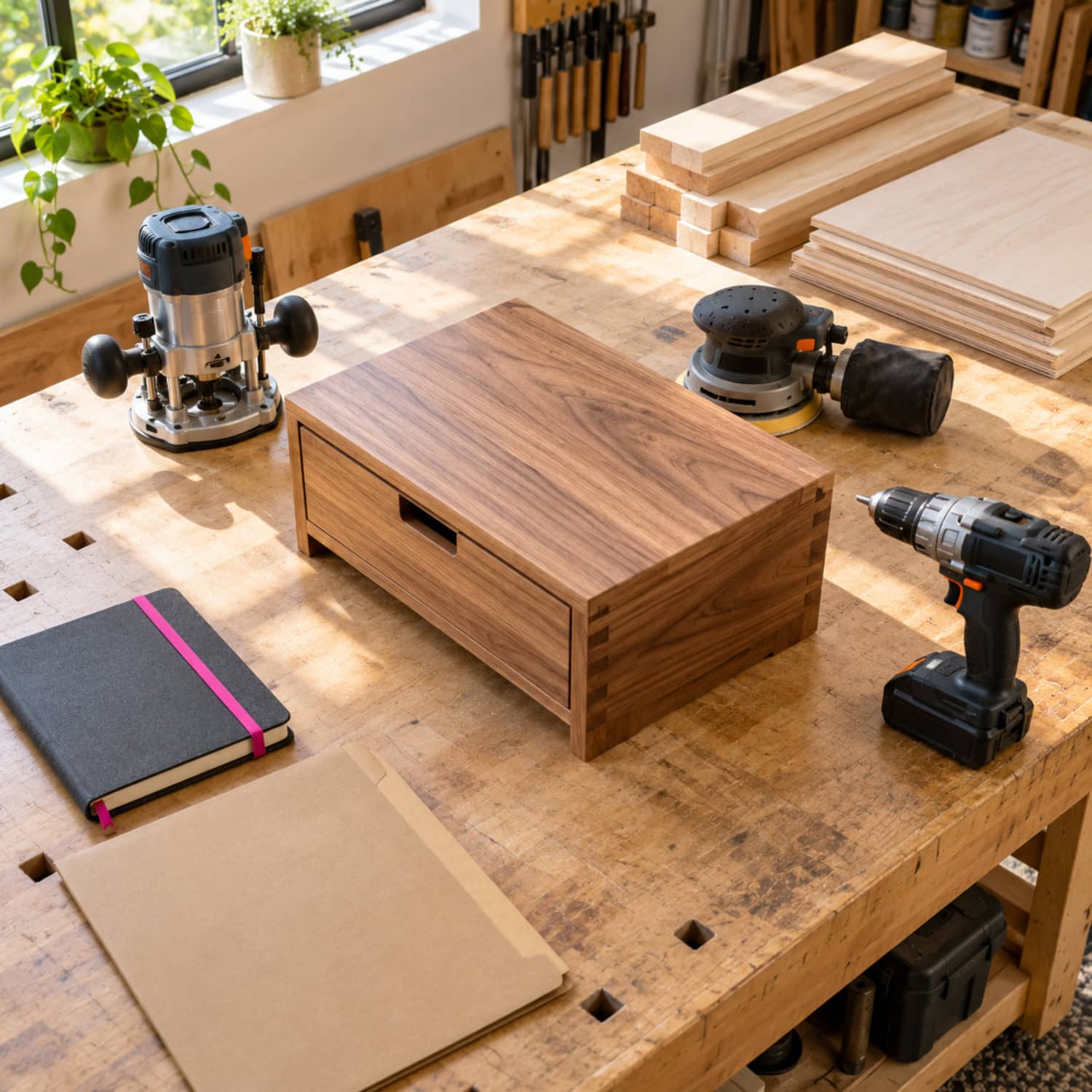
15. Woodworking business launch plan
A woodworking business launch works best when the sequence turns uncertainty into evidence before fixed costs expand.
The first 30 to 90 days should produce real information about buyers, quoted hours, actual hours, cash flow, and channel quality.
- Choose one starting format and define the buyer it serves.
- Build a small portfolio, prototype, sample, or drawing that makes the offer concrete.
- Put the offer in front of real prospects through one or two plausible channels.
- Record price objections, qualified inquiries, and signs of commitment.
- Build the unit economics using materials, labor, overhead, delivery, and profit.
- Check business registration, tax, zoning, and permit requirements that apply to the planned work. Also confirm the relevant insurance and product rules.
- Create a written quote and contract process for custom jobs, including deposits and changes.
- Limit equipment purchases to the production needs identified in Section 8.
- Launch with conservative lead times and enough working capital to handle materials and delays.
- Track quote-to-actual hours and costs on every job.
- Review which buyer groups and channels produce qualified orders rather than attention alone.
- Raise prices, narrow scope, change channels, or drop weak products based on the first sales cycle.
- Expand equipment, space, or labor only after a specific bottleneck is proven.
During the first sales cycle, prioritize a repeatable sale that still looks sensible after every hour and cost is counted.
Branding and shop upgrades can follow.
FAQ
These answers cover common decisions that come up when starting a woodworking business and point to the detailed sections where each decision is explained.
How much does it cost to start a woodworking business?
It depends on tools, workspace, materials, insurance, and working capital. See Section 5.
Do I need an LLC for a woodworking business?
No, an LLC is one structure option rather than a woodworking license, and your entity choice is separate from permits and tax registration.
See Section 6.
Can I start a woodworking business from home?
Yes, if your workspace supports the work and local home-business, zoning, noise, and permit rules allow it. See Sections 6 and 8.
What woodworking products should I sell first?
Start with an offer tied to a defined buyer and measurable job economics rather than choosing only by what is easy to make. See Sections 2, 3, and 10.
Is Etsy or Facebook Marketplace better for woodworking?
It depends on the buyer, product size, price point, and level of customization because the channels attract different expectations. See Section 4.
How should I price custom woodworking?
Price from materials, owner labor, overhead, job-specific delivery, and profit, then compare the result with the buyer and channel.
See Sections 5 and 10.
Should I quit my job to start woodworking full time?
Not until the order pipeline and cash flow are consistent enough for your risk tolerance, because full-time work also adds sales and administrative load.
See Sections 9 and 15.
Do I need a website before I get my first customer?
Not necessarily, because a strong portfolio and a channel that reaches qualified buyers can validate the offer before a full website becomes important.
See Section 4.
Should I buy an existing woodworking business?
It depends on whether the shop’s demand, job economics, tools, customer relationships, and owner workload survive due diligence. See Section 13.
Conclusion
For a woodworking business, the durable rule is simple: validate demand and real job economics before you buy tools or build speculative inventory.
The business becomes credible when paying customers, accurate job costing, disciplined scope, and repeatable operations agree with each other.
1. Sell to a defined buyer. Choose products and channels around the people willing to pay the required price.
2. Price the whole job. Count materials, every owner hour, overhead, delivery, and profit before accepting the work.
3. Protect cash and time. Use qualification, written scope, deposits, and actual job tracking before expanding the shop.
Further reading
These resources cover small-business setup, taxes, workplace safety, product safety, and practical woodworking-business questions.
- U.S. Small Business Administration: Federal guidance on planning, launching, and managing a small business.
- Internal Revenue Service: Federal tax information for businesses and self-employed owners.
- Occupational Safety and Health Administration: Workplace safety information relevant when a shop has employees or larger operations.
- U.S. Consumer Product Safety Commission: Product safety information for regulated consumer products, including children’s products.
- Cutlistor woodworking business guide: A broad startup guide covering niche selection, tools, home-shop setup, pricing, and marketing.
- TRUiC woodworking business overview: A business overview covering startup considerations, target market, legal setup, and launch planning.
- Fine Woodworking discussion on making a living: Practitioner discussion about the commercial realities behind earning a living from woodworking.
- WOODWEB business forum: Professional-shop discussion of estimating workload and the cost of unpaid pre-sale work.