To start a stationery business, choose a specific customer and product direction, test whether people will pay, select a production method, model the full cost of each order, and launch through one or two sales channels.
Our recommendation is to prove demand before committing heavily to inventory or production equipment.
A stationery idea can look excellent on a screen and still fail on paper quality, shipping cost, labor, or customer acquisition.
There is no defensible universal startup-cost range for this business because a home-based design brand, print-on-demand shop, curated retailer, and physical stationery store require very different spending.
Licensing also depends on where and how you operate, so check state and local requirements before selling.

Last fact-checked: October 6, 2026
This guide is for US beginners considering an original-design stationery brand, curated retail shop, home-based operation, or small online store. It covers product validation, production, suppliers, margins, channels, legal checkpoints, fulfillment, wholesale, and scaling without assuming that one business model fits every stationery category.
1. How a stationery business works and the launch sequence
A stationery business turns a defined customer need into a repeatable offer through design or sourcing, production, selling, fulfillment, and reordering.
The launch sequence matters because each decision changes the economics of the next one.
| Stage | Decision | Move forward when |
|---|---|---|
| 1. Business model | Decide whether you will design, curate, personalize, print, or retail stationery | You can name the customer, offer, and reason to buy |
| 2. Product format | Choose a narrow starting assortment | You know what must be sampled and tested |
| 3. Demand | Test whether strangers will pay | You have paid orders, preorders, or credible small-market sales signals |
| 4. Sales channel | Choose where buyers will discover and buy | The channel fits the product and its economics |
| 5. Economics | Price the complete order, not just the item | The contribution remains acceptable after production, labor, fees, packaging, and shipping |
| 6. Legal setup | Register and verify the requirements that apply to your operation | You know the structure, tax, license, home-use, and insurance requirements that apply |
| 7. Contracts | Set supplier, printer, venue, or wholesale terms | Responsibilities, payment, quality, and delivery expectations are clear |
| 8. Equipment and suppliers | Buy only what the validated model requires | Samples meet the required paper, print, finishing, and consistency standards |
| 9. Operations | Build fulfillment and record-keeping routines | An order can move from payment to delivery without improvisation |
| 10. Products and pricing | Refine assortment and price points | Products earn enough after their real variable costs and labor |
| 11. Fix or drop weak offers | Stop protecting products that do not work | You know whether the problem is product, price, channel, or acquisition |
| 12. Scale | Add stock, products, channels, or production capacity | The current offer sells repeatedly and operations are controlled |
| 13. Existing business option | Compare buying against building | The seller’s numbers, inventory, channels, and suppliers survive due diligence |
| 14. Traps | Reject shortcuts that move risk rather than remove it | You can explain the economics behind every major promise |
| 15. Launch | Execute in dependency order | Demand, production, economics, compliance, and fulfillment are ready together |
The attractive part is designing or finding stationery.
The business part is making the same quality arrive at the customer’s door at a price that still leaves money after the dull expenses have eaten.


2. Stationery business formats and where to start
Stationery covers several operating models, and they behave differently.
Pick the format before comparing printers, suppliers, marketplaces, or inventory because those choices depend on what you are actually selling.
| Format | Upfront exposure | Best for | Main constraint |
|---|---|---|---|
| Original-design brand | Low to high depending on production | Founders with a strong visual point of view | Differentiation and production economics |
| Print-on-demand | Low inventory exposure | Testing designs without bulk stock | Higher unit cost and less control over output |
| Home production | Equipment plus materials | Small runs, personalization, rapid experiments | Labor, finishing, media handling, and consistency |
| Commercial printer or manufacturer | Samples plus order commitments | Repeatable branded products and larger runs | Minimum order quantities, lead times, and cash tied in stock |
| Curated online store | Inventory plus fulfillment | Founders strong at selection and merchandising | Buying the right assortment without overstocking |
| Physical stationery shop | Inventory plus premises costs | Tactile categories and local community retail | Fixed overhead and the need for assortment depth |
| Wholesale brand | Production plus trade operations | Proven products that retailers can resell | Retailer margin, payment terms, and channel conflict |
For a first launch, favor the model that lets you learn with the least irreversible spending.
That usually means a narrow collection, samples, and small tests rather than a wall of products that exists mainly to make the store look finished.
3. Validate stationery demand before committing cash
For a stationery business, the central operating rule is simple: prove demand before committing heavily to inventory or production equipment.
Compliments are pleasant, but a paid order tells you something a heart emoji cannot.
Start with a clear customer and use case. “Cute stationery” is too broad to guide product decisions.
A focused offer could instead serve fountain-pen users who care about paper behavior, wedding clients who need coordinated printed pieces, or buyers who want distinctive independent notebooks.
Then test the offer in a way that creates real buying friction.
Useful tests include a small product batch, preorders, a market stall, or a limited marketplace launch.
The goal is not maximum revenue. The goal is evidence that people who do not owe you encouragement will exchange money for the product.
A founder can spend weeks refining packaging while the core question remains untouched.
The better sequence is to put a credible sample in front of the intended buyer, state a real price, and watch what happens.
When evaluating a test, look beyond raw sales.
Note which designs attract attention, which products actually convert, what objections appear, and whether customers return or ask for related items.
A product that needs constant discounting to move is giving you information, not being difficult.
Unsold inventory is stationery with a storage bill. Keep the first commitment small enough that a failed test teaches rather than traps you.

4. Choose sales channels that fit how stationery is bought
Stationery can sell through online marketplaces, an own website, social channels, and physical markets.
Local retail and wholesale add two more routes. Channel choice should follow buying behavior and unit economics rather than fashion.
Etsy can place a new seller near existing search traffic, but the founder still competes for visibility and absorbs marketplace costs.
An own website gives more control over presentation and customer relationships, but the business must create its own traffic.
Physical markets and local stores can be especially useful when touch matters.
Picture a customer picking up a notebook, flexing the cover, feeling the paper, and testing whether the product seems worth the price.
A product that depends on texture can be harder to sell through a thumbnail.
Do not launch everywhere at once. Choose one primary channel and one useful secondary test.
Compare order value, conversion, shipping burden, acquisition effort, and customer feedback before adding another storefront.
For low-ticket products, channel economics matter quickly.
A sale can look successful until platform costs, packaging, postage, and promotional spend are counted together.
Treat every channel as its own profit model.


5. Model startup costs and stationery unit economics
A general stationery business has no useful single startup-cost benchmark because the operating models create different cost structures.
The meaningful question is which costs your chosen model creates before the first sale and which costs repeat with every order.
Build the startup budget from the costs created by your chosen model:
| Cost area | Applies when | Why it matters |
|---|---|---|
| Product development and samples | Any original or customized product | You need a saleable physical result before scaling |
| Initial inventory | Curated retail or batch production | Cash is committed before sell-through is known |
| Production equipment | Printing or finishing stays in-house | Equipment adds consumables, maintenance, space, and labor |
| Selling and fulfillment | Any channel | Packaging, photography, channel costs, and market fees affect launch cash |
| Business setup and workspace | Most models | Registration, insurance, and workspace needs vary by operation |
A physical store adds a different class of commitments from a home-based design business.
For each product, calculate contribution per order before deciding that the price “feels right.” Use this formula:
Contribution per order = order revenue – production cost – packaging – shipping subsidy – platform and payment costs – direct labor – variable marketing cost
Here is a worked example using illustrative numbers, not a benchmark.
| Item | Illustrative amount |
|---|---|
| Order revenue | $30 |
| Production cost | $9 |
| Packaging | $2 |
| Shipping subsidy | $6 |
| Platform and payment costs | $3 |
| Direct labor | $4 |
| Variable marketing cost | $2 |
| Contribution per order | $4 |
If the business receives 100 similar orders, contribution is $400.
If fixed monthly overhead is an illustrative $250, the remaining amount is $150 before taxes and any owner-level costs not already included.
Now stress-test sales at half the estimate. At 50 orders, contribution falls to $200 while the illustrative $250 fixed overhead remains.
The result becomes a $50 loss. That is why a thin contribution can make a promising product fragile.
Include labor even when you perform it yourself. Cutting, folding, and personalization consume time. So do proofing, packing, and customer messages.
One maker reported roughly 65 hours for a DIY wedding-invitation project, a useful reminder that material cost alone can badly understate the work.
Also model shipping before setting the retail price. Free shipping is not free to the seller.
Charging separately, absorbing part of the cost, or raising the product price are all pricing choices with different conversion effects.
Keep cash outside inventory for the costs that arrive before the next sale or wholesale payment.
If outside financing is part of the plan, include its repayment in the cash-flow model instead of treating borrowed cash as proof that the product economics work.


6. Set up the stationery business legally
A US stationery business should verify business registration, tax obligations, and local licensing before launch.
It should also check home-use, insurance, and product-specific requirements.
Exact requirements vary by jurisdiction and business model, so use the relevant government agencies rather than copying another seller’s setup.
Choose a business structure that fits your tax and liability situation.
If you are considering a limited liability company (LLC), compare it with the other structures available in your state.
If the choice materially affects tax or liability, discuss it with a qualified attorney or tax professional.
Retail sellers should check whether they need a sales tax permit and whether a resale certificate applies when buying inventory for resale.
Requirements and terminology vary, so confirm them with your state revenue agency.
A home-based business should also check local business-license, zoning, lease, or home-occupation rules.
A rented apartment and a detached studio can face different practical constraints even before a printer arrives.
If you operate a physical shop, confirm local business licensing, zoning, lease restrictions, and insurance before signing long commitments.
If you sell regulated product categories, including products intended for children, verify the applicable product-safety rules before ordering inventory.
Price insurance for the way the business actually operates, including any premises, inventory, or customer-facing activity.
Coverage needs vary, so use a licensed insurance professional when the decision is material.
If your stationery uses fonts, artwork, photographs, characters, or other licensed creative material, confirm that your commercial use is permitted before selling the product.
Brand protection is a separate issue from choosing a store name.
If trademark protection matters, check federal trademark requirements and clearance before investing heavily in packaging or signage.

7. Put supplier and wholesale terms in writing
Stationery suppliers, printers, manufacturers, event venues, and retail accounts can all create obligations that deserve written terms.
The important clauses depend on the relationship, but the recurring risks are quality, timing, payment, and who absorbs problems.
For a printer or manufacturer, define the product specification clearly enough that a repeat order means the same thing. Put these points in writing:
- Paper, dimensions, binding, and finish.
- Color expectations and approved sample standards.
- Packaging, lead time, and defect handling.
For wholesale, write down the commercial terms that affect both parties:
- Pricing and case or pack quantities.
- Payment timing, returns, and damaged goods.
- Online resale and branding expectations.
A retailer can expand reach, but the relationship can also create a new competitor if both parties sell the same branded item online without a channel policy.
For custom stationery, use client terms that cover proofing and approvals, payment and cancellation, plus delivery expectations.
Personalization becomes expensive when every revision arrives as a surprise.
Keep approved samples and written specifications for quality control.
A later batch should be compared with an agreed standard rather than memory alone.

8. Choose production equipment and suppliers after sampling
Stationery production should be chosen from the product backward.
The required paper, print quality, finishing, batch size, and turnaround set the constraints.
Then choose among home equipment, commercial printing, print-on-demand, or manufacturing.
Heavy stock and specialty papers expose weak assumptions quickly.
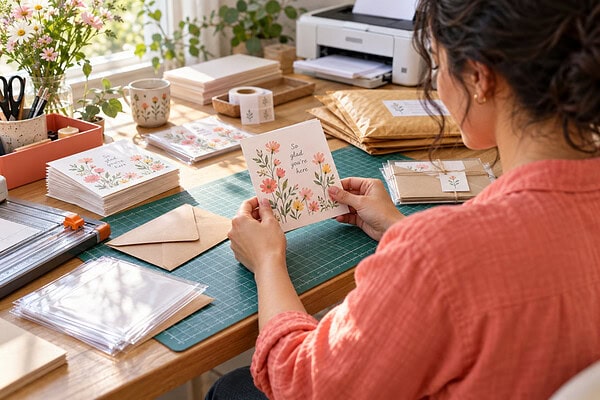
A desktop printer that looks capable on a specification sheet may struggle with a real feed path, thick card, envelopes, or consistent output across a run.
Printing is only one step if the product also needs cutting, folding, scoring, binding, or careful packing.
A printer is not a shortcut if it turns you into the finishing department.
Home production earns its place when flexibility and small runs justify the time, space, maintenance, and learning curve.
Use this pre-purchase checklist before buying equipment or placing a meaningful supplier order:
- Produce a physical sample using the exact paper or stock you intend to sell.
- Test writing behavior, bleed-through, feel, color, and finishing that matter to the intended customer.
- Confirm the supplier or equipment can handle the required size, thickness, envelopes, binding, or specialty media.
- Price the complete finished unit. Include setup, waste, and consumables. Then add finishing, packaging, and inbound shipping.
- Test consistency across more than one sample or run.
- Ask how quickly the item can be reordered and what happens when a stock or material becomes unavailable.
- Check minimum order quantities and calculate the cash tied up in every design or stock-keeping unit.
- Inspect how the finished product survives packing and delivery without bending, scuffing, or creasing.
- Compare the outsourced and in-house options using the same quality standard and labor assumptions.
- Buy production equipment only when the expected use justifies owning the process rather than renting it through a supplier.
A cheap notebook that feels cheap is expensive inventory.
Reject samples that require you to apologize for the paper, print, or finish before the customer has even seen the price.
9. Build operations for fulfillment and repeatability
A stationery business becomes operationally demanding when orders increase because every small task multiplies.
Build a simple order flow before volume forces you to invent one during a busy week.
Document how an order moves from payment through production, quality check, packing, shipping, and customer handoff.
Track inventory by stock-keeping unit, or SKU, so you know which designs are selling and which are merely occupying shelves.
Keep packaging protective without making it economically absurd. Paper goods are light, but they can bend, crease, scuff, or arrive looking used.
The customer does not care that the package was beautiful before the postal system sat on it.
Watch the founder’s labor as closely as material costs.
Picture a personalized invitation seller answering proof changes in the afternoon and packing orders at midnight.
Growth that adds one unit of revenue and one unit of founder exhaustion is not much of a scale advantage.
Record the reasons for reprints, refunds, damaged shipments, late orders, and customer-service contacts.
Those patterns show which part of the operation needs fixing before more marketing pours volume into it.

10. Build a tight product mix and price it deliberately
A new stationery business should launch with enough depth to look intentional but not so many products that inventory becomes a guessing game.
Choose products that share a customer, aesthetic, use case, or purchasing occasion.
Paper quality, binding, size, and finish can all influence what customers consider worth paying for.
Pen compatibility, packaging, and visual design can matter too. Premium pricing works only when buyers can perceive the extra value.
Use average order value, or AOV, to judge whether complementary products help the economics of each transaction.
A notebook may pair naturally with note cards, stickers, pens, or coordinated paper goods, but additions should support the same customer rather than create a random gift shop.
Test prices instead of deciding in advance that “nobody will pay” a certain amount.
Buyers compare price aggressively, including buyers who prefer independent brands.
The job is to find the price where the product’s perceived value and your required economics can coexist.
If a product only works when labor is treated as free or shipping is ignored, the product does not work at that price.
Change the price, product, production method, bundle, or channel.
11. Know when to fix or drop a product or channel
A weak stationery offer should be diagnosed before it is expanded.
Separate product problems from channel problems and economic problems so you do not solve the wrong thing.
If people engage with the design but refuse the price, investigate perceived value and cost structure.
If buyers purchase in person but ignore the product online, the tactile experience or online presentation may be doing more work than expected.
If a product sells but contribution is negligible, volume can make the problem larger rather than better.
A stack of orders with no room for labor, returns, or customer acquisition is activity, not resilience.
Set a review point before launch for each product and channel. Look first at paid demand, contribution, and fulfillment time.
Then check defects, returns, and repeat interest. Decide whether to improve, move, change, or stop the offer.
12. Scale stationery only after the small model repeats
Scaling a stationery business should add capacity to a working system, not complexity to an unresolved one.
The best next step depends on which constraint is already visible.
If demand is consistent but home production consumes too much labor, compare commercial printing or manufacturing.
If one channel works but customer acquisition is concentrated there, test a second channel without abandoning the first proven channel.
If customers repeatedly buy related products, expand around that behavior rather than adding designs because they are enjoyable to make.
More stock-keeping units increase purchasing, forecasting, storage, and reorder work.
Wholesale can make sense after direct sales have clarified which products deserve wider distribution.
Before offering wholesale, model the lower selling price, retailer economics, and payment timing.
Then add pack quantities, any barcode needs, and the cash required before retailer payment arrives.
Revenue can look cheerful while cash flow quietly files a complaint.
A large wholesale order is less exciting when the supplier must be paid long before the retailer pays you.
13. Check an existing stationery business before buying it
Buying an existing stationery business can shortcut product development and customer acquisition, but only if the assets and economics transfer cleanly.
Treat the seller’s story as the beginning of due diligence rather than the conclusion.
Use this checklist before agreeing on a purchase:
- Reconcile sales records with deposits and marketplace or payment records.
- Rebuild contribution by major product using production and packaging, selling fees and shipping, then labor and discounts.
- Review inventory by age, quantity, condition, and realistic sell-through rather than the seller’s original cost alone.
- Identify which sales channels generate orders and whether those accounts can actually transfer.
- Review supplier relationships, minimum order quantities, lead times, and whether pricing depends on the current owner.
- Inspect samples from recent production runs for consistency and quality.
- Check customer complaints, refunds, damaged shipments, and recurring service issues.
- Review any wholesale relationships for payment terms, online resale, returns, and channel conflict.
- Confirm which creative and brand assets are included. Then verify whether domains, photographs, and customer data are transferable.
- Calculate how much owner labor is required to maintain the reported sales.
A business that depends on the seller’s personal production skills, audience, or informal supplier favors can change materially after the handoff.
Price the business you can operate, not the version that existed only with the previous owner inside it.
14. Avoid common stationery startup traps
Most stationery traps are not mysterious. They come from treating one constraint as if it solved the whole business.
| Myth | What actually happens |
|---|---|
| More products make a new shop look more legitimate | A broad assortment increases inventory exposure before you know what sells |
| Print-on-demand removes startup risk | It reduces inventory exposure but can leave less room for margin and quality control |
| Better quality automatically supports any price | Buyers still compare prices, so premium materials must create value customers can perceive |
| Etsy traffic will produce the first customers by itself | Marketplace access does not remove the need for differentiation, strong listings, reviews, and acquisition work |
| Free shipping is just a marketing decision | The shipping cost still exists and must be paid through product price, seller margin, or a separate charge |
| Wholesale is simply more volume | Wholesale adds retailer economics, payment terms, inventory funding, and possible channel conflict |
| Buying equipment creates independence | Equipment also creates maintenance, consumable, space, finishing, and labor obligations |
Be especially wary of any setup that looks cheap only because one cost is hidden somewhere else.
Low inventory can mean high unit cost. Low production cost can mean a large minimum order. Higher control can mean more founder labor.

15. Launch a stationery business in dependency order
A stationery launch should move from an offer that buyers have tested toward production, compliance, repeatable fulfillment, and only then greater inventory or capacity.
Use the launch plan as a gate, not as a calendar you must obey regardless of what the tests show.
Before spending meaningfully
- Choose the target customer and the specific use case or reason to buy.
- Select a narrow opening assortment and define the required paper, finish, format, and quality.
- Produce samples and test them with the intended buyer.
- Run a small paid-demand test through a market, preorder, marketplace listing, or limited batch.
- Record objections, price resistance, and which products actually convert.
Before signing supplier or venue commitments
- Build the per-order contribution model using the supplier’s real quote and your realistic labor.
- Stress-test the model at lower sales and include shipping rather than treating it as an afterthought.
- Verify business registration, tax, and local licensing requirements. Then check home-use, zoning, insurance, and any product-specific rules that apply.
- Approve a physical sample and write down the specification that the supplier must repeat.
- Put payment, delivery, quality, returns, and channel terms in writing where relevant.
Before opening sales fully
- Set up product records and SKU-level inventory tracking where inventory is held.
- Prepare packaging that protects the product in the actual shipping method.
- Write the fulfillment sequence from paid order through delivery and customer follow-up.
- Photograph products in a way that communicates scale, texture, finish, and use.
- Choose one main acquisition channel and one secondary test rather than scattering effort across every platform.
During the first 30 to 90 days
- Track contribution, fulfillment time, defects, returns, and customer questions by product.
- Compare channel performance rather than combining all sales into one comforting revenue number.
- Reorder only the products that have earned a larger inventory commitment.
- Fix repeated quality or shipping problems before adding more traffic.
- Add products, equipment, or wholesale only when the existing model shows repeatable demand and controlled operations.
The first useful milestone is a small system that can take a real customer from discovery to delivery without destroying margin or your schedule.
FAQ
Is a stationery business profitable?
It depends on contribution after direct production and fulfillment costs, plus selling and acquisition costs.
A product can sell well and still produce little profit if those costs are ignored. See Section 5.
How much does it cost to start a stationery business?
There is no single credible range for all stationery models.
A home-based designer, print-on-demand seller, inventory retailer, and physical shop have different cost structures. See Sections 2 and 5.
Do I need an LLC to start a stationery business?
It depends on your jurisdiction and chosen business structure.
Verify the structure, tax, and liability implications that apply to you before launch. See Section 6.
Can I start a stationery business from home?
Yes, a home-based model is possible, but local business, zoning, and lease constraints still need checking.
Production, storage, and home-occupation rules can matter too. See Sections 2, 6, and 8.
Should I use print-on-demand or print stationery myself?
It depends on required quality, volume, and labor, plus equipment cost and inventory risk.
Compare the per-unit economics and physical samples before deciding. See Section 8.
How do I get the first stationery customers?
Start with one channel where the target customer already shops and use a small paid-demand test instead of waiting for organic attention.
Markets, marketplace listings, preorders, and direct launch activity can all serve that test. See Sections 3 and 4.
Can a stationery business replace a full-time income?
It can only do so if profit scales faster than the founder’s labor and fixed costs.
Track contribution, repeat demand, fulfillment capacity, and channel acquisition before treating revenue growth as salary replacement.
See Sections 9 and 12.
Do I need a formal business plan before I start?
No, a long document is not necessary before a small test launch, but written assumptions still matter.
Record the offer, production method, channel, costs, and launch gates. See Sections 1 and 5.
Conclusion
A stationery business becomes much easier to manage when creative decisions are forced through commercial tests.
Prove demand before committing heavily to inventory or production equipment, then let real sales determine what deserves more stock, better machinery, or another channel.
1. Validate with money before scaling with money. Use small paid tests to decide which products deserve deeper inventory or production commitments.
2. Price the whole order. Include direct production and fulfillment costs first. Then add selling costs, shipping, and variable acquisition before judging whether a product is viable.
3. Add complexity only after repetition. New products, equipment, channels, and wholesale should solve a proven constraint rather than create a new one.
Further reading
- U.S. Small Business Administration: Federal starting point for business planning, registration, funding, and local assistance.
- Internal Revenue Service: Federal tax information for businesses and employers.
- U.S. Patent and Trademark Office: Federal information on trademarks and brand protection.
- JIM stationery business guide: Broad overview of niche choice, validation, setup, costs, selling, and operations.
- Grow Your Boutique stationery guide: Retail-focused coverage of assortment, sourcing, inventory, merchandising, and margins.
- Printify stationery business guide: Print-on-demand perspective on products, channels, inventory, and launching.
- UK Business Forums paper and card production discussion: Practitioner discussion of in-house printing, commercial production, paper stock, and finishing trade-offs.
- PrinterKnowledge wedding stationery printer discussion: Detailed discussion of printers, thick stock, envelopes, media handling, ink cost, and small-workspace constraints.