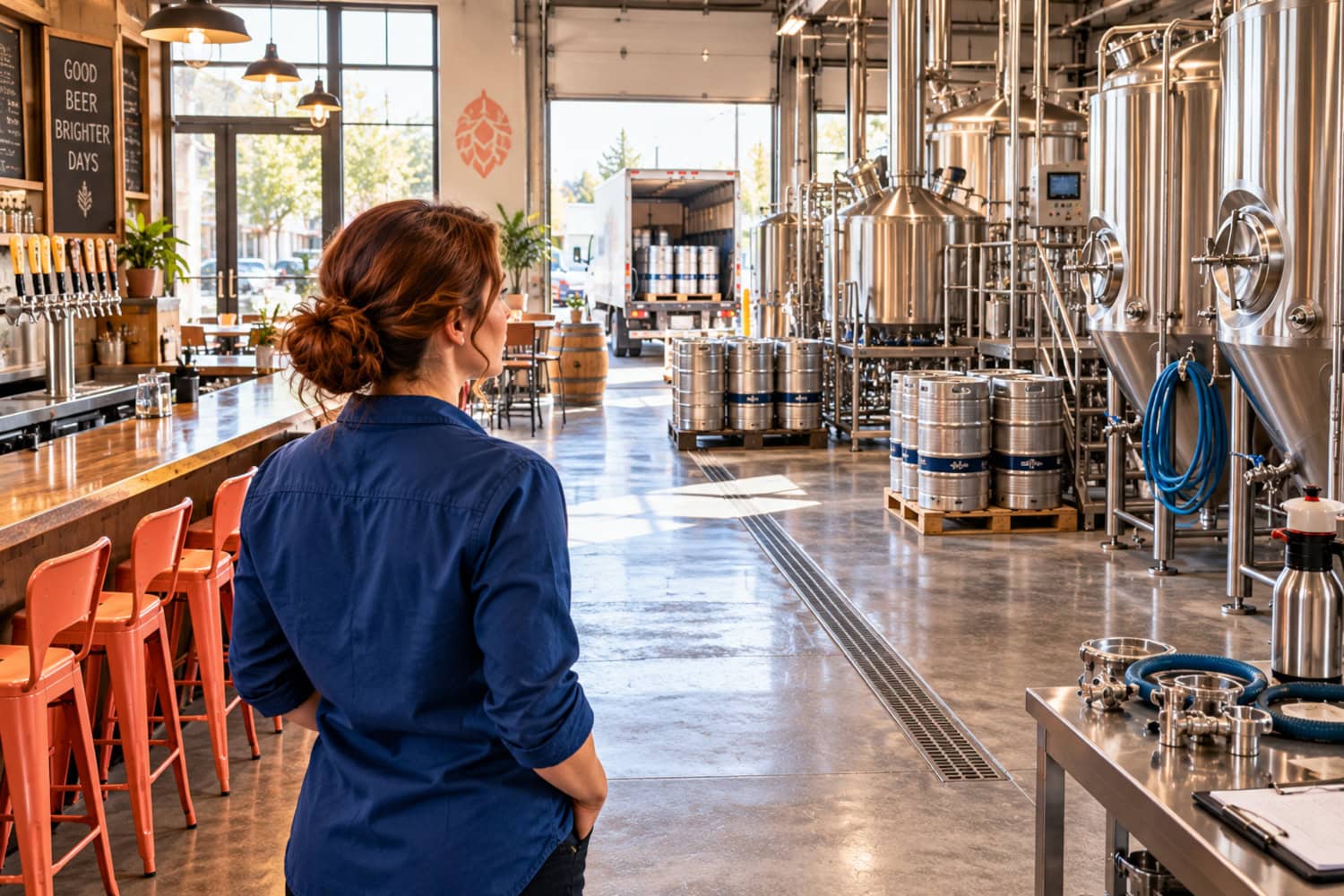
To start a brewery, identify the customers and sales channels you expect to serve, choose a brewery format, and test whether conservative sales will cover its costs.
Next, assess sites for production requirements, secure financing, establish the business, obtain alcohol approvals, and install equipment suited to projected sales.
The critical decision is how and where you will sell the beer before committing to brewhouse capacity.
There is no useful single startup price for every brewery: a small taproom, a brewpub with a kitchen, and a distribution plant require different buildings, equipment, and cash reserves.
In the United States, a brewery or brewpub needs federal qualification through the Alcohol and Tobacco Tax and Trade Bureau, plus applicable state and local approvals.
After opening, customer traffic, production consistency, and paid labor determine whether the owner earns a living.
Last fact-checked: October 8, 2026
This guide is for first-time US founders considering a small independent brewery, especially a taproom-led operation. It covers format choice, demand, property inspections, finances, licensing, production equipment, day-to-day work, and expansion decisions. Distribution breweries and brewpubs are compared where their different economics change the plan.
1. How a brewery business works
A brewery makes money when it sells beer through a channel that leaves enough cash after making, serving, and delivering it.
A neighborhood taproom earns customer-facing sales revenue.
A production brewery relies more heavily on packaged beer and wholesale orders. A brewpub adds restaurant operations.
The owner also manages approvals, the premises, sales, production, maintenance, and payroll.
Plan in that order rather than following an equipment catalog.
| Stage | Main decision | Move forward when |
|---|---|---|
| Choose the model | Taproom, brewpub, production, or contract route | You know the intended buyers and sales channel |
| Test demand | Customers, repeat visits, and likely sales | Conservative demand assumptions have a plausible basis |
| Screen sites | Customer access and production suitability | Zoning and major utility constraints have been investigated |
| Build the budget | Opening cost, operating losses, owner pay | A weak-sales scenario can be funded or the plan reduced |
| Set up and qualify | Business formation, federal, state, and local approvals | The legal path and its premises dependencies are understood |
| Contract and equip | Lease, suppliers, brewhouse, cellar, service space | The commitments fit the approved model and site |
| Operate and sell | Staff, production, taproom, pricing | Roles, quality checks, and sales reporting are ready |
| Review alternatives | Repair, expand, acquire, or reject offers | You can compare the effect on cash and workload |
| Open and learn | Inspections, controlled opening, initial trading | Beer can legally be sold and early performance can be measured |
2. Choose the brewery format before planning the facility
A small taproom brewery and a distribution-focused brewery can make equally good beer while facing very different financial problems.
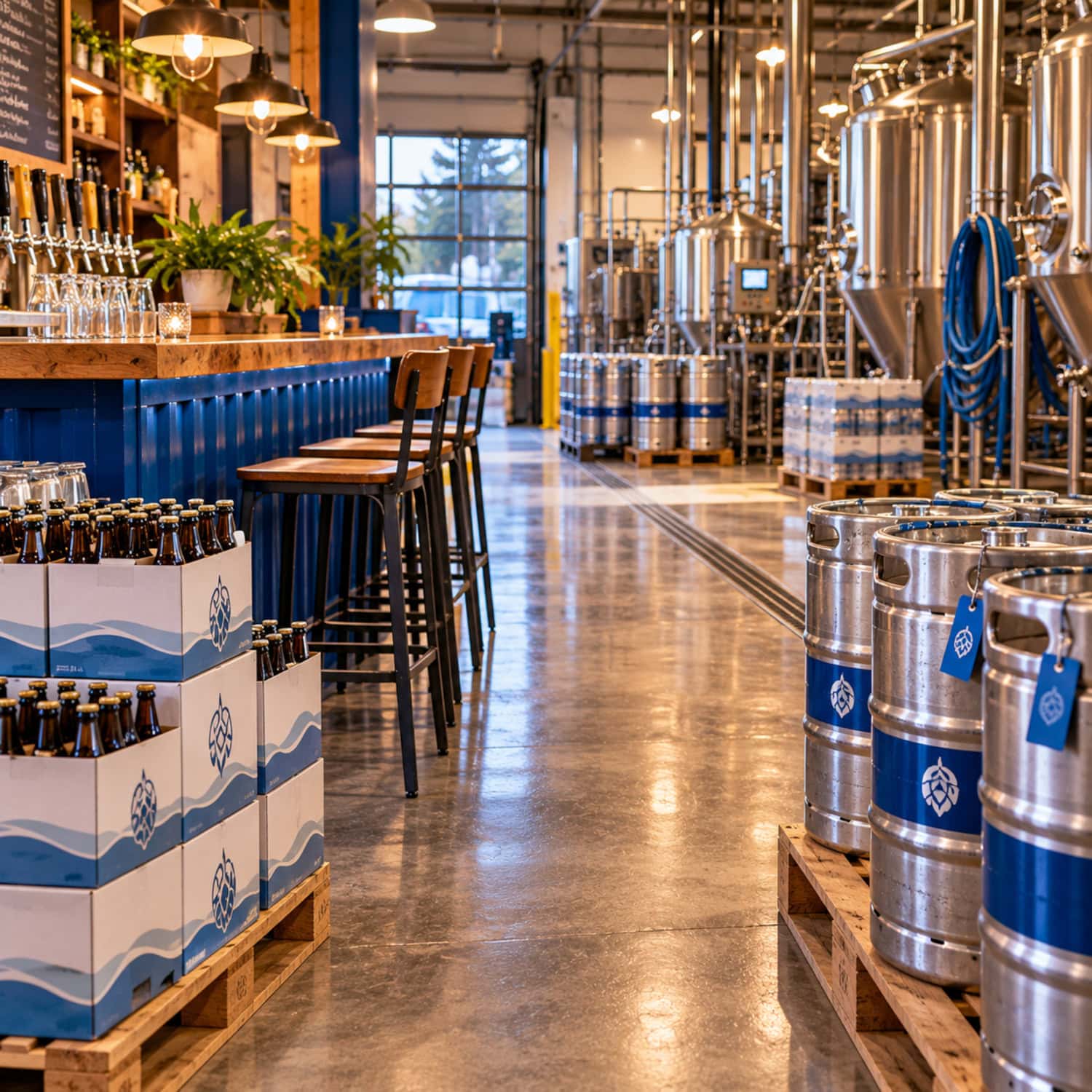
The taproom needs people to visit.
The distributor needs reliable orders, packaging, logistics, and a price that still works after others take their share.
| Format | Main revenue route | Capital and operating implications | Best fit |
|---|---|---|---|
| Nanobrewery with a taproom | Small batches sold largely on-site | Lower production scale, but frequent brewing and limited labor capacity | Founder testing a focused neighborhood concept |
| Taproom brewery | Beer sold directly to guests | Guest space and service staff matter alongside production space | Strong local repeat-visit market |
| Brewpub | Beer and prepared food served together | Adds kitchen buildout, food safety, staffing, and restaurant management | Market where food is central to the visit |
| Production brewery | Packaged beer, keg sales, and wholesale | Greater packaging, warehousing, sales, and transport requirements | Proven demand beyond the brewery premises |
| Contract-production brand | Beer produced at another qualified brewery under an appropriate arrangement | Reduces the need for owned production equipment, but adds manufacturing agreements and outside dependence | Founder prioritizing brand and sales before a facility |
This article uses a taproom-led brewery as the working example.
The same planning logic applies to other formats, but changing the route to market changes pricing, required volume, staffing, and equipment.
3. Prove local demand and define the customer visit
A brewery needs evidence of repeat purchases, not just compliments on a homebrew recipe.
A potential customer who enjoys a tasting at a party has made no commitment to travel across town, pay retail prices, and return next weekend.
Consider two prospective properties. One is on a busy street near other evening destinations.
The other has cheaper rent but little customer activity after work. The difference is not just foot traffic.
It is whether the brewery can become part of a routine that customers already have.
Start with the occasion. Will customers come for a quick beer after work, a group gathering, an event, or food with friends?
Then examine what nearby bars, breweries, and restaurants already provide.
A new IPA recipe rarely answers why someone should change their usual meeting place.
Consistently good beer matters, but customers also need a reason to return.
A practical demand study should contain evidence that changes a financial assumption:
- Visit competing taprooms at different days and times. Note who attends, what they order, and whether seats are occupied outside peak hours.
- Identify the customer group you intend to win and the reason it would return. Include people who are not dedicated craft-beer enthusiasts.
- Compare the planned experience with nearby alternatives, including food, seating, accessibility, events, and non-beer choices.
- Talk to potential customers about actual habits and willingness to travel and spend. Treat verbal enthusiasm as weaker evidence than observed purchasing behavior.
- Translate a conservative estimate of visits and spending into monthly revenue, then test a materially weaker scenario.
For a wholesale concept, repeat the exercise with bars, retailers, and other potential buyers.
Interest in stocking a sample is different from recurring paid orders at the required volume.
The beer does not sell itself. Atmosphere, service, events, and marketing help explain why people return when competitors also pour excellent beer.
4. Evaluate the location as a brewery and a customer venue
An appealing storefront can become a poor brewery if the floor cannot drain, the utilities cannot support production, or trucks cannot reach the equipment area.
Check the physical constraints while the property is still a possibility, not after the lease is signed.
Imagine a space with exposed brick, attractive windows, and an affordable monthly rent.
The first production washdown sends water toward a corner without a drain.
Every brew day then involves moving liquid that the building should have handled. Cheap rent can have expensive drains.
Assess taproom visibility, access, nearby activity, and guest layout.
For production, investigate zoning, floor loading, clearance, power, water, wastewater, ventilation, refrigeration, drainage, storage, and deliveries.
The balance depends on how much beer is sold onsite.
Questions for the landlord and technical advisers
- Is brewing and the proposed alcohol sales activity allowed under zoning and the property’s permitted use?
- Can the floor support filled tanks and handle regular wet cleaning without standing water?
- Where will floor drains, wastewater lines, and any required pretreatment connect?
- Are power, water, ventilation, cooling capacity, and equipment clearances sufficient for the proposed layout?
- Can tanks and major components be delivered through doors, loading areas, and internal routes?
- Who pays for permanent upgrades, and who owns them when the tenancy ends?
- What happens if building approval or an essential alcohol permit is refused or delayed?
- Are rent commencement, renewal options, increases, assignment, and termination terms workable if the buildout runs late?
Have qualified building, mechanical, electrical, and code professionals assess the space before a binding construction commitment.
A sketch of tanks on a floor plan is not an engineering review.
5. Calculate startup costs and operating economics
Brewery startup costs include much more than a brewhouse.
The useful budget covers everything paid before the first legal sale, the months until revenue becomes dependable, and enough compensation to keep the owner from subsidizing the business indefinitely.
| Cost area | What the budget needs to include | Common omission |
|---|---|---|
| Property and buildout | Deposit, rent during construction, drains, utilities, cooling, guest areas | Paying rent before alcohol sales are allowed |
| Production equipment | Brewhouse, fermentation tanks, transfers, cleaning, installation | Freight, rigging, installation, and spare parts |
| Taproom and packaging | Draft system, service equipment, kegs, glasses, optional packaging | Repairs, consumables, and replacement equipment |
| Professional and approval costs | Legal, accounting, design, engineering, permit preparation | Revisions caused by property or layout changes |
| Opening inventory | Ingredients, cleaning supplies, merchandise, beer in process | Paying for inputs before beer is ready to sell |
| Staffing and marketing | Hiring, training, preopening promotion | Payroll before full customer traffic develops |
| Working cash | Rent, utilities, insurance, debt service, taxes, owner pay | Slow launch months and unexpected delays |
Build the model by sales channel
The money remaining after each sale’s direct costs is its contribution.
In a taproom, direct costs include beer ingredients and other costs that rise with each sale.
For wholesale, packaging, freight, commissions, and channel pricing matter too.
Keep the channels separate so a busy production line does not hide weak wholesale economics.
A simple monthly operating estimate is:
Operating result = units sold x (selling price per unit – variable cost per unit) – monthly fixed costs.
The following numbers are illustrative, not a brewery benchmark.
They model 16-ounce taproom servings, exclude food sales, and assume fixed costs already include a realistic allowance for the owner’s labor.
| Monthly item | Expected case | Half-sales stress test |
|---|---|---|
| Servings sold | 3,000 | 1,500 |
| Selling price per serving | $8 | $8 |
| Variable cost per serving | $2 | $2 |
| Beer sales | $24,000 | $12,000 |
| Total variable costs | $6,000 | $3,000 |
| Money remaining after variable costs | $18,000 | $9,000 |
| Fixed costs including owner labor | $14,000 | $14,000 |
| Illustrative operating result | $4,000 surplus | $5,000 loss |
In this example, selling half the expected beer turns a modest surplus into a substantial loss.
Variable costs fall with volume, but rent, many wages, insurance, and debt obligations remain.
A forecast should also account for debt principal, startup investment, taxes, and cash timing separately from this simplified operating result.
Wholesale needs its own calculation using the brewery’s actual net selling price and channel costs. Higher volume is not automatically a cure.
In one operator-reported example, a minority of gallons sold through the taproom produced most revenue.
That illustrates the importance of channel mix, not a transferable revenue ratio for every brewery.
Capital and the cash runway
Build a monthly cash schedule from lease signing through opening and beyond.
Show construction draws, deposits, equipment payments, inventory purchases, permit-related delays, and months with weak or no sales.
Add a separate contingency for surprises rather than using projected opening-month profit to cover them.
Financing might combine founder equity, investors, bank or Small Business Administration-backed lending, and properly structured equipment finance.
Each source changes required payments, control, or personal exposure.
Ask a lender or accountant to examine the weak-sales case before accepting repayment obligations.
6. Establish the business and obtain brewery approvals
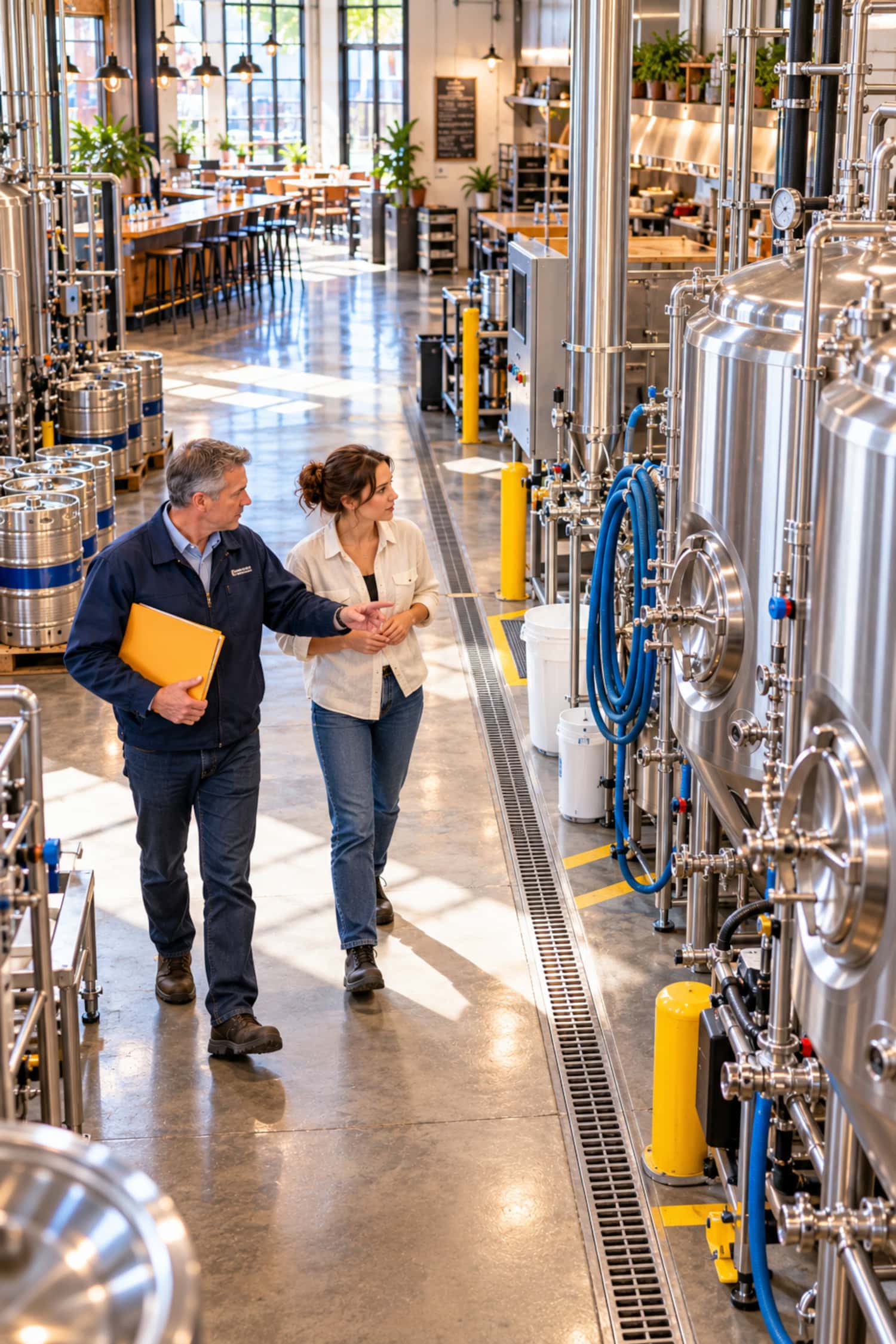
In the United States, a brewery or brewpub must qualify through the Alcohol and Tobacco Tax and Trade Bureau (TTB) under a Brewer’s Notice before operating as a federally regulated brewer.
That federal qualification is only one part of the legal path.
State alcohol licensing and local property approvals also control what can open and sell.
The proposed premises, ownership, manufacturing activity, and sales channels matter to applications.
Identify the requirements for your exact format before signing a lease that assumes a particular opening date.
| Requirement | What it controls | Where to check |
|---|---|---|
| Business formation and registration | Legal owner, governing documents, ongoing filings | State business filing office |
| Employer Identification Number (EIN) and taxes | Federal tax identity, payroll, applicable business taxes | Internal Revenue Service and state revenue department |
| TTB Brewer’s Notice | Federal qualification of brewing operations | TTB |
| State brewer or alcohol license | Manufacturing, taproom sales, self-distribution or other permitted activity | State alcohol beverage control agency |
| Zoning and building approvals | Allowed use, construction, occupancy, fire safety | City or county planning, building, and fire offices |
| Food service permits if applicable | Kitchen plan review, food safety operations, staff certification | Local or state health department |
| Wastewater and environmental approvals | Discharge handling and other applicable facility obligations | Sewer authority and environmental agency |
| Food facility registration and labeling where applicable | Non-alcohol food products, packaging, and other regulated items | Food and Drug Administration and relevant state agencies |
| Workplace safety | Worker training, hazards, and equipment practices | Occupational Safety and Health Administration and state counterparts |
An LLC, or limited liability company, is one possible business structure, not a universal federal brewery requirement.
Compare it with corporations or other structures based on investors, taxes, recordkeeping, and liability exposure.
An LLC alone does not replace insurance or safe operations.
Alcohol rules differ by state, including which license permits serving beer onsite, selling packaged beer to visitors, delivering to retailers, or using distributors.
State three-tier distribution systems can affect relationships among producers, wholesalers, and retailers.
Verify allowed transactions with the state regulator before assuming the taproom can sell through every channel.
Federal qualification, state authorization, construction approval, and local occupancy clearance have different dependencies.
Some applications require a defined premises.
Begin planning early and arrange conditional site control where feasible, but do not brew or sell commercially until the relevant approvals allow it.
Breweries also face labeling, taxes, recordkeeping, and safety obligations.
Ask an alcohol-industry attorney and qualified accountant to review the planned products, approvals, and taxes before major commitments.
7. Negotiate the lease and supplier agreements
The brewery lease deserves more scrutiny than a typical small retail lease because specialized building improvements are difficult to move.
A favorable opening rent may matter less than renewal rights, construction responsibility, or the ability to exit if licensing fails.
Picture the founder who has financed floor drains, installed a chiller, and built a tasting room.
A steep rent increase at renewal is no longer a simple reason to find another storefront.
The costly improvements give the property owner bargaining power unless the original contract anticipated the problem.
Work through the lease alongside engineering and legal review.
Seek clear provisions for permitted use, installation and ownership of fixtures, landlord approvals, access for contractors, rent commencement, permit contingencies, maintenance obligations, renewal options, and end-of-term restoration.
The exact protections are negotiated, not presumed.
Supplier agreements also matter.
Ingredients, kegs, cleaning materials, refrigeration support, packaging, and equipment servicing create continuing dependencies.
Contract production adds separate obligations for scheduling, specifications, testing, recalls, ownership of finished beer, and liability allocation.
8. Select brewery equipment for the actual workload
Brewhouse size is a labor and cash decision, not merely a production specification. A very small system means more brew days to meet the same demand.
A larger system can leave too much cash tied up in equipment, tanks, ingredients, and beer that has no buyer.
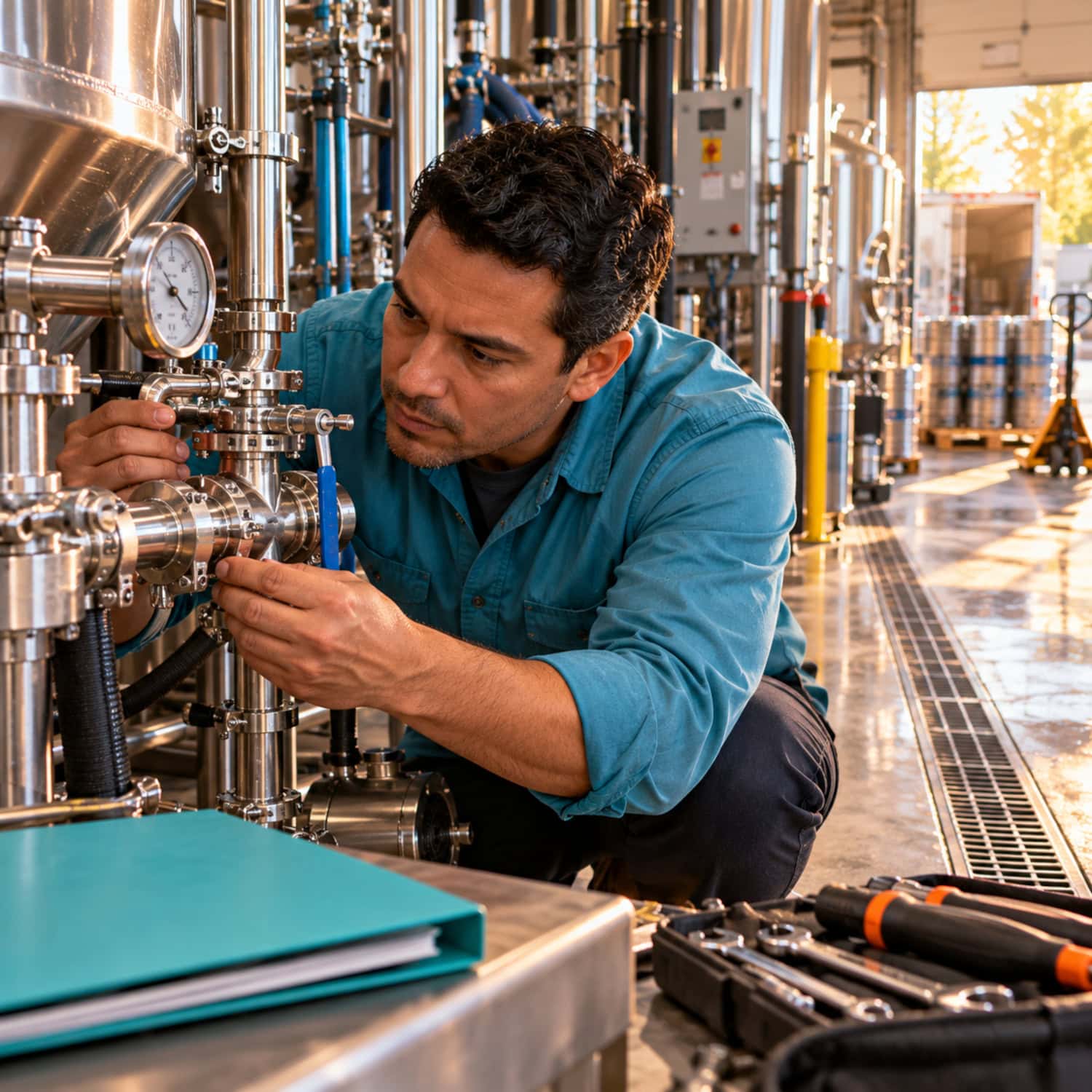
A typical production flow uses a mash tun and kettle to create wort, fermenters to turn it into beer, cold storage and conditioning equipment where needed, and a service or packaging route.
Supporting systems include cooling, pumps, transfer lines, cleaning equipment, and safety provisions.
Cellar capacity, the amount of beer that can ferment and condition at once, can limit output even when the brewhouse has unused time.
The label “nanobrewery” does not provide a safe standard capacity.
Two taprooms with the same sized kettle can have different demands, menus, production schedules, and staffing.
Estimate sellable volume and production frequency first, then ask equipment suppliers to propose a configuration.
Pre-purchase inspection checklist
- Confirm the expected sales volume by product and channel, and translate it into realistic production runs.
- Check whether fermentation and conditioning space supports that schedule without rushing beer through the cellar.
- Measure doors, ceilings, floor loading, access routes, drains, and service clearances against equipment drawings.
- Verify electrical, water, wastewater, refrigeration, and ventilation needs with qualified contractors.
- Inspect used tanks and fittings for damage, cleanability, missing components, and compatibility.
- Obtain a full delivered-and-installed quotation, including rigging, connecting services, testing, and repairs.
- Ask who provides spare parts, technical support, and service when a critical component fails.
- Check whether the layout leaves safe room to clean, maintain, and eventually modify the system.
A used fermenter listed at an attractive price is only a bargain if it can enter the building, fit the cooling system, and pass inspection for service.
An oversized tank wedged behind a doorway is an expensive storage object.
Budget packaging separately. Retail-bound cans need materials, storage, quality checks, and labor that a draft-led taproom may avoid.
9. Build repeatable brewery operations and paid roles
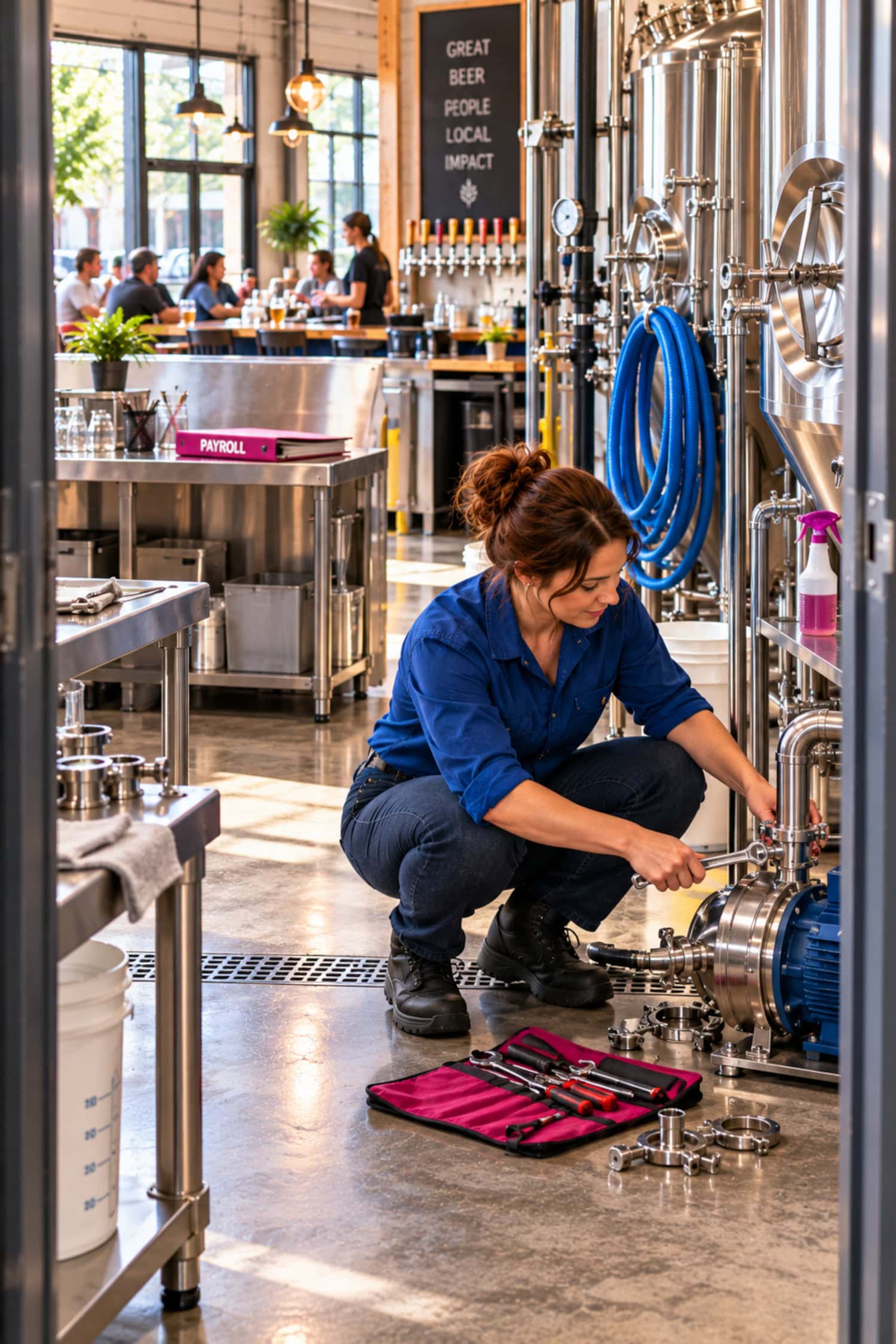
The workday in a small brewery often includes cleaning a tank, answering a supplier, fixing a draft problem, managing payroll, training a server, and chasing an overdue delivery.
Brewing occupies only part of it. A profitable plan needs explicit ownership of each job.
Commercial consistency requires documented production procedures, sanitation practices, quality checks, lot or batch records, and an orderly response when a beer fails expectations.
Product loss and rework reduce the amount of finished beer available for sale while the building continues to consume cash.
Divide responsibility across four functions: production and maintenance, customer service, sales and marketing, and finance and compliance.
One person may initially perform several roles, but each needs scheduled time and a defined backup.
A founder who works the bar every evening cannot simultaneously assume unlimited availability for brewing and outside sales.
Track daily cash and card receipts, sales by beer, inventory movement, labor hours, waste, equipment downtime, and customer traffic.
Recordkeeping also supports brewery-specific alcohol reporting and tax obligations.
Inventory counts should distinguish beer fermenting, beer ready to serve, and packaged stock waiting for sale.
A founder’s unpaid hours are still a cost.
Test the monthly accounts with market-rate pay for a manager or brewer even if the founder does not hire one immediately.
Without that adjustment, an apparently profitable brewery may just be buying the owner’s work at no recorded price.
10. Price the beer and decide whether food belongs
A taproom can keep more of the final customer price than a brewery selling through wholesale channels, but it must pay for hospitality space and service.
Price each beer with its route to market in mind, rather than applying the same target margin to every keg.
Compare variable production and selling costs with the revenue the brewery actually receives.
For draft beer, account for portions lost in service and the staff required to pour it.
For packaged beer, consider containers, labeling, storage, distribution, and retail pricing.
Retailers and distributors need their own margins, so their shelf price is not the brewery’s revenue.
Build a menu people will return for
The range should suit the intended customers and the brewing schedule.
A menu full of experimental one-offs may attract enthusiasts while demanding more recipes, ingredients, cellar changes, and staff explanations.
A smaller stable lineup makes repeat purchasing and production forecasting easier to observe.
Food requires a separate choice:
| Food approach | Main advantage | Main operating tradeoff |
|---|---|---|
| No kitchen | Keeps management focused on brewing and beverages | Guests may leave to eat elsewhere |
| Visiting food trucks or outside vendors | Adds a food option without building a full kitchen | Availability and consistency depend on partners |
| Small, limited food offer | More control with a narrower menu | Adds food handling, supplies, and permit obligations |
| Full brewpub kitchen | Supports a full meal visit and broader occasions | Creates a second staffing, safety, and cost structure |
Picture a Saturday taproom that fills just before dinner and empties when groups head out for food. A reliable food partner could help.
But building a commercial kitchen to solve that one problem might add more fixed costs than the extra visits support.
Evaluate the kitchen as its own business with a dedicated labor plan and cost forecast.
Serving food can support the brewery. It can also obscure whether brewing and hospitality are earning enough on their own.
11. Know when to change the brewery plan
A brewery should reconsider its hours, menu, staffing, or premises when poor performance persists after a fair trial and the cash forecast no longer supports the original assumptions.
More production is not the default repair for weak customer demand.
Separate problems before acting. Empty weekday seats point toward the visit occasion, marketing, or operating hours.
Customers arriving but failing to return point toward product, service, price, or experience.
Beer selling well but leaving too little cash points toward direct costs, staffing, fixed expenses, or channel mix.
Look for trends by day and product, not a single slow evening. Compare improvement options with the cost of continuing unchanged.
An early choice might be fewer taproom hours with stronger events, a more focused beer lineup, or better local promotion.
A deeper problem may require negotiating premises costs, abandoning an unprofitable wholesale channel, or closing before debts accumulate further.
More tanks worsen the cost of unsold beer. Structural building problems require a separate remedy. Cost each option before deciding.
12. Expand only when the brewery earns the capacity
Growth makes sense when demand repeatedly exceeds sustainable capacity and the extra contribution can pay for equipment, people, and space.
A fuller calendar alone does not prove that a larger brewhouse is the right investment.
Check where the bottleneck sits.
It might be cellar space, a packaging schedule, storage, service staff, a distributor’s orders, or the number of customers the taproom can accommodate.
Each calls for a different expense. A second fermenter will not help a room with empty tables.
Wholesale adds sales work, packaging, deliveries, and payment collection.
Another taproom adds hospitality and lease obligations. Budget each as a separate commitment.
Define success in advance.
A founder who values a sustainable neighborhood business with a paid manager has a different expansion target from one seeking regional retail distribution.
A larger brewery that pays its owner less after debt and staffing costs is a poor bargain.
13. Buying an existing brewery
An existing brewery can offer equipment, fitted premises, a customer base, and operating history that a startup lacks.
It can also carry a poor lease, obsolete equipment, weak demand, and approvals that require additional steps when ownership changes.
Visit the operation as a customer before reviewing the seller’s projections.
A polished brewpub on a packed event night tells little about ordinary weekday sales.
Ask for transaction-level records and look for seasonality, refunds, waste, and product mix.
Brewery acquisition due-diligence checklist
- Reconcile reported sales with payment processor records, tax filings, and bank deposits.
- Examine monthly profit after normalizing owner wages, maintenance, and rent.
- Review the lease, remaining term, renewal rights, landlord consents, and ownership of installed improvements.
- Have a specialist inspect the brewhouse, tanks, cooling, drains, and supporting utilities.
- Count usable inventory and separate finished beer, work in process, ingredients, and obsolete stock.
- Verify the status of federal, state, and local licenses and what changes or fresh approvals the transaction requires.
- Review supplier, distributor, customer, loan, and equipment finance obligations.
- Check employee responsibilities, required skills, turnover, and the effect of replacing the departing owner.
- Model lower sales and immediate repairs before making a binding offer.
Do not assume that purchasing tanks or acquiring the company automatically transfers all alcohol permissions to a new operator.
Have the relevant agencies and a qualified attorney confirm the transaction-specific path.
The sale may be faster than a new buildout, but it is not automatically simpler.
14. Reject turnkey promises that omit the hard questions
Turnkey brewery proposals and attractive secondhand equipment listings often concentrate attention on visible assets.
The less visible commitments are the customer’s reason to come, legal site qualification, installation costs, sufficient cash, and the founder’s workload.
| Promise or assumption | What actually needs checking |
|---|---|
| “Great beer will bring the crowds” | Evidence of paid repeat visits and a differentiated customer occasion |
| “Start as small as possible” | Brew-day workload, cellar space, and unit economics at that scale |
| “A larger brewhouse means bigger profit” | Demand, wholesale pricing, inventory, debt, and replacement labor |
| “The lease is cheap” | Drainage, wastewater, utility upgrades, and renewal protections |
| “Used equipment cuts startup cost” | Transport, compatibility, repairs, installation, and service support |
| “The brewery is profitable because the owner runs it” | Operating result after paying for the owner’s working roles |
| “A turnkey buildout means fast opening” | Actual federal, state, local, construction, and inspection dependencies |
15. Follow a brewery launch plan with decision gates
A brewery launch runs through several approvals and construction dependencies, so the schedule should use verifiable milestones rather than a promised opening date.
Keep cash commitments reversible until the related decision has been checked as far as practical.
Before committing major capital
- Define the customer occasion, brewery format, and primary sales channel.
- Document evidence of local demand and a conservative revenue scenario.
- Build the full startup budget, monthly cash forecast, and half-sales stress test.
- Assess whether commercial brewing experience and the needed operating skills exist within the founding team.
- Shortlist viable sites and seek preliminary guidance on zoning, utilities, and licensing.
Before signing the main contracts
- Choose and form the legal business, obtain its tax identity, and arrange appropriate insurance advice.
- Have qualified professionals inspect the site and price required buildout work.
- Map TTB, state alcohol, local building, health, and environmental approvals that apply.
- Negotiate lease safeguards for permits, construction responsibility, rent timing, and renewals.
- Review equipment and supplier terms against the cash schedule and realistic production volumes.
Before opening to customers
- Complete the necessary qualifications, licenses, inspections, and occupancy approvals.
- Install, commission, and safely test brewing, cooling, cleaning, and service equipment.
- Finalize sanitation, quality, inventory, reporting, and tax recordkeeping procedures.
- Hire and train staff for production, service, safety, and customer complaints.
- Set menus and pricing, prepare the first saleable batches, and communicate only an opening schedule supported by approvals.
In the first 30 to 90 days
- Compare daily and weekly transactions with forecasts, separating peak hours from ordinary trade.
- Record actual ingredient costs, beer losses, payroll, and cash balances.
- Adjust production timing, service schedules, and events based on observed demand.
- Review customer return behavior and which beers actually sell.
- Reforecast cash needs before approving additional equipment or another sales channel.
FAQ
How much does it cost to start a brewery?
It depends on the format, condition of the site, equipment, and cash needed before sales stabilize.
Build a site-specific budget rather than trusting one headline price; see Section 5.
Do I need a federal brewery license?
Yes, a US brewery or brewpub must obtain TTB qualification through a Brewer’s Notice before operating as a federally regulated brewer.
State and local approvals also apply; see Section 6.
Do I need an LLC to open a brewery?
No, an LLC is a business-structure option rather than a universal federal requirement.
Compare ownership and tax needs before selecting an entity; see Section 6.
Is a small brewery profitable?
It can be, but profit depends on sales channel, operating costs, debt, and compensation for owner labor.
Test half of forecast sales before assuming the numbers work; see Section 5.
Can I open a brewery without my own brewhouse?
Yes, contract production is a possible model if properly arranged with an appropriately qualified producer.
It shifts costs and operational dependence rather than eliminating them; see Section 2.
What is the biggest risk when leasing brewery space?
A poorly suited property can require costly utilities, drainage, and construction while rent accrues before sales begin.
Inspect the building and negotiate the lease together; see Sections 4 and 7.
Can I run a brewery part-time from home?
No, homebrewing is not a substitute for a properly qualified commercial brewing operation, and a staffed public taproom requires ongoing coverage.
Explore the contract route if the goal is to avoid a full facility; see Sections 2 and 6.
Is a full kitchen necessary for a taproom brewery?
No, a brewery can consider outside food vendors or a limited offer instead, subject to applicable rules.
The right choice depends on customer behavior and the extra food-service costs; see Section 10.
Conclusion
Build the brewery around a credible path to selling its beer, then let that sales plan determine the facility and equipment.
The business must also earn enough to pay the people who make it work, including the owner.
1. Prove the buyer: Test recurring demand and the selling channel before committing to irreversible expenses.
2. Price the whole operation: Include construction delays, weak sales, cash reserves, and paid owner labor in the budget.
3. Get permission before production: Confirm premises suitability and every required approval before commercial brewing or sales.
Further reading
- TTB Brewery and Brewpub: Federal guidance on qualifying and operating a brewery or brewpub.
- U.S. Small Business Administration: Federal resources for planning, financing, and managing a small business.
- Internal Revenue Service: Federal guidance on business tax identity and employer obligations.
- Brewery Startup Planning: A practical overview of formats, market decisions, and brewery planning.
- Starting a Brewery: A startup overview covering concepts, premises, equipment, and opening steps.
- Top Tips for Starting a Brewery: Considerations for location, equipment, and operating choices.
- Brewery Equipment Startup Overview: Equipment-focused guidance for matching a brewing system to the intended operation.
- Brewery Financing Discussion: Practical questions about available capital, demand, and how much brewing capacity to purchase.
- New Brewery Location Discussion: Operator discussion of floor drains, utilities, equipment access, and facility design.