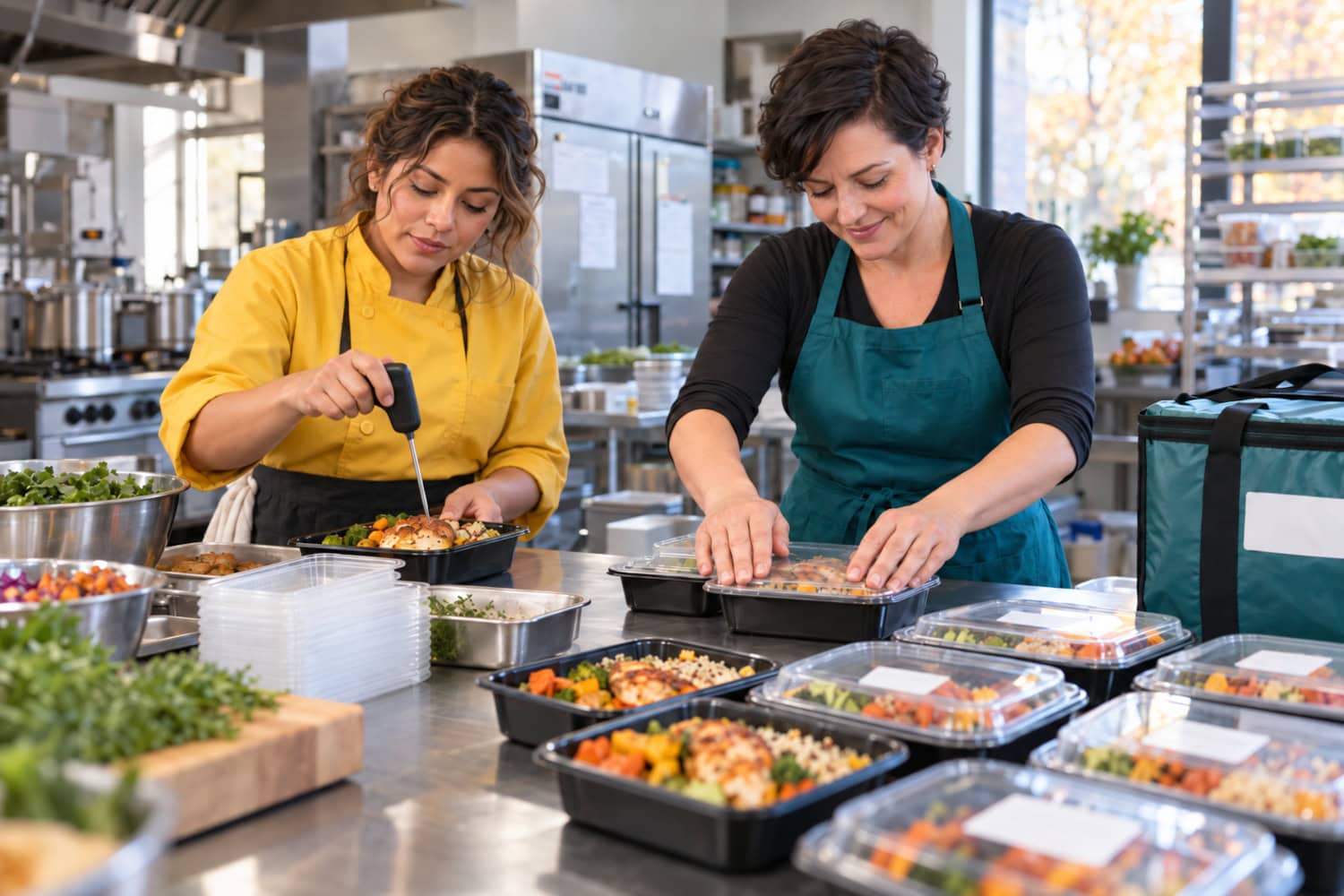
To start a meal prep business, choose a specific customer and meal format, check where those meals may legally be prepared, test demand for a priced weekly menu, and calculate the cost of each order.
Register the business, secure an approved production space, set up safe packing and fulfillment, and launch with a manageable ordering schedule.
Confirm a legally usable kitchen and paying demand before investing in more production capacity.
A lean shared-kitchen launch may call for roughly $3,000 to $15,000, while a more built-out operation can cost $20,000 to $50,000 or more.
These are broad planning ranges, not quotes for your location. Local health department approval and food safety requirements are the first legal gate.
Labor, unsold meals, kitchen rent, and delivery can erase an attractive ingredient-only margin.
Last fact-checked: October 11, 2026
This guide is for first-time US founders selling ready-to-eat or ready-to-reheat meals through local pickup, delivery, or recurring orders. It covers kitchen eligibility, startup budgets, weekly production, pricing, customer retention, and growth. It also distinguishes prepared-meal delivery from cooking in a client’s home.
1. How a meal prep business works
A meal prep business sells convenience on a repeat schedule: customers select meals, the kitchen prepares batches, and orders reach buyers while the food remains safe and appealing.
The business works only if each production cycle pays for the meals sold and the capacity reserved for them.
| Stage | Decision | Move forward when |
|---|---|---|
| Design (Sections 2 to 4) | Format, buyers, and local sales channel | You know the intended menu, audience, and feasible production route. |
| Budget (Section 5) | Startup spend and per-meal economics | A realistic price leaves enough money after variable costs. |
| Authorize (Sections 6 to 7) | Business setup, permissions, and kitchen agreement | You have a viable approval route and contract terms you can afford. |
| Prepare (Sections 8 to 10) | Equipment, procedures, menu, and pricing | Meals can be produced, packed, ordered, and fulfilled consistently. |
| Evaluate alternatives (Sections 11 to 12) | Existing business and common traps | You understand what you are buying and which claims to distrust. |
| Launch (Section 13) | First permitted order cycles | Orders, payments, preparation, and handoff work end to end. |
| Review (Section 14) | Keep, change, or stop an offer | Actual contribution and repeat orders justify continuing. |
| Expand (Section 15) | Additional capacity or customers | A demonstrated bottleneck, rather than optimism, supports the expense. |
2. Choose a meal prep business format
Prepared meals, personalized cooking, and ingredient kits solve different customer problems and create different kitchen obligations.
For a first launch, weekly ready-to-reheat meals with a limited local service area offer an easier production test than a large customized menu or nationwide shipping.
| Format | Entry cost | Best for | Operational trade-off |
|---|---|---|---|
| Standardized ready-to-reheat meals | Kitchen and packaging costs vary with volume | Buyers seeking convenient weekday meals | Efficient batches, but menu repetition can reduce reorders |
| Customized meal plans | Extra planning and preparation labor | Buyers with specific preferences or exclusions | More dietary flexibility, less shared production |
| Family-sized prepared meals | Container size and delivery cost drive spending | Households seeking fewer cooking decisions | Larger portions, less individual meal choice |
| Personal chef preparation in a client’s home | Travel, tools, insurance, and any required permissions | Clients seeking an in-home service | Labor-intensive and governed by a different operating setup |
| Meal kits | Ingredients, packing, and fulfillment determine costs | Buyers willing to finish cooking | Different handling process and less ready-to-eat convenience |
The rest of the launch process focuses on locally sold prepared meals.
A personal chef service must have its own legal and cost checks rather than borrowing the assumptions of a commercial meal kitchen.
3. Find customers before committing to kitchen capacity
A busy social media page is weak evidence of meal prep demand if nobody orders at the offered price.
The useful test is a specific menu offered to a specific local buyer group, with the cost and collection method made clear.
An approved kitchen and repeat paying customers belong in the same decision.
A room that passes inspection but sits idle is an expensive way to discover that customers prefer grocery-store meals.
Conversely, enthusiasm for a menu means little if there is no permitted place to produce it.
Start with one group whose needs you can describe precisely, such as workers who want refrigerated lunches or households looking for prepared dinners.
Ask about weekly meal quantity, portion expectations, dietary limits, acceptable price, and whether pickup or delivery fits their routine.
Show a proposed menu and provisional total price, then revise that price after calculating full costs in Section 5.
Record specific buying interest rather than reactions to food photographs.
Before you are authorized to sell, gather nonbinding interest rather than accepting paid food orders.
Once the food operation is permitted, compare first purchases with repeat orders.
A paying customer who returns after experiencing the packaging and reheated food tells you more than a hundred likes.
4. Choose pickup and local delivery channels
Pickup generally offers a simpler cost structure for a small meal prep launch, while local delivery offers convenience at the price of routing time and cold-chain handling.
Nationwide refrigerated shipping introduces a substantially different cost and reliability problem.
| Channel | Customer benefit | Cost or risk to test |
|---|---|---|
| Scheduled pickup | Predictable collection window | Convenient location, missed pickups, safe holding |
| Local delivery | Food reaches the buyer directly | Driver time, route density, packaging, temperature control |
| Wider-area shipping | Larger geographic reach | Refrigerated transport, shipping charges, damaged or late orders |
Delivery radius changes menu economics.
A customer across town may pay the same meal price as a neighbor, but serving that order requires a longer trip.
Set a service area and minimum order size using actual route costs before promising delivery everywhere.
5. Calculate meal prep startup costs and break-even
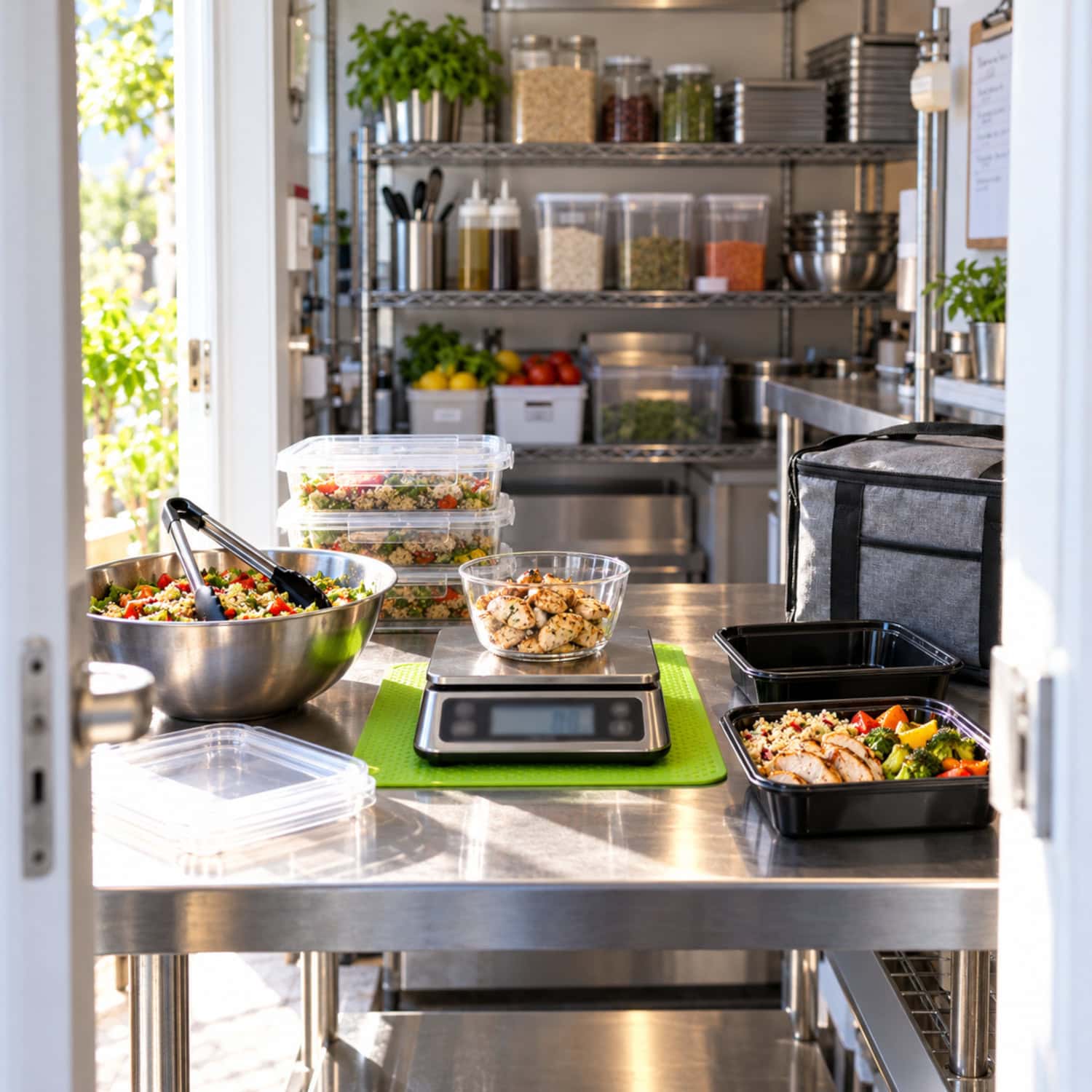
The major cost difference between a small meal prep service and a larger operation is how much kitchen time, storage, equipment, and staffing the founder commits to before orders are reliable.
Use approximately $3,000 to $15,000 as a rough shared-kitchen planning envelope and $20,000 to $50,000 or more for a more substantial setup, then build a location-specific budget.
| Cost category | What to budget for | What makes it change |
|---|---|---|
| Kitchen access | Rent, deposits, approved storage, and utilities | Shared hours versus dedicated space |
| Equipment | Cooking, chilling, weighing, and packing tools | Existing kitchen inventory versus purchases |
| Opening inventory | Ingredients, containers, labels, and cleaning supplies | Menu complexity and initial order count |
| Compliance | Permits, training, inspections, and insurance | Local requirements and operating model |
| Selling and fulfillment | Ordering system, payment fees, pickup setup, and delivery | Recurring orders and service area |
| Cash reserve | Rent and bills during weak sales weeks | Fixed commitments and customer reorder rate |
To work out whether a meal pays its share of overhead, calculate:
Contribution per meal = selling price – ingredients – packaging – paid production labor – variable fulfillment and payment costs.
Monthly operating result = meals sold x contribution per meal – monthly fixed costs.
This example uses illustrative numbers, not an industry benchmark.
It assumes that $3 of paid labor is included in each meal’s variable costs, even if the founder performs the work.
| Item | Illustrative amount |
|---|---|
| Selling price per meal | $16.00 |
| Ingredients per meal | $5.00 |
| Packaging per meal | $1.00 |
| Paid production labor per meal | $3.00 |
| Fulfillment and payment costs per meal | $2.00 |
| Contribution per meal | $5.00 |
| Meals sold per month | 250 |
| Monthly contribution from meals | $1,250.00 |
| Fixed kitchen, insurance, and system costs per month | $1,100.00 |
| Monthly operating result before tax and startup-cost recovery | $150.00 |
At half the planned sales, 125 meals generate $625 in contribution while fixed costs remain $1,100. The operating result becomes a $475 loss.
At $5 contribution per meal, the example needs 220 meals per month to cover those fixed costs, before recovering opening investment.
Keep enough cash to absorb slow ordering weeks and replace spoiled or damaged meals.
Borrowing for a dedicated kitchen before achieving stable order volume increases the number of meals needed just to pay the bills.
The cost of the founder’s hours should remain visible even when no payroll check is written.
6. Register the business and confirm food permits
In the United States, selling prepared meals commonly requires clearance from the local or state food regulatory authority and approval for the kitchen and activities involved.
A business registration or limited liability company (LLC) filing alone does not authorize food production.
| Requirement | When it matters | Where to check |
|---|---|---|
| Health department permit and kitchen plan review | Preparing and selling meals through a regulated food establishment | Local or state health department |
| Food safety training or certification | Owners and staff handling food where required | Local or state food regulator |
| Zoning and occupancy approval | Using a commercial kitchen or a location for pickup | City or county planning and building offices |
| Fire inspection | Premises and cooking equipment subject to fire rules | Local fire authority |
| Cottage food or home-kitchen eligibility | Proposing to cook and sell meals from home | State agriculture or health department and local authorities |
| Federal food facility registration and labeling | Operations classified as food manufacturing, packing, or holding rather than exempt activities | US Food and Drug Administration (FDA) and relevant regulator |
| Meat and poultry processing rules | An operation that triggers federal or state inspection requirements | US Department of Agriculture (USDA) and state agriculture authority |
| Business registration, tax obligations, and insurance | Establishing the selling business and protecting against claims | State business and tax agencies and an insurance agent |
Cottage food permissions often focus on particular foods and sales methods.
Do not assume a home kitchen can prepare refrigerated, ready-to-reheat meat or other meals for public sale.
Rules, permitted products, and facility requirements vary by jurisdiction, so describe your exact menu and production method when asking the regulator.
Choose a sole proprietorship or LLC based on ownership, liability exposure, cost, and tax treatment.
Obtain an employer identification number (EIN) where appropriate, separate business finances, and check sales tax obligations with your state revenue agency.
Discuss product liability, general liability, commercial auto coverage, and workers’ compensation where relevant with a licensed insurance agent.
Employee rules also depend on the business and state.
If the menu or kitchen setup involves uncertain federal oversight, have the applicable food regulator or a food safety compliance professional confirm the classification before investing in equipment.
7. Secure a kitchen agreement that fits the orders
A shared kitchen may reduce initial spending, but its headline hourly rate does not reveal the full cost of storage, cleaning, scheduling, and production bottlenecks.
Verify the facility’s permissions for your proposed activity before signing a long commitment.
Ask the kitchen owner these questions in order:
- Is this kitchen approved for the exact meals, packing activities, and sales model planned?
- What refrigeration, dry storage, preparation stations, and time slots are included?
- Who is responsible for sanitation, waste disposal, equipment problems, and inspection access?
- How are additional hours, deliveries, shared equipment, and storage billed?
- What happens if the required operational permit or plan approval is refused?
- How much notice and money are required to leave or reduce booked hours?
Get the kitchen agreement and insurance obligations in writing.
An inspection-ready location is useful only if the approval covers the intended operator and food activity.
Final operating approval may depend on the selected site, so keep contract commitments conditional where possible.
8. Buy equipment and source ingredients for a small menu
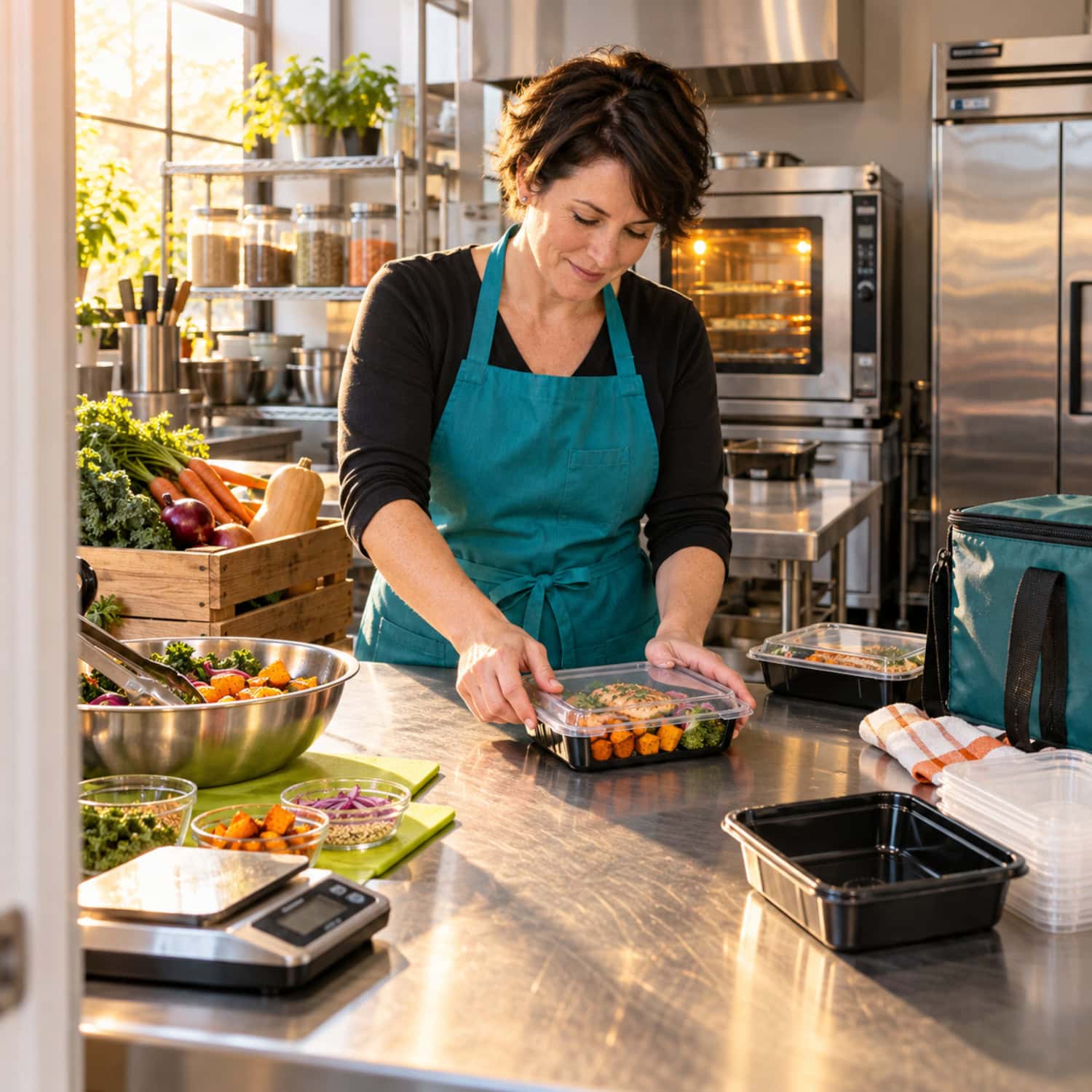
A rented kitchen may already contain the ovens, preparation benches, and refrigeration needed for early meal prep batches.
Buy only the tools that remove a real production constraint, then compare ingredient suppliers on usable portion cost rather than shelf price alone.
Use this pre-purchase checklist:
- Inspect the kitchen’s existing cooking, chilling, weighing, and storage equipment.
- Confirm whether equipment is approved and suitable for the proposed food process.
- Test containers for sealing, leakage, breakage, and performance after reheating.
- Check that labels can display the necessary meal, ingredient, and handling information.
- Price ingredients from retail and wholesale sources using the same finished portion size.
- Confirm supplier availability, order minimums, delivery days, and storage requirements.
- Buy additional equipment only after measuring the time or capacity it would save.
A cheaper ingredient purchased in a large case can become the expensive option if half the case sits unused.
Shared ingredients across a short rotating menu make purchasing easier and reduce leftovers.
9. Build a safe weekly production and ordering routine
Meal prep operations require coordinated order cutoffs, ingredient purchasing, batch cooking, refrigeration, packing, and reliable handoff.
Food that tastes good straight from the pan still has to taste and feel acceptable after storage and reheating.
Set a predictable ordering deadline so the kitchen knows how much to make.
The weekly order record should distinguish meal selections, quantities, dietary requests, payments, pickup or delivery choices, and order changes.
Plan purchase quantities from confirmed orders, with a limited allowance for errors rather than speculative extra inventory.
Have written procedures for cooling, storage, sanitation, temperature checks, allergen handling, and refrigerated transport that meet the applicable food rules.
Test each recipe through the full packing, storage, and reheating journey before listing it.
Do not assume all recipes remain safe or appealing for the same number of days.
Ordering software deserves a rehearsal too.
Rotating menus can produce missed substitutions, old items on subscriptions, or customers forced to cancel merely to choose different meals.
Test a first order, a meal swap, a skipped week, a cancellation, and the final kitchen production list before relying on automated recurring billing.
10. Design the menu and set prices customers can sustain
A focused meal prep menu should give customers meaningful variety without multiplying ingredients, preparation techniques, and unused stock.
Price each meal for its actual portion and service level, not by applying the same ingredient multiplier to every recipe.
Customers assess total weekly spending, portion size, flavor, dietary suitability, convenience, and whether the food survives reheating.
Offer enough choice to accommodate the intended audience, but measure the extra labor caused by special requests.
Clearly describe ingredients and dietary features without making unsubstantiated health claims.
One-time orders can help hesitant customers try the service.
Weekly subscriptions improve predictability only if buyers can understand cutoff times and manage choices, pauses, and cancellation.
A recurring charge with a broken meal-swap process can cost more in support work and lost customers than it saves in forecasting.
11. Check an existing meal prep business before buying
Buying a meal prep business may provide customers, kitchen access, equipment, and recurring orders.
None of those assets has much value until their ownership, transferability, food permits, and actual financial performance are established.
Use this acquisition checklist:
- Reconcile reported sales with payment records, refunds, and bank deposits.
- Check order history for repeat customers, pauses, cancellations, and discounts.
- Recalculate per-meal profit after labor, packaging, rent, and delivery.
- Inspect the kitchen lease, food permits, inspection history, and whether approvals transfer.
- Confirm ownership and condition of equipment, refrigeration, and delivery assets.
- Examine supplier terms, recipe documentation, staff arrangements, and outstanding liabilities.
- Test the ordering platform and confirm access to customer and subscription records.
An existing subscriber list is less reassuring if customers can cancel before the new owner completes the first production week.
12. Avoid meal prep startup traps
Meal prep business offers sometimes confuse cooking skill, order volume, and profitability.
The most damaging assumptions appear early, while equipment and kitchen contracts are still easy to sign.
| Myth | What actually happens |
|---|---|
| More orders always mean more profit | Discounts, delivery distance, and labor can cause higher sales to produce weaker margins. |
| A home kitchen is automatically the cheapest legal option | The intended food and local rules may rule out home production entirely. |
| Subscriptions guarantee reliable income | Customers can pause or cancel, and poorly configured meal changes create fulfillment work. |
| Professional-looking packaging makes meals ready to sell | Container performance, labeling, handling, and kitchen permission still matter. |
| A turnkey kitchen or software package eliminates startup risk | Rent and platform fees continue even when paid orders are thin. |
A service can look busy while losing money.
The kitchen calendar is full, deliveries are running, and customers are pleased, yet the owner has quietly left labor out of the price.
13. Launch the first permitted meal prep order cycle
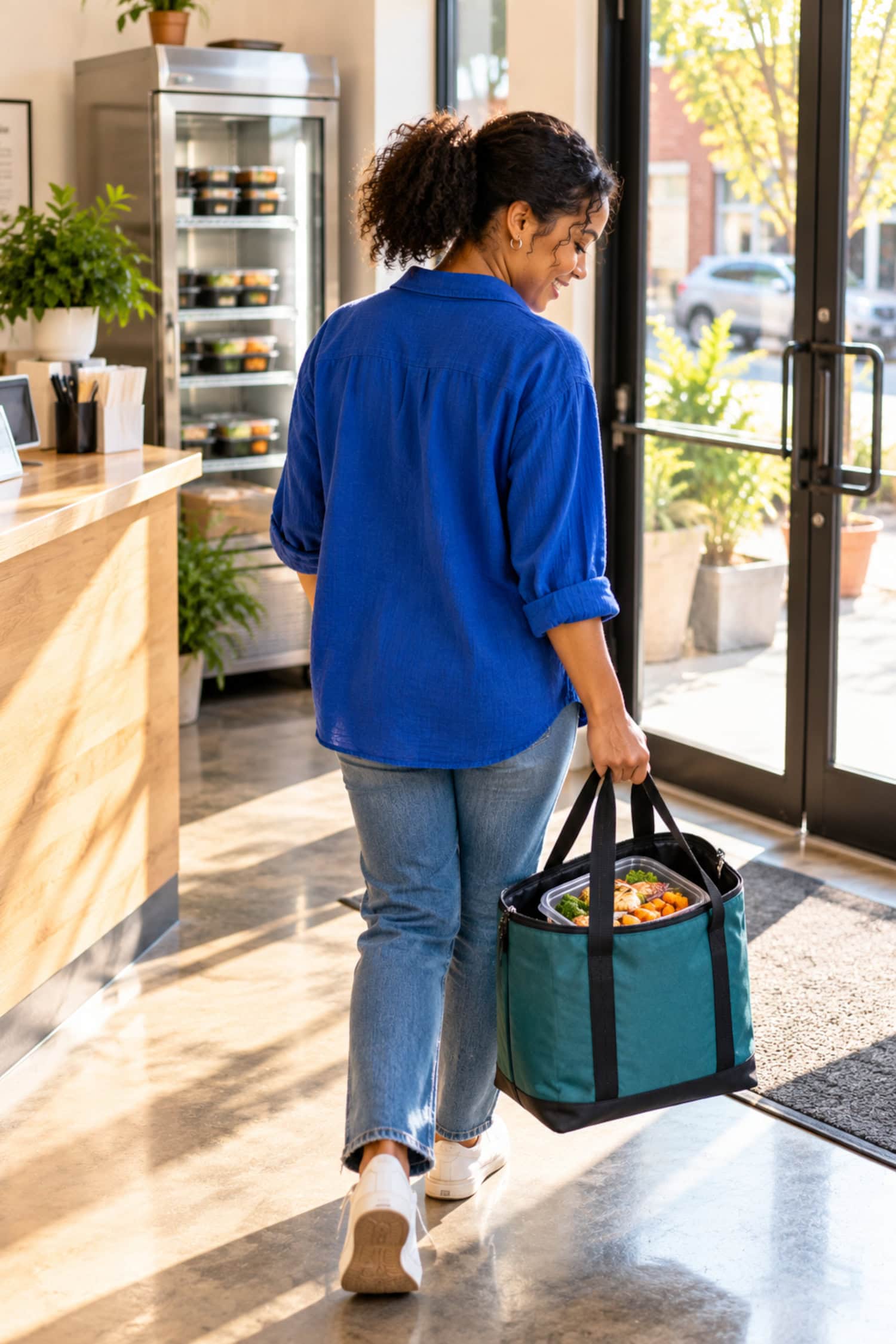
The first meal prep launch should be a small, controlled production cycle with a defined menu and order cutoff.
Opening means the necessary food approvals are in place and a paying order can be completed without improvised handling or missing information.
Follow this sequence:
- Select one buyer group, initial menu, and local pickup or delivery area.
- Confirm the proposed menu and kitchen approval pathway with the relevant regulator.
- Calculate prices and likely volume, and gather nonbinding customer interest.
- Register the business, price insurance, and secure kitchen terms subject to necessary approvals.
- Complete inspections, permits, food safety training, and any required labeling checks.
- Test recipes, containers, refrigeration procedures, and the complete ordering workflow.
- Open sales, collect permitted orders, and prepare only the planned production quantity.
- Complete fulfillment and record actual ingredient use, paid labor, packing losses, and delivery time.
- Check repeat orders and customer complaints after the first cycles before increasing commitments.
Record when a meal is missing, a tray cracks, a pickup is missed, or a recipe reheats poorly.
Those observations guide changes that advertising metrics cannot reveal.
14. Know when to change or stop an offer
A meal prep menu that attracts first orders but few reorders has a different problem from a menu with loyal buyers and negative per-meal contribution.
The response depends on whether taste, price, delivery, customer acquisition, or production cost is failing.
| Signal | What to investigate | Practical response |
|---|---|---|
| Good first-order demand, weak reorders | Reheated taste, portions, variety, packaging, reliability | Change the offer before buying more advertising. |
| Repeat orders, negative contribution | Labor time, ingredients, packing, delivery, discounts | Reprice or simplify the costly meals. |
| Profitable meals, monthly losses | Kitchen rent and other fixed costs versus volume | Reduce fixed commitments or increase paid order volume. |
| Orders exceed safe production capacity | Station use, staffing, refrigeration, pickup and delivery load | Fix the specific production constraint. |
Stop an unprofitable item or service area if revised pricing and process cannot cover its costs.
Closing a weak offer is preferable to carrying its losses into a larger kitchen.
15. Scale a meal prep business only when the bottleneck is clear
Extra cooking capacity cannot solve a shortage of repeat customers.
Expansion should follow proof that the existing meal prep operation can fulfill orders safely, generate money after real labor costs, and retain buyers without perpetual discounts.
If orders exceed available kitchen hours, compare additional shared-kitchen sessions with new equipment or dedicated space.
If kitchens have idle hours, work on acquiring and retaining customers instead.
If most complaints concern changes to weekly meal selections, improve the ordering system before adding more menu options.
Measure monthly contribution, fixed costs, meal production time, successful deliveries, and repeat purchases after every expansion.
More meals are valuable only if the next batch keeps its quality and still pays for itself.
FAQ
Can I start a meal prep business from home?
It depends on your state’s food rules and the meals you plan to sell.
Refrigerated prepared meals may require an approved commercial kitchen; see Section 6.
How much money do I need to start a meal prep business?
Rough planning ranges are $3,000 to $15,000 for a lean shared-kitchen launch and $20,000 to $50,000 or more for a larger setup.
Actual commitments depend on space, equipment, and delivery; see Section 5.
Do I need an LLC for meal prep?
No, an LLC is not a universal requirement to sell meals. Food permits and liability exposure are separate considerations; see Section 6.
How many meal prep customers do I need to break even?
It depends on meals purchased per customer, contribution per meal, and fixed costs.
The illustrative example requires 220 meals each month, not a fixed number of customers; see Section 5.
Should a meal prep business offer weekly subscriptions?
Not necessarily, because some customers prefer one-time purchases and flexible pauses.
Subscriptions work only when the ordering and fulfillment process can manage changes; see Section 10.
Conclusion
Start with a permitted way to produce meals and evidence that customers will keep paying for them.
A meal prep business earns the right to a larger kitchen when its existing orders justify the expense.
- Check kitchen and food permit eligibility with the appropriate regulator before committing to space.
- Count paid labor, packaging, and fulfillment in every meal’s price before taking orders.
- Use repeat orders and actual contribution to decide whether to expand production.
Further reading
- U.S. Food and Drug Administration: Find federal guidance on food facility registration, labeling, and the distinction between different food operations.
- How to Start a Meal Prep Business: A restaurant equipment seller’s practical overview of kitchen tools, packaging, and service setup.
- Can I Start a Meal Prep Business From Home?: Explore home-kitchen eligibility and why prepared foods require a closer look at local permissions.
- How to Start a Meal Prep Business: An ecommerce platform’s walkthrough of selling formats, ordering, and customer acquisition.
- Best app to create a pick-your-own-items menu: See a merchant’s specific requirements for mix-and-match weekly meal bundles.
- Allow users to edit subscription contracts: Examine how rotating menus and substitutions can complicate meal subscriptions.
- Disable shipping for local delivery only: Review the checkout complications of limiting orders to pickup and local delivery.