To start an ice cream shop, choose a selling format, check local demand, compare possible sites, and build a budget around realistic sales.
Next, establish the business, confirm the health and zoning approvals your location requires, negotiate the lease, select equipment and suppliers, and train staff before opening.
A wholesale-supplied scoop shop is a simpler first retail model than making ice cream in-house.
The expensive mistake is committing to a permanent storefront before its customer demand, seasonal sales, and staffing costs can support it.
Startup investment varies too much between a cart and a fully built-out shop for one reliable price range.
Your main permission gate is local food-service approval, with additional requirements if you manufacture dairy products.
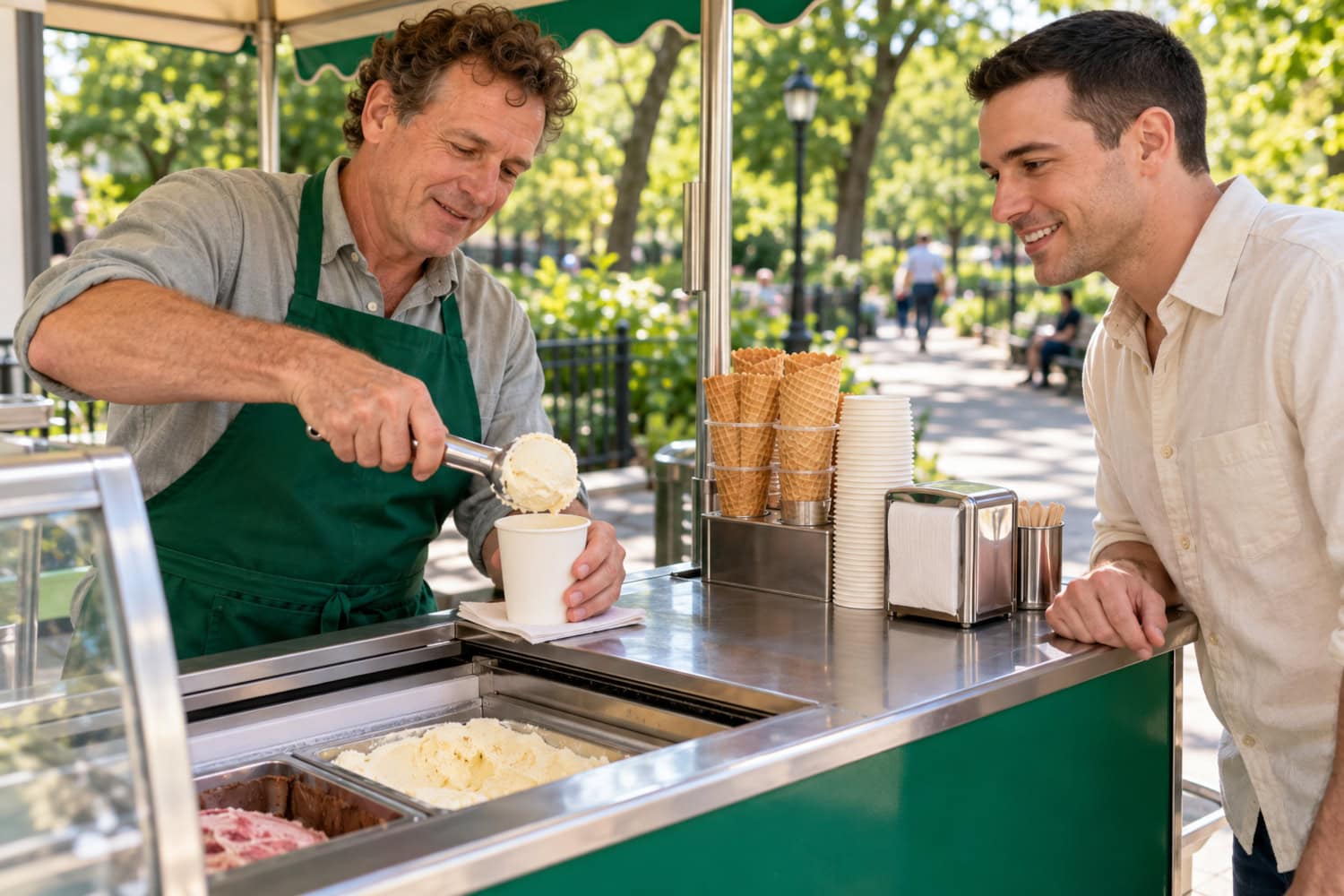
The daily work is portion control, food safety, cleaning, equipment upkeep, and getting customers served while they are willing to wait.
Last fact-checked: October 11, 2026
This guide is for first-time owners in the United States considering an independent ice cream cart, kiosk, or storefront.
It covers the economics of hard-scoop and soft-serve retail, plus the extra demands of making your own product.
Franchise acquisition is covered as an alternative, not as the default route.
1. How an ice cream shop works and the launch sequence
An ice cream shop earns money one transaction at a time, but rent, payroll, and freezer expenses continue even when sales slow.
Its opening sequence should therefore eliminate the expensive unknowns before the purchases that are hardest to reverse.
| Stage | Decision | Move forward when |
|---|---|---|
| Format | Choose cart, kiosk, scoop shop, soft serve, or in-house production | You know what product you will sell and how you will serve it |
| Demand | Identify customers and their buying patterns | You have a credible basis for expected busy and slow periods |
| Site | Check traffic, access, utilities, and permitted use | A candidate space can support the concept physically and legally |
| Economics | Budget setup costs, staffing, and slow-month cash needs | Conservative sales can cover a realistically staffed operation |
| Setup | Register the business and check required approvals and insurance | You know the legal party, approval path, and conditions for opening |
| Contracts | Agree on occupancy and supplier terms | Major commitments account for permits, delivery, and exit risks |
| Equipment | Match machines and storage to the menu and busiest hour | The machines fit the site and have a credible repair plan |
| Operations | Train the team and set cleaning and inventory routines | Staff can run a full shift safely and consistently |
| Menu | Price portions and simplify service | Each item earns enough relative to its cost and preparation time |
| Opening | Test service, then measure results | The shop can handle actual orders and monitor its economics |
Repair and expansion decisions follow opening.
Buying an existing shop or evaluating a turnkey offer is an alternative entry path that calls for separate checks.
2. Ice cream shop formats and their investment demands
A cart that sells purchased ice cream, a soft-serve counter, and a creamery that manufactures its own batches have very different equipment and approval burdens.
Choose the format before asking suppliers for prices or estimating your startup budget.
| Format | Entry cost profile | Best for | Main constraint |
|---|---|---|---|
| Cart or stand | Lower commitment than a full storefront, but requires cold storage and a permitted site | Testing demand and limited selling periods | Power, mobility, storage, and location permissions |
| Kiosk | Smaller retail footprint, with occupancy and equipment expenses | Locations with established customer movement | Limited preparation and storage space |
| Wholesale hard-scoop shop | Storefront build-out, dipping cabinets, storage freezers, and inventory | Retail-first owners who want to avoid manufacturing | Supplier terms and ongoing rent |
| Soft-serve shop | Significant dependence on specialized machines | A focused, fast-service concept | Cleaning, breakdowns, and specialist repairs |
| In-house creamery | Retail plus production space, training, freezers, and processing equipment | Owners seeking control over original recipes | Additional production labor and dairy compliance |
For a first permanent shop, this article focuses on selling commercially produced ice cream, with soft serve and in-house production treated as decisions requiring additional checks.
Buying wholesale gives up some control over recipes but avoids building a manufacturing operation alongside the store.
3. Find customers before projecting ice cream sales
A busy sidewalk only matters if enough people there will stop and buy at your price.
A tourist district, a neighborhood shopping street, and a seasonal attraction produce different patterns of repeat purchases and quiet periods.
- Visit candidate trading areas on weekdays, weekends, and during the hours you expect to operate. Count relevant passersby rather than treating all foot traffic as potential customers.
- Note nearby dessert competitors, their prices, queues, serving formats, and apparent busy periods.
- Separate local repeat customers from visitors whose spending may disappear outside a holiday season.
- Test a small permitted selling format or another low-commitment way of gathering real paid-order evidence when practical.
- Record what customers actually buy, the average amount spent per order, and how demand changes with the day and weather.
An attractive premium concept still needs customers willing to pay its price repeatedly.
Admiration for a flavor or a storefront design is weaker evidence than completed purchases.
4. Choose a location that survives its quiet season
A vacation-town ice cream shop can be crowded in summer and nearly empty when visitors leave.
The right shop format is the one whose fixed commitments its realistic trading season can sustain, whether it opens all year or operates seasonally.
For each candidate site, evaluate foot traffic alongside the costs that continue during slow periods.
A seasonal schedule reduces some operating expenses, but a lease and equipment payments may continue while the doors are closed.
| Site factor | What to establish | Warning sign |
|---|---|---|
| Customers | Repeat local trade versus tourist-dependent trade | Forecast assumes peak-season traffic all year |
| Occupancy | Rent and other charges during open and closed periods | The quiet months require sales the area cannot support |
| Use and approvals | Zoning, food-service suitability, occupancy, and inspection path | Essential approvals are uncertain after substantial spending |
| Physical fit | Power, water, cold storage, service counter, and customer queue | Layout changes require expensive construction |
| Access | Visibility, pickup access, and supplier deliveries | Customers or deliveries cannot reach the counter easily |
Imagine a summer afternoon when the line reaches the door, yet the only freezer fails.
A visually perfect location cannot compensate for insufficient power, storage, or a layout that prevents staff from serving the queue.
Inspect the physical operation before treating a promising address as a viable shop.
5. Ice cream shop startup costs and break-even sales
A cart and a full storefront do not share a meaningful universal startup price.
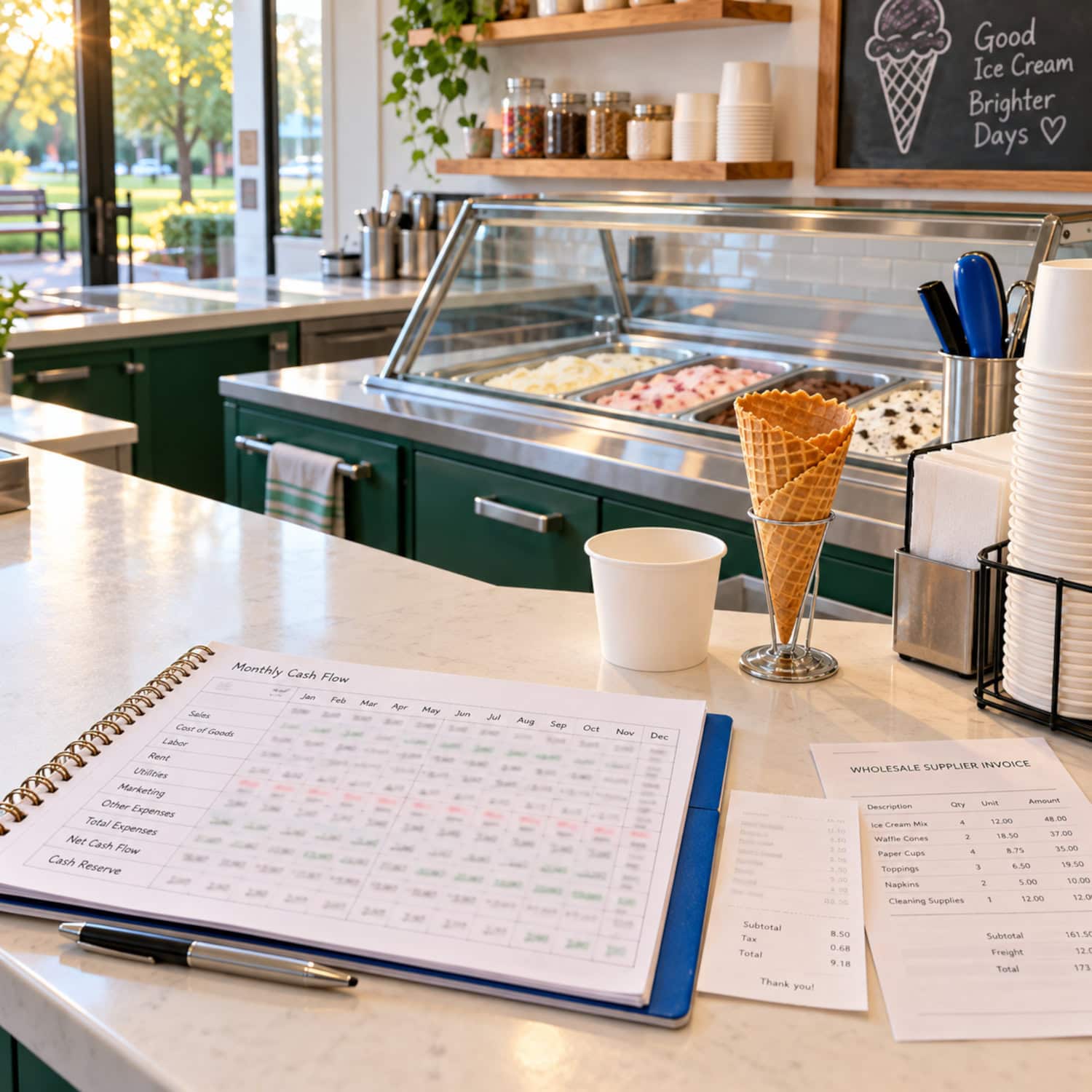
Build a location-specific budget for the chosen model and keep enough cash for weak sales, repairs, and preopening delays.
| Startup cost | What belongs in the estimate |
|---|---|
| Premises | Deposit, initial occupancy costs, construction, counter layout, signs |
| Equipment | Display or dipping cabinets, storage freezers, machines, installation, smallwares |
| Product | Opening inventory, cups, cones, napkins, toppings, and supplier minimum orders |
| Compliance | Business setup, approval work, inspections, certification, and insurance |
| Opening | Training, initial payroll, point-of-sale setup, and promotion |
| Reserve | Cash for slow months, waste, breakdowns, and delayed opening |
A franchise or heavily built-out retail project can reach a six-figure commitment, but that possibility is not a general estimate for independent shops.
Obtain actual site, contractor, and equipment quotes before choosing a financing amount.
Borrowing for the initial build-out does not eliminate the need for operating cash.
Calculate what each sale contributes
The money left from an average order after its ice cream, serving materials, and payment fees is its contribution toward payroll and other fixed bills.
Monthly operating result = number of orders x contribution per order – monthly fixed expenses.
The following are illustrative numbers, not industry benchmarks.
Payroll includes a budget for the owner’s working time, so the result does not silently depend on free owner labor.
| Monthly model input or result | Illustrative amount |
|---|---|
| Average check per order | $6.50 |
| Ice cream, cone or cup, and serving materials per order | $2.10 |
| Payment cost per order | $0.25 |
| Contribution per order | $4.15 |
| Orders in the month | 2,400 |
| Sales | $15,600 |
| Ice cream and serving materials | $5,040 |
| Payment costs | $600 |
| Employee and owner labor | $3,600 |
| Rent, utilities, and other fixed expenses | $3,900 |
| Monthly operating result before debt and taxes | $2,460 |
In this example, ice cream and serving materials cost 32.3% of sales, and labor costs 23.1%.
Together, food and labor are the shop’s prime cost, or about 55.4% of sales.
These percentages help expose a shop whose apparent product margin looks attractive until wages are included.
The illustrative shop breaks even at 1,808 orders per month, based on $7,500 in fixed expenses divided by $4.15 left per order, rounded up.
Across 30 open days, that means about 61 orders a day. A monthly average hides the real challenge if most orders arrive in a short evening rush.
Stress-test the slow month
At half the expected volume, the same shop sells 1,200 orders.
Contributions fall to $4,980 while the modeled $7,500 of monthly labor and other fixed expenses remain, producing a $2,520 operating loss before debt and taxes.
Payroll may be adjustable in practice, but never assume the necessary reductions before building a realistic schedule.
Plan a month-by-month cash forecast rather than spreading summer revenue evenly across the year.
The reserve should cover the months in which sales fall below break-even, plus equipment failure or opening delays.
A forecast that works only when every day looks like July is too fragile for a long lease.
6. Register the shop and clear food-service approvals
The main legal gate for a US ice cream storefront is the local food-service approval process, often involving a health department permit and review of the proposed facility.
Making ice cream rather than simply serving purchased product can add dairy-processing and manufacturing obligations.
- Choose a business structure, register the business as required, and obtain an employer identification number (EIN) if applicable. A limited liability company (LLC) is a possible structure, not a universal requirement or blanket protection from liability.
- Ask the city or county planning office whether the property permits the intended food-service use, signage, and occupancy. Confirm the local business license and any required fire review or inspection.
- Ask the health department what plan review, retail food permit, inspections, sinks, cold storage, and food safety manager certification apply to your service format.
- If you will make ice cream or mix commercially, contact the state agriculture or dairy regulator about processing approval and labeling. Determine whether federal Food and Drug Administration (FDA) food facility registration applies to your manufacturing activity.
- If you plan a cart or other mobile service, ask whether an approved commissary, storage site, and separate mobile vending permissions are required. Do not assume home production qualifies under cottage food rules.
- Check sales tax registration and resale certificate requirements with the state revenue department, and arrange appropriate coverage for general liability, products, property, and employees. Workers’ compensation requirements depend on your state’s employment rules.
Serving alcohol-containing products introduces liquor licensing where alcohol is sold.
Requirements vary with the activity and locality, so confirm the approval route before committing to construction or production equipment.
Have a qualified local food-service advisor or attorney review an unclear production or occupancy approval before you sign an unconditional lease.
7. Negotiate the lease and supplier terms
A promising space becomes expensive when the lease starts before you can pass plan review or install the equipment.
Occupancy terms and supply terms should reflect how the actual ice cream operation will work.
Ask the landlord or property manager these questions before signing:
- Is ice cream service, and in-house production if planned, an allowed use under the lease and local zoning?
- Who pays for electrical, plumbing, counter, or refrigeration-related improvements?
- Can the agreement protect you if a necessary permit or facility approval is refused?
- What rent and additional occupancy charges continue when the shop closes seasonally?
- What are the renewal, assignment, repair responsibility, and early-exit terms?
For wholesale supply, compare delivered prices, minimum orders, delivery schedules, available flavors, and storage requirements.
An attractive per-container price becomes costly if the minimum order leaves too much product sitting in a freezer.
Check what happens if delivery is missed during your busiest selling period.
8. Choose equipment that can be repaired locally
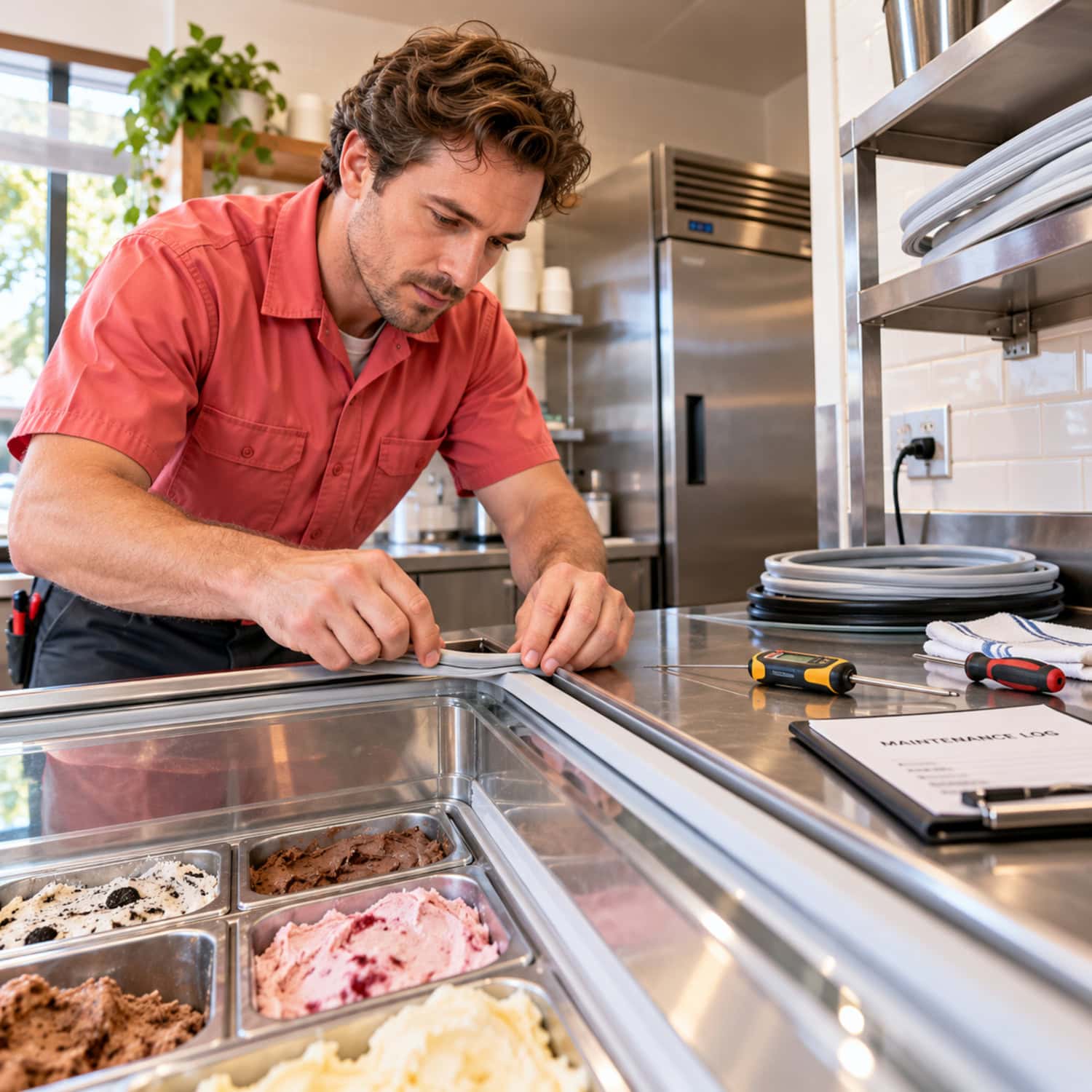
A used dipping cabinet can save upfront cash but is a poor bargain if the nearest qualified repair technician cannot service it.
Equipment decisions should account for serving capacity, cleaning, parts availability, installation conditions, and the cost of downtime.
The core wholesale-scoop setup typically needs a dipping cabinet, back-stock freezer, service tools, suitable handwashing and cleaning facilities, and a point-of-sale (POS) system.
Soft serve requires specialized machinery and a stricter machine-specific cleaning routine.
In-house production may add a batch freezer, hardening equipment, and more cold storage.
Before buying equipment, work through this inspection checklist:
- Confirm the machine’s model, condition, age, and actual operating performance, including its ability to hold the temperatures required for its intended product.
- Ask for service and maintenance history, manuals, and a demonstration under normal conditions.
- Confirm a local technician works on that model and that replacement parts are available.
- Check power, plumbing, physical dimensions, ventilation needs if specified, and delivery access against the chosen site.
- Estimate capacity against the busiest expected hour, not just average daily orders.
- Price installation, routine cleaning, consumables, and likely replacement parts alongside the purchase price.
- For a soft-serve machine, confirm cleaning procedures, staff training, spare gaskets, and a downtime plan.
- For used equipment, make purchase contingent on satisfactory inspection and testing where practical.
A breakdown on a busy weekend costs more than the repair bill.
It can take away the sales that were supposed to carry the shop through the slow season.
9. Run the shop safely without relying on unpaid owner labor
Ice cream service looks simple from the customer side, but freezer checks, cleaning, shift coverage, inventory, and payment reconciliation happen every day the shop trades.
Design staffing around the actual rush, not just the number of people needed to unlock the door.
Set written routines for safe product handling, temperature records where required, machine cleaning, portion sizes, restocking, and closing.
Train more than one employee on critical tasks so the owner is not the only person who can fix a routine problem or work the machine correctly.
Watch sales by hour, average check, labor hours, discarded product, and stock remaining.
The cost of a rushed, oversized scoop is multiplied over every order.
A shop can be busy and still leave little owner income if its payroll calculation excludes the hours spent covering shifts.
A point-of-sale report tells you what was sold; it does not explain why a busy counter ran out of popular flavors or why staff could not keep up.
Pair the numbers with a short daily log of queue delays, stockouts, cleaning issues, and equipment faults.
10. Set a menu that earns money during the rush
An elaborate sundae can command a higher ticket while occupying enough staff time to delay several quick scoop orders.
Price products for both what goes into them and the service time they consume.
Start with a manageable range of cones, cups, and flavors, then add shakes, sundaes, or toppings only when customers buy them at prices that justify the extra handling.
Standard portions and measured add-ons keep ingredient use predictable.
Track popular flavors against leftover stock rather than treating a large flavor wall as an automatic advantage.
Compare items using the money left after product and serving costs, preparation time, and their effect on the line.
If staff spend the busiest hour assembling slow specialty desserts while easy orders leave the queue, additional menu variety can reduce total sales.
Your strongest item is the one that customers want and your team can serve reliably at a worthwhile return.
11. Launch the shop and measure the first 90 days
A soft opening should reveal bottlenecks while the ice cream shop still has room to change the layout, staffing schedule, and menu.
Opening-day attention is less valuable than repeat purchases and orders served correctly during a normal rush.
- Before spending heavily, settle the format, document local demand, shortlist sites, and build the slow-month financial model.
- Before signing contracts, confirm the business party, insurance quotes, site approval path, lease conditions, and supply commitments.
- Before opening, complete required inspections, install and test equipment, set portion standards, and train staff on food safety and cleaning.
- During a controlled soft opening, record order times, queues, product waste, equipment performance, and payment problems.
- During the first 30 to 90 days, compare actual daily orders, average check, payroll, and contribution against the model. Rework hours, portions, and menu items where the numbers do not hold.
If early demand falls short, distinguish a weak location from slow service or a product that customers reject.
These causes require different responses.
12. Decide when to repair the model or close
A shop that sells well in summer may still lose money over its full trading cycle.
Judge performance after allowing for the owner’s labor, off-season bills, equipment downtime, and any debt payments.
Before extending hours, changing prices, or adding menu categories, identify the specific problem.
Low transaction counts suggest a demand or location issue.
Healthy demand with weak cash results points to costs, portions, payroll, or pricing. Queues with abandoned orders suggest a capacity problem.
For an underperforming seasonal storefront, review lease obligations and the likely cash requirement through the next slow period.
If the shop cannot fund that period without an unrealistic rebound, an orderly closure may protect more capital than another season of hope.
A mobile format has different options for changing selling sites, subject to its permits.
13. Expand only after the first operation stands on its own
A second ice cream shop multiplies leases, staff schedules, and maintenance demands before it proves any additional profit.
Expansion makes sense when the original site produces dependable results under a repeatable staffing and service model.
Document portion specifications, daily cleaning, stock ordering, machine service, and shift handovers.
Test whether trained employees can operate the first site while the owner is absent without materially changing its results.
If its apparent profit disappears once paid staff replace the owner, fix that before adding a second address.
More stores also mean more freezer failures to coordinate.
Confirm that technicians, suppliers, and cash reserves can support the larger operation, especially across the same peak season.

14. Evaluate an existing shop or franchise carefully
Buying an ice cream shop gives you an existing site and possibly customers, but its stated profit may reflect the unpaid work of the seller and family.
A franchise offers a defined concept while adding contractual costs and restrictions that must be covered by actual sales.
Before buying, perform this numbered due-diligence review:
- Match revenue claims to point-of-sale records, bank deposits, and tax filings.
- Review monthly results across busy and quiet seasons, not just the strongest annual summary.
- Recalculate profit after paying market-rate labor for every hour the seller and relatives work.
- Inspect freezers and machines, review maintenance history, and check local repair options.
- Confirm the lease can be assigned and that the site’s permits, approvals, and supplier terms can be continued or renewed as required.
- Compare inventory, outstanding obligations, equipment ownership, and future repair or replacement spending with the asking price.
- For a franchise, review the franchise disclosure document, ongoing fees, restrictions, and required investment with qualified professional help.
Longer opening hours do not automatically mean proportionally higher sales.
Some additional hours may bring little traffic while adding paid labor, cleaning time, and operating costs.
15. Avoid costly ice cream shop myths and turnkey traps
Equipment packages and polished sales forecasts cannot establish local demand, legal suitability, or reliable service capacity.
The following assumptions deserve a specific check before money changes hands.
| Myth | What actually happens |
|---|---|
| A busy summer guarantees an annual profit | Slow months can consume peak-season cash while rent continues |
| High gross margin means high owner income | Labor, occupancy, repairs, and unpaid owner hours can absorb the margin |
| A used machine is automatically the economical choice | No parts or local service can make downtime more expensive than the saving |
| Making ice cream increases profit by itself | Production adds equipment, labor, cold storage, training, and approvals |
| More flavors and desserts always mean more sales | Complex items can slow the queue and increase leftover inventory |
| A turnkey package removes the hard work | Site demand, permits, employee training, and repairs remain the owner’s responsibility |
When considering a turnkey deal, ask for itemized equipment prices, proof of ownership, repair support, installation responsibilities, and the assumptions behind any income projection.
Never value the offer on projected sales alone.
FAQ
How much does it cost to open an ice cream shop?
It depends on the format, site work, equipment, and cash reserve; the costs of a cart and a fully built-out storefront are too different for one dependable range.
Use the itemized budget in Section 5.
Do I need an LLC to open an ice cream shop?
No, an LLC is not universally required, although the business must meet the registration and tax rules that apply to its structure. See Section 6.
What permits does an ice cream shop need?
Typically, food-service approval and applicable zoning, occupancy, local business, and sales tax permissions; manufacturing and mobile formats add their own checks.
See Section 6.
Is an ice cream shop profitable?
It can be, if orders leave enough money after product costs to pay staff, occupancy, other expenses, and the owner.
See the worked calculation and slow-month test in Section 5.
Should I make ice cream or buy it wholesale?
For a first retail operation, buying wholesale generally avoids the extra equipment, labor, and dairy production approvals of making it in-house.
Compare the formats in Section 2.
Can I run an ice cream shop part-time or seasonally?
Yes, a permitted cart or seasonal schedule can limit selling hours, but storage, cleaning, and some fixed payments continue outside those hours.
See Section 4.
Conclusion
Choose an ice cream shop model that can pay for its slow months, equipment upkeep, and real labor before it becomes a long-term commitment.
A small test that produces believable sales numbers is more useful than a spectacular opening forecast.
- Test real demand before committing to a permanent location.
- Confirm the food-service approval path before signing an unconditional lease.
- Model slow-month cash flow and paid owner labor before buying machines.
Further reading
- U.S. Food and Drug Administration: Look for food facility registration and food safety requirements if your ice cream shop will manufacture products.
- Opening an Ice Cream Shop: This restaurant equipment seller covers store planning, equipment categories, and opening tasks.
- How to Open an Ice Cream Shop: This equipment seller discusses equipment capacity and planning a workable service counter.
- Starting an ice cream shop: A practical discussion of seasonality, portion control, menu complexity, and service speed.
- Buying a restaurant: A discussion about an ice cream and coffee shop purchase, owner labor, and the danger of relying on reported profit.
- Paging Soft Serve Business Experts: Questions about machine downtime, cleaning, service support, and spare parts for a seasonal operation.