To start a winery, select a production model, identify customers willing to pay for the wine, estimate the cash needed until release, and establish the business.
Next, confirm that the proposed premises and activities can qualify under federal, state, and local rules, secure supply and production arrangements, and prepare to sell through permitted channels.
Choose the winery model and establish a credible route to buyers before committing to an owned production facility.
Planning figures for very different winery projects range from roughly $75,000 to more than $1 million, but that spread is not a dependable budget for any single operation.
Federal Alcohol and Tobacco Tax and Trade Bureau (TTB) qualification and state alcohol licensing are central approval gates for producers.
Aging inventory, uneven sales, and repeated harvest spending determine how long the business must carry its own costs.
Last fact-checked: October 11, 2026
This article is for first-time founders in the United States comparing estate wineries, small production facilities, shared premises, and production outsourced to another winery.
It covers the decisions that lead to a lawful first release and a financially sustainable operation, rather than instruction in the chemistry of making wine or opening a retail-only wine shop.
1. How a winery works and the launch sequence
A winery turns grapes, other fruit, or purchased wine inputs into finished products and revenue, but its operating responsibilities depend on who owns the production premises and who actually makes the wine.
A winery with its own cellar has different costs and approvals from a brand contracting with an existing producer.
| Stage | Decision | Move forward when |
|---|---|---|
| 1. Business format | Estate, owned facility, shared premises, or outsourced production | You know who will produce the wine and who carries the regulatory responsibilities |
| 2. Customer demand | Buyer, price, and product identity | You have independent evidence of interest at a feasible price |
| 3. Sales channel and location | Direct sales, wholesale, hospitality, and site | The channel is realistic and the intended site has a credible approval path |
| 4. Economics | Launch spending, release schedule, and reserve | The cash forecast survives weaker-than-planned sales |
| 5. Business and licenses | Entity, federal qualification, state licensing, and local clearance | You understand the approvals for the exact activities |
| 6. Contracts | Property, fruit, production, partners, and distribution | Terms allocate cost, timing, quality, and exit risks |
| 7. Equipment | Owned, shared, used, or contracted production assets | Equipment fits the approved process and expected volume |
| 8. Operations | Production, inventory, staffing, and reporting | Every batch and bottle can be tracked through sale |
| 9. Product and price | Wines, release timing, and realized selling prices | Each planned channel leaves enough money after its costs |
| 10. Adjustment and expansion | Maintain, change, or increase production | Sales and cash support the next vintage |
| 11. Buying instead | Acquire an existing licensed operation | Due diligence confirms what transfers and what requires new approval |
| 12. Common traps | Unreliable startup assumptions or packaged offers | Claims have been tested against real contracts and expenses |
| 13. Opening | Begin authorized production and sales | Permissions, operations, and cash reserves are ready |
2. Winery business formats and entry costs
An estate vineyard and an urban producer buying grapes might both sell bottles under their own labels, yet the estate must also finance and manage agricultural production.
Compare the work behind each model before comparing headline startup prices.
| Format | Main capital commitment | Suitable for |
|---|---|---|
| Estate winery with vineyard | Land, vineyard development, production buildings, equipment, and possibly hospitality | Founders seeking control from growing through bottling, with substantial capital and time |
| Winery buying grapes or juice | Approved production space, equipment, storage, and purchased inputs | Winemakers who want direct production control without farming |
| Alternating proprietor in shared premises | Shared facility use, production costs, and the applicant’s own required qualifications | Producers who want to make their wine within another qualified facility |
| Custom-crush client | Contract production, fruit or wine, packaging, and sales | Founders seeking less owned infrastructure while accepting production-provider dependence |
| Contract-produced wine brand | Product development, inventory, branding, and customer acquisition | Founders focused on sales rather than running a cellar |
A custom-crush client paying a qualified winery to make wine is not automatically an alternating proprietor.
The latter operates under a distinct federal arrangement. Nor does owning a label automatically mean owning a winery.
This article focuses on launching a small producing winery, while treating outsourced production as a serious alternative when capital or skills are limited.
3. Finding customers before committing to a cellar
Friends may praise a homemade vintage without ever paying the retail price required to keep a commercial winery operating.
Test whether strangers, restaurants, retailers, or prospective tasting-room visitors want the specific wine at the planned price.
The practical priority is to settle the operating model and prove a route to paying customers before financing an owned cellar.
Otherwise, a founder can complete a successful harvest and face the much harder task of moving bottles that no buyer has agreed to consider.
Use a short validation sequence:
- Define the intended customer and why that buyer would choose this wine over existing options.
- Identify comparable wine prices and the channels where those customers actually purchase.
- Discuss the proposed style, price, and purchase occasions with potential buyers outside your circle of friends.
- Ask prospective trade accounts about category fit, realistic reorder behavior, and the terms they require.
- Record expressions of interest separately from binding commitments or actual orders, and take orders only when legally authorized.
- Reduce or redesign the proposed first release if the reachable customer base cannot support the volume.
Wine quality matters, but it cannot compensate for inaccessible buyers.
Marketing cannot rescue an inconsistent product either. Each must be tested on its own merits.
4. Sales channels and winery locations
The highest bottle price is not necessarily the best revenue channel once selling expenses are counted.
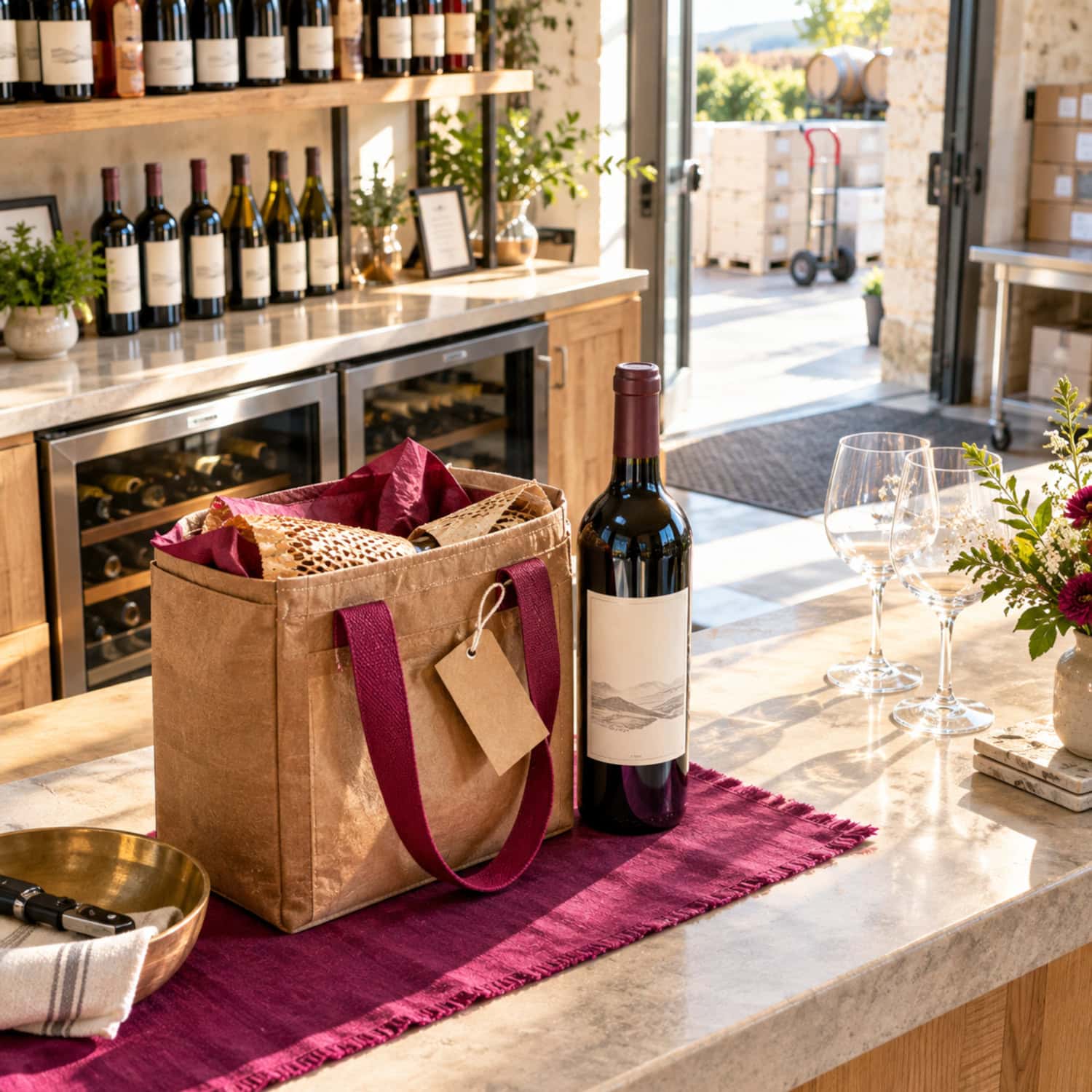
A tasting room may earn more per bottle than wholesale but also requires a suitable location, staff, service costs, and a steady flow of visitors.
| Channel | Commercial advantage | Main constraint |
|---|---|---|
| Tasting room | Direct customer contact and retail pricing | Visitor demand, zoning, hospitality space, staffing, and insurance |
| Wine club | Repeat purchases from established customers | Recruitment, retention, fulfillment, and permitted delivery arrangements |
| Direct online sales | Customer relationship and potential geographic reach | State-by-state shipping permissions, fulfillment, and acquisition expense |
| Restaurants and retailers | Placement with existing customer traffic | Lower realized producer price and account servicing |
| Distributor-led wholesale | Access to accounts through an intermediary | Distributor and retailer margins, limited control, and commercial terms |
Alcohol distribution commonly involves a three-tier structure of producer, distributor, and retailer, with exceptions and direct-sale permissions determined by state law.
Verify the actual privileges of your license with the state alcohol regulator before counting on tasting-room service, self-distribution, or shipment across state lines.
For premises, check whether local planning officials allow wine production, warehousing, customer visits, and events as separate uses.
A cheap warehouse without adequate drainage, cooling, loading access, or permissible wastewater handling can become an expensive conversion.
A vineyard site’s agricultural zoning does not automatically authorize a tasting room.
5. Winery startup costs and break-even economics
A realistic winery budget begins with the chosen format, production volume, first release date, and sales channel.
Broad figures from about $75,000 for narrowly scoped winery plans to $500,000 and well beyond $1 million for infrastructure-heavy starts should be treated as illustrations of different businesses, not a standard price range.
| Spending category | What the budget must include | Main driver |
|---|---|---|
| Property and approvals | Site control, zoning work, design, utilities, and facility changes | Whether the premises are owned, leased, or shared |
| Production | Fruit, winemaking labor, processing, storage, and testing | Wine style, batch size, and outsourcing terms |
| Equipment | Tanks, cooling, pumps, cleaning systems, packaging, and possible bottling equipment | Production method and owned capacity |
| Packaging and inventory | Bottles, closures, labels, finished stock, and storage | Lot size and release schedule |
| Sales and hospitality | Branding, sales work, fulfillment, tasting space, and staffing | Direct, wholesale, or mixed distribution |
| Compliance and protection | Licenses, records, taxes, professional review, and insurance | Activities and location |
| Working capital | Cash for recurring bills and the next production cycle | Aging period, sell-through, and payment timing |
The cash forecast should track when fruit and processing bills are paid, when inventory becomes saleable, and when customers actually pay.
A barrel in the cellar can have an impressive future selling price while leaving the bank account empty during the next harvest.
A bottle-level example with weaker sales
Annual operating result = direct-sales revenue + wholesale revenue – production and packaging costs – channel-specific costs – fixed annual expenses.
The following are illustrative numbers, not industry benchmarks.
They assume all planned bottles are sold during the period, an assumption that deserves skepticism in a first-year plan.
| Item | Planned sales | Half the planned volume |
|---|---|---|
| Direct-sale bottles at $28 each | 3,000 | 1,500 |
| Wholesale bottles at $14 each | 3,000 | 1,500 |
| Total sales revenue | $126,000 | $63,000 |
| Production and packaging at $8 per bottle | $48,000 | $24,000 |
| Direct-selling and fulfillment at $3 per direct bottle | $9,000 | $4,500 |
| Wholesale handling at $1 per wholesale bottle | $3,000 | $1,500 |
| Money remaining after variable costs | $66,000 | $33,000 |
| Fixed annual costs including an owner-pay allowance | $60,000 | $60,000 |
| Annual operating result | $6,000 | -$27,000 |
At the assumed half-direct, half-wholesale mix, each pair of bottles leaves $22 after variable costs.
The winery therefore needs 2,728 such pairs, or 5,456 bottles, to cover its $60,000 fixed expense in this illustration.
The planned $6,000 surplus is thin even though half the bottles sell directly at twice the wholesale price.
At half the projected volume, bottle-related expenses fall, but rent and other fixed commitments remain.
Neither result includes the initial facility investment, financing payments, or income taxes; inventory that remains unsold also ties up cash.
Reserve enough to carry fixed bills through slow sales and to fund the next harvest before assuming the first vintage will pay for it.
Debt can spread initial spending over time, but repayments make the timing mismatch more severe.
Ask lenders about the release schedule and working-capital need, not just the purchase price of equipment.
6. Winery permits and business insurance
Commercial wine production in the United States involves federal alcohol qualification, state alcohol permissions, and local land-use approvals.
Which applications apply depends on whether the business makes wine, stores wine, operates within shared premises, sells to the public, or only contracts with a producer.
- Set up the business. Choose a sole proprietorship or business entity, register as required, obtain an Employer Identification Number (EIN) where applicable, and arrange business banking and tax records. A limited liability company (LLC) is a choice, not a universal federal winery requirement.
- Determine the federal operating category. The Alcohol and Tobacco Tax and Trade Bureau distinguishes bonded wineries, bonded wine cellars, alternating proprietors, and custom-crush arrangements. Check the qualification and Federal Basic Permit requirements for the activity you will actually conduct, including any conditionally required bond.
- Confirm state alcohol privileges. Ask the state alcohol licensing agency about production, storage, direct sales, tasting rooms, distribution, and shipping rights. Federal approval does not confer those state permissions.
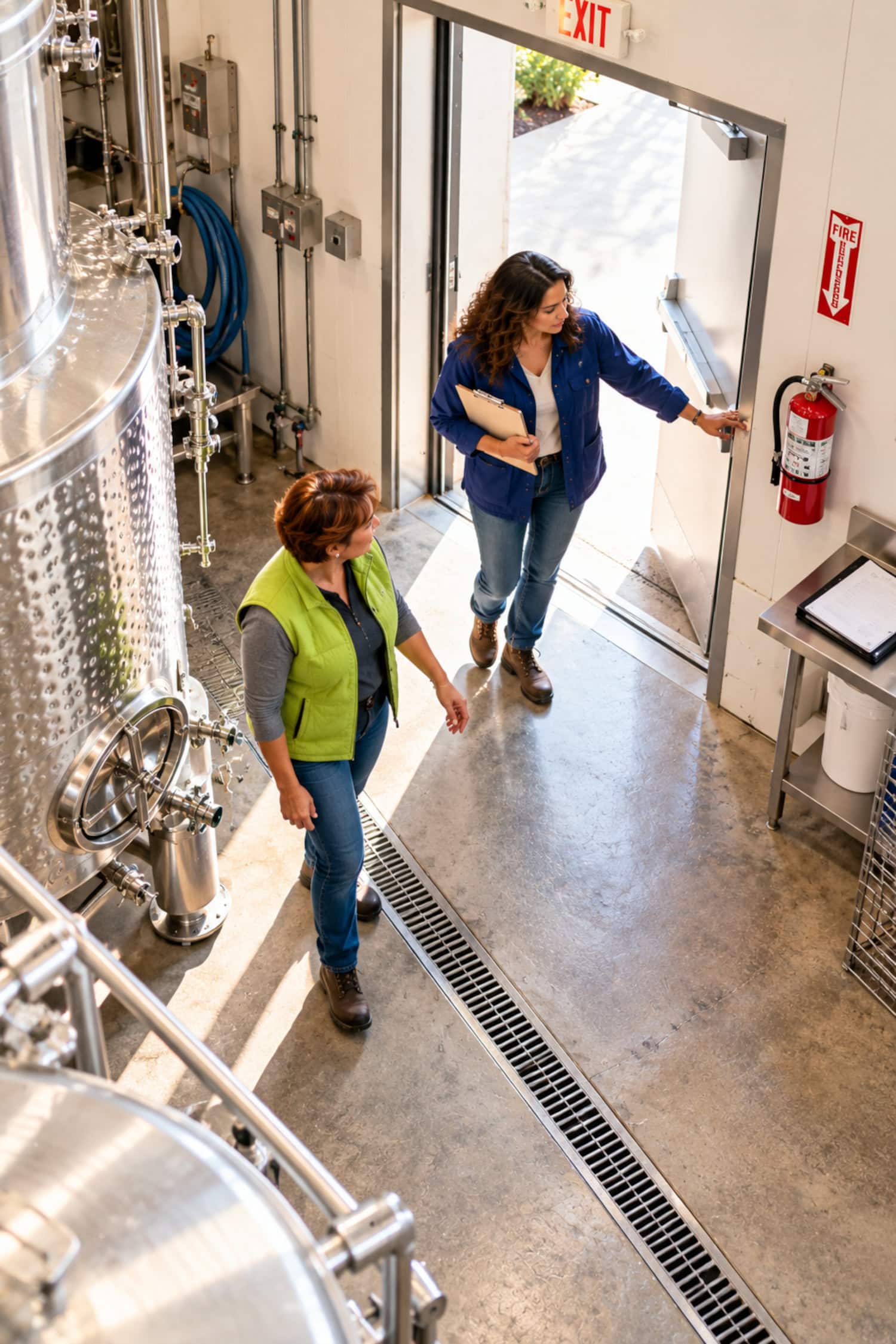
- Clear the site with local authorities. Check zoning, land use, building permits, fire and occupancy review, wastewater and utility requirements, and any approval for on-premises service or events.
- Plan labeling and federal reporting. Confirm the requirements for wine labels, including any TTB Certificate of Label Approval (COLA), alcohol taxes, production records, and periodic reports that apply to your operation.
- Check overlapping production rules. Determine whether Food and Drug Administration (FDA) food-facility registration or other food-safety requirements apply. Check workplace rules with the Occupational Safety and Health Administration (OSHA) and applicable waste and wastewater rules with the Environmental Protection Agency (EPA) and local authorities. Vineyard operations require separate attention to water access, land use, produce-safety rules, and pesticide licensing where applicable. Organic claims need certification review, and agricultural founders can investigate U.S. Department of Agriculture (USDA) programs and loans.
- Arrange coverage and employment compliance. Obtain quotes for premises and equipment, general and product liability, liquor liability where relevant, and workers’ compensation when employees are covered by state law. Confirm sales tax, resale, and local business-license obligations with the responsible agencies.
If food will be served in a tasting room, local health review and food-safety rules can add another approval path.
Cottage-food exceptions do not replace winery alcohol authorizations.
Have an alcohol-licensing attorney or qualified compliance specialist review the planned structure and site before a nonrefundable property commitment.
7. Winery leases and production contracts
A well-written winery lease cannot make a site legally usable, but it can limit the damage if permission is denied.
Seek conditional site control long enough to investigate and apply, while avoiding an unconditional buildout commitment before the approval path is clear.
The following terms deserve particular scrutiny:
- Property agreement: permitted uses, licensing contingencies, improvements, utility capacity, wastewater responsibility, visitor access, and exit terms.
- Fruit supply: varieties, quality standards, delivery timing, pricing, shortages, and harvest substitutions.
- Custom-crush or shared facility agreement: allocation of winemaking decisions, licensed responsibilities, production slots, records, storage, losses, bottling, and release conditions.
- Distributor or account agreement: territory, exclusivity, credit and payment terms, promotional spending, termination, and any return rights.
- Owner and partner agreement: capital contributions, authority, follow-on funding, disagreement procedures, and exit arrangements.
Imagine two founders reserving a shared production slot while their sales plan still assumes exclusive use of the tanks during harvest.
The contract’s scheduling language decides whose wine gets processed first when capacity is tight.
Review the actual production calendar, not just the price per batch.
8. Winery equipment and facility inspection
For a first winery, buy equipment sized for the viable production plan, not for an aspirational harvest years away.
If a qualified production partner already supplies tanks, presses, cooling, and bottling access, duplicating those assets defeats much of the reason for outsourcing.
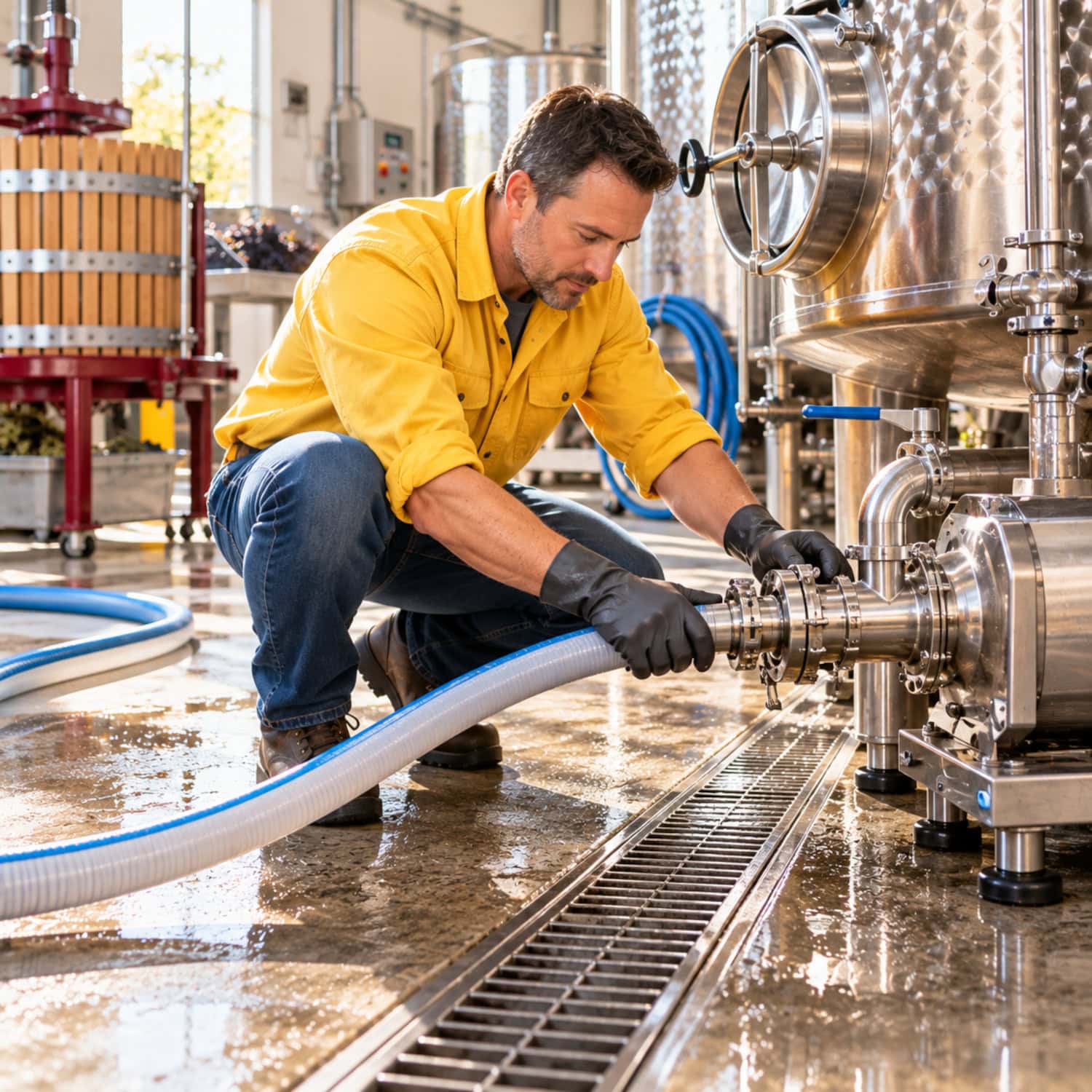
For an owned winery, review fermentation and storage tanks, temperature control, cleaning systems, pumps, grape handling, press access, laboratory testing arrangements, and safe storage.
A bottling contractor or shared equipment can change the investment considerably.
Before buying a used system or signing off on a facility, complete this inspection:
- Verify actual working capacity against the planned grape deliveries and batch schedule.
- Confirm food-contact surfaces and the ability to clean and sanitize the equipment.
- Check cooling capacity and temperature-control compatibility with the tank sizes.
- Inspect pumps, valves, fittings, and connections for leaks, damage, or missing parts.
- Confirm power, water, drainage, wastewater handling, and loading access at the site.
- Review service records, maintenance needs, and availability of replacement components.
- Price transport, installation, testing, and any construction needed to make the system usable.
- Get a qualified technician’s inspection when condition or compliance cannot be established directly.
A low auction price on a tank tells you little about the total installed cost if the room cannot keep the wine at the intended temperature.
9. Winery operations and record-keeping
Once winery production begins, the owner must reconcile physical wine movements with inventory records, costs, taxes, and sales.
This workload exists even if an outside winemaker handles fermentation.
Track grape or wine inputs, batches, processing losses, storage transfers, bottling counts, finished inventory, and the eventual sales channel.
Allocate costs to wine lots rather than hiding weak products inside a single annual expense figure.
Reconcile records on a regular schedule so losses and discrepancies are found before regulatory reports or sales forecasts depend on them.
An owner-run winery also needs dependable cleaning, maintenance, testing, packaging, customer service, and sales coverage.
Commercial production requires repeatable quality controls beyond the judgment used for a small home batch.
Employ or contract for the skills you do not have, and include that labor in the model even if the founder initially performs it without drawing a paycheck.
10. Choosing wines and setting prices
A first winery portfolio works better when every wine has a clear customer, credible fruit supply, planned release window, and channel price.
Adding several varieties can increase batch complexity and cash tied up in labels, packaging, and aging before it increases actual demand.
Start with the wines that fit the buyers identified in Section 3.
For each one, track fruit and production cost, bottle and label cost, storage, selling expense, and any distributor or retailer margin.
The amount collected by the producer differs sharply between a bottle sold in a tasting room and one sold through wholesale, as Section 5 demonstrates.
Plan inventory by release readiness, not just harvest date. A wine intended for longer aging requires more cash before customers can purchase it.
A wine ready earlier does not automatically sell faster if buyers or legally available channels are missing.
Limit the initial range to products the winery can produce consistently, explain clearly, and sell repeatedly.
11. When to change or expand the winery
For a winery, increasing production before existing bottles sell creates more inventory and may bring the next fruit bill forward.
Judge expansion by actual sell-through, repeat buying, cash on hand, and whether added production leaves enough money after its channel costs.
| Warning sign | Practical response |
|---|---|
| Wine remains unsold beyond the expected sales cycle | Reduce the next production commitment and revisit buyer demand |
| A tasting room is busy but contributes little after labor | Review visitor conversion, staffing, and the real sales margin |
| Wholesale accounts sell through but seldom reorder | Investigate customer fit, account terms, and repeat demand |
| One wine requires disproportionate storage and working capital | Reassess its release timing, price, or position in the range |
| Added volume requires a major new facility | Compare outside production or shared capacity before expanding the building |
Closing a weak tasting room, changing a product, or holding production steady can be a financially sound choice.
There is no reason to double the vintage merely because the equipment has room.
12. Buying an existing winery
Acquiring an operating winery can provide premises, equipment, production history, and customer relationships, but the advertised sale price rarely explains what approvals or obligations will pass to the buyer.
Alcohol qualifications and site permissions must be checked for the proposed owner and transaction rather than assumed transferable.
Use this due-diligence sequence before committing:
- Obtain financial statements, tax records, debt schedules, and documented owner compensation.
- Reconcile physical bottled inventory, bulk wine, aging lots, and their stated values.
- Review actual direct and wholesale sales, returns, discounts, customer retention, and distribution obligations.
- Inspect the property, equipment, utilities, environmental conditions, and deferred maintenance.
- Confirm zoning and determine which federal, state, and local approvals require new applications or changes.
- Review grape supply, production, wine-club, distributor, employee, and partner contracts for assignment or termination restrictions.
- Model how much cash is needed after purchase for operations, inventory replacement, and any delayed sales.
If the winery’s strongest revenue comes from personal relationships with the departing owner, treat those relationships as uncertain until customers demonstrate they will remain.
13. Winery startup myths and packaged offers
An attractive turnkey winery package can bundle equipment, branding, wine, or facility access without proving there is a legal and profitable channel for the finished product.
Compare the full contractual obligation with the actual functions the package supplies.
| Myth | What actually happens |
|---|---|
| A winery requires a vineyard | Commercial wineries can use purchased grapes or juice, while brands can contract production |
| Affordable used tanks mean an affordable winery | Utilities, installation, compliance, staff, storage, and working capital remain |
| Great wine will sell itself | Customers still need to discover it, understand its value, and buy again |
| Every boutique winery needs a tasting room or club | Those channels work only when their additional revenue justifies their costs |
| A small first batch automatically makes the business low-risk | Low volume can leave too little money after bottle costs to pay fixed expenses |
| Federal approval lets the winery sell anywhere | State distribution, tasting, and shipping permissions also apply |
Before paying for a packaged arrangement, inspect the production facility, establish who holds the approvals, read every supply and fulfillment contract, and check the permitted sales activities.
Marketing projections do not replace the customer’s actual willingness to buy.
14. Winery launch plan
A new winery should reach first release only after its operations, cash, and legal permissions are ready for the particular wines and channels it intends to use.
The sequence below keeps expensive commitments behind the decisions they depend on.
- Before major spending: Choose the format, test buyer interest, identify a realistic channel, and build a budget that includes the production-to-payment gap.
- Before a binding property or production contract: Register the business as appropriate, scope federal and state qualifications, discuss permitted site uses with local officials, price insurance, and negotiate approval contingencies.
- Before ordering fruit or installing equipment: Secure suitable premises or a qualified production partner, review supplier terms, and confirm capacity, timing, and facility requirements.
- Before producing commercially: Obtain every required operational approval and put batch records, quality controls, responsible personnel, and insurance in place.
- Before first sales: Confirm applicable label approval, state sales permissions, shipping eligibility, tax handling, and inventory-to-sales procedures.
- During the first 30 to 90 days of sales: Compare real bottle margins and repeat purchases with the plan, track cash collected, and amend the next release or vintage before making expansion commitments.
The first harvest and the first permitted sale may occur far apart.
That interval belongs in the opening budget, not in an optimistic note at the bottom of a spreadsheet.
FAQ
Can you start a winery without a vineyard?
Yes. A production winery can buy fruit, and a brand can use custom-crush services, though their approvals and responsibilities differ. See Section 2.
How much money does it take to start a winery?
Rough planning figures for different winery scopes run from about $75,000 to more than $1 million, with no reliable universal startup price.
See Section 5.
Can you make and sell wine from a home garage?
It depends on federal qualification, state alcohol requirements, and local zoning for that specific premises. See Section 6.
Do you need an LLC to open a winery?
No. An LLC is an optional legal structure, while alcohol approvals depend on the business activities and operator. See Section 6.
Is a tasting room necessary for a winery to make money?
No. Direct sales, wholesale, and other permitted channels can work if their margins and customer demand support the business. See Section 4.
How soon will a new winery make a profit?
It depends on the release schedule, sales volume, fixed costs, and cash invested before wine is ready. See Section 5.
Conclusion
A winery has a better chance of surviving its first production cycles when its business model and access to customers are established before money is locked into an oversized production facility.
The launch succeeds through permitted sales and cash discipline, not through the size of the first harvest.
- Test real demand at a viable bottle price before making major commitments.
- Confirm federal, state, and local permissions for the chosen operator, premises, and sales channels.
- Fund the time between production and payment, and expand only against demonstrated sell-through.
Further reading
- TTB Getting Started in the Wine Industry: Review federal winery qualification categories and the regulatory steps for different wine operations.
- Starting a Wine Brand From Scratch: Explore practical questions about differentiation, production scale, and finding buyers for a new wine brand.
- Building a New Brand or Winery: Examine how fruit payments, early operating costs, and delayed release revenue affect financing.
- Transitioning a Garage to a Commercial Winery: Read a practical discussion of why property suitability and zoning matter when converting an existing space.
- Testing Demand Before Commercializing Wine: Explore the questions behind willingness to buy, pricing, and commercial readiness.
- Small Winery Needing to Level Up: See a discussion of seasonal winery sales, returning customers, and challenges in expanding a small operation.