To start a food cart business, choose a focused menu, find customers who will buy it, check where vending is allowed, calculate the costs, confirm the approval path, and equip a cart for that specific operation.
Verify that your menu and proposed cart can pass local review before paying for equipment.
Your local health department and city vending office are the first contacts, because food preparation rules and permission to occupy a selling spot are separate questions.
There is no reliable nationwide startup price for a food cart: the bill depends on the food process, approved equipment, commissary access, location fees, and cash needed after opening.
The expensive surprise is often an inexpensive cart that needs major alterations or cannot be approved at all.
After launch, profit depends on how many orders you can complete during the busy window and what remains after all the work and costs.
Last fact-checked: October 11, 2026
This is for US beginners planning their first small, independently operated food cart rather than a full-size food truck or restaurant. It covers format choices, local permissions, startup economics, commissaries, locations, equipment, daily operations, and the first sales decisions. Costs and permits must be confirmed for the intended city and menu.
1. How a food cart business works
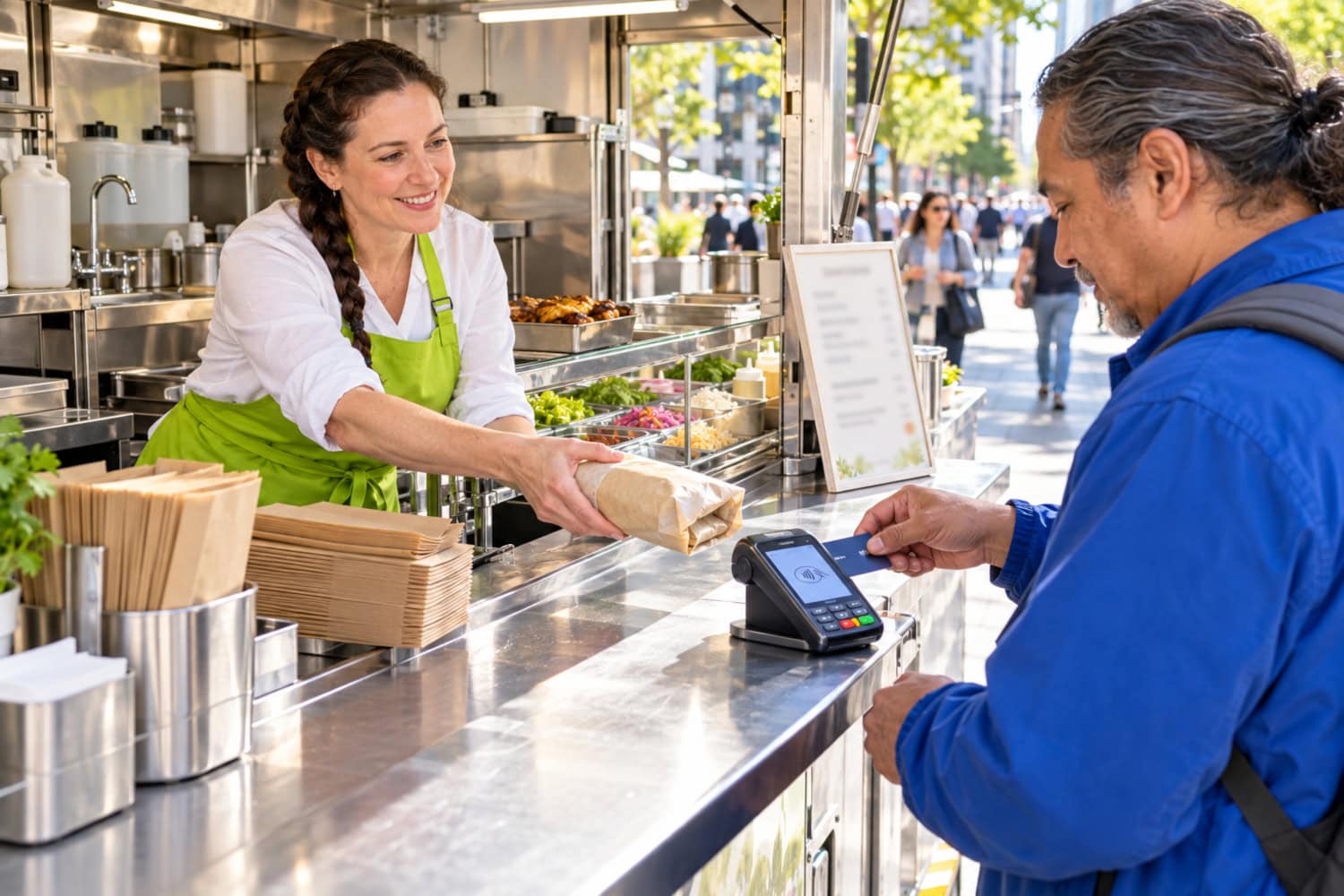
A food cart makes money by selling a limited menu at locations where people are ready to purchase food.
The business works only when legal access, enough peak-hour sales, and a repeatable preparation routine coincide.
| Stage | Decision | Move forward when |
|---|---|---|
| 1. Business model | Choose the kind of cart operation | You can describe the food, customer, and selling window |
| 2. Format | Choose a cart or a smaller testing format | The format suits your menu and available capital |
| 3. Menu and customers | Find evidence people will pay | You have a short menu and a plausible customer base |
| 4. Locations | Qualify regular sites and events | You know the access rules and commercial terms |
| 5. Economics | Calculate costs, break-even sales, and capacity | Conservative sales can support the numbers |
| 6. Approvals | Confirm the menu, cart, and operating requirements | The relevant agencies have given you a clear approval path |
| 7. Agreements | Arrange a base and selling rights | The terms, costs, and responsibilities are documented |
| 8. Cart purchase | Inspect equipment or an existing operation | The specifications and documents fit the approval path |
| 9. Operations | Prepare pricing, staff, supplies, and service | The workflow handles the required rush |
| 10. Launch | Complete approvals and open carefully | Inspection, site access, and safety systems are ready |
| 11. Review | Keep, change, or expand the operation | Actual profit and owner hours justify the decision |
The cart may be the most visible asset, but the selling window is what gives that asset a chance to earn its keep.
2. Choose the food cart format
A low purchase price does little good if the format cannot prepare your menu safely or serve enough orders.
Compare the real operating requirements before deciding that a cart is cheaper than every alternative.
| Format | Entry-cost character | Best fit and limitation |
|---|---|---|
| Simple pushcart | Relatively low equipment commitment | Narrow, approved menus with limited cooking and storage needs |
| Cooking or refrigerated cart | More equipment and utility expense | Foods needing controlled heat or cold, subject to cart approval |
| Temporary market stall | Potentially lower-cost demand test | Markets or events that allow the proposed preparation setup |
| Trailer or food truck | Greater vehicle, storage, and operating commitment | Larger production needs that a cart cannot meet |
For a first launch, focus on a cart with the least complex approved menu that still has enough service capacity.
A temporary stall is worth considering for an initial test if local rules permit the same food process there.
3. Pick a short menu and find paying customers
A food cart with many distinct dishes needs more ingredients, storage, preparation space, and equipment.
Begin with a few products that share supplies and can be handed over quickly.
The menu affects the equipment specification, and that specification affects which approvals are possible.
A heated item, a refrigerated topping, and a food assembled entirely elsewhere can lead to different requirements even when sold from the same size cart.
Before committing money, make a small demand record:
- Visit potential selling areas during the exact lunch, evening, or event window you hope to serve.
- Count likely buyers and observe what nearby food sellers actually sell, rather than relying on general foot traffic.
- Compare menu prices, waiting times, and the kinds of purchases customers make there.
- Where permitted, use an approved temporary selling setup to record paid orders, average check, and preparation time.
- Keep only products that customers buy at a price compatible with the cost model in Section 5.
Praise for a recipe is encouraging. A line of people paying for it at the intended price gives you something to plan around.
4. Qualify selling locations and paid events
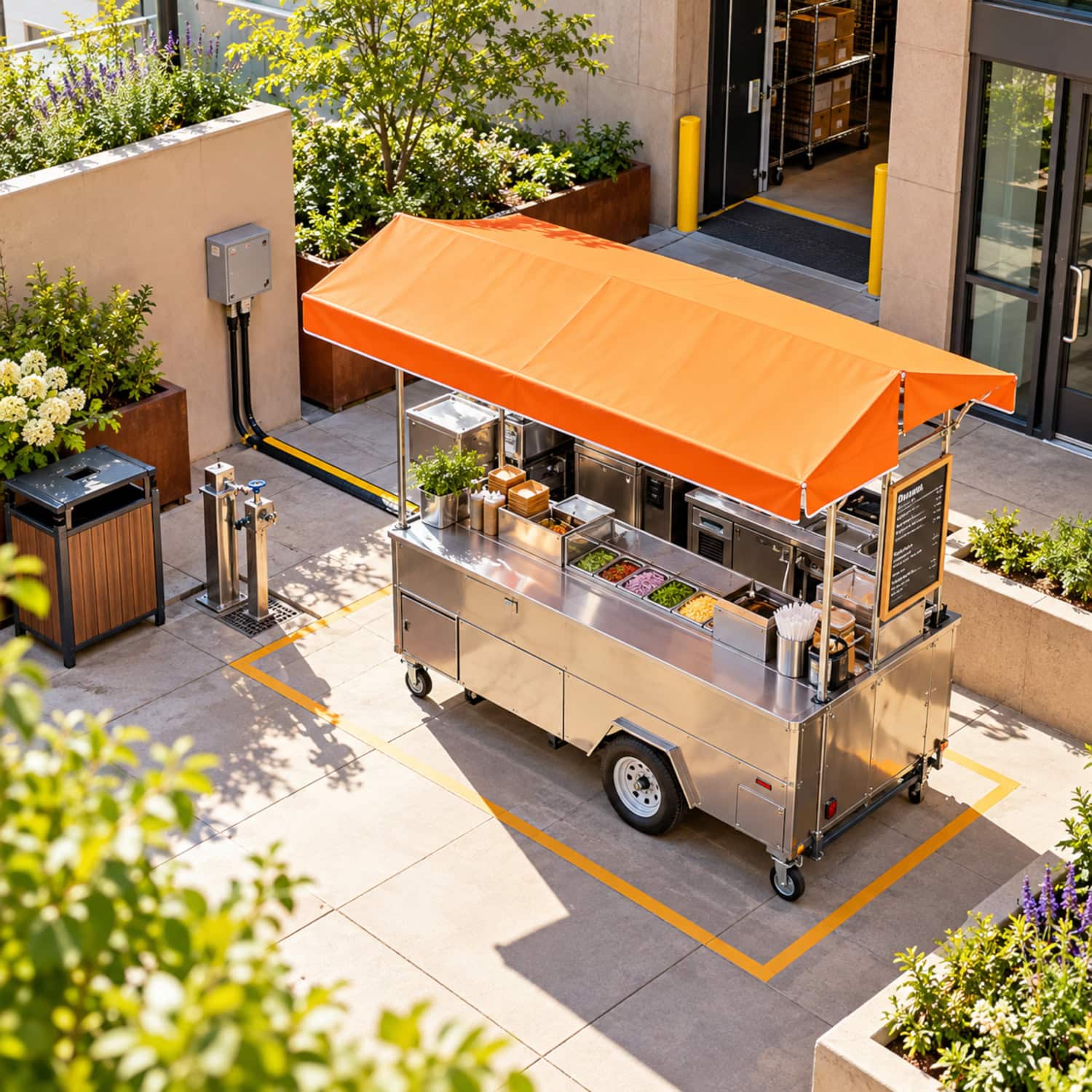
A busy sidewalk is useless to a food cart if vending is prohibited there or customers rush past without buying.
Assess the right to sell and the likely transactions during a particular period, not just the size of the crowd.
| Site factor | What to verify | Warning sign |
|---|---|---|
| Legal access | Public vending restrictions or private-property authorization | A host promises a spot without confirming vending permission |
| Customer timing | Buyers present during your actual service hours | Heavy traffic outside meal or snack periods |
| Competition | Similar menus and number of food vendors | Several sellers depend on the same small buying window |
| Site cost | Rent, flat vendor fee, percentage of sales, or both | Fees remain high even when turnout disappoints |
| Logistics | Cart access, unloading, water, power, and waste arrangements | Setup demands more time or equipment than anticipated |
| Reliability | Repeat access, cancellations, and weather exposure | A single uncertain event is the entire sales plan |
An event organizer’s attendance estimate is not a sales forecast.
Ask about historical food-vendor sales, competing cuisines, utility charges, and cancellation terms before accepting a fee.
Section 5 shows how to turn those answers into a minimum order count.
For recurring private-property sites, approach the owner or manager with a clear menu, operating hours, cart dimensions, and the insurance documentation they request.
Treat any proposed placement as conditional until municipal permission and contract terms are settled.
5. Food cart startup costs and break-even sales
The purchase price is only one part of food cart startup cost.
A complete budget includes equipment made compliant for your menu, setup expenses, and enough cash to operate when early sales are weak.
| Cost group | Include in the budget |
|---|---|
| Before opening | Cart, modifications, approved equipment, inspections, permits, business setup, and initial insurance |
| Base and location | Commissary or storage deposit, site rent, event deposits, and transport arrangements |
| Service setup | Initial food stock, packaging, signs, card reader, utensils, and cleaning supplies |
| Utilities and upkeep | Power, fuel, propane where used, maintenance, and replacement parts |
| Operating reserve | Recurring bills, spoilage, repairs, and owner living expenses while sales develop |
Request real quotes for your proposed cart, approved base, insurance, and first selling locations.
Keep startup purchases separate from working capital, the cash that keeps the operation running after the doors, or serving window, open.
Financing a cart does not finance the many recurring bills around it.
A worked break-even example
The money left from each order after ingredients, packaging, and transaction charges is its contribution.
Monthly operating profit after a target amount for the owner’s work can be modeled as:
Monthly result = (selling price – variable cost per order) x orders sold – monthly fixed costs.
These are illustrative numbers, not a startup-cost or earnings benchmark:
| Item | Illustrative amount |
|---|---|
| Average selling price per order | $10 |
| Ingredients per order | $3 |
| Packaging and payment costs per order | $1 |
| Total variable cost per order | $4 |
| Contribution per order | $6 |
| Monthly fixed costs, including $1,500 of target owner pay and $900 of other expenses | $2,400 |
| Orders sold in a month | 500 |
| Sales revenue | $5,000 |
| Contribution after variable costs | $3,000 |
| Monthly result after fixed costs and target owner pay | $600 |
With $6 left per order and $2,400 to cover, monthly break-even is 400 orders.
At 20 selling days and two productive hours per day, that means 20 orders per day, averaging 10 an hour during the productive windows.
If sales fall to 250 orders, variable costs fall with sales, but the $2,400 monthly fixed bill remains.
Contribution becomes $1,500 and the monthly result is a $900 loss.
That is why the reserve matters even when every individual item sells for more than its ingredients cost.
Apply the same math to an event
Suppose a single event requires $300 in combined vendor fees, travel, and paid help, all illustrative.
At $6 contribution per order, you need 50 orders simply to cover those event-specific expenses.
If the selling window is three hours, that requires about 17 orders per hour before counting other overhead.
At 25 orders, the event loses $150 against those expenses.
Check whether the cart and staffing can physically handle the required pace before accepting the booking.
Your startup budget is ready only when the equipment and compliance quotes are known, the conservative sales case makes sense, and there is cash left for slow weeks.
Borrowing can spread a purchase payment across time, but it increases the monthly sales burden.
6. Confirm food cart permits before purchasing equipment
Verify the menu’s legal preparation method and the cart’s required specification before buying the cart.
A perfectly working used grill or espresso machine may be unusable for your business if required certifications or documentation are missing.
Food-cart rules differ by jurisdiction and by what is prepared or served.
Contact the local health department about the food process and plan review, then confirm vending rights with the city or local permitting office.
Obtain the applicable approvals and inspections before serving the public.
| Requirement | What it governs | Where to confirm |
|---|---|---|
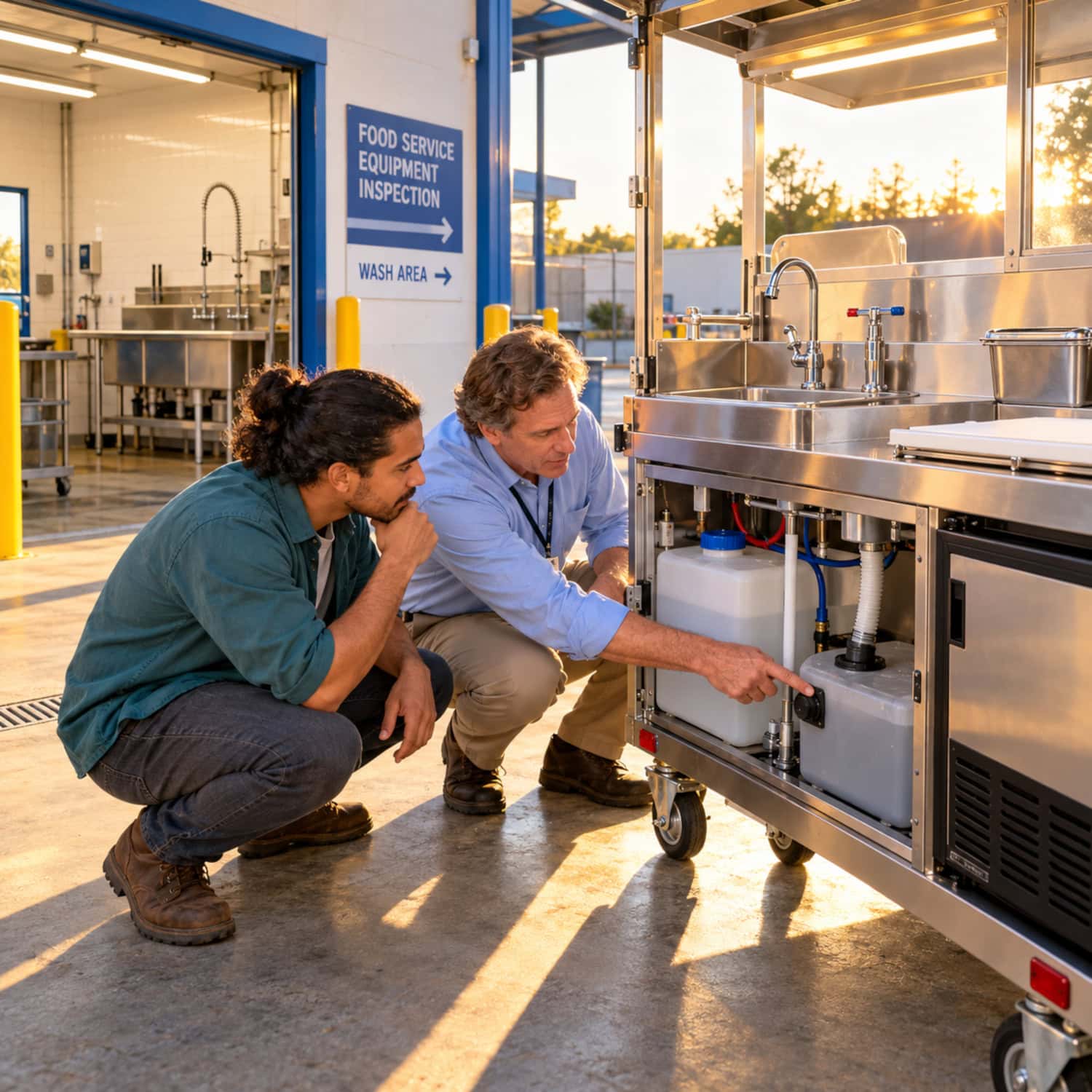
| Health permit and plan review | Menu, food handling, cart layout, sinks, hot water, refrigeration, and waste systems | City or county health department |
| Food safety certification | Required training or certification for food handlers and managers | Local health department |
| Mobile vending and business licenses | Permission to run the food business and vend in that jurisdiction | City or county licensing office |
| Zoning and site permission | Approved streets, parks, private lots, and vending hours | City planning or vending office, plus property owner |
| Fire inspection | Cooking equipment, fuel, propane, and fire precautions where applicable | Local fire authority |
| Commissary or base approval | Approved preparation, storage, cleaning, water, and wastewater services | Local health department |
| Sales tax registration | Collection and reporting obligations that apply to food sales | State revenue department |
| Home preparation or cottage food rules | Whether any proposed food can legally be prepared at home | State or local health or agriculture department |
| Alcohol licensing, if proposed | Whether alcohol service from a cart is allowed and how it is licensed | State alcohol regulator and local authority |
Ask the health department these questions about your exact menu and proposed unit:
- Which menu items can be prepared or assembled on this kind of cart?
- What drawings, equipment specifications, and certifications are needed for plan review?
- What sink, hot-water, clean-water, wastewater, refrigeration, and cooking provisions apply?
- Is a commissary or other approved base required, and what must that base provide?
- Which reviews or inspections must happen before equipment purchase or opening?
- Does approval cover more than one selling location, and which additional city permits apply?
Choose a business structure and register the business through the appropriate state or local office.
An LLC is an option, not a substitute for food permits or insurance.
Ask the state revenue department about tax registration and the IRS about whether an employer identification number (EIN), a federal business tax identifier, is appropriate for your setup.
Price general liability and product liability coverage, as well as coverage for equipment and transport where needed.
If you hire staff, confirm payroll and workers’ compensation obligations with the relevant state agencies and insurer.
The approval process may take longer when drawings, equipment corrections, or another inspection are required, so avoid promising an opening date until these dependencies are clear.
7. Arrange a commissary and secure site terms
A food cart may need an approved commissary, a base where the business prepares or stores food and handles required cleaning and servicing.
Renting kitchen space alone does not necessarily provide cart parking, potable water, wastewater disposal, or the storage access your permit requires.
Compare bases by their approved functions, hours of access, distance to selling sites, and full monthly price.
A low kitchen rental rate loses its appeal if every service day requires a long detour for water or cleaning.
Before signing a commissary or placement agreement, work through the terms with the owner:
- Confirm the legal business name, insurance requirements, and exact approved use.
- Record the food preparation, water, washing, storage, and waste services included in the price.
- Check access hours, overnight cart storage, and the process when utilities fail.
- Specify the selling dates, load-in arrangements, site utilities, and any competing vendors.
- Document flat fees, sales percentages, deposits, cancellation rights, and responsibility for site damage.
- Confirm how the arrangement ends if a permit is refused or the site cannot legally host the cart.
Do not assume that permission from a property owner overrides city vending restrictions. Both sides of the permission question have to work.
8. Inspect the cart and evaluate used business offers
The cart should be a purchase made against a written list of requirements, not an attractive photograph and a seller’s assurances.
New, used, rented, and custom equipment all deserve the same compliance check.
Use this numbered inspection list before paying for a cart:
- Match its dimensions and preparation layout to the health department’s plan-review requirements.
- Obtain documentation and required certifications for installed commercial equipment.
- Inspect sinks, handwashing access, hot water, and fresh-water and wastewater capacity.
- Verify refrigeration and hot-holding equipment against the planned menu.
- Check electrical demand, power supply, fuel systems, and safe installation by qualified professionals.
- Inspect physical condition, drainage, cleaning access, corrosion, and repair history.
- Check weight, towing or pushing arrangements, storage dimensions, and access to regular selling sites.
- Confirm what is included in the sale, what is missing, and the full cost of making the unit usable.
- Discuss the proposed unit and documentation with the relevant approving authority before committing funds.
Buying an existing food cart business adds a second risk: the cart might be usable but the advertised sales may depend on locations, event invitations, or permits that will not transfer.
For a purchase of an operating business, verify:
- Actual sales and expense records, including cash sales and event fees.
- Ownership of the cart and equipment, outstanding obligations, and repair needs.
- Whether the current permits require a new application or inspection after a sale.
- Whether commissary, storage, supplier, and site agreements can continue under a new owner.
- How much unpaid owner or family labor is hidden behind the reported profit.
- Why the owner is selling and whether the price makes sense without optimistic future bookings.
| Sales pitch | What to check |
|---|---|
| A fully equipped cart is ready to open | Whether this menu and the actual equipment can be approved locally |
| A turnkey cart includes profitable locations | Whether the selling rights are written, transferable, and supported by sales records |
| A crowded event guarantees good money | Whether realistic orders cover the event fee, labor, and operating costs |
9. Build a service routine and set prices
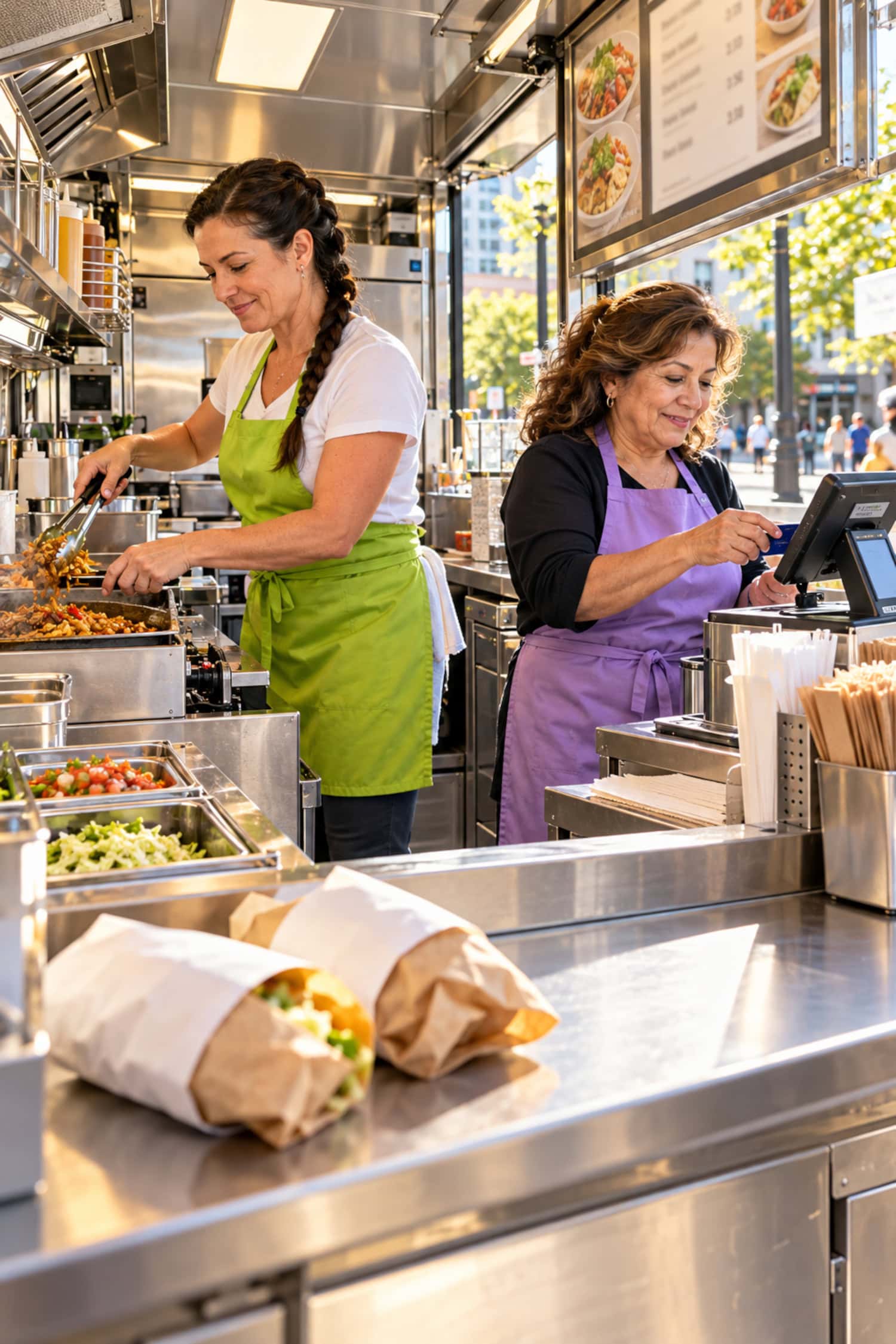
A cart often makes most of its sales in a compressed lunch or evening rush.
An elaborate menu or awkward workstation can turn a good location into a long line that stops buying.
Practice the full order cycle with the intended equipment.
Separate food preparation, payment, and pickup where space permits; determine whether one worker can serve the rush or whether an additional person earns their cost.
At lunch, a single worker might be cooking the next batch while finished orders wait to be bagged and customers wait to pay.
More foot traffic cannot remove that bottleneck.
Set each price using the actual ingredient quantity, packaging, payment fees, and a share of overhead.
Check the resulting menu against what nearby customers pay.
In the Section 5 illustration, ingredients use 30% of the $10 sale, and $1,500 in owner compensation is 30% of $5,000 in monthly revenue.
Their combined 60% is the prime cost percentage, a measure of food and labor against sales in that illustration.
Also track the average check, waste, and orders per rush hour.
A normal cart day includes preparation, shopping, loading, setup, service, breakdown, washing, and records.
Hours visible to customers are only part of the work.
Maintain reliable payment processing, clear signs with readable prices, inventory logs, and backup arrangements for critical refrigeration or power failures.
10. Launch the cart in controlled stages
A food cart is ready to open when its approvals, site access, supplies, food safety systems, and service routine are ready together.
A short first service at an approved location is more useful than a heavily advertised opening that the cart cannot handle.
Use this launch sequence:
- Before major spending: Document the menu, customer, intended service window, and preliminary answers from the health and vending authorities.
- Before signing contracts: Finish the conservative budget, choose the business structure, price insurance, and confirm the commissary and site terms.
- Before acquiring equipment: Obtain the needed specifications and review the exact cart documents against them.
- Before serving: Complete required permits and inspections, arrange safe food storage and cleaning, confirm staff credentials, and test payments and utilities.
- At first service: Offer the short menu, keep a record of orders and waiting times, and note items that slow the line.
- During the first 30 to 90 days: Review sales and contribution by location, total owner hours, waste, and cash left after fixed bills.
For each event, keep its own profit record. A profitable weekday site should not hide an event that loses money after travel, vendor fees, and labor.
11. Decide when to change locations or expand
A food cart’s next investment should follow repeatable profit, not the excitement of a single busy event.
Compare sites by cash remaining after location-specific costs and by the owner’s total hours.
If a location has weak transactions during its best selling window, test another legal site or a better time slot before extending opening hours.
If demand is strong but service is slow, simplify the menu or improve the workflow before taking on a second cart.
Expansion makes sense when the first operation can reliably cover paid labor, replacement equipment, and the owner’s expected compensation.
A closed window during a quiet afternoon may be a more profitable decision than staying open simply because the cart is already parked.
FAQ
How much does it cost to start a food cart business?
It depends on your menu, local cart requirements, commissary costs, and selling-site fees; there is no reliable single nationwide figure.
Build separate purchase, opening, and operating-reserve budgets using Section 5.
Can I sell food from a cart anywhere?
No. Local vending, zoning, site-access, and health requirements determine where you can operate; see Sections 4 and 6.
Do I need a commissary kitchen for a food cart?
It depends on your jurisdiction and food process.
Your local health department can specify any required approved base and its functions; see Section 7.
Do I need an LLC to start a food cart?
No single business structure is required for every food cart. Your entity choice does not replace the permits and insurance discussed in Section 6.
Is a food cart more profitable than a food truck?
Not necessarily.
A cart usually commits less capital but may also limit menu choice and peak-hour sales; compare formats in Section 2 and break-even capacity in Section 5.
How do I know if a food festival is worth the fee?
Calculate whether realistic paid orders can cover the vendor fee and all event-specific costs.
Check the working example in Section 5 and the location criteria in Section 4.
Conclusion
The soundest start is to establish that the menu and cart can gain approval before putting money into equipment.
A cart earns its place in the business only when an attainable selling window covers the full cost of operating it.
- Record your health department contacts, required approvals, and cart inspection conditions.
- Budget for commissary access, site fees, equipment compliance, owner labor, and a reserve before signing agreements.
- Prove profit per location and event at realistic service speed before adding more equipment.
Further reading
- U.S. Small Business Administration: Find federal small-business planning resources and ways to locate help with business setup and financing.
- U.S. Food and Drug Administration: Find federal retail-food safety material and use it to frame questions for the local health authority responsible for your cart.
- Food cart startup cost: A commercial planning guide devoted to food-cart budget categories.
- Food cart business startup: A vendor-led overview with commissary and site-selection considerations.
- Food costs: A practitioner discussion of why ingredient markup alone cannot set profitable menu prices.
- Food cart versus food truck: A discussion of the trade-off between lower cart investment and service capacity.
- Commissary requirements: A discussion of late-discovered commissary costs and why local verification matters.
- Learning from a tough first event: A practitioner conversation about paid event participation that failed to earn enough to cover costs.