To start a candy business, choose whether to make candy, resell it, or hire a manufacturer. Pick a small product range, identify likely buyers, check the rules for producing and selling those products, and test paid orders.
Then calculate the full cost of every package, establish the business, arrange suitable production, and launch through a channel your candy can handle.
The expensive beginner mistake is buying equipment, ordering too much inventory, or signing a store lease before customers demonstrate they will pay a workable price.
A home-based producer and a staffed candy shop have radically different budgets: a physical candy store alone can cost roughly $15,000 to $300,000, so the only useful budget is one built for your own format.
State cottage food rules and local permits can determine the legal starting point. Repeat orders, product stability, and the work behind each sale determine whether the venture lasts.
Last fact-checked: October 8, 2026
This guide is for US beginners considering homemade candy, specialty chocolate, online sales, wholesale, or a physical candy shop. It covers the choices, costs, food rules, production demands, and sales tests involved in the first launch. It does not cover large industrial factory development or franchise disclosure reviews.
1. How a candy business works
A candy business earns money by selling finished confections to consumers or other businesses, either after making the product or purchasing it from a supplier.
The operating sequence changes with the model, but each choice sets requirements for the next one.
| Stage | Decision | Move forward when |
|---|---|---|
| 1. Business model | Make, resell, or outsource candy | You know who produces the product and bears the inventory risk |
| 2. Format | Choose a workable starting scale | You understand its likely commitments |
| 3. Customers | Identify paying buyers | You have a legal way to test actual purchases |
| 4. Sales channel | Pick local, online, wholesale, or retail | The product fits the channel’s costs and conditions |
| 5. Economics | Price products and estimate break-even sales | The required volume is plausible |
| 6. Legal setup | Confirm the applicable approvals | You know what must be completed before selling |
| 7. Contracts | Negotiate the commitments | Terms and responsibilities are documented |
| 8. Equipment and supply | Match purchases to the operation | Capacity and total costs are justified |
| 9. Production | Establish repeatable, stable output | Products meet the required handling and quality standards |
| 10. Product and price | Set an efficient assortment | Every selling route has workable pricing |
| 11. Corrections | Decide what to change or discontinue | Weak products have clear review triggers |
| 12. Growth | Evaluate wholesale or more capacity | Additional sales remain profitable |
| 13. Acquisition | Inspect an existing shop if relevant | Claims survive financial and operational checks |
| 14. Traps | Screen offers and assumptions | Commitments are based on verifiable terms |
| 15. Launch | Open and monitor sales | Orders, records, and follow-up procedures are ready |
A reseller needs reliable stock replenishment rather than recipes. A producer must manage batches, hygiene, packaging, and storage conditions.
A brand using a contract manufacturer needs product specifications and funds for the minimum run.
2. Candy business formats and their trade-offs
The lowest-commitment format depends on what the owner already knows how to make, which local rules allow sales, and how much stock must be purchased.
A storefront typically adds rent and staffing costs that do not disappear during a slow week.
| Format | Main entry costs | Best suited to | Main constraint |
|---|---|---|---|
| Homemade small batches | Ingredients, tools, compliant space, packaging | A maker testing a few recipes | Product and channel restrictions may apply |
| Market stall or pop-up | Stock, event fees, display, transport | Testing local customers face to face | Sales depend on event and audience fit |
| Online candy seller | Inventory, store setup, packing, delivery | Products able to withstand shipment | Shipping permission and delivered cost |
| Candy reseller | Wholesale stock, storage, merchandising | Founders who prefer buying over production | Supplier price and stock turnover |
| Private-label candy brand | Design, manufacturer minimums, stock | Founders focused on brand and sales | Larger upfront orders and less direct control |
| Physical candy shop | Lease, fixtures, inventory, utilities, staff | Operators with demonstrated local demand | Fixed bills and foot traffic |
| Wholesale producer | Approved production space, larger batches, inventory | Makers with repeat business orders | Consistency, terms, and buyer margins |
The focus here is a limited product range sold in a small, legally permitted test. The same checks apply before opening a permanent shop.
Freeze-dried candy deserves particular caution.
In many local markets, several stalls already sell it, and shoppers become less willing to pay a premium.
That is a local pattern, not proof that the whole category is declining.
3. Finding customers willing to buy candy
A buyer who says homemade candy tastes wonderful has given useful feedback but has not established demand at a commercial price.
Build evidence from actual paid purchases before committing to expensive equipment, a long lease, or a large manufacturing order.
Picture a table of beautifully wrapped gummies at a community event.
Visitors happily accept samples, ask how they are made, and walk away after seeing the price.
The recipe may be excellent. The business proposition still needs work. Compliments do not pay the ingredient invoice.
Use a narrow test that matches the intended business.
A maker considering local gift sales might offer a small, fixed selection through permitted local orders.
A retailer might run a temporary stall before choosing permanent space.
Someone considering wholesale should speak with shop owners about order sizes, shelf-life expectations, and the price at which they would actually purchase.
A practical demand test records more than the cash collected:
- Define the buyer and occasion, such as personal treats, gifts, or a store’s resale shelf.
- Confirm that the production method and proposed sales channel are allowed before taking orders.
- Offer a small assortment with posted prices and consistent package sizes.
- Record how many units sell at each price, what remains, and which buyers reorder.
- Ask purchasers what they would change, including sweetness, texture, packaging, and size.
- Repeat the test in another selling period before treating one successful event as ordinary demand.
A novelty such as an unusually sour candy can draw first buyers, but only reorders show that the recipe has a market.
One large order can distort a small test. Separate repeat buyers from one-time bulk purchases.
4. Choosing where to sell candy
Candy sells through markets, direct local orders, websites, resellers, and permanent shops, but a product suitable for one route may be expensive or impractical in another.
Select the channel around how buyers shop and what happens to the candy before they eat it.
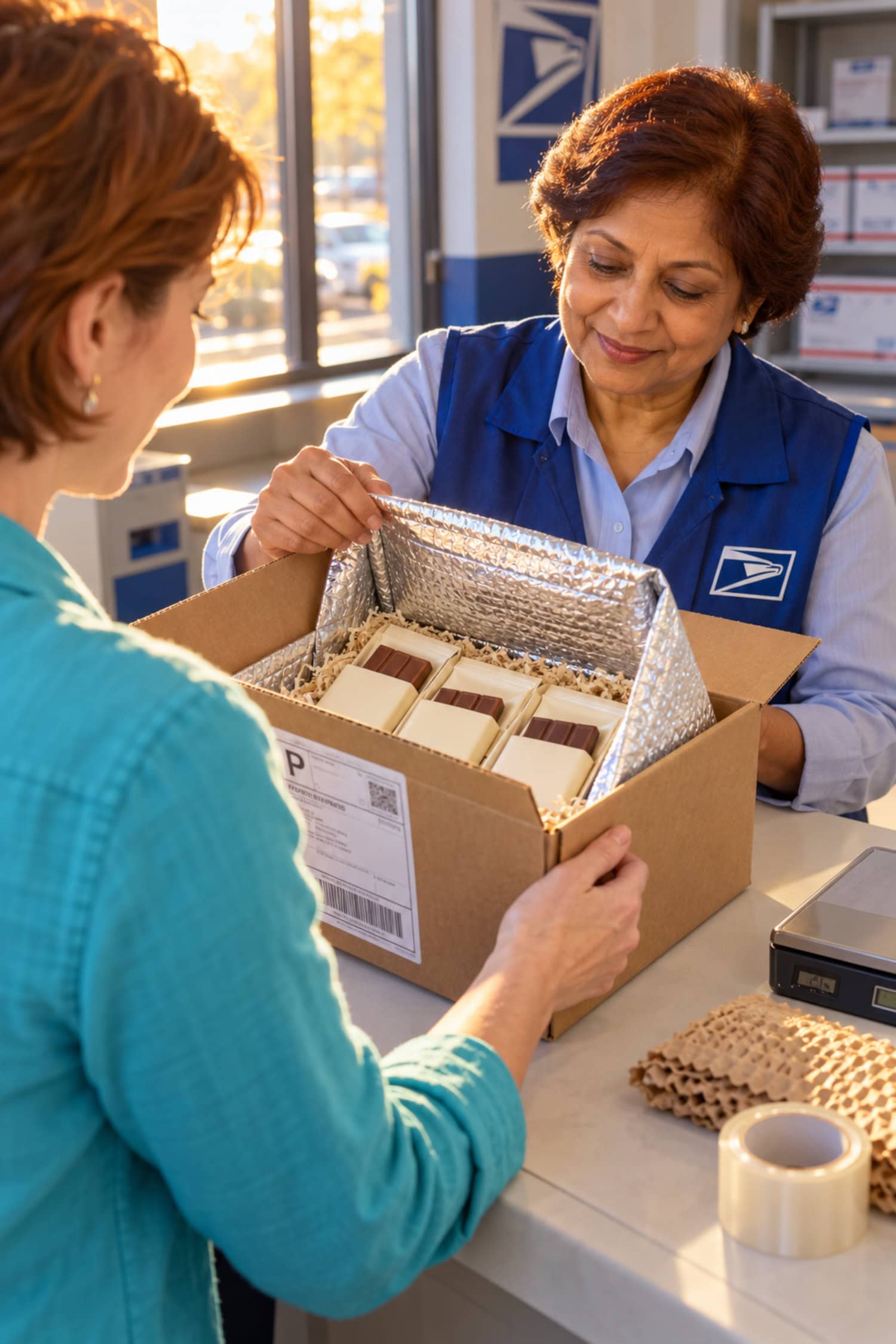
A specialist chocolate maker can sell an excellent product across a counter and still lose it in a warm delivery vehicle.
Add insulation and cold packs, and the customer’s delivered price increases.
Absorbing the shipping expense instead reduces what the business keeps. The packaging decision has become a pricing decision.
For a first local test, markets and pop-ups offer immediate feedback, though the stall fee, transport, setup time, and changing crowd all count.
The same product can sell out at one event and barely move at another with different shoppers. Busy markets do not necessarily suit premium candy.
Online selling extends reach but adds another set of tests.
Confirm that the production arrangement permits the intended shipping, that the product survives transit, and that packaging plus postage leaves enough money from each order.
A website cannot rescue melted candy.
Wholesale changes the buyer.
A gift shop or grocer cares about package presentation, consistent supply, storage space, resale price, and how long stock remains sellable.
Those requirements might call for different packaging and larger, more predictable batches than direct local sales.
A store lease should be assessed against realistic purchases, not pedestrian traffic alone.
A tourist street can produce plenty of browsing without enough transactions to support rent and payroll.
Watch the intended site’s shopper behavior and estimate the sales needed each open day before negotiating a location.
5. Candy business startup costs and break-even sales
A candy business budget must include the setup purchases, the cost of each item sold, and the bills that continue even when sales slow.
Opening a physical candy store can cost anywhere from roughly $15,000 to $300,000, a span so wide that it cannot serve as the budget for any one shop.
A home producer, a reseller, and a staffed retailer should build separate budgets from supplier quotes and their own selling plan.
Do not treat the lowest estimate as a promised price.
| Cost group | What to budget | What changes the amount |
|---|---|---|
| Initial setup | Permits, business setup, workspace, basic tools, display | Production model and location |
| Initial stock | Ingredients or wholesale candy, packaging, labels | Assortment, supplier minimums, batch size |
| Per-package costs | Ingredients, packaging, paid production time, sales fees | Recipe, package size, sales channel |
| Recurring fixed costs | Rent, kitchen access, insurance, utilities, software | Operating format and commitments |
| Fulfillment | Packing labor, insulation, shipping, replacement orders | Destination, product stability, weather |
| Cash reserve | Money for bills before the next profitable sale | Sales uncertainty and payment timing |
Calculate the money each package leaves after its own costs, called its contribution.
Then compare the contribution with the fixed bills that must be covered each month.
Contribution per pack = selling price – variable cost per pack.
Monthly operating result = packs sold x contribution per pack – monthly fixed costs.
Break-even packs = monthly fixed costs / contribution per pack, rounded up.
Here is one worked example using illustrative numbers, not industry benchmarks.
It represents direct local sales, with no shipping or wholesale discounts.
| Item | Illustrative amount |
|---|---|
| Selling price per pack | $8.00 |
| Ingredients per pack | $1.10 |
| Packaging and label per pack | $0.60 |
| Production labor per pack | $1.50 |
| Variable sales expenses per pack | $0.50 |
| Total variable cost per pack | $3.70 |
| Contribution per pack | $4.30 |
| Monthly fixed costs | $430.00 |
| Break-even volume | 100 packs |
| Operating result at 150 packs | $215.00 |
| Operating result at 75 packs | -$107.50 |
If planned monthly sales of 150 packs fall by half, the per-pack costs fall with sales, but the $430 fixed bill remains.
The example moves from a $215 operating surplus to a $107.50 operating loss.
A busy month can still lose money if the owner forgets labor or the costs of getting each order to the buyer.
This example pays for the stated production labor but excludes income tax, borrowing costs, and other expenses not listed.
Add them to a real budget. Additional owner compensation must also be funded.
Keep a cash reserve for slow weeks, rejected batches, replacement supplies, and customers who pay after delivery.
Borrowing adds another payment without improving per-package economics.
6. Candy business licenses and insurance
The approvals for selling candy in the United States depend on the product, production site, state and local rules, and intended sales channels.
Confirm these conditions with the relevant agencies before accepting an order, signing a lease, or arranging interstate shipments.
| Business activity | Requirement to investigate | Where to confirm |
|---|---|---|
| Making candy at home | Cottage food eligibility, product restrictions, labeling, sales limits, shipping permission, home occupation rules | State agriculture or health department and local zoning office |
| Using a commercial kitchen | Facility permission, health review, food safety training, inspections, fire and zoning rules | Local health, building, and fire authorities |
| Operating a food production facility | Possible FDA food facility registration, applicable exemptions, food safety rules, ingredient and allergen labeling | U.S. Food and Drug Administration and state food regulator |
| Running a storefront | Local business license, occupancy and zoning, food retail requirements, sales tax permit | City or county licensing office, health department, state revenue department |
| Buying stock for resale | Sales tax registration and possible resale certificate, product labeling and supplier documentation | State revenue department and relevant food regulator |
| Selling wholesale | Facility and distribution permissions, supplier documentation, applicable food handling and temperature controls | State food regulator and relevant federal agency |
| Employing staff | Payroll registrations, workplace safety rules, applicable food safety training and workers’ compensation | State labor agency, state insurance authority, relevant workplace safety regulator |
A product made in a household kitchen may fit a state’s cottage food system, but permission to sell at a local event does not establish permission to ship nationwide or supply stores.
The same recipe sold through a different channel can change the required facility and documentation.
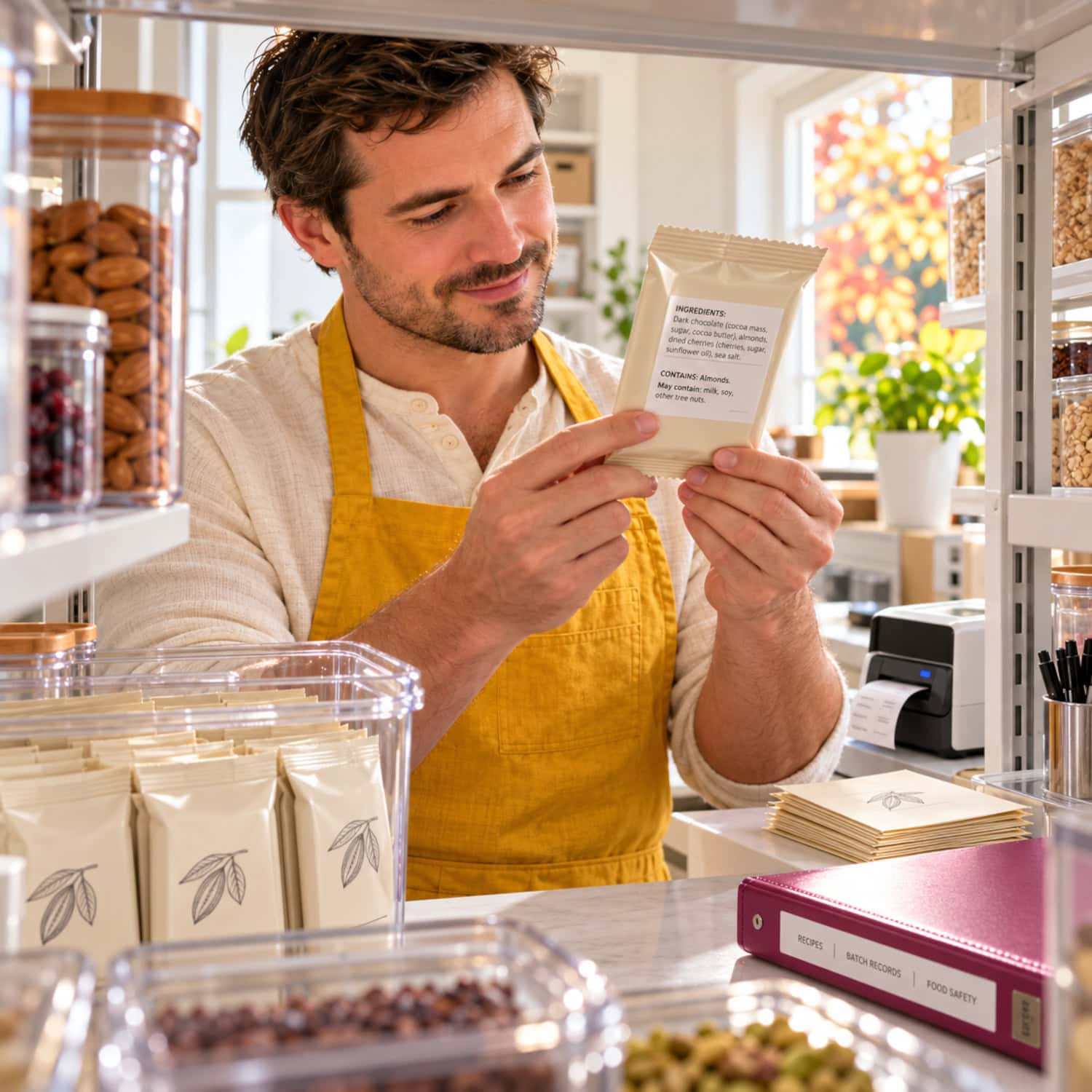
Check label requirements before ordering printed pouches.
Ingredient and allergen information, business identification, and other required statements depend on the applicable rules and product.
An attractive pouch becomes waste if it omits required information.
Register the business as required and consider whether a sole proprietorship, limited liability company (LLC), or another form suits the ownership and liability situation.
An LLC is a legal structure choice, not a substitute for food permissions or safe production.
Ask a qualified attorney or accountant about the structure and taxes for the actual operation.
Separate business finances, check tax obligations, and obtain an Employer Identification Number (EIN) when needed.
General liability and product liability coverage deserve attention because customers consume the goods.
Discuss coverage for spoilage, property, deliveries, and employees with an insurance professional rather than assuming an ordinary household policy covers commercial candy production.
A brand name registration and trademark protection are different questions.
Check potential conflicts before investing in branded packaging, and investigate trademark options with the relevant federal office if building a broader consumer brand.
7. Candy business contracts and commitments
Candy supply contracts, manufacturer agreements, market bookings, and retail leases can create obligations long before the corresponding goods have sold.
Read the cancellation terms and the consequences of unsold stock as carefully as the headline price.
For ingredient suppliers, document specifications, order minimums, lead times, substitution policies, damage claims, and who pays freight.
Bulk discounts lose value when ingredients remain unused.
A contract manufacturer needs agreed recipes or product specifications, quality standards, packaging responsibilities, ownership of any custom formulation, minimum orders, and a process for rejected production.
Ask how the parties handle a batch that looks right on production day but fails a stability requirement before its intended selling date.
Wholesale arrangements need a different negotiation.
Confirm order minimums, returns, shelf-life requirements, delivery responsibility, payment dates, and whether a distributor sits between producer and retailer.
If buyers pay later, ingredients and labor may need funding well before the sale proceeds arrive.
For a storefront, check the permitted use, required improvements, temperature control, repair duties, signage rules, rent increases, and exit provisions.
If a lease requires a legal entity name or proof of insurance, have those matters arranged before signing.
A market stall agreement also deserves a read: event cancellation and restrictions on food vendors affect whether attendance is financially sensible.
8. Candy-making equipment and suppliers
Buy candy equipment for a specific product, legal workspace, and realistic batch volume.
A machine that makes thousands of pieces efficiently offers little benefit when the business has confirmed orders for only a small fraction of its output.
The equipment list varies sharply. Hard candy production may call for accurate heating and shaping tools.
Chocolate calls for equipment and storage suited to its temperature sensitivity. Gummies require controlled formulation and molding.
Freeze-dried products introduce a specialized machine whose purchase price must be justified by expected sales.
An owner moving from handmade batches to a larger depositor may find that output rises while packing, labeling, and cleaning remain slow.
The slowest task limits actual capacity.
Use this pre-purchase inspection and supplier checklist:
- Identify the exact candies, batch sizes, and required production conditions.
- Confirm that the intended workspace can legally and practically accommodate the equipment.
- Compare total installed cost, including power needs, cleaning, maintenance, and replacement parts.
- Ask the supplier to demonstrate output using a product comparable to yours.
- Check how quickly operators can change flavors, clean contact surfaces, and restart production.
- For used equipment, inspect wear, service records, missing parts, and the availability of repairs.
- Request actual ingredient and packaging minimums, lead times, freight charges, and reorder conditions.
- Calculate whether labor saved and additional profitable sales justify the purchase.
For finished candy, compare landed cost: purchase price plus freight and other expenses needed to receive sellable stock.
Check whether the supplier can replenish the same items without forcing the store into slow-moving substitutes.
Avoid building the first assortment around a supplier’s biggest catalog.
A broad selection looks impressive on shelves, but cash trapped in slow sellers cannot pay for fast sellers that need replenishing.
9. Managing candy production and shelf life
For homemade candy, repeatable quality and a supportable shelf life determine how much can be produced in advance and which customers can be served.
A recipe that tastes right when packed may behave differently after storage or transportation.
Imagine sour hard candy that leaves the kitchen crisp. After time in a pouch, the pieces become sticky or chewy. It is a common failure.
Packaging, moisture exposure, formulation, and storage conditions all deserve investigation rather than a guessed longer date on the label.
Moisture doesn’t read the sell-by label.
Build a batch record containing the recipe version, ingredient lots, production date, yield, packaging used, and observed defects.
Log rejected batches separately. When a customer reports a problem, those records help identify which products and processes need attention.
Shelf-life decisions affect inventory. A product that must sell quickly does not suit long advance production runs.
The same limitation may rule out a retailer wanting months of shelf time or an online route with unpredictable transit conditions.
A different pouch might reduce moisture problems, but a packaging change requires product-specific evaluation rather than an assumption that protection has improved.
For products with uncertain safety or stability, use appropriate qualified testing and food safety expertise to establish storage and shelf-life conditions.
Other makers’ shelf-life claims cannot establish your product’s safety.
Scheduling matters as much as the recipe. Making large batches before a market locks time and ingredients into sales that have not occurred.
Small repeatable runs or legally permitted preorders reduce that exposure, though each order still needs realistic production and delivery time.
Track the full workflow from mixing to customer handoff. Setting, wrapping, labeling, customer communication, and transport all consume capacity.
A part-time candy business can become a full-time packing operation long before it supports a full-time income.
10. Choosing candy products and setting prices
A workable candy assortment balances buyer interest with batch efficiency, packaging needs, and the price each channel can support.
More flavors may attract attention while quietly multiplying ingredient purchases, changeovers, and leftover stock.
Suppose a maker accepts a wholesale request for many individually flavored confections.
Each flavor needs a separate production run, cleaning, packing, and tracking. A smaller selection could fill the order with fewer interruptions.
Experienced producers usually solve this by cutting the range, not by adding hours.
For each product, record the sellable yield from a batch and the full labor time, including preparation and cleanup.
Use the same package-size basis when comparing flavors.
Very small batches waste labor: setup and cleanup take nearly as long as for a full batch, even when the ingredients are cheap.
Pricing starts with the direct-sale economics developed in Section 5, then changes for each channel.
Do not confuse markup, the amount added to cost, with gross margin, the share of selling price left after product costs.
A percentage markup and the same percentage margin produce different prices.
Wholesale needs its own calculation. In the illustrative $8 direct-sale example, imagine a retailer offers $5 per pack.
With the original $3.70 variable cost, just $1.30 remains before any extra wholesale delivery, handling, or account costs.
The retailer’s need for resale margin can make a successful direct-sale product unattractive at wholesale prices.
If a channel needs a lower price, simplify production, change the package, or decline it.
Raising the final shelf price is not automatically feasible because the customer still decides whether the candy is worth buying.
Keep sizes, formulas, and prices consistent across orders.
A shop asking for another case expects the same product it bought last time, not a newly improvised version.
11. Fixing candy products that stop selling
Weak candy sales need a diagnosis before they trigger a discount or a larger marketing effort.
Separate problems with the product, the customer, the selling location, and the amount of money each transaction leaves.
If shoppers try samples but rarely buy, examine the displayed price, package size, and reason to purchase.
If one market sells well and another stalls, inspect customer fit and event costs before changing the recipe.
If online orders arrive damaged, review transit tests and packing costs rather than spending more to attract customers to the same experience.
| Signal | Likely question | Practical response |
|---|---|---|
| Praise but few purchases | Is the offer worth the asking price to these buyers? | Test a clearer product or package offer |
| Sales but little cash left | Are labor and selling fees included? | Recalculate each package and channel |
| Excess unsold stock | Are batches too large or flavors too numerous? | Reduce the range or production volume |
| Sticky, melted, or damaged goods | Do storage and packaging suit the product? | Stop the affected sale and investigate quality |
| A storefront stays slow | Can achievable traffic cover fixed bills? | Review the lease, inventory, and exit options |
Set a review date and a financial limit for each test so that a bad month does not turn into an open-ended commitment.
A slow but profitable flavor may stay. A consistently unprofitable one needs correction.
12. Growing candy production and wholesale
Candy business expansion works when repeat orders can be fulfilled consistently at a price that covers larger batches, more equipment, and the additional costs of distribution.
Growing sales without measuring those changes can increase workload faster than income.
Before outsourcing, determine whether the manufacturer can reproduce the product and meet its storage and packaging needs.
Ask for its minimum order quantity (MOQ), meaning the smallest run it will accept.
Then calculate the cash locked into that run. Set production control and rejection procedures in the agreement.
Wholesale adds retailer margins and sometimes distributor margins.
A business priced solely for direct sales can discover too late that the chain leaves too little for the maker.
Establish separate direct, wholesale, and distributor-assisted price scenarios before accepting a big account.
Buyers may also demand dependable replenishment and a longer proven shelf life.
That changes production scheduling and the amount of finished stock the business needs to hold.
It can also increase waste if expected orders do not arrive.
Consider a producer who can make a larger candy batch in one day but still needs several days to wrap and label the pieces.
Another cooker will not clear that bottleneck.
Examine labor, packaging speed, defect rate, and the portion of installed capacity actually used before adding machinery.
Growth does not always mean more volume: dropping slow flavors or adding one more profitable local outlet can raise income without new machinery.
13. Buying an existing candy store
An existing candy shop offers a lease, fixtures, stock, and some sales history, but the buyer takes over the problems behind those assets as well.
Verify the earnings and operating burden before assigning value to an attractive storefront.
Imagine a colorful shop on a busy visitor street.
The displays are full, but weekday sales cannot cover an employee, so the owner works every shift. A storefront gives unsold candy an address.
Use a numbered acquisition review:
- Request sales records, tax filings, expense details, and inventory reports for a meaningful operating period.
- Reconcile recorded sales with payment settlements and business bank deposits.
- Identify how much unpaid owner labor is needed to keep the doors open.
- Separate sellable stock from candy near the end of its usable life.
- Review supplier prices, recurring purchase minimums, and ownership of any proprietary products.
- Read the lease, transfer conditions, rent changes, and obligations for repairs or improvements.
- Confirm what permits, insurance arrangements, equipment, websites, and accounts actually transfer.
- Recalculate the business after paying for labor and replacing worn equipment.
Do not value undocumented sales projections as income.
Franchise or turnkey candy-store packages also need an independent look at their contracts, investment requirements, and the actual support provided.
14. Candy business traps and unrealistic offers
The most expensive candy startup errors come from applying one model’s assumptions to another or confusing product excitement with a durable sales operation.
Treat simple income claims and ready-made packages as claims to examine, rather than instructions to follow.
| Myth | What actually happens |
|---|---|
| A good homemade recipe will sell itself | Customers still choose among price, convenience, packaging, and other treats |
| A cheaper pouch always improves profit | Poor protection can shorten sellable life and increase damaged stock |
| Selling online removes location limits | Shipping rules, climate, delivery expense, and damage still shape the market |
| Wholesale means easy volume | Buyers expect lower purchase prices, stable supply, and usable shelf life |
| A popular flavor deserves its own equipment | Purchase payback depends on profitable sales and time saved |
| A busy candy store must be profitable | Rent, payroll, spoilage, and conversion determine its result |
Be wary of machinery offers that showcase maximum output without cleaning time or order volume.
Examine suppliers who quote a low per-unit price but require more stock than the business can sell.
For turnkey packages, verify earnings from records.
An especially appealing mistake is to create a flavor for every preference before knowing which few people reorder.
Variety costs money twice: first in purchasing ingredients and packaging, then in time lost changing and cleaning production setups.
15. A practical candy business launch plan
A small candy business launch should move from a permitted sales test to reliable fulfillment, with contracts and purchases added only when needed.
The aim of the first operating period is to establish what customers buy, what each sale costs, and whether the product survives the journey.
Before spending heavily
- Choose making, reselling, or contract manufacturing and write down the intended customer.
- Select a short product range and identify the legal production and selling route.
- Obtain ingredient, stock, packaging, and basic equipment quotes.
- Build a per-package cost sheet and estimate monthly fixed bills.
- Design a small paid-order test that complies with applicable requirements.
Before signing contracts
- Establish the required business registration and investigate suitable insurance.
- Confirm food production, labeling, sales tax, and channel requirements with the proper agencies.
- Compare suppliers or manufacturers using total delivered costs and purchase minimums.
- Review lease, event, wholesale, or manufacturing terms, including cancellation and unsold stock.
Before the first sale
- Establish a repeatable recipe or an approved finished-goods supply process.
- Check packaging, handling, and shelf-life suitability for the chosen product and channel.
- Prepare accurate labels, package prices, payment methods, and order records.
- Practice the entire workflow from order to handoff, including customer problems and refunds.
During the first 30 to 90 days
- Log sales, returns, leftover stock, labor time, and customer reorders by product.
- Recalculate contribution when ingredient prices, packaging, or selling fees change.
- Remove products or channels that consume effort without leaving enough money.
- Consider larger batches or longer commitments only after the existing operation is dependable.
A useful launch result may be a handful of products with repeat buyers and clear costs. Use early records to guide later decisions.
Frequently asked questions
Can I start a candy business from home?
Yes, if your specific products and sales method qualify under applicable home-food and local rules.
Verify production, labeling, and delivery permissions as described in Section 6.
How much does it cost to start a candy business?
It depends on the model: a physical candy store can cost roughly $15,000 to $300,000, while a home pilot needs far less.
Build a quote-based budget for your format using Section 5.
Do I need an LLC to sell candy?
No, an LLC is not automatically required simply because the product is candy.
Choose a legal form based on the actual business and local rules in Section 6.
Is a candy business profitable?
It can be when paid sales leave enough after product costs to cover fixed expenses and the owner’s compensation.
Work through the example and lower-sales test in Section 5.
Can I sell homemade candy online?
Yes, where the particular production arrangement and shipping destination permit it.
Check those permissions and the delivered product cost in Sections 4 and 6.
What candy should a beginner sell first?
A small selection of products that can be made or sourced consistently and sold at a workable price.
Test buyers and manage variety using Sections 3 and 10.
Do I need to offer free samples?
No, free samples are optional and cannot replace recorded purchases at the intended selling price.
The paid-demand procedure in Section 3 remains the useful test.
Can I take preorders for homemade candy?
It depends on local food sales permissions and the promised delivery arrangement.
Use the production scheduling principles in Section 9 only after checking the rules in Section 6.
Conclusion
Start with repeat paid demand and workable package economics before committing to major candy equipment, a storefront, or wholesale inventory.
That order keeps expensive decisions tied to actual customers.
1. Confirm the legal route: Verify the product, kitchen, label, and sales channel before taking payment.
2. Price the complete sale: Include labor, packaging, selling expenses, and bills that arrive even when no candy sells.
3. Expand only what works: Increase production after quality, repeat orders, and the money left per sale are dependable.
Further reading
- U.S. Food and Drug Administration: Check whether a candy production facility must register with the FDA and what ingredient and allergen labels must show.
- Internal Revenue Service: Get the Employer Identification Number a candy business uses for payroll and business tax filings.
- Candy business beginner discussion: Read founders’ questions about where to start and how to assess demand.
- Candy shelf-life discussion: Explore practical concerns about making confections suitable for bulk orders.