To start a cookie business, choose a manageable product line and customer base, check where you are allowed to bake and sell, test whether buyers will pay your proposed prices, and calculate the cost of each order.
Set up required registrations, food-safety measures, and labeling before accepting sales. Then establish payment, pickup, and production rules. Legal permission and paying customers come before a bigger baking setup.
An eligible home kitchen avoids commercial kitchen rent; shared kitchens, markets, and shipping change costs and compliance.
The daily work includes baking consistent batches, packaging fresh cookies, handling inquiries, and turning down orders that underpay labor.
Last fact-checked: October 8, 2026
This guide is for first-time cookie sellers in the United States, especially home bakers considering local preorders, farmers markets, custom decorated cookies, or limited wholesale sales. It covers launch decisions, daily work, and responsible expansion without assuming a storefront or a national startup-cost benchmark.
1. How a cookie business works and the launch sequence
A cookie business sells a repeatable baked product at a price covering ingredients, labor, packaging, selling expenses, and overhead, because even a full order book loses money when orders underpay the work required.
| Stage | Decision | Move forward when |
|---|---|---|
| Offer and audience, Sections 2 to 4 | Choose cookies, buyers, and a permitted sales route | You can describe the offer, likely customer, and how an order will reach them |
| Financial test, Section 5 | Establish startup spending and earnings per order | The projected price pays for labor and the business can withstand slower sales |
| Business setup, Section 6 | Check kitchen, product, registration, tax, and insurance requirements | You know which approvals apply and have a lawful path to sales |
| Agreements and tools, Sections 7 to 8 | Set terms, select equipment, and test packaging | Order rules are clear and equipment produces consistent batches |
| Daily work and pricing, Sections 9 to 10 | Establish production, payments, and a sellable menu | Orders can be made, packed, and handed over as promised |
| Repair or expand, Sections 11 to 12 | Respond to weak products or capacity pressure | Additional work increases realistic earnings rather than only volume |
| Alternative entry paths, Sections 13 to 14 | Evaluate an existing business or a packaged startup offer | Records and obligations withstand scrutiny |
| Opening, Section 15 | Complete the launch checks and review early sales | Sales are lawful, paid, documented, and operationally manageable |
A seller might spend Saturday decorating a custom dozen and charge only for flour, icing, and the box. The missing item is the seller’s Saturday.
2. Choose a cookie business format that fits your capacity
A baker with one free Saturday might handle a small preorder batch yet struggle with a full market stall, since home preorders, decorated work, wholesale, and storefronts demand different time and capital commitments.
Choose one format.
| Format | Starting cost exposure | Best for | Main constraint |
|---|---|---|---|
| Home-kitchen preorders | Lower fixed costs if existing equipment and local law allow | Bakers wanting predictable batch quantities | Kitchen eligibility, pickup, and restricted sales channels |
| Custom decorated orders | Tools, packaging, and substantial design labor | Bakers skilled at personalized gifts and events | Quotes, deadlines, and labor per cookie |
| Farmers markets and pop-ups | Booth charges, display supplies, and unsold stock | Sellers with access to local foot traffic | Uncertain turnout and inventory losses |
| Shared commercial kitchen | Kitchen rent, travel, and scheduled production time | Bakers whose home kitchen is unsuitable or too small | Rent and limited access hours |
| Wholesale to cafes or shops | Repeatable larger batches and delivery | Sellers with steady production and business buyers | Lower selling price per unit and concentrated accounts |
| Cookie storefront | Premises, fit-out, staffing, and more fixed bills | Operators with established demand and funding | Sales must cover substantial ongoing expenses |
Start with direct local sales from an eligible home or shared kitchen; consider shipping and wholesale later.
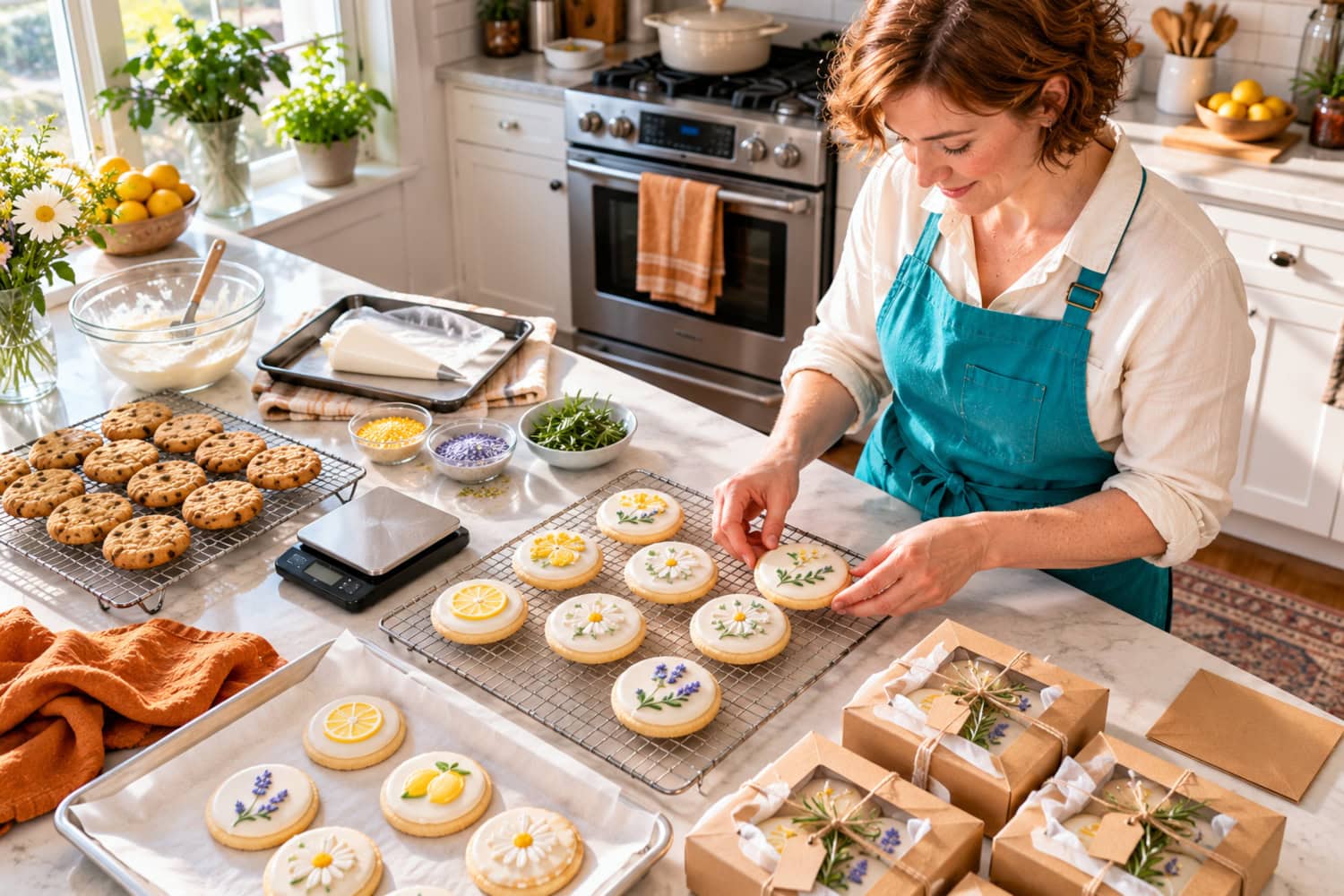
Decorated sugar cookies demand more design, icing, and individual packaging time than plain drop cookies.
Compare earnings per hour, not just price per piece.
Products needing careful temperature control restrict the kitchen and transport options.
A design that survives pickup can break in a parcel; assess this before offering shipping.
3. Find customers who will pay for the cookies
A cookie photo gets praise but a priced order form stays empty, which is why the seller needs a specific buyer, buying occasion, acceptable price, and practical purchase method before planning large batches.
A lawful path to sales and real paid demand should determine whether a baker needs greater capacity.
Before authorization, the baker can research comparable products, speak with prospective buyers, and test recipes without selling.
Once approvals are in place, a limited paid preorder tests demand at an advertised price.
Party-favor buyers and offices ordering gifts bring different deadlines; choose the offer for the buyer.
Check demand without confusing attention with sales
- Identify one buyer group and one occasion your cookies suit.
- Compare nearby alternatives on cookie size, presentation, ingredients, and visible selling price.
- Ask prospective customers what quantity and pickup arrangement they would actually use.
- Test consistent batches for taste and appearance, and record improvements without promising products you cannot repeat.
- After legal clearance, offer a limited paid preorder at an advertised price and cutoff date.
- Record inquiries, completed payments, repeat orders, and refusals at the stated price.
A baker gets social media likes but no orders when the purchase link appears, while a quieter seller attracts returning weekend customers.
Judge channels by completed, worthwhile sales.
Repeated rejection at a viable price points to the offer or audience rather than production speed.
4. Pick a sales channel and control unsold stock
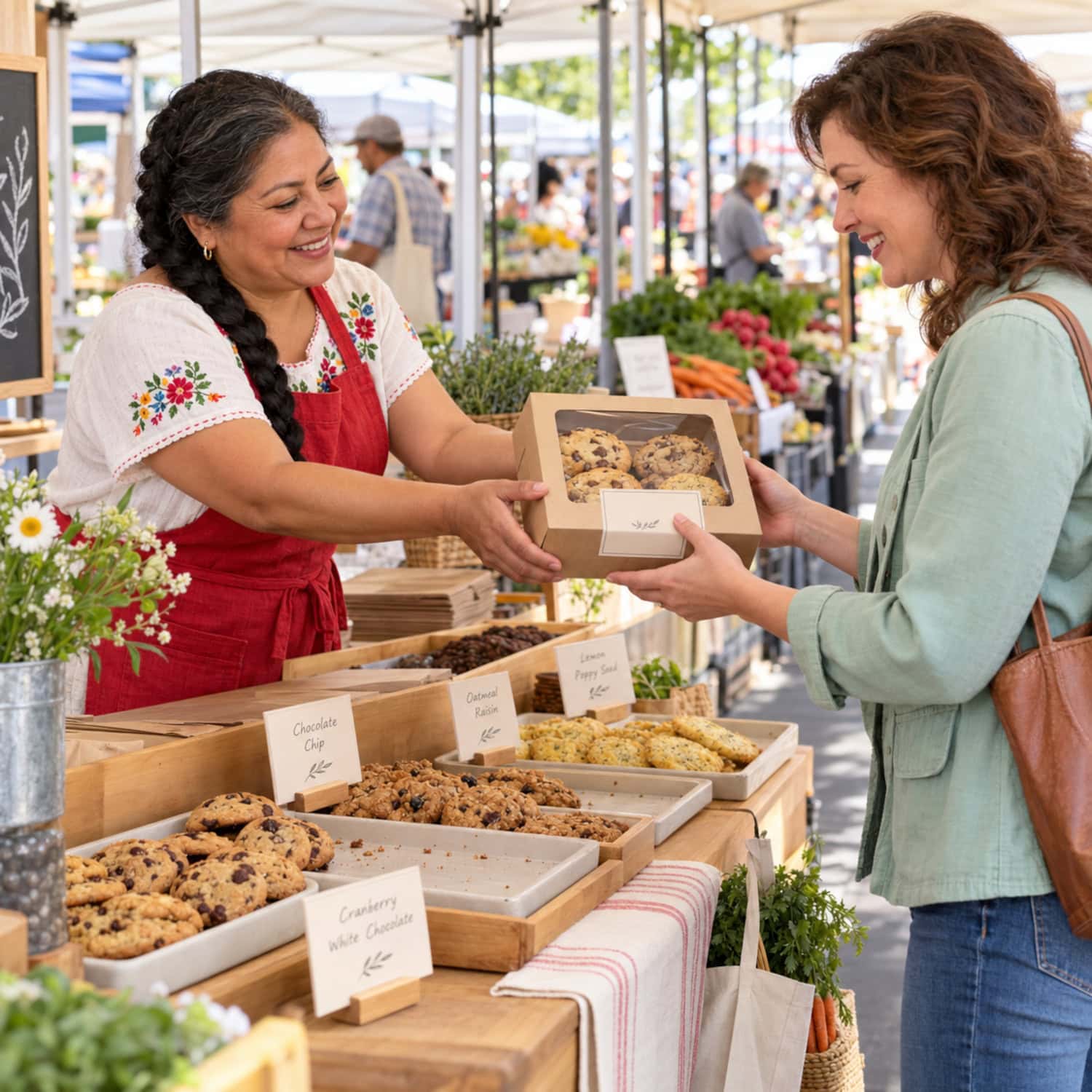
A cookie baker finishes a market with unsold trays despite a busy week in the kitchen, while preorders offer more predictable quantities but less exposure to new buyers.
Both channels need lawful arrangements and their own profitability checks.
| Channel | Why sellers use it | What to measure | Main risk |
|---|---|---|---|
| Scheduled preorders | Bake mainly against committed demand | Paid orders and fulfilled pickup slots | Missed payments and last-minute changes |
| Farmers markets | Meet customers face to face | Revenue after booth, travel, labor, and leftovers | Uncertain turnout |
| Instagram or Facebook inquiries | Display work and start conversations | Inquiries that become paid orders | Attention without conversion |
| Website or online ordering page | Show products and collect orders | Completed checkouts and repeat customers | Setup effort with little buying traffic |
| Local delivery | Serve buyers who cannot collect | Profit after mileage, packing, and travel time | Small orders becoming expensive trips |
| Shipping | Reach customers outside pickup range | Net earnings after postage, breakage, and replacements | Freshness loss and channel restrictions |
Rain can turn pre-baked market stock into leftovers.
Keep initial quantities conservative, record sales by flavor, and track later paid orders from market contacts separately.
Home pickup has another hidden cost: sharing an address and allowing customers into personal time.
Use a pickup arrangement that is both lawful and comfortable for the household, with a defined handoff window rather than indefinite availability.
5. Work out startup costs and earnings per order
A baker who counts only flour and sugar may discover that commercial kitchen rent exceeds expected profit, especially when moving from an eligible home kitchen to rented space.
Budget for the actual setup, not a national average.
| Cost category | Upfront questions | Ongoing costs to track |
|---|---|---|
| Kitchen and approvals | Is the present kitchen eligible, or is rental required? | Rent, inspection-related work, utilities |
| Baking equipment | Can existing oven, mixer, pans, and scale meet the planned volume? | Repairs and replacement |
| Ingredients | How much stock is needed for the first confirmed batches? | Recipe ingredients and spoilage |
| Packaging and labels | What keeps the product safe, fresh, and properly described? | Boxes, bags, inserts, and labels |
| Selling and payment | Is there a booth, website, or payment setup cost? | Transaction charges, stall fees, delivery |
| Business protection and administration | Which registrations, training, or coverage are necessary? | Insurance, accounting, and renewals |
| Cash reserve | How much can be kept aside without borrowing? | Slow weeks, refunds, and rejected batches |
Calculate what each paid order leaves after its own costs.
Hands-on baking, decorating, packing, and customer work count even when the owner takes no wages.
Monthly operating result = orders sold x (price per order – ingredients – packaging – transaction costs – valued owner labor) – monthly fixed costs.
These illustrative numbers, not market benchmarks, represent a local preorder business selling one dozen per order with valued owner labor.
| Illustrative item | Amount per dozen order |
|---|---|
| Selling price | $30.00 |
| Ingredients | $5.50 |
| Packaging | $2.50 |
| Payment and other order-specific fees | $1.50 |
| Owner labor, 45 minutes at $18 per hour | $13.50 |
| Food-cost percentage, ingredients divided by price | 18.3% |
| Labor-cost percentage, valued labor divided by price | 45.0% |
| Prime cost, ingredients plus valued labor | $19.00 (63.3% of price) |
| Money left for fixed costs and additional earnings | $7.00 |
Suppose fixed monthly bills total an illustrative $140.
At 40 dozen orders, the business has $280 left from orders and $140 after fixed bills, before taxes and unexpected losses.
The example counts $540 of owner labor as a variable cost; prime cost excludes packaging and fees.
Stress test: If sales fall by half, to 20 dozen orders, the money left from orders drops to $140, while fixed bills remain $140.
There is then nothing left beyond the valued labor, before taxes or losses.
A rented kitchen or underpriced custom work would change the outcome sharply.
Market, shipping, and wholesale calculations must count unsold event cookies as costs, not sales.
Reserve cash for bills and failed batches; financed equipment adds fixed payments.
6. Register the business and check food rules
A cookie seller can have finished recipes but no legal place to bake them, because cottage food rules vary by jurisdiction and restrict kitchens, products, labels, and sales channels.
Verify eligibility before accepting orders.
A household pet or kitchen condition might rule out home production. Commercial rent then changes the required selling price.
Ask your state agriculture or health department about the proposed activity before committing.
| Requirement | What it means for a cookie business | Where to check |
|---|---|---|
| Cottage food eligibility | Whether a home kitchen, specific cookie products, and sales methods are permitted | State agriculture or health department |
| Food establishment permit and plan review | Whether a commercial kitchen or shop needs approval before operating | Local health department |
| Food safety training or certification | Whether the owner or food handlers need approved training | State or local health department |
| Food labels and allergens | Which ingredients, allergen statements, business details, and other disclosures the package must carry | State food regulator and Food and Drug Administration (FDA) |
| Federal food facility registration | Whether the proposed commercial food-production facility falls under FDA registration requirements or an exemption | FDA and the relevant state regulator |
| Business registration and tax identification | Which ownership structure, trade-name filing, tax records, or employer identification number apply | State business agency and Internal Revenue Service (IRS) |
| Sales tax registration and resale paperwork | Whether retail cookie sales or wholesale purchasing require permits or certificates | State revenue department |
| Zoning, home occupation, and local business permits | Whether the property and proposed customer traffic or pickup activities are allowed | Local zoning and licensing offices |
| Fire and premises safety | Whether a commercial shop or production facility needs inspection or approval | Local fire and building departments |
| Insurance | Which general or product liability coverage is appropriate, including requirements from kitchen owners or markets | Licensed insurance agent and contract counterparties |
You do not automatically need a limited liability company (LLC) to sell cookies.
It is one potential ownership structure, not permission to ignore food rules or a shield against every claim.
Compare a sole proprietorship with an LLC in terms of filings, separate finances, liability concerns, and ongoing obligations before choosing.
Separate records make business earnings easier to distinguish from household spending.
Check with the IRS about the need for an employer identification number (EIN) and review payroll duties before hiring.
Before leasing a shop, check health plan review, zoning, and fire approval. Mobile selling may require a commissary.
A co-packer, a business that produces cookies for another brand, raises additional facility and labeling questions.
7. Put customer and supplier terms in writing
A custom-cookie customer requests four themes within a budget for plain cookies, so the baker needs written agreement on price, designs, deadline, payment, and handoff before buying ingredients.
If the budget cannot pay for those designs, offer simpler decoration or decline the order.
Agree on these customer terms:
- Order scope: quantities, designs, and ingredient or allergen disclosures.
- Fulfillment: pickup arrangements and deadline.
- Payment: deposit and final payment deadline.
- Changes: artwork approval cutoff, revisions, and cancellations.
Questions for a kitchen owner, market organizer, or supplier
- Which activities and products are permitted at this kitchen or selling site?
- What equipment, storage, cleaning access, and production hours are included?
- Which insurance and certificates must the cookie seller provide?
- What fees apply if an event is canceled or scheduled hours change?
- Who is responsible for damaged goods, equipment problems, or failed delivery?
- When are invoices due, and can prices or minimum quantities change?
A shared kitchen agreement that allows two hours of oven access but no cooling or packing space is a poor fit for iced cookies needing additional handling.
Check the entire workflow, not only whether the oven is available.
Custom samples take decorating time, so their price and any deposit belong in the quote before baking begins.
8. Choose equipment and test packaging before buying more
Cookie business equipment should fit the tested recipe and permitted kitchen, because buying for imagined future volume ties up money before actual orders justify greater capacity.
The core tools are an oven, mixer, and food scale. Pans, racks, storage, and packaging complete the setup; decorators need icing and shaping tools.
Improve dough consistency by standardizing recipes, batch sizes, oven loading, and cooling before increasing mixer capacity.
Equipment and packaging inspection checklist
- Confirm that existing tools are permitted in the proposed kitchen and meet the expected production schedule.
- Test whether batches fit the oven and cooling space without changing bake quality.
- Measure portions consistently with a scale and record actual yield.
- Check that racks, trays, and containers allow safe handling and organized storage.
- For decorated cookies, make the same designs twice and time the decorating work.
- Pack representative cookies, then inspect their appearance and texture at the expected pickup or delivery time.
- Test boxes and bags for crushing, movement, seal quality, and labeling space.
- If shipping is legally permitted, test transit durability and calculate actual packed weight before offering a price.
- Price any missing equipment, maintenance, or replacement supplies against confirmed orders rather than hoped-for sales.
A cookie may leave the oven soft, look beautiful in its gift bag, then become unpleasantly hard before delivery.
Attractive packaging does not establish shelf life.
Run a real-time storage test using the actual recipe and package, and do not make unsupported freshness promises.
Fragile icing needs protective materials, increasing package size and postage.
Pricing shipping by cookie weight alone leaves protective material costs unpaid.
9. Run production and payments on a schedule
An invoice remains unpaid as the scheduled bake day approaches, even though the baker has kitchen hours reserved, packaging to prepare, and a handoff date to meet.
Track payment, production, and pickup in one calendar so unpaid work does not displace paid orders.
Set an order cutoff and payment policy, schedule compatible batches, and log yield, labor, and failures in an order sheet.
A late payment leaves the production slot unconfirmed, so the stated policy should protect ingredients and decorating time already committed to paid orders.
Use a handoff checklist before releasing the cookies:
- Match the quantity to the paid order.
- Inspect the cookies and packaging condition.
- Confirm that required labels accompany the correct products.
- Verify the customer and agreed pickup details.
Retain ingredient and batch records to investigate problems.
Cross-town delivery takes time. Group pickups or price the trip.
10. Keep the menu small and price special work separately
A first cookie menu works best when the baker can reproduce its texture and appearance, explain the price clearly, and prepare orders without wasting ingredients across too many flavors.
Add new cookies when demand and kitchen capacity justify them.
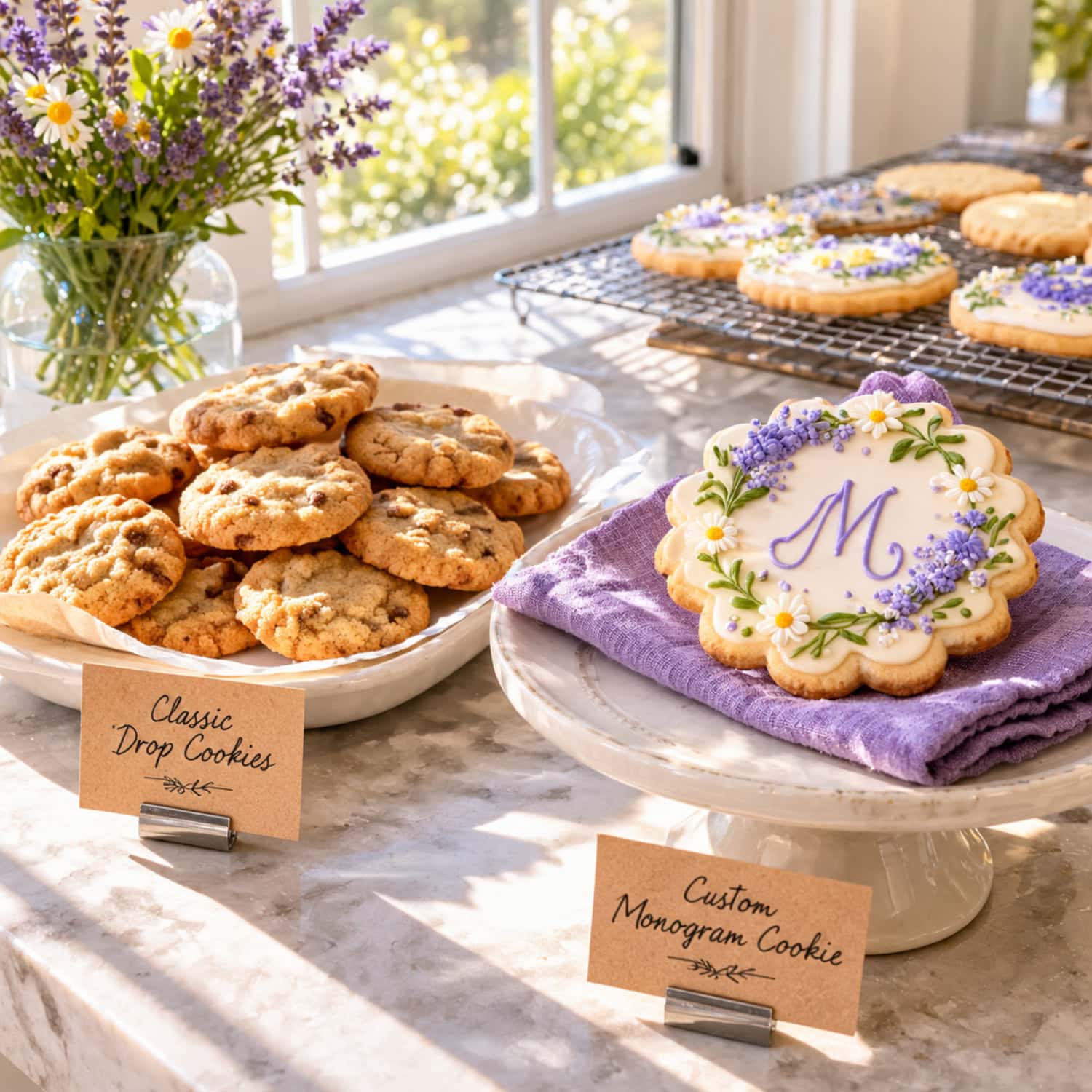
Choose a small core selection and separate standard items from personalized designs.
A decorated cookie with multiple icing colors, tiny lettering, and a special shape must be quoted against its actual work, not against the size of a plain cookie.
| Pricing decision | Plain or standard cookies | Custom decorated cookies |
|---|---|---|
| Main cost driver | Batch yield, ingredients, and packing time | Design time, icing detail, and individual handling |
| Useful selling unit | Cookie, box, or dozen | Minimum quantity and quoted design group |
| Customer expects | Clear displayed price and consistent product | Agreed artwork, deadlines, and presentation |
| Frequent pricing mistake | Ignoring batch labor and fees | Discounting larger orders although detail work remains |
Discount only when a larger order saves enough labor or selling expense.
Mixing one larger dough batch may save setup time, but outlining and filling 48 intricate cookies still requires hands-on work on each piece.
Costs set the price floor; buyer expectations, presentation, flavor, and size shape the achievable price.
Avoid hiding prices at markets.
Clear product descriptions and an uncomplicated way to pay reduce uncertainty for buyers who are already comparing stalls.
Review recipe ingredients and allergens whenever flavors change.
11. Know when to change or discontinue an offer
Three unsold boxes return from a cookie market while another product earns too little for its decorating hours, so the seller must review quality, customer demand, and earnings separately.
Do not discount every product. Weak purchases may reflect value or presentation; low earnings despite orders point toward labor and fees.
Retest packaging when breakage or staleness causes refunds.
A box of unsold market cookies cannot be counted as future profit simply because it has not been thrown away.
Once its sellable life ends, the loss belongs to the event that produced it.
Track those losses by market date and flavor before increasing or reducing the next batch.
12. Expand only when additional volume improves earnings
As orders grow, oven space, decorating hours, calendar slots, or storage can become constraints that must be addressed without sacrificing earnings to new equipment, kitchen rent, labor, or delivery.
A home seller moving from manageable batches to thousands of cookies each month can reach the limit of solo production time.
Possible responses include a shorter menu, production blocks, equipment upgrades, hired help, or a commercial kitchen.
Each solves a different constraint and carries a different bill.
Wholesale looks attractive because the orders are larger and repeated.
A cafe buying regularly expects predictable delivery and may negotiate a lower unit price than direct customers.
Losing a large account leaves the baker with bigger kitchen bills unless other sales replace it.
Price the extra production hours and calculate what additional orders cover new bills. A larger oven will not shorten hand decoration.
A storefront requires an especially different calculation. Rent, staff, site approvals, and display losses become obligations even on a quiet weekday.
Full-time income should be judged by net earnings and hours worked, not by whether baking feels busy.
13. Check an existing cookie business before buying it
A cookie business for sale shows a full order calendar but no record of the owner’s hours, making it difficult to judge whether those sales paid for the work.
Verify what transfers before buying recipes, equipment, or customer relationships. Followers are not orders.
Customers who chose the seller for personal decorating skills might not return after a sale.
Buyer due-diligence checklist
- Review recorded sales by product and channel, separating completed orders from inquiries.
- Compare sales records with bank deposits, payment processor reports, refunds, and tax records.
- Identify ingredient, packaging, rent, selling, delivery, and labor costs needed to produce those sales.
- Ask how many hours the existing owner spends baking, decorating, selling, and coordinating pickups.
- Verify ownership and condition of ovens, mixers, stock, customer records, and other included assets.
- Determine whether the kitchen, lease, permits, registrations, market spaces, and wholesale agreements can transfer to a new owner.
- Check how much revenue depends on a few repeat customers or the seller’s personal reputation.
- Confirm any outstanding deposits, prepaid orders, supplier bills, and obligations to customers.
- Recalculate likely earnings if you must pay for kitchen access or labor the seller supplied personally.
Well-photographed work hides evening hours spent on icing; count them before deciding what the business is worth.
14. Avoid packaged promises and common startup traps
Cookie startup packages, ready-made storefront plans, equipment bundles, and easy-order promises must be judged by what they actually supply, because no template guarantees a legal kitchen, paying customers, or profitable production.
| Common claim or assumption | What actually matters |
|---|---|
| If people praise my cookies, sales will follow | Test paid orders at a visible price after legal clearance |
| Every home baker can sell under cottage food rules | Kitchen, recipe, label, and channel eligibility must be checked locally |
| A website will bring buyers once it is published | Track how visitors find the offer and whether they complete purchases |
| More flavors attract more customers | Extra ingredients and preparation can increase waste and mistakes |
| Large custom orders deserve automatic discounts | Detailed decoration often takes nearly the same time per piece |
| Cheap shipping will increase profit | Postage, protective materials, damage, and replacements must all be priced |
| More revenue will replace my salary | Compare earnings after costs with the hours and added commitments required |
Ask how many weekly orders a forecast requires and how many the kitchen can actually produce.
Compare the promised sales with documented capacity and recurring expenses.
15. Open with a controlled first batch of sales
A first cookie preorder sells out, but every customer requests a different pickup time, forcing the baker to test order policies and scheduling alongside demand and price.
Keep quantities small and standardize fulfillment; too many designs and pickup arrangements can turn early interest into missed deadlines.
Before spending heavily
- Choose the buyer, core cookie selection, and likely sales channel.
- Check preliminary kitchen and product eligibility with the appropriate regulator.
- Repeat recipes, time the work, and calculate expected cost per order.
- Research competing offerings and test demand without making unauthorized sales.
- Prepare a startup budget and a slower-sales scenario.
Before signing agreements or accepting orders
- Complete applicable business registration, kitchen approval, training, tax, labeling, and insurance steps.
- Agree on kitchen access, supplier terms, market participation, or other arrangements in writing.
- Test equipment capacity, ingredient storage, packaging, freshness, and any proposed delivery process.
- Publish prices, payment deadlines, ordering cutoff, cancellation terms, and pickup details.
At launch and over the first 30 to 90 days
- Offer a limited menu and a capped quantity through one clearly chosen channel.
- Confirm payment and record the required delivery date for every order.
- Check each packed batch against the promised quantity, condition, and label.
- Record actual orders, failed inquiries, labor hours, fees, leftovers, and refunds.
- Review which products and channels produce worthwhile repeat sales before adding capacity.
A sellout at an inadequate price can teach the wrong lesson. Judge success by repeatable, adequately paid orders.
FAQ
Can I start a cookie business from home?
Yes, if your kitchen, cookie products, and sales methods qualify under the rules where you operate. See Section 6.
Do I need an LLC to sell homemade cookies?
No, an LLC is not a universal requirement for selling cookies, though business registration and food rules may still apply. See Section 6.
How much does starting a cookie business cost?
It depends on kitchen eligibility, equipment, product type, and sales channel; no single startup figure fits every seller. See Section 5.
How much should I charge per dozen cookies?
$30 per dozen is the illustrative selling price in Section 5, leaving $7 after ingredients, packaging, fees, and valued owner labor, before fixed costs.
Actual prices depend on design work and demand. See Sections 5 and 10.
Is selling cookies at farmers markets profitable?
It depends on paid sales after stall charges, travel, labor, and unsold products. See Section 4.
Can I ship cookies to customers in other states?
It depends on the rules for the product and operating setup, plus whether freshness and shipping costs are workable. See Sections 4, 6, and 8.
Can I keep a full-time job while selling cookies?
Yes, if lawful kitchen access, order deadlines, and production limits fit the hours you actually have. See Section 9.
Should I give friends and family a discount?
Yes, if the reduction is an intentional gift or the order still pays enough for your costs and time. See Section 10.
Conclusion
Expand the baking setup only once permitted products attract customers who pay enough to cover the work.
Check the rules for your proposed kitchen, calculate one realistic order, and choose a sales channel.
1. Check permission first: Confirm the kitchen, cookies, labels, and sales route before accepting payment.
2. Price the hours: Count production, decoration, packing, and delivery work alongside materials and fees.
3. Grow from paid orders: Add equipment, flavors, or rented space only after actual sales support the extra cost.
Further reading
- U.S. Small Business Administration: Find general guidance on registration, planning, and funding a small US business.
- U.S. Food and Drug Administration: Explore federal food-safety, facility, and labeling information relevant to food businesses.
- Internal Revenue Service: Review tax identification and record-keeping requirements for a small business.
- U.S. Department of Agriculture: Find federal food and agriculture information and links to relevant programs.
- Pricing Non-Decorated Cookies: Read a baker’s discussion about kitchen rent, insurance, and owner labor.
- Call for Help! Packaging for Shipping and Freshness!: See packaging and shelf-life problems discussed by cookie sellers.