To start a coffee cart business, choose a selling format, identify likely customers, estimate sales conservatively, and confirm the local approval process.
Then establish the business, settle a short menu and its prices, agree on a suitable location or event package, buy equipment for that service, and prepare to open.
The expensive beginner mistake is building a cart before proving that a location and operating format are workable.
Published startup estimates vary from roughly $3,500 to $45,000 across different cart configurations, with some larger mobile setups estimated much higher.
That spread is a warning against treating any single price as a standard budget. Health departments may review cart plans before construction and require service permits.
After opening, customer bookings, rush-hour capacity, travel, and cleanup determine whether the sales justify the work.
Last fact-checked: October 8, 2026
This article is for first-time US owners considering a small coffee cart, market setup, or private-event service.
It covers business formats, demand, costs, approvals, equipment, daily operations, and the first months of trading.
Local legal requirements must be checked for the intended format and jurisdiction.
1. How a coffee cart business works
Coffee carts sell individual drinks, prepaid event service, or both. The format drives the sequence.
Private-event clients buy promised service hours rather than individual walk-up drinks, so the operator must settle the drink menu and full package terms before signing an agreement.
| Stage | Decision | Move forward when |
|---|---|---|
| Business format | Retail, events, or both | Model and likely customers are clear |
| Demand | Which customers will buy, and how often | Buyers are plausibly available |
| Location | Where and when sales can happen | Access and utilities are workable |
| Economics | What sales must cover | Conservative sales cover costs and labor |
| Business setup | What registration, approvals, and coverage apply | Requirements and insurance are clarified |
| Menu and pricing | Which drinks and packages to promise | Prices and preparation times fit the service model |
| Agreements | What locations and clients are committing to | Service terms and duties are documented |
| Equipment | What the approved service setup requires | Capacity and transport requirements match |
| Operations | How orders, sanitation, and records will work | Setup and packing work safely |
| Performance review | Whether to improve or leave a weak site | Sales and costs are recorded |
| Expansion | Whether extra capacity is justified | Results justify added capacity |
| Acquisitions | Whether to buy an existing operation | Assets and earnings are verified |
| Offers and traps | Whether a packaged deal is credible | Claims and obligations are checked |
| Launch | What to do before and after opening | Approvals and rehearsals are complete |
2. Coffee cart formats and their trade-offs
An event cart depends on bookings and concentrated service. A recurring retail cart depends on repeat customers and dependable site access.
| Format | Entry-cost consideration | Who it suits |
|---|---|---|
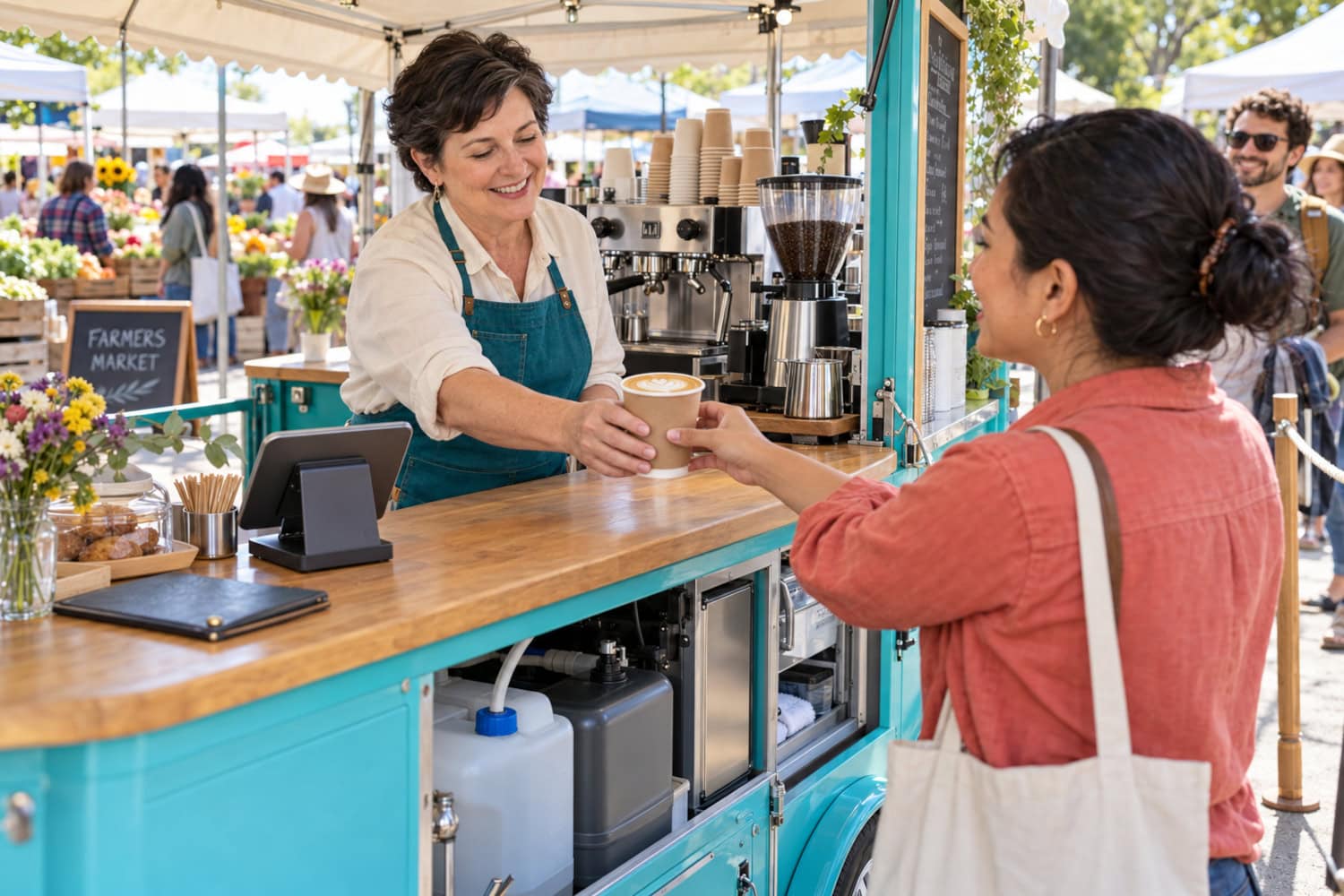
| Farmers market booth or pop-up | May avoid a permanent cart build, but still has equipment, event, and approval costs | Someone testing public demand on scheduled dates |
| Collapsible or pushcart setup | Compact footprint, but water, electrical, and transport solutions add cost | Owners moving between approved locations |
| Fixed recurring cart | Site arrangements and utilities may shape the build | Operators pursuing repeat daily or weekly customers |
| Wedding or private-event coffee bar | Setup and service capacity matter more than spontaneous walk-up traffic | Owners willing to sell and manage bookings |
| Corporate catering cart | Professional presentation, capacity, and dependable service matter | Owners developing office and organizer relationships |
| Trailer-based coffee service | Vehicle and infrastructure investment can be materially larger | Operators needing a more self-contained setup |
This article focuses on small carts and portable bars, not trucks. The forecasts use different inputs.
Market projections use drinks per trading hour, average sale, drink costs, and attendance costs, while event projections use confirmed bookings, package prices, guest counts, and the costs of staff and supplies.
Separate the models until their revenue covers costs conservatively.
3. Coffee cart customers and demand
People can pass a coffee cart without buying.
Demand means expected orders during authorized selling hours, so busy sidewalks and scheduled markets need different forecasts.
Watch competitors, queues, and repeat visitors during planned service hours, because those observations reveal purchasing behavior better than a general foot-traffic count.
For catering, organizers’ requirements and clients’ guest counts, schedules, and budgets establish fit. Inquiries remain separate from bookings.
An office client might value a short line over latte art when a limited break leaves guests little time for drinks and a complicated order slows service.
Check demand without pretending a forecast is a booking
- Identify a specific customer group and the occasion when it buys coffee.
- Record actual selling windows rather than relying on daily foot traffic.
- Compare relevant nearby options, including their convenience and pricing.
- Ask a market manager or event organizer about likely attendance and vendor rules.
- Separate confirmed bookings, active inquiries, and speculative opportunities.
- Estimate a low-sales case before committing to ongoing payments.
Market sales also generate catering leads. Count only converted bookings.
4. Coffee cart locations and operating rights
An office lobby seems ideal until the espresso machine exceeds its power supply.
Without an approved wastewater plan, foot traffic cannot fix the site.
A site needs plausible sales and permission to operate before cart investment.
Sidewalks, markets, and private events follow different rules; property-owner consent does not replace health or fire approval.
A crowd is not a sales forecast.
Site utilities and physical access must support the planned menu and the expected number of completed orders during the same busiest selling hours used in the revenue forecast.
Check the site in this order:
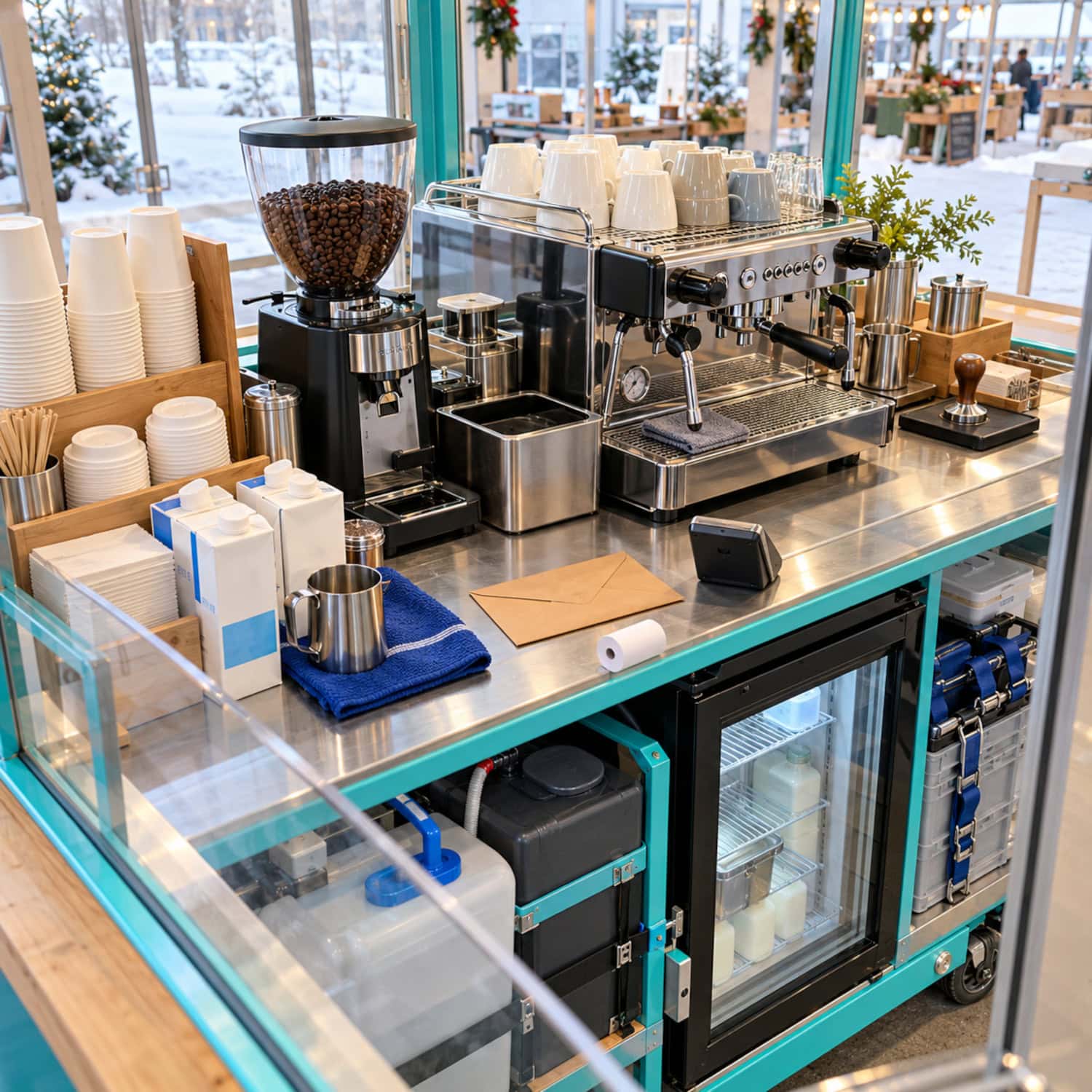
- Confirm power, clean water, refrigeration, and wastewater disposal.
- Inspect loading access and space for the cart and queue.
- Compare fees with the sales needed to cover them, using Section 5.
5. Startup costs and coffee cart economics
Even a cheap cart needs equipment, utilities, approvals, and opening cash.
Because pop-up and trailer estimates cover different setups, a beginner should compare complete equipment and approval costs alongside the cash needed to survive slow opening dates.
| Cost category | What to budget for | What changes the number |
|---|---|---|
| Cart and fabrication | Cart, counter, fittings, mobility | Size, materials, and required layout |
| Coffee equipment | Machine, grinder, brewer, accessories | Drink volume, certification, and used versus new |
| Utilities and sanitation | Water tanks, pump, sinks, drainage, refrigeration, power | Venue utilities and health requirements |
| Setup and compliance | Applications, inspections, registration, training | Local authority and business format |
| Launch inventory | Beans, milk, alternatives, cups, lids, cleaning items | Menu and expected first-service volume |
| Selling and transport | Market fees, hauling, storage, fuel | Number and distance of service dates |
| Protection and systems | Insurance, payment processing, bookkeeping | Coverage and operating arrangement |
| Cash reserve | Repairs, slow dates, delayed bookings | Exposure to uncertain sales and equipment failure |
One beginner budgeted $8,000 to $15,000 despite owning equipment; another reported about $10,000 using a self-built cart and used machine.
Judge the full service date. Cheap ingredients do not make an expensive day profitable.
Work out one service date
Operating surplus = sales revenue – drink-variable costs – service-date and allocated overhead costs. Include an allowance for your labor.
The following are illustrative numbers, not industry averages or recommended selling prices.
| Item | Illustrative calculation | Amount |
|---|---|---|
| Drink sales | 80 orders at $6 each | $480 |
| Drink-variable costs | 80 orders at $1.75 each | $140 |
| Contribution after drink costs | $480 less $140 | $340 |
| Event or site fee | Fixed for the service date | $65 |
| Paid help | Fixed allowance | $75 |
| Owner’s labor allowance | Fixed allowance | $80 |
| Travel and setup | Fixed allowance | $30 |
| Insurance and equipment reserve allocation | Fixed allowance | $50 |
| Total non-drink costs | Sum of the five allowances | $300 |
| Operating surplus | $340 less $300 | $40 |
At 40 orders, revenue falls to $240 and drink costs to $70, but other costs remain $300: a $130 operating shortfall.
With $4.25 left per drink, 71 orders cover those costs.
Drink costs are about 29% of these sales, and labor about 32%. Together, this prime cost is roughly 61%.
Keep cash for repairs and slow dates. Financing still requires payments when sales stop, so stress-test the financed and cash-funded cases.
6. Business registration and operating approvals
A US coffee cart may need business registration, food permits, tax registration, location approval, and insurance.
Requirements vary by menu, format, and jurisdiction.
| Requirement | Why it matters | Where to confirm it |
|---|---|---|
| Business form and registration | Determines who contracts and reports income | State business registration office |
| Employer identification number and tax setup | Supports applicable business and employment tax processes | Internal Revenue Service and state revenue department |
| Sales tax permit and resale certificate | May govern taxable drink sales and qualifying inventory purchases | State revenue department |
| Local business and vending permissions | Governs commercial activity and allowed locations | City or county licensing office |
| Health permit and plan review | May govern design, preparation, water, and sanitation | Local health department |
| Food safety training or certification | May apply to the owner or food handlers | Local health department |
| Commissary or approved servicing base | May be required for mobile water, cleaning, or storage activities | Local health department |
| Fire inspection and power safety | May apply to generators, fuel, electrical installations, or service sites | Local fire authority and venue |
| Zoning and property access | Restricts where vending may take place | Local planning office and property owner |
| Insurance | Addresses liability, equipment, vehicle, and event exposure | Licensed insurance agent and venue |
Some health departments require plan review before construction.
Before installing sinks or tanks, ask how the local health department classifies the planned cart and what specifications apply to washing, safe water supply, wastewater disposal, and food handling.
A limited liability company (LLC) is not universally mandatory. Sole proprietorships and LLCs differ in taxation and legal duties.
An LLC does not replace insurance. Ask an attorney or certified public accountant before consequential choices.
Cottage food rules for home-prepared products do not automatically authorize made-to-order coffee.
Ask the health department about pastries and obtain applicable liquor permissions before serving alcohol.
7. Coffee cart menu and pricing
A specialty drink on a coffee cart delays simple orders while occupying preparation equipment.
Espresso, cold brew, drip, and matcha need different processes and stock. Shared ingredients limit leftovers.
Before signing an event contract, decide exactly which drinks, guest counts, extra orders, and service extensions the quoted price covers so the service promise survives a busy queue.
The menu also determines needed equipment, power, refrigeration, and labor.
In Section 5, a $6 drink leaves $4.25 after drink costs, requiring 71 orders to cover $300 of other expenses.
Test proposed menu prices against the same labor-inclusive method before accepting market fees.
Event quotes specify hours, guest count, drinks, extra charges, and cancellation.
Reported prices span about $100 to $150 hourly and $650 to over $1,200 per booking, with widely different inclusions.
Fees and labor can exhaust that revenue.
For pastries, estimate unsold stock and confirm that food-service permissions cover the products and their handling.
8. Coffee cart location and event agreements
Wedding guests sometimes request coffee from the cart after booked service ends.
The agreement must define included service and extension charges. Overtime has a cost.
For recurring sites, contracts cover access, utilities, fees, and exit terms, because restricted access can erase the paid selling window.
Event agreements specify the menu priced in Section 7, guest counts, hours, payment, and cancellation.
Insurance documents should be agreed before entry.
Questions to ask a property manager or event client
- Which exact area can the cart occupy, and for which dates and hours?
- Who supplies electricity and water, and what capacity is available?
- Where may staff load, unload, wash, and dispose of approved wastewater?
- What fees, commissions, deposits, or minimum commitments apply?
- What permits and insurance documents must be supplied before entry?
- What happens if the venue closes, attendance changes, or an event is canceled?
- For catering, what drinks, guest counts, and service extensions are included?
Extra service adds labor and occupies the cart longer, so specify how the client approves overtime and pays for it rather than negotiating beside a waiting queue.
9. Coffee cart equipment and utilities
A coffee cart espresso machine can look inexpensive at purchase but prove costly when it recovers too slowly for peak orders or demands more electricity than the agreed venue can supply.
Equipment must match the agreed menu, approvals, and available utilities, or a booked service window ends before the queue does.
Group equipment by what the cart must do:
- Coffee preparation: Espresso machine, grinder, and brewer suited to the promised drinks.
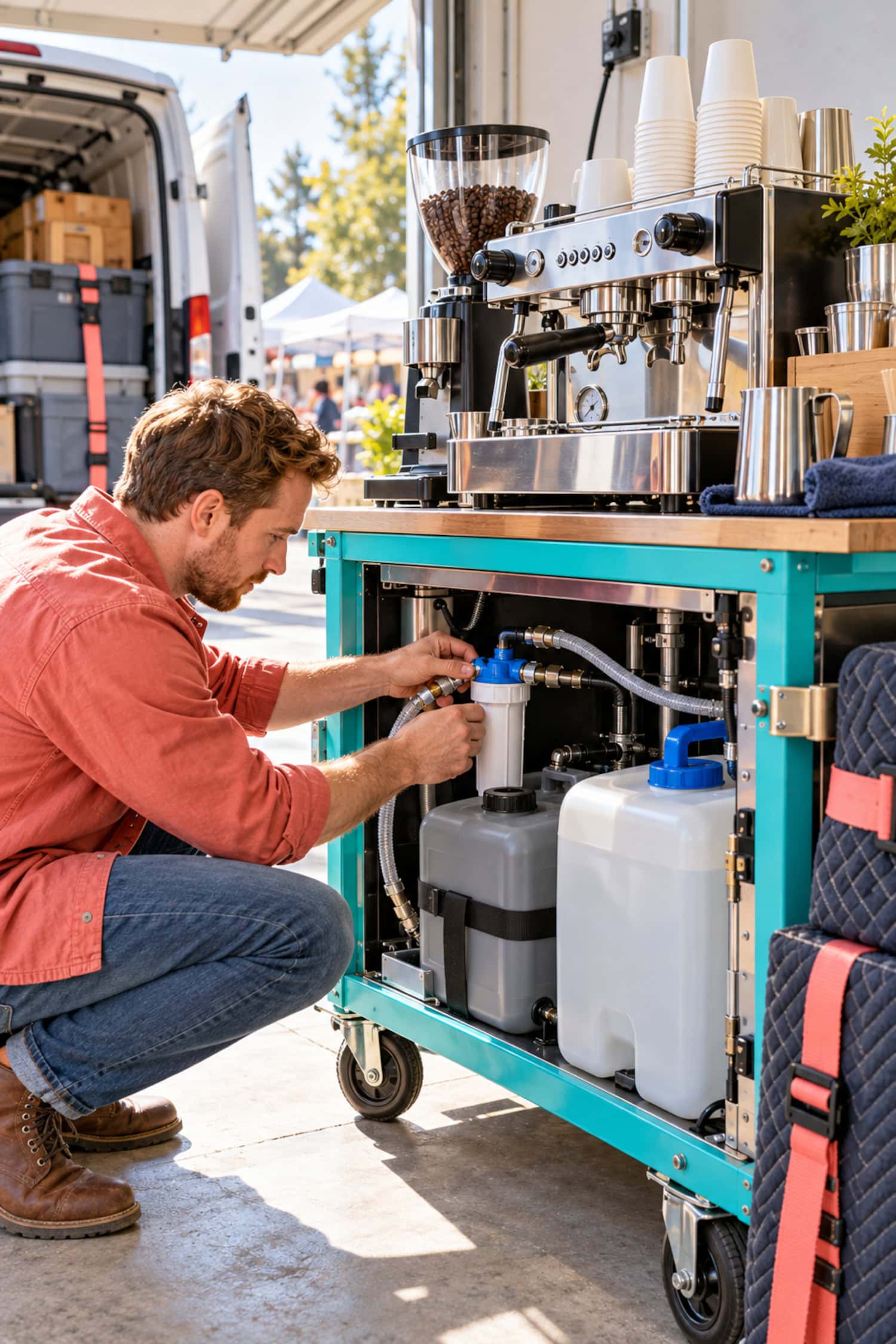
- Food-safe service: Refrigeration, clean-water and wastewater tanks, sinks, and cleaning supplies.
- Transactions: A point-of-sale (POS) system that takes and records payments.
Confirm required certifications and repair support.
Power must run coffee equipment, refrigeration, and hot water together during a rush, not merely provide an outlet on paper.
Qualified professionals handle electrical or fuel installations.
Equipment inspection before purchase
- Confirm the equipment model and any commercial certification the authority requires.
- Check electrical requirements against actual venue and cart supply.
- Check water feed, filtration needs, wastewater handling, and cleaning access.
- Ask how quickly the machine recovers during repeated milk-drink orders.
- Inspect a used unit’s maintenance history and available replacement parts.
- Verify grinder condition and whether it can keep up with peak service.
- Measure the packed cart, machine weight, and vehicle loading clearance.
- Confirm how refrigeration stays safe during transport and service.
- Test a complete workflow before paying for permanent fixtures.
A cart fits the van, but the espresso machine still needs protective transport and help lifting it.
Portability is a daily expense disguised as a feature.
10. Coffee cart operations and daily workload
A short coffee cart shift also requires travel, setup, cleanup, and records.
Count every hour of labor before the first drink and after the last, because loading the vehicle and sanitizing equipment extend a seemingly short selling day well beyond paid service hours.
Every hour counts.
Before service, check ingredients, refrigeration, power, water, and payments.
A solo barista handling payments and steaming can become the bottleneck during a rush; measure completed drinks per hour.
Use records that separate the causes of a strong or weak trading date:
- Orders and money: Completed drinks, total sales, and event deposits.
- Service inputs: Ingredients used, labor hours, and site charges.
- Other work: Travel expenses, booking leads, and the time spent on setup and pack-down.
Track deposits apart from completed sales; a future event still requires staffing and supplies.
11. When to improve or leave a coffee cart location
One rainy market proves little. Several coffee cart dates losing money after drink costs, labor, fees, and travel deserve more attention.
Repeated losses carry more weight.
Compare orders per selling hour with the break-even count from Section 5, then decide whether customer fit, operating hours, production speed, or site fees explain repeated losses.
A fee might be renegotiated, but an empty selling window calls for moving or leaving.
Recalculate the order threshold using any proposed lower site fee before paying to return.
12. Scaling a coffee cart business
Another coffee cart adds storage and travel work.
Expand for confirmed jobs or measured queues, but first identify whether payment handling, drink preparation, or the machine itself limits throughput during the periods when customers are actually waiting.
A second barista addresses payment and milk bottlenecks, while a new machine addresses machine limits.
Additional labor raises the break-even order count unless it increases sales. Calculate that change.
Before taking overlapping jobs, compare travel and loading hours with available time, and check vehicle capacity and storage space.
Each added cart also needs maintenance and booking records, even when idle.
13. Buying an existing coffee cart operation
Photos of a long coffee queue cannot tell a buyer who collected the money or whether an event will recur, so investigate equipment, verified earnings, client commitments, and transferable trading rights instead.
Due diligence before paying a seller
- Review dated sales records and match them with payment deposits where possible.
- Separate retail revenue, event deposits, and completed catering jobs.
- Compare sales with ingredient, labor, location, transport, and maintenance costs.
- Inspect equipment, maintenance records, and the condition of the cart structure.
- Confirm ownership of the equipment and whether any financing or liens remain.
- Check whether location permissions, bookings, and permits can transfer to a buyer.
- Ask why the business is being sold and what work the owner currently performs.
- Verify any customer contracts and the terms for outstanding deposits or cancellations.
If a market spot belongs to the seller personally, the cart may change owners without its trading rights.
If event deposits cover future work, the purchase agreement must identify who holds the funds and owes the service.
Verify transferability before paying.
14. Coffee cart turnkey offers and traps
Turnkey coffee cart packages save assembly work, but the included components, approval documents, utility requirements, and repair support still determine whether the advertised setup suits the promised menu and repeated service dates.
The label proves little.
| Myth | What actually happens |
|---|---|
| A compact cart avoids meaningful permitting | Requirements can still cover water, sanitation, food handling, and location |
| A good espresso machine guarantees fast service | Workflow, milk steaming, staffing, and power can limit output |
| Expensive events are automatically profitable | Fees and labor can consume the margin even with steady sales |
| A premium event quote explains every rejected lead | Fit, package clarity, timing, and lead quality may also matter |
| A turnkey business includes dependable income | Revenue depends on bookings and customers not supplied by the hardware |
Compare itemized dimensions, utility specifications, warranties, and approval documents with the planned setup.
Ask for these before buying. Earnings estimates excluding labor or booking costs overstate the surplus.
15. Coffee cart launch plan
A coffee cart launch requires approvals and agreements that match the priced service.
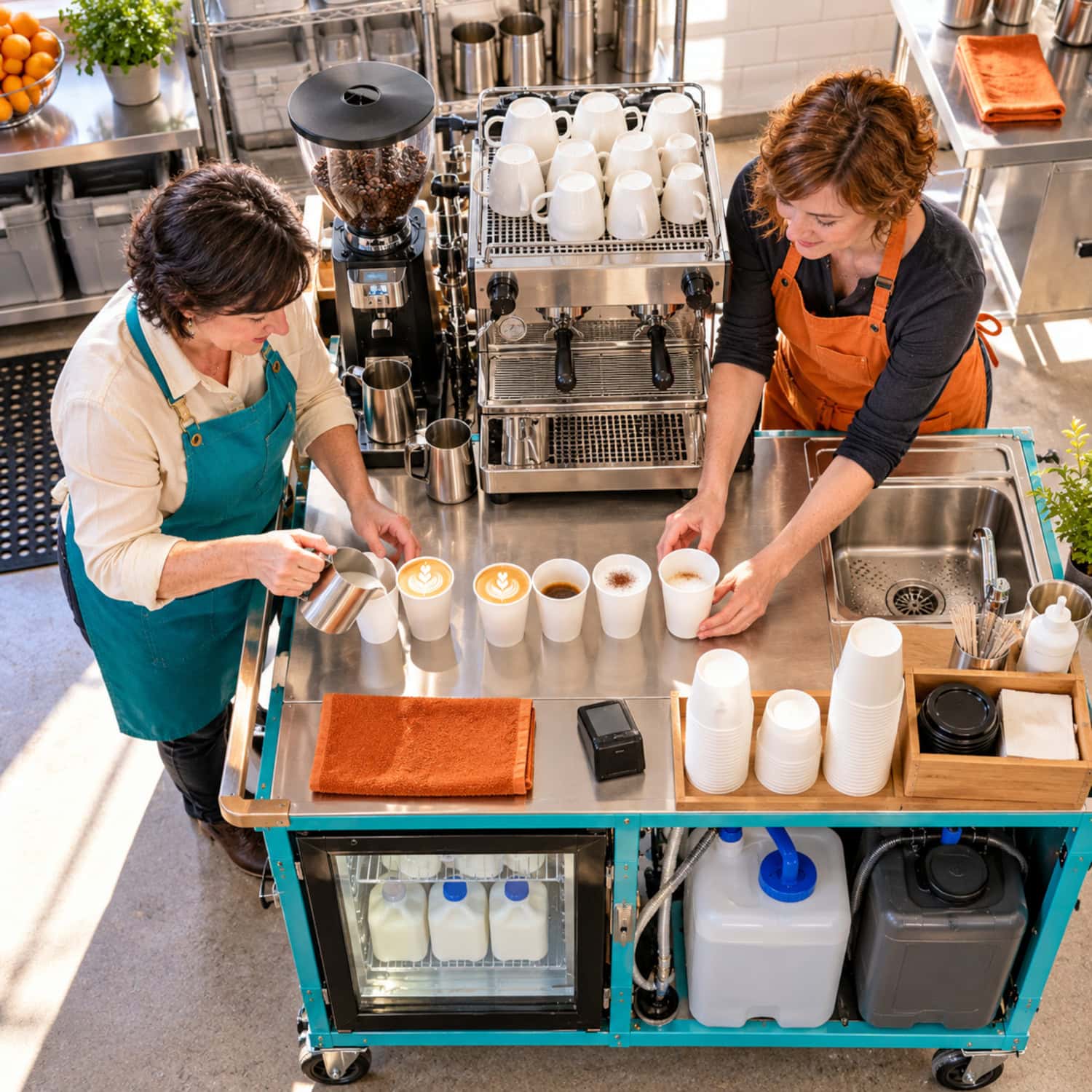
Rehearsal reveals whether milk, cups, and wastewater containers compete for counter space, delaying drink preparation precisely when a client expects the cart to serve many people during a limited time.
- Identify the operating format, likely customers, potential sites, and the health department’s design and permit requirements before major spending.
- Model a low-sales trading date, compare equipment configurations, choose the business structure, and obtain guidance on insurance and required approvals.
- Price a short drink menu and event package, then confirm authorized selling space, utility access, fees, cancellation terms, and coverage before signing.
- Secure any necessary plan review and verify the equipment, sanitation, refrigeration, and transport arrangements before building or purchasing the final setup.
- Complete the remaining permits and training, test payment processing, and rehearse the full service and pack-down before opening.
- Record every sale and service cost, measure peak-hour delays, and follow up on genuine booking leads during the first 30 days.
- Review venues and packages using results from days 31 to 90, fix bottlenecks, and stop attending unproductive dates before expanding.
The layout needs its own check. Fix cramped counter space or cleaning delays before the first large event.
FAQ
How much does it cost to start a coffee cart business?
$3,500 to $45,000 is the approximate span of reported estimates for differing cart configurations. Larger builds can cost more; see Section 5.
Do I need an LLC to sell coffee from a cart?
No, an LLC is not automatically required. Business structure affects tax and legal duties; see Section 6.
Do I need a health permit for a coffee cart?
It depends on the menu, format, and health department. Check permits and plan review before building; see Section 6.
Can a coffee cart operate without fixed plumbing?
Yes, where the local authority approves portable fresh water, wastewater, and handwashing arrangements. See Section 9.
Can I start a coffee cart on weekends?
Yes, a part-time market or event schedule is possible where approved opportunities exist.
Count transport, setup, and cleanup as working time; see Section 10.
How much profit can a coffee cart make?
It depends on completed orders, drink costs, location charges, labor, and overhead.
The illustrative event in Section 5 earns a $40 operating surplus at 80 sales but loses $130 at 40 sales.
Do I need a commissary for a private-event cart?
It depends on the cart classification and its water, cleaning, and storage arrangements. See Section 6.
Can I sell pastries with coffee?
Yes, if the relevant food-service permissions cover the products and their handling. See Section 7 for the menu decision.
Conclusion
A viable coffee cart starts with purchases customers are likely to make at a location where the operator is permitted to sell, before the owner invests in a site-specific build.
Use the first trading dates to judge whether the service and its costs work in practice.
1. Set the menu and price before an event contract promises specific drinks, service hours, and extra charges.
2. Price the whole service date including your labor, transport, fees, and a repair reserve.
3. Expand from recorded results rather than attractive crowds, optimistic bookings, or supplier promises.
Further reading
- U.S. Small Business Administration: Federal guidance on planning, registering, funding, and operating a small business.
- Internal Revenue Service: Federal information on business taxes, employer identification numbers, and recordkeeping.
- U.S. Food and Drug Administration: Food safety resources and information relevant to food-service operations.
- U.S. Department of Labor: Employment and wage guidance for operators who hire staff.
- Home-Barista: Technical discussions of espresso machines, grinders, and commercial-use considerations.
- Barista Exchange: Coffee-industry discussions of mobile service, equipment, and operating logistics.